How Agentic AI Will Reshape Search and Content Discovery
How agentic AI changes discovery and why runtime provenance, DLP, and approvals are essential—practical Aegis implementation guidance.
From search to agency: how discovery changed and what’s at stake
The shift from link-based search to agentic discovery rewrites assumptions about trust, provenance, and safety. Traditional search surfaces documents and domains; agentic systems fetch, synthesize, act, and—critically—publish results or take actions on behalf of users. This increases productivity but also raises three operational requirements: capture where results came from, validate parameters before acting, and apply publish-time policy controls (redaction, approvals, egress limits). Enterprise adoption of agentic systems is accelerating: McKinsey reports growing agent experimentation and scaling across business functions. (McKinsey & Company)
A practical security posture for agentic discovery must balance automation and human oversight. The rest of this post explains trust and provenance needs, patterns for enforcing safe publishing, and a concrete implementation example using Aegis—the runtime policy and observability gateway for multi-agent AI systems (Aegis Gateway). Portions of the Aegis design draw on product specs and operational use cases from the Aegis brief.
Trust and provenance in agentic discovery
Why provenance matters now
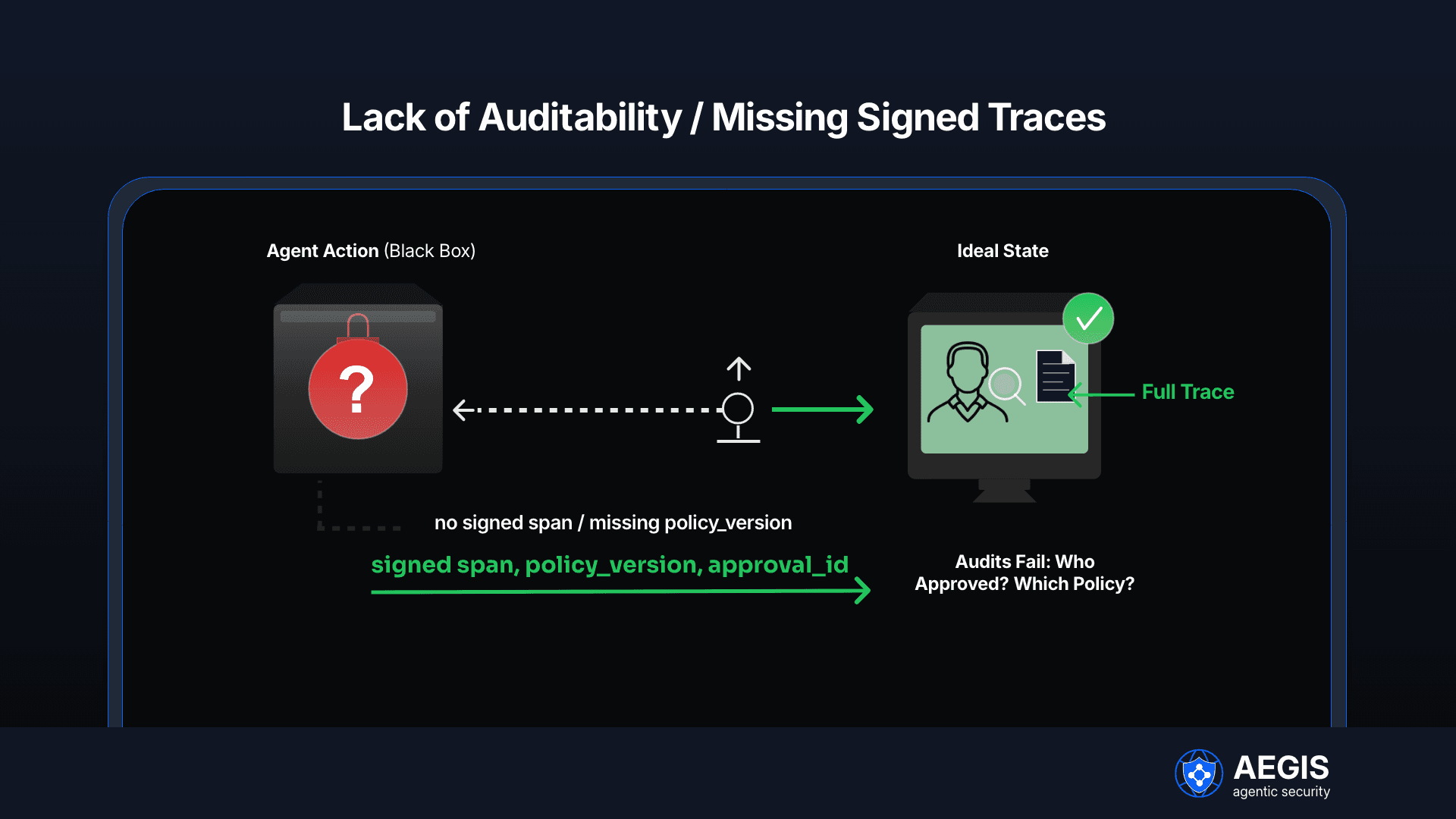
Agentic agents synthesize across internal systems, third-party APIs, and web sources. When an agent posts a summary or takes an action, auditors and end users need to know: which sources were used, when they were fetched, and what transformations occurred. Without this, organizations cannot demonstrate compliance or resolve content disputes. Recent industry surveys also show security teams are worried about agents taking unintended actions or exfiltrating data—visibility into data lineage is essential. (TechRadar)
Provenance model (practical)
A minimal provenance record for a synthesized artifact should include:
- source_id (URI or internal doc id)
- fetch_timestamp (ISO8601)
- agent_id and parent_agent_id
- tool_connector (e.g., kb-fetch, web-scrape, vector-db)
- transform_summary (summarization prompt + parameters)
- redaction_map (what was removed or sanitized)
- policy_version and decision_id
Show provenance to users in-line (short trace) and store full spans in the audit log for SOC/Compliance review. Aegis emits signed OpenTelemetry spans with this metadata and attaches an attestation token to published artifacts so downstream systems can validate origin and policy decisions.
👉🏻 Explore how agentic AI is reshaping modern enterprises
Policy patterns to enforce safe publishing
Core policy primitives
To govern agents at runtime, implement the following primitives:
- Identity & allowlists — require an agent identity token and enforce per-agent allowed tools/domains.
- Parameter validation — enforce schemas and range checks for critical parameters (e.g., payment amounts, export flags).
- DLP redaction — deterministic redaction rules (regex or structured field masks) before any external publish.
- Approval flows — require human signoff for high-risk actions (e.g., payment over threshold, external publication).
- Rate & budget limits — per-agent rate limits and daily budgets for expensive connectors.
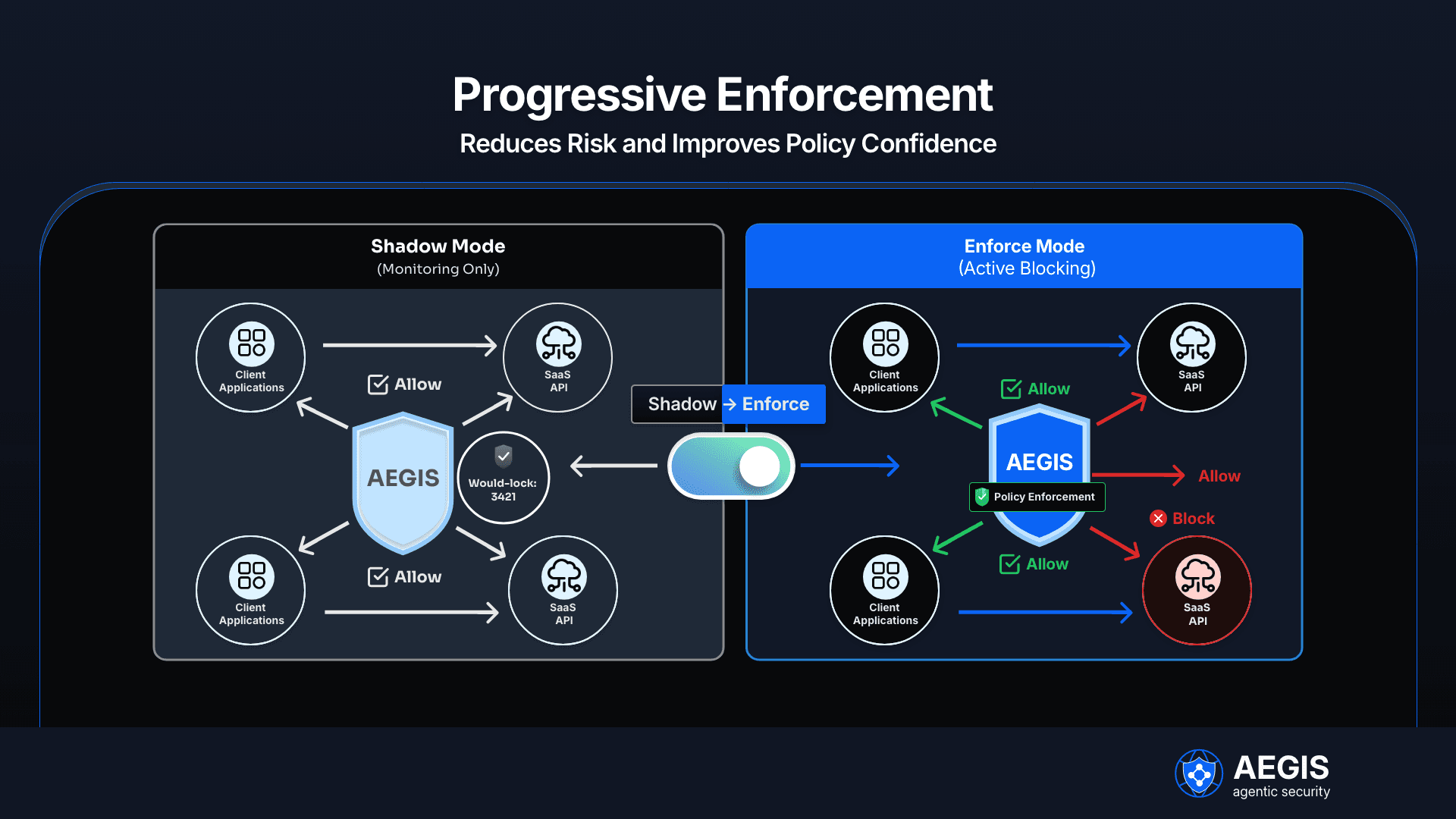
- Shadow mode — run policies in observation mode first to collect would-block metrics.
Table: Typical policy examples and enforcement outcome
Policy intent | Example rule (pseudocode) | Enforcement outcome |
Prevent exfiltration | deny if destination not in tenant_allowlist | Block + audit |
Payment ceiling | allow if amount <= 5000; else approval_needed | Pause & request approval |
PII redaction | redact fields matching SSN regex before publish | Sanitized output |
Publish control | allow internal-summaries; deny external export | Block external channel posts |
Operational patterns and metrics
Operationalize policies with measurable metrics: would-block rate (shadow), enforced-block rate, approval latency, hallucination incidents per 1k queries, and egress violations per week. Use synthetic source injection tests to detect hallucination risk and monitor the fraction of outputs that required sanitization—these are leading indicators of dataset quality and agent prompt hygiene.
👉🏻 Move from chat to action with next-gen AI agents
.png&w=3840&q=75)
Implementation example with Aegis
Aegis conceptual stack
Aegis Gateway acts as the runtime policy and observability fabric between orchestrators (agent frameworks) and tools (APIs, data stores, connectors). It provides identity, policy evaluation (OPA-based), deterministic DLP, approval orchestration, and OpenTelemetry traces. The gateway enforces allow/deny/sanitize/approval_needed outcomes in real time with minimal latency.
Example: customer support agent publishing a KB summary
- Support agent synthesizes an answer from internal KB and external docs.
- Aegis intercepts the publish call: verifies agent token, enforces allowlist for external channels, runs parameter checks (length, channel), and applies DLP redaction.
- If the summary contains disallowed PII or the policy requires approval (e.g., publishing to public channel), Aegis returns approval_needed and posts a compact approval request with provenance metadata to Slack/Teams.
- On approval, Aegis issues a one-time override token and logs a signed OpenTelemetry span with policy_version, decision_reason, and source list.
This flow reduces accidental leak risk, preserves auditability, and keeps human-in-the-loop for high-risk decisions.
👉🏻 Strengthen user trust with transparent AI experiences
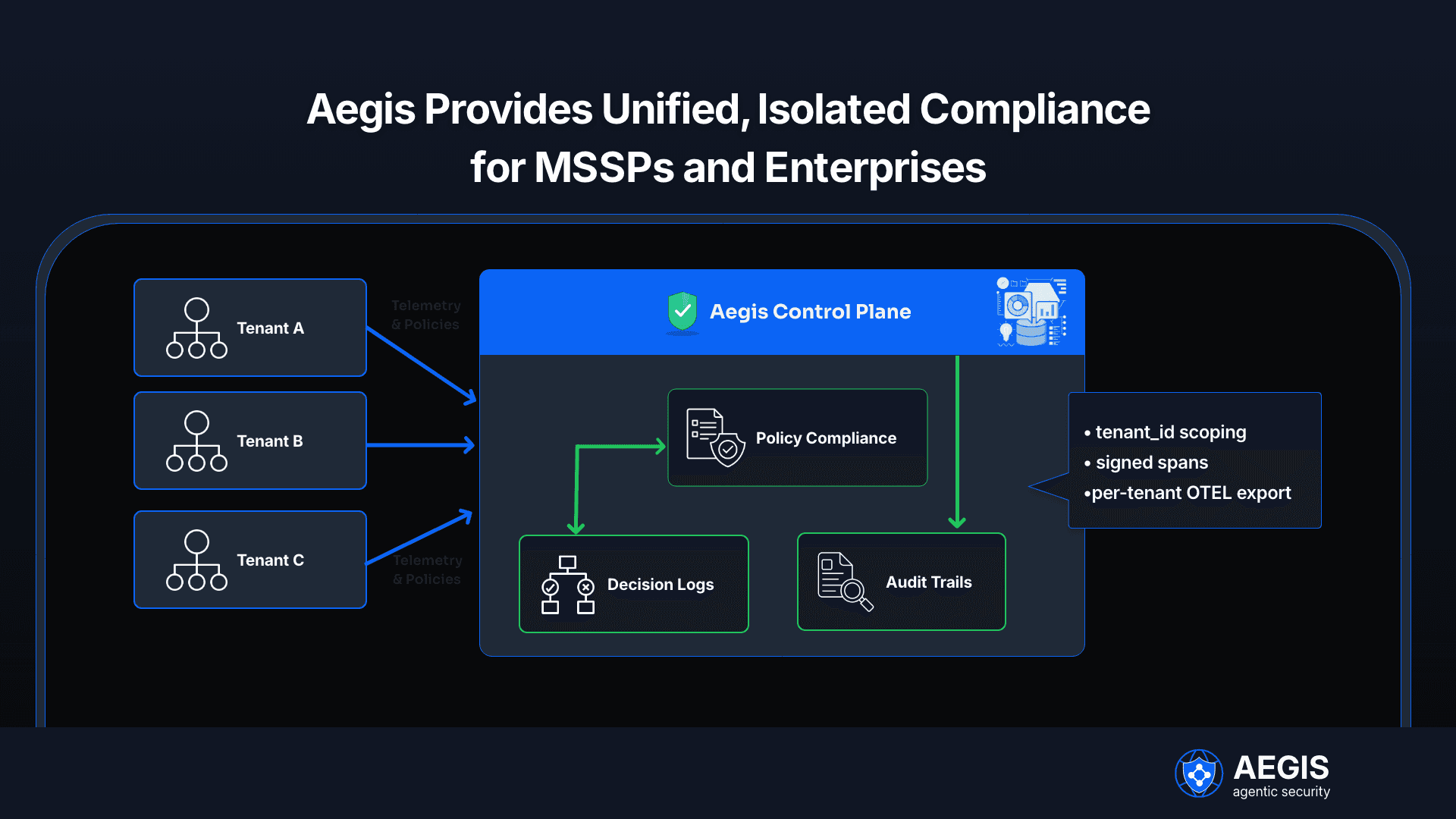
Table: Aegis runtime outcomes and actions
Decision | Typical trigger | Aegis behaviour |
allow | low-risk internal summary | forward + emit span |
sanitize | contains PII fields | redact fields + forward |
approval_needed | external publish OR high amount | pause, notify approvers |
deny | egress to disallowed domain | block + alert SOC |
Integration & rollout
Start in shadow mode to collect would-blocks and tune regex/stateful DLP rules. Wire OpenTelemetry to SIEM and FinOps dashboards for cost governance. For MSSPs or multi-tenant deployments, enforce tenant-scoped bundles and region-tagged routing. Aegis supports hot-reloadable policy bundles and a CLI/SDK for policy-as-code workflows, easing developer adoption.
👉🏻 Adapt your SEO strategy for the age of agentic search
Real-world considerations and edge cases
- Conflict resolution: when sources disagree, attach source-level confidence and require human arbitration for public posting.
- Copyrighted material: policies should treat copyrighted content as restricted for public republishing; offer citation-only modes.
- Latency sensitivity: use prepared OPA queries, caching, and WASM compilation to keep P99 decision latencies low.
- Approval overload: allow policies to specify thresholds and time windows to reduce alert fatigue (e.g., allow low-dollar payments without approval during business hours).
- Attack surface: treat agent tokens like user credentials—short-lived, signed, and rotated.
Where to learn more and reference materials
For practical industry context on agentic adoption and enterprise trends, see McKinsey’s recent reporting on the rise of agentic systems and their incorporation into business functions. (McKinsey & Company) For security risk perspectives and adoption challenges, recent reporting and surveys highlight concerns about agent misbehavior and the need for governance. (TechRadar)
Frequently Asked Questions
- How does runtime policy differ from IAM?
Runtime policy inspects call parameters and enforces contextual rules per agent invocation; IAM controls who can authenticate. Both are required—Aegis pairs identity with per-call policy checks. - Can Aegis block data exfiltration to arbitrary domains?
Yes — Aegis enforces egress allowlists and inspects outbound parameters, returning a PolicyViolation on disallowed destinations. - What happens when a policy requires approval?
Aegis pauses the call, posts a compact approval request with provenance and estimated risk to configured channels, and issues a one-time override token on approval. - How do we measure policy effectiveness?
Key metrics: would-block rate (shadow), enforced-block rate, hallucination incidents per 1k queries, approval latency, and top blocked agents/tools. - Can Aegis be deployed gradually?
Yes—deploy in shadow mode to collect telemetry, tune rules, and then gradually flip enforcement. This is the recommended rollout path. - Is provenance tamper-proof?
Aegis signs spans/attestations (optional) so downstream auditors can verify integrity; policy history and audit logs are versioned and stored with tamper-evidence.
👉🏻 Explore new opportunities at the intersection of AI and the metaverse
operational takeaways
Agentic discovery changes the surface area of risk: agents synthesize and act, so provenance, parameter validation, DLP, and approval workflows must move to the runtime plane. Aegis implements these controls as a lightweight policy and telemetry gateway between orchestrators and tools—enabling least-privilege, auditability, and human oversight while preserving automation velocity. For organizations piloting agents, start with shadow mode, measure the would-block signals, and adopt policy templates for common domains (payments, PHI, exports). The combination of signed provenance, deterministic redaction, and per-agent budgets delivers a pragmatic path to operational trust for agentic discovery.
👉🏻 Innovate with confidence while managing AI risks effectively
Additional resources:
- McKinsey — Seizing the agentic AI advantage. https://www.mckinsey.com/capabilities/quantumblack/our-insights/seizing-the-agentic-ai-advantage. (McKinsey & Company)
- Reuters coverage on agentic project risks and Gartner forecasting. (Reuters)