
Agents vs Chatbots: Moving Beyond Q&A to Actionable AI
Learn how AI agents differ from chatbots, why they require stronger security and governance, and how Aegis enables safe, auditable autonomous AI operations.
AI Agents vs Chatbots: Moving Beyond Q&A to Actionable AI
The evolution from conversational chatbots to autonomous agents marks a profound shift in enterprise AI. While chatbots serve as information interfaces, AI agents actively perform tasks—executing multi-step workflows, invoking APIs, and making contextual decisions. However, this evolution introduces new operational and security challenges. Without proper guardrails, autonomous agents can escalate privileges, mismanage costs, or trigger compliance incidents.
To bridge this gap, organizations need runtime enforcement, observability, and policy governance. This is where Aegis Gateway, Aegissecurity agentic AI security mesh, becomes essential. It enforces fine-grained policies at the intersection of agents and tools, ensuring that every autonomous action is authorized, observable, and reversible.
.png&w=3840&q=75)
Chatbots vs Agents: Functional and Risk Differences
Functional Separation: Interface vs Execution Plane
Chatbots primarily handle user interactions—parsing queries, retrieving responses, and providing information in real time. They are stateless and synchronous, returning answers within a few seconds. Agents, in contrast, reside in the execution plane—they act. An AI agent can trigger a workflow, interact with APIs, and orchestrate other systems asynchronously.
Attribute | Chatbots | AI Agents |
Core Role | Conversational UI | Autonomous Action |
State | Stateless | Stateful / Contextual |
Execution | Synchronous (immediate) | Asynchronous (multi-step) |
Control Surface | Dialogue interface | Tool + API integrations |
Example | FAQ Bot | Finance or Deployment Agent |
The distinction matters. When agents invoke APIs or modify resources, authorization and auditability become as critical as conversational accuracy.
UX & Operational Distinctions
Agents demand richer UX support. While chatbots prioritize clarity and tone, agents need status dashboards, rollback mechanisms, and explainability logs. Users must see why an agent took an action and have an escape hatch to override it.
Moreover, latency expectations differ. A chatbot that pauses for 15 seconds frustrates users; an agent performing an approved payment within a few minutes is acceptable—because it’s performing work, not conversation.
👉🏻 Start your journey toward fully autonomous AI systems
Designing Safe Agent UX
Transparency and Rationale Display
Transparency is not optional. A safe agent interface must display not only the action outcome but also the rationale—the reasoning or policy that led to it. This mitigates the risk of “black-box” automation. For example, an agent could show:
“Action executed under policy finance-agent:v3; approved via Slack at 10:42 UTC.”
Aegis Gateway reinforces this by embedding policy version identifiers and decision reasons into telemetry spans, helping developers and auditors trace every agent action.
Approval, Rollback, and Human Oversight
Agents should never operate unchecked. A human-in-the-loop approval mechanism is a foundational safety feature. For high-risk actions—like payments, deployments, or data exports—Aegis automatically pauses execution, requests approval in Slack or Teams, and resumes only with an override token.
When something goes wrong, rollback paths must be clear. The UX should make it easy to revoke an agent action and restore previous states, whether by configuration rollback or API reversal.
👉🏻 Choose the right AI approach to drive measurable outcomes
Implementation Checklist: Gateway + Policy + Telemetry
1. Gateway: The Enforcement Plane
Aegis Gateway functions as a runtime policy and observability fabric between agents and tools. Acting as a reverse proxy or sidecar, it inspects each call—validating the agent’s identity, the target tool, and the parameters.
If an agent violates policy, Aegis blocks the call and logs a structured telemetry span. This architecture mirrors service meshes like Istio but is purpose-built for AI agents.
2. Policy: The Governance Plane
Policies in Aegis are written as YAML or JSON and compiled into Open Policy Agent (OPA) bundles. These define what each agent can do, under what conditions, and when human approvals are required. Example snippet:
agent: finance-agent
allowed_tools:
- name: stripe-payments
actions:
- create_payment
conditions:
max_amount: 5000
approval_needed_if: amount > 5000
This ensures a planner agent cannot coerce a finance agent into unauthorized actions—a critical safeguard against agent privilege escalation.
3. Telemetry: The Observability Plane
Every decision is recorded as a structured trace:
agent_id, tool, decision, policy_version, latency, and reason.
Aegis integrates with OpenTelemetry to provide dashboards showing:
- Top agents and tools by activity
- Policy violations over time
- Approval workflows and turnaround latency
- Budget consumption by tenant
Metric | Purpose | Aegis Visualization |
Allow/Deny Ratio | Detect policy drift | Time-series chart |
P99 Latency | Track enforcement overhead | Heatmap |
Policy Version Coverage | Audit policy updates | Bar chart |
Spend by Agent | Monitor cost governance | Pie chart |
The Role of Aegis in Safe, Auditable Autonomy
Aegis Gateway transforms AI automation from a security risk into a governable system of record. Built for multi-agent architectures like LangGraph, AgentKit, and CrewAI, it applies security principles familiar to DevSecOps teams—least privilege, immutability, observability—to the new agentic frontier.
Runtime Policy Enforcement
Each tool call passes through Aegis’s runtime gateway, which evaluates:
- Agent identity (via short-lived JWTs)
- Tool and endpoint target
- Parameters and conditions
- Policy version and decision mode
Outcomes include allow, deny, sanitize, or approval_needed. Deterministic DLP redacts sensitive data, and policies can run in shadow mode before enforcement for tuning.
Governance and Compliance
Enterprises in regulated sectors—finance, healthcare, energy, and government—require tamper-proof audit trails. Aegis signs every log entry, linking agent actions to policies and approvals. SOC and compliance teams gain real-time visibility into agent behavior and historical policy context.
Developer Experience
Security must not slow innovation. Aegis provides:
- CLI & SDKs for registering agents and testing policies
- Dry-run simulation mode for safe rollout
- Dashboards for policy drift and violation monitoring
- Hot-reload policies without downtime
This gives developers a mesh-style safety layer that integrates seamlessly with orchestrators, reducing the friction of adopting secure multi-agent workflows.
Industry Use Cases
FinTech: Secure Payment Workflows
Aegis enforces payment ceilings and approval flows. For instance, any transaction above $5,000 triggers Slack-based approval. Policies include regex validation for account IDs and strict parameter checks—blocking unauthorized transfers.
Healthcare: PHI & PII Protection
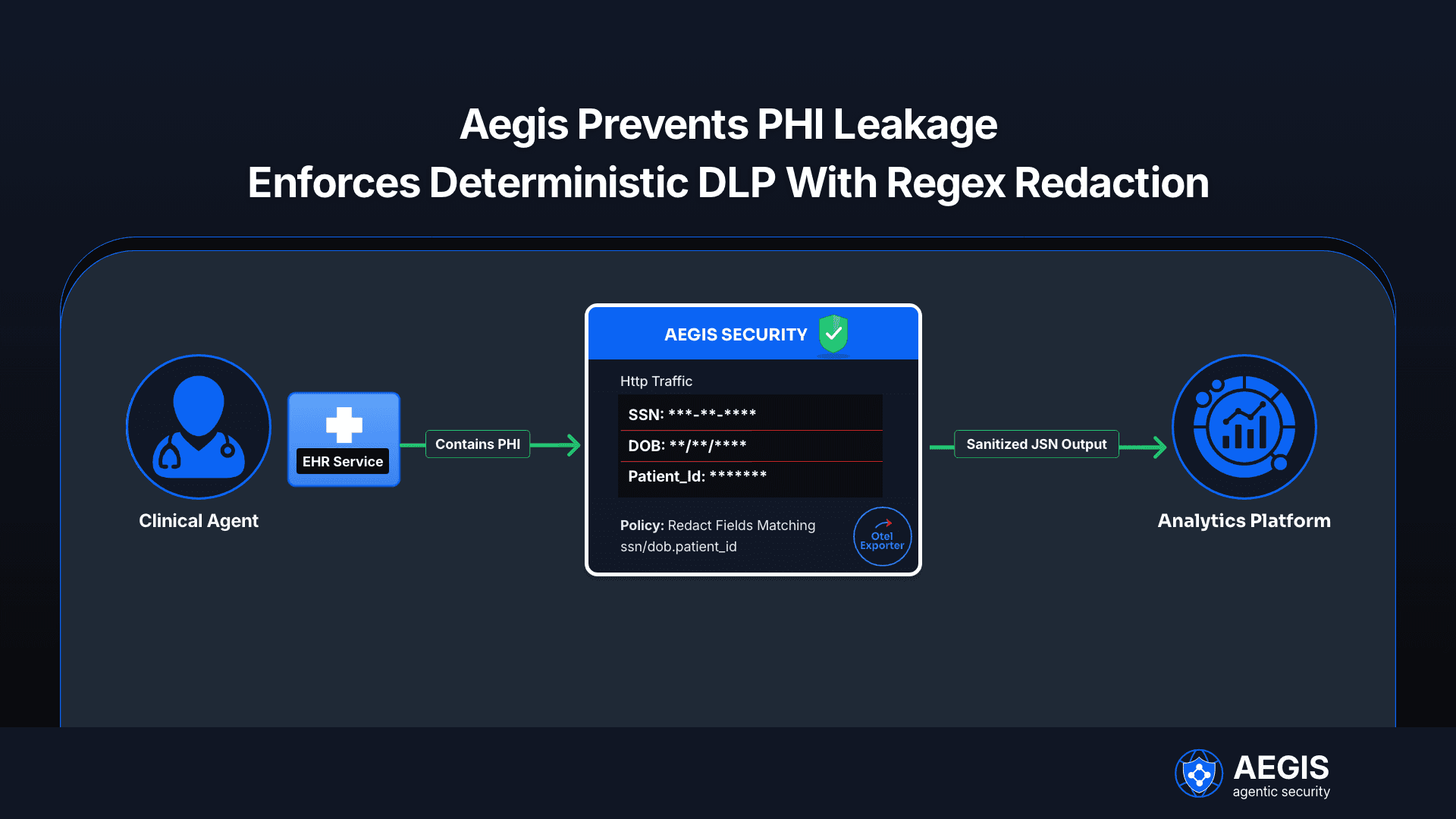
Agent requests to EHR systems are intercepted. Aegis performs deterministic DLP, redacting SSNs or patient IDs before forwarding payloads. Only pre-approved endpoints are allowed, ensuring compliance with data residency and HIPAA controls.
SaaS & FinOps: Cost Governance
By assigning per-agent budgets and rate limits, Aegis prevents runaway API costs. Dashboards display usage and projected spend, empowering FinOps teams to optimize budgets without halting innovation.
DevOps: Controlled Automation
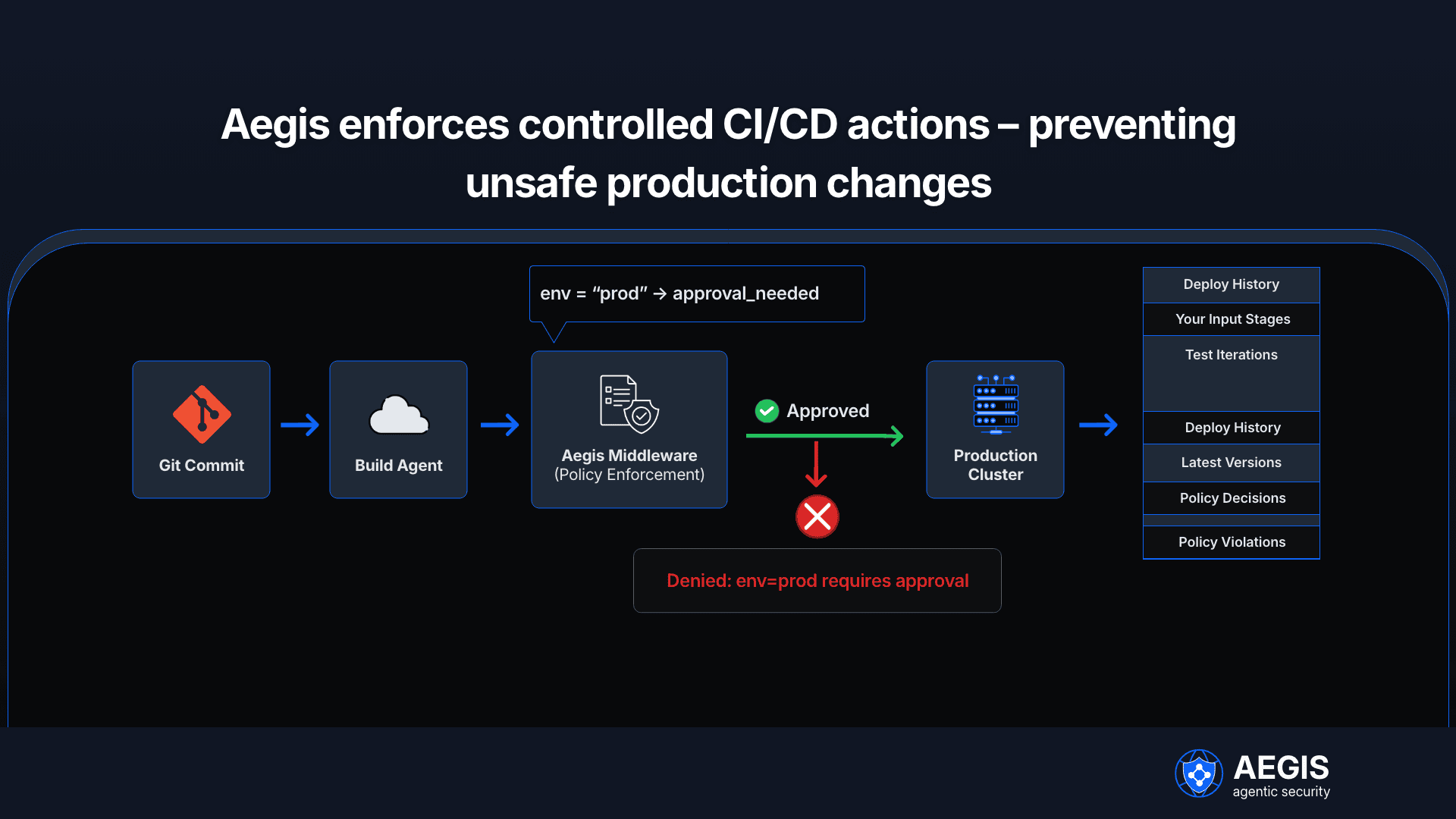
CI/CD agents executing deployments are gated by environment-level policies—staging deploys allowed automatically; production deploys require human approval.
MSSPs: Multi-Tenant Compliance
For service providers managing multiple clients, Aegis enforces tenant-scoped policies and produces SIEM-ready logs with signed spans. Each tenant’s data and telemetry remain isolated—vital for audit integrity.
Sector | Common Risk | Aegis Control |
FinTech | Unauthorized payments | Parameter limits + approvals |
Healthcare | PHI leakage | Deterministic DLP |
SaaS | Cost explosions | Per-agent budgets |
DevOps | Unsafe deployments | Policy gating |
MSSP | Cross-tenant interference | Tenant isolation & signing |
Organizational Shift: Treat Agents as Software Products
A key cultural change in AI operations is recognizing that agents are not chat features—they are microservices. Each carries risk and cost. Enterprises must:
- Assign owners to each agent.
- Maintain versioned policies.
- Monitor action telemetry.
- Audit for compliance and cost exposure.
Aegis accelerates this maturity by introducing policy-as-code for AI systems—bringing agent governance under the same rigor as infrastructure-as-code.
👉🏻 Build user confidence with transparent and reliable AI agents
Frequently Asked Questions
1. How do AI agents differ from chatbots in enterprise settings?
Chatbots answer questions; agents take actions. Agents invoke APIs, make changes, and require real-time policy enforcement to prevent risky operations.
2. Why do AI agents need runtime security controls?
Because agents act autonomously, traditional IAM isn’t sufficient. Aegis enforces per-call decisions—allowing, denying, or requiring approval for each action.
3. What is the latency impact of using Aegis?
Aegis maintains <20 ms latency per decision at P99, thanks to in-memory caching and OPA prepared queries.
4. Can Aegis integrate with existing orchestrators?
Yes. Aegis integrates with popular frameworks like LangChain, LangGraph, CrewAI, and AgentKit via lightweight SDKs and middleware.
5. How does Aegis handle sensitive data like PHI or payment info?
It applies deterministic DLP—automatically redacting sensitive fields before allowing outbound requests.
6. Is Aegis suitable for multi-tenant environments?
Absolutely. It enforces tenant-scoped policies, signs audit logs, and isolates telemetry for MSSP or enterprise deployments.