What Is Agentic AI? Understanding Autonomous Agents in 2026
Autonomous agents—often referred to as agentic AI—are redefining how enterprises execute automation, orchestration, and decision-making across cloud systems. Yet, despite the buzz, confusion persists about what these agents actually do, how they differ from chatbots, and where the risk boundaries lie.
What Agentic AI Actually Is
Core Capabilities
Agentic AI refers to LLMs augmented with planning, tool orchestration, and autonomous decision loops. Unlike traditional chatbots that merely respond to user input, these agents act independently to achieve defined goals.
Modern agentic frameworks—such as LangGraph, CrewAI, and AgentKit—enable agents to:
- Plan multi-step workflows (e.g., “deploy code → test → roll back if failed”)
- Call APIs and execute tools autonomously
- Retain contextual memory across sessions
- Collaborate with other agents through message passing
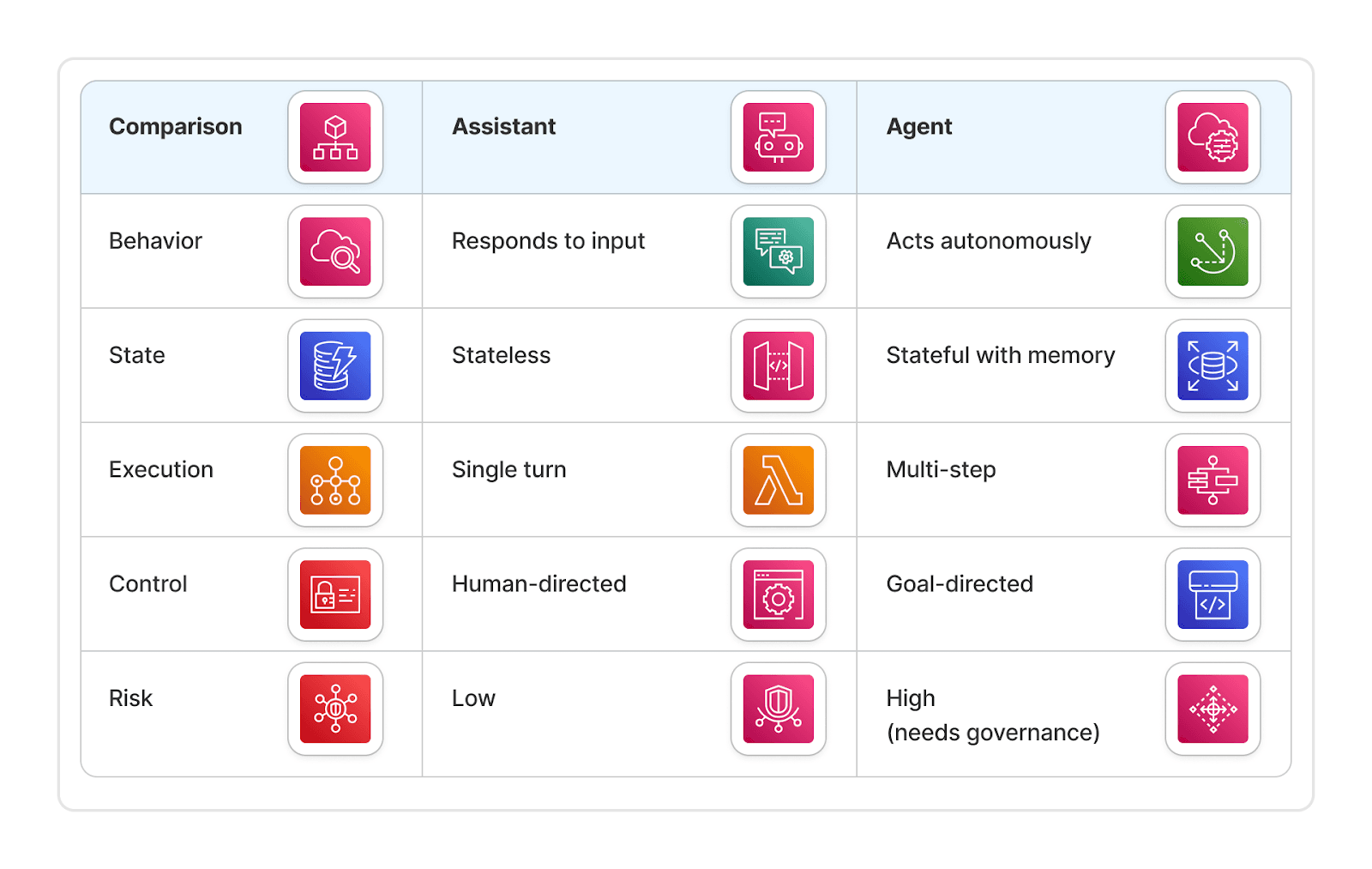
Agents differ from assistants in a fundamental way:
Assistants answer. Agents act.
How It Differs from Chatbots
Traditional automation relied on human-scripted workflows or single-turn LLM responses. Agentic AI changes that model—agents reason, plan, and call tools repeatedly until objectives are reached.
However, this autonomy also introduces new risks: misaligned actions, unsafe parameters, and data exfiltration.
Research shows security and integration are top barriers (architectureandgovernance.com)
👉🏻 See how Agentic AI goes beyond content generation to drive real actions
Business Scenarios That Justify Agentic AI
Agentic AI is already reshaping key sectors—particularly where repetitive, policy-bound automation saves time and cost.
FinTech
Agents can autonomously reconcile transactions, process refunds, and initiate payments under approval-based policies. A financial “Planner” agent may generate draft transactions that require human sign-off before execution.
Healthcare
Agents handle secure scheduling, medical record summarization, and patient triage. Strict runtime policies ensure they can read—but not modify—protected data under HIPAA constraints.
SaaS & Cloud Operations
Multi-agent systems monitor deployments, roll back failed releases, or remediate incidents automatically. In these scenarios, observability and least-privilege enforcement are critical to prevent overreach.
Sector | Example Use Case | Risk Type | Control Mechanism |
FinTech | Payment automation | Financial fraud | Policy-based approval |
Healthcare | Record summarization | Data privacy | Scoped identity tokens |
SaaS | Incident remediation | Unauthorized remediation | Least-privilege runtime |
Manufacturing | Predictive maintenance | Data leak | Egress control |
Across multiple industries, adoption is growing—but security remains the gating factor.
Risks That Stop Production Adoption
According to 2025 Capgemini research, only 8% of organizations have agentic AI deployed at scale, though over 60% are piloting or exploring it. The main inhibitors: security, compliance, and observability.
Technical Gaps
- Lack of Identity Controls — Agents reuse static API keys, making impersonation trivial.
- Parameter Manipulation — Without field-level validation, injected prompts can alter transaction values or payloads.
- Prompt Injection & Chain Poisoning — Attackers manipulate memory or cross-agent context.
- Egress Leakage — Agents exfiltrate data by calling unapproved domains.
- Runaway Costs — Agents can trigger infinite tool calls, inflating cloud bills.
Governance Challenges
Analysts warn that “over 40% of agentic projects will be scrapped before ROI due to governance failures” (Reuters, 2025). Enterprises lack:
- Per-agent auditability
- Runtime policy visibility
- Human-in-the-loop approvals
- Centralized observability
.png&w=3840&q=75)
Without these, agent autonomy becomes an uncontrolled liability rather than an operational advantage.
Building a Safe Runtime: Policy, Identity, and Telemetry
Introducing Aegis Gateway
Aegis Gateway from Aegissecurity is a runtime policy and observability fabric for multi-agent AI systems. It acts as a security mesh, enforcing least-privilege boundaries between agents and tools while maintaining full traceability.
At its core, Aegis evaluates every agent-to-tool call through a policy-as-code engine built on Open Policy Agent (OPA) principles.
Core Capabilities:
- Runtime Policy Enforcement: Allow, deny, sanitize, or require approval for any agent call.
- Scoped Identity: Short-lived tokens (JWTs) uniquely identify each agent, tenant, and tool scope.
- Telemetry: Every call emits structured OpenTelemetry spans with decision metadata.
- Human-in-the-Loop Controls: High-risk actions trigger Slack/Teams approval requests.
Egress Control: Restricts outbound domains to approved APIs. - Cost Governance: Tracks per-agent budgets and enforces rate limits.
Aegis Feature | Description | Enterprise Benefit |
Policy-as-Code | YAML/JSON security policies compiled into OPA bundles | Standardized, auditable control |
Runtime Enforcement | Proxy inspects every agent call | Prevents unauthorized actions |
Scoped Tokens | Short-lived JWTs with Ed25519 signatures | Eliminates long-lived credentials |
Shadow Mode | Observe would-block metrics before enforcing | Safe rollout strategy |
Observability | OpenTelemetry metrics for allow/deny/latency | Full traceability |
Human Approvals | Slack/MS Teams approval flow | Human oversight for high-risk actions |
By combining these capabilities, Aegis forms the “Istio + OPA for AI agents”—a transparent runtime layer that scales across orchestrators like LangGraph or AgentKit.
👉🏻 Move beyond chatbots with AI that actually gets work done
Architecture Overview
The Aegis architecture includes two planes:
- Data Plane: Envoy-based proxy + external authorization server in Go. Evaluates each agent call in ≤20 ms using cached OPA bundles.
- Control Plane: FastAPI-based management service for defining, validating, and versioning policies. Integrates with JWT token issuance and audit storage.
Every decision is auditable. Each policy change is versioned, signed, and stored.
This model directly supports compliance standards (SOC2, ISO 27001, PCI-DSS readiness).
Adoption Playbook: Shadow → Enforce → Scale
Deploying agentic AI safely requires measured rollout.
Phase 1: Shadow Mode
Run Aegis in “shadow” mode. The gateway logs would-block events without enforcing them, allowing teams to visualize baseline behavior and policy impact.
Key Metrics:
- Would-deny ratio
- Blocked call frequency
- Latency per decision
Phase 2: Enforcement Mode
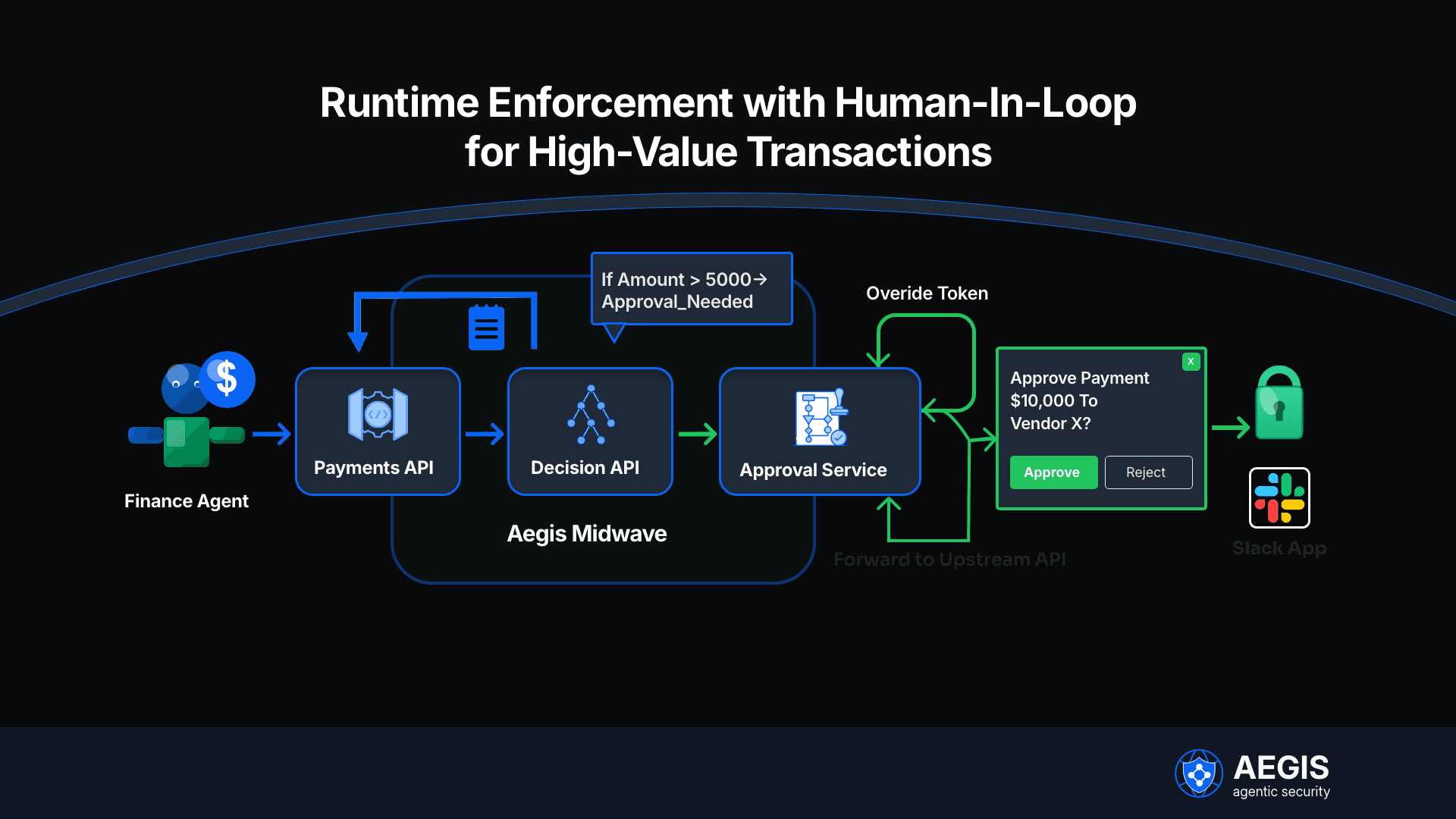
Once thresholds are tuned, flip enforcement on. Approvals for high-risk actions (e.g., payments > $5000) flow through Slack/Teams. All policy violations trigger structured telemetry for SIEM ingestion.
Phase 3: Scale and Optimize
As confidence builds, integrate Aegis across multiple orchestrators and tenants.
Measure KPIs such as:
- Policy coverage (% of tools governed)
- Approval latency (avg < 2 min)
- P99 decision latency (< 20 ms)
- False-negative rate (0%)
KPI | Target | Purpose |
Enforcement Latency | < 20 ms | Maintain performance |
Policy Coverage | ≥ 80% | Broad control |
Block Accuracy | 100% | Zero false negatives |
Observability Coverage | 100% | Complete traceability |
Aegis provides CLI and SDK tools for rapid policy authoring, dry-run validation, and rollback management—enabling security teams to move as fast as engineering.
👉🏻 Unlock the full potential of LLMs with intelligent agent-driven workflows
The Aegis Advantage for Enterprises
Aegis’s policy-as-code, identity enforcement, and observability-first design make it uniquely suited for enterprise-grade AI adoption:
- Compliance: Tamper-proof logs, versioned policies, and audit trails satisfy regulator expectations.
- Security: Deterministic DLP redaction and least-privilege boundaries prevent data misuse.
- FinOps: Built-in spend tracking keeps agent-driven costs predictable.
- Scalability: Optimized OPA caching ensures P99 < 20 ms, even under 10 000 RPS.
- Integration: Works seamlessly with LangChain, LangGraph, and other frameworks via lightweight middleware.
Aegis transforms agentic AI from an experimental risk into a secure, governed automation fabric suitable for production workloads.
Frequently Asked Questions
1. What is agentic AI in simple terms?
Agentic AI refers to autonomous systems built on LLMs that can plan, act, and make decisions through multi-step reasoning—unlike chatbots that only respond.
2. Why is agentic AI risky in production?
Because agents can autonomously execute tool calls, any lack of runtime governance can result in unauthorized actions, data leaks, or financial losses.
3. How does Aegis enforce safety between agents and tools?
Aegis acts as a runtime gateway, inspecting every agent call, applying policy logic, and logging all actions for audit and observability.
4. Can Aegis integrate with existing agent frameworks?
Yes. Aegis provides SDKs and middleware for popular orchestrators (e.g., LangGraph, AgentKit) with minimal code changes.
5. What’s the best way to start using Aegis?
Begin in shadow mode to understand agent behavior, then enable enforcement once policies are tuned and validated.
6. How does Aegis support compliance and FinOps?
By generating auditable traces for every decision, enforcing budgets, and ensuring that all agent activity remains attributable and within policy.
Agentic AI offers transformative automation potential—but autonomy without governance is chaos. Aegis by Aegissecurity provides the runtime policy, identity, and observability foundation enterprises need to deploy autonomous agents safely, confidently, and at scale.