Balancing Risk and Innovation in Agent Deployments
Practical playbook for agent governance: policy-as-code, shadow rollouts, approvals, and runtime enforcement with Aegis.
alancing Risk and Innovation in Agent Deployments
Blog Cover (design above): place the 16:9 cover at the very top using the cover brief provided.
Introduction
Enterprises face a dual mandate: scale agentic AI workflows for velocity and automation while preventing costly or dangerous actions that leak data, spike spend, or breach compliance. Gartner warns that many agentic projects will be canceled without governance, noting “agent washing” and a high failure rate in early deployments. (Gartner) This post outlines a practical governance model, a 4-week rollout playbook, and how Aegis — a runtime policy & observability gateway — turns governance from a blocker into an accelerator. Core concepts: policy-as-code, shadow mode, risk-tiered approvals, and telemetry-driven policy tuning.
Governance model: roles, risk tiers, and policy levers
High-level model
A practical governance org chart is small and cross-functional: Product Owner → Security Champion → Policy Steward → SOC Reviewer. Policy ownership sits with the Policy Steward; approvals and incident review live with SOC and product owners. Map each agent to a risk tier (Low / Medium / High) that determines allowed actions and approval types. This operational model mirrors IAM risk scoring but evaluates actions, parameters, budgets and egress, not just identity.
Risk-tier mapping (table)
Risk tier | Typical agents | Allowed actions (examples) | Human intervention level |
Low | Data enrichment, reporting agents | Read internal docs, non-sensitive API calls | Auto-approve (policy auto-allow) |
Medium | Customer-facing write agents | Create tickets, limited writes, parameter sanitization | Automated approvals or batched human review |
High | Finance, infra-change, EHR agents | Payments, prod deploys, exports | Approval_needed (human approval required) |
Policy levers
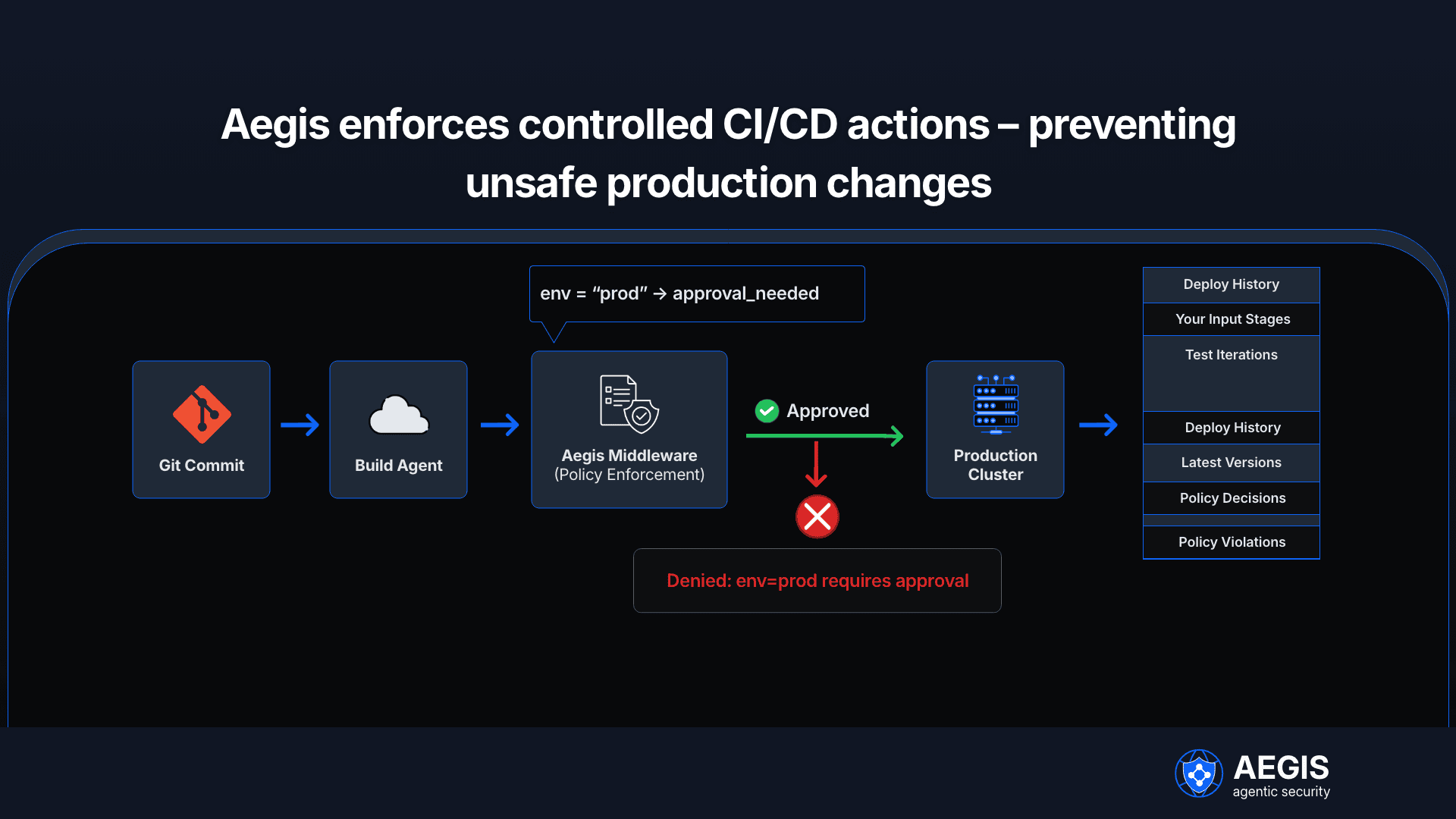
Policy actions should include allow, deny, sanitize, and approval_needed. Additional levers: budgets (daily/weekly), time windows (business hours), rate limits, and parameter constraints (regex, numeric ceilings). Aegis implements these levers at the agent→tool boundary so decisions are made in real time and fully auditable.
👉🏻 Choose the right security vendors with a framework built for multi-agent ecosystems
Policy lifecycle: write, simulate, shadow, enforce
Policy-as-code & tooling
Policies live as code (YAML/JSON) with schema validation and versioning. Compile to OPA bundles (or equivalent) to achieve low-latency evaluation. Enforce CI checks that run policy validation and a policy-dry-run in dev. The control plane should support hot-reload and rollback of policy bundles. Aegis’ architecture compiles policy-as-code to fast evaluators and pushes bundles to the data plane.
Shadow mode: the safety valve
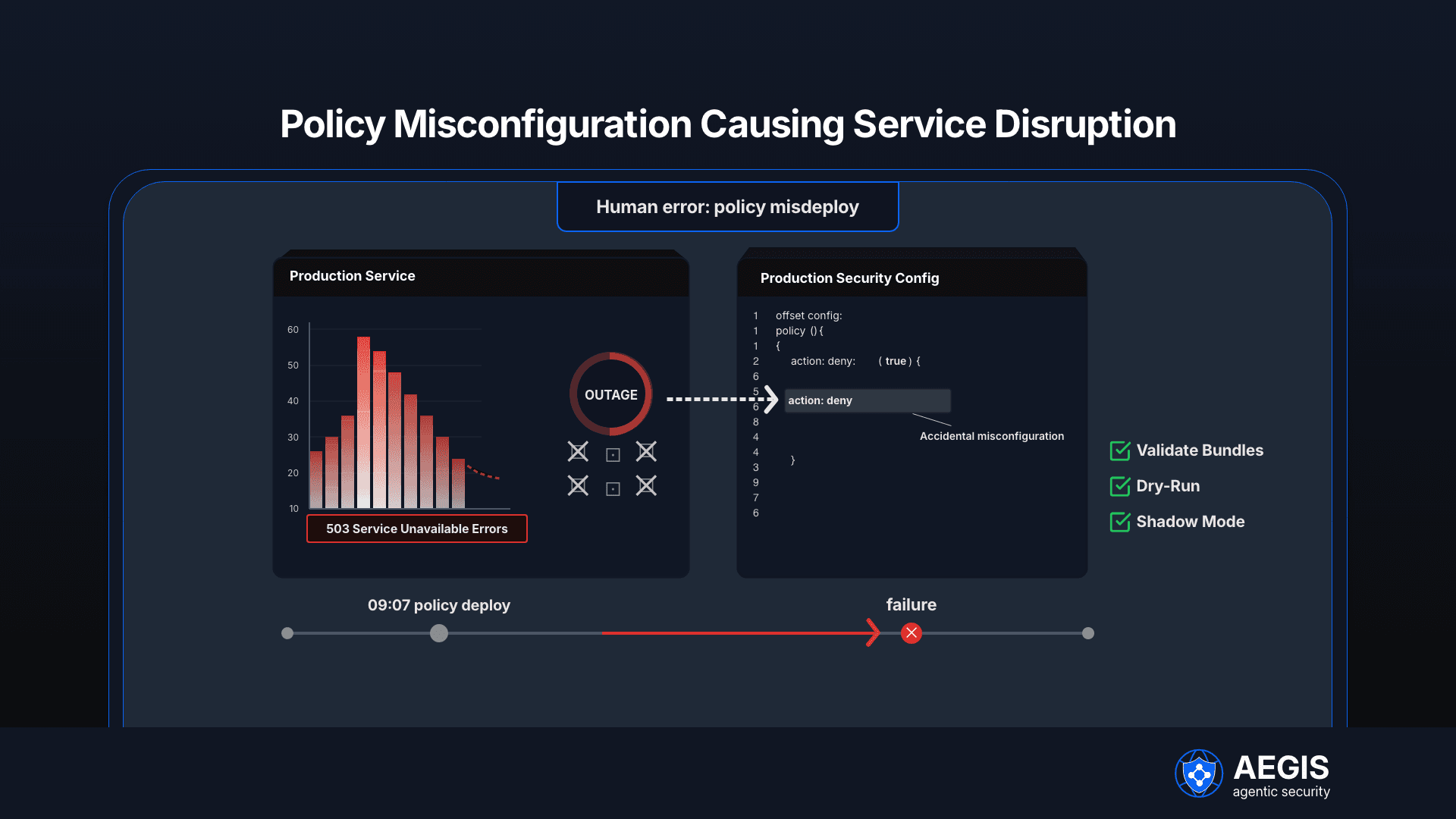
Run policies in shadow mode to collect “would-block” telemetry without impacting runtime behavior. Shadow runs produce distributions of offending parameters, false positives, and workload impact metrics so teams can trim over-broad rules. In one operational example a product team ran shadow mode for seven days and removed ~80% of would-block rules before flipping to enforcement — dramatically reducing human approvals and outages.
👉🏻 Stay ahead by aligning your systems with the next generation of AI standards
Running shadow mode: practical playbook (4 weeks)
Week 0 — Prep & inventory
Inventory agents, connectors, and high-risk tools (payments, EHR, infra). Tag agents with owner and domain (dev/prod/tenant). Baseline: which agents touch sensitive data or cost-heavy APIs? Use short-lived tokens at ingress to ensure agent identity.
Week 1 — Baseline policy set & dry run
Write baseline policies with permissive defaults for low-risk agents and conservative defaults for high-risk agents. Compile bundles and run dry-run CI against test traffic. Validate schema and create rollout plan.
Week 2 — Shadow mode (7–14 days)
Flip policies into shadow mode. Capture would-block stats: per-agent would-block count, parameter histograms, would-block false positive rates. Tune regexes and numeric ceilings. Track key metrics: % calls automated, would-block ratio, and infra incidents avoided.
Week 3 — Gradual enforcement & approvals tuning
Start enforcement for Low/Medium tiers where shadow showed low false positives. For High tier, keep approval_needed but tune thresholds and integrate automated approvers for aggregated, low-risk approvals.
Week 4 — Operationalize: dashboards & SLOs
Create dashboards for policy coverage, pending approvals, mean time to approve (MTTA), and budget burn. Train SOC on review workflow. Adopt escalation playbooks for blocked production actions.
Implementation checklist
- Agent inventory completed
- Policies authored & schema-validated
- Shadow mode metrics collected for 7–14 days
- Approval workflow integrated (Slack/Teams)
- Dashboards for MTTA, approvals queue length, budget usage
👉🏻 Strengthen enterprise outcomes through smarter collaboration with agent vendors
Measuring success: telemetry and KPIs
Key metrics to track (table)
Metric | Why it matters | Target (example) |
% calls automated | Shows velocity retained | ≥ 75% automated |
Approval queue length | Operational load on humans | < 10 pending per reviewer |
Mean time to approve (MTTA) | Time-to-action for high-risk flows | < 15 minutes for critical ops |
Infra incidents avoided | Safety impact | Reported prevented incidents quarterly |
Policy coverage | Percent of critical tools governed | ≥ 80% in pilot |
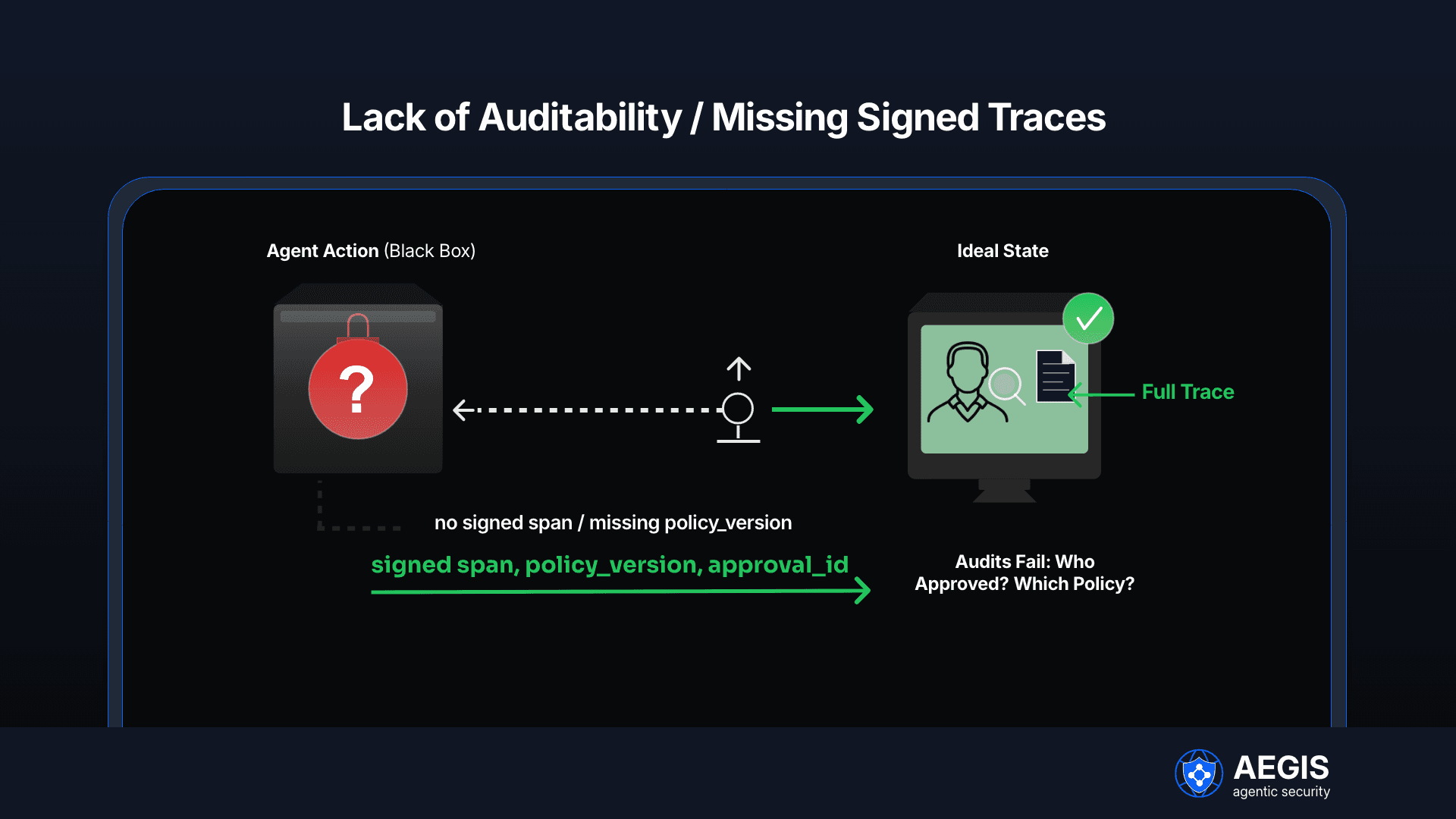
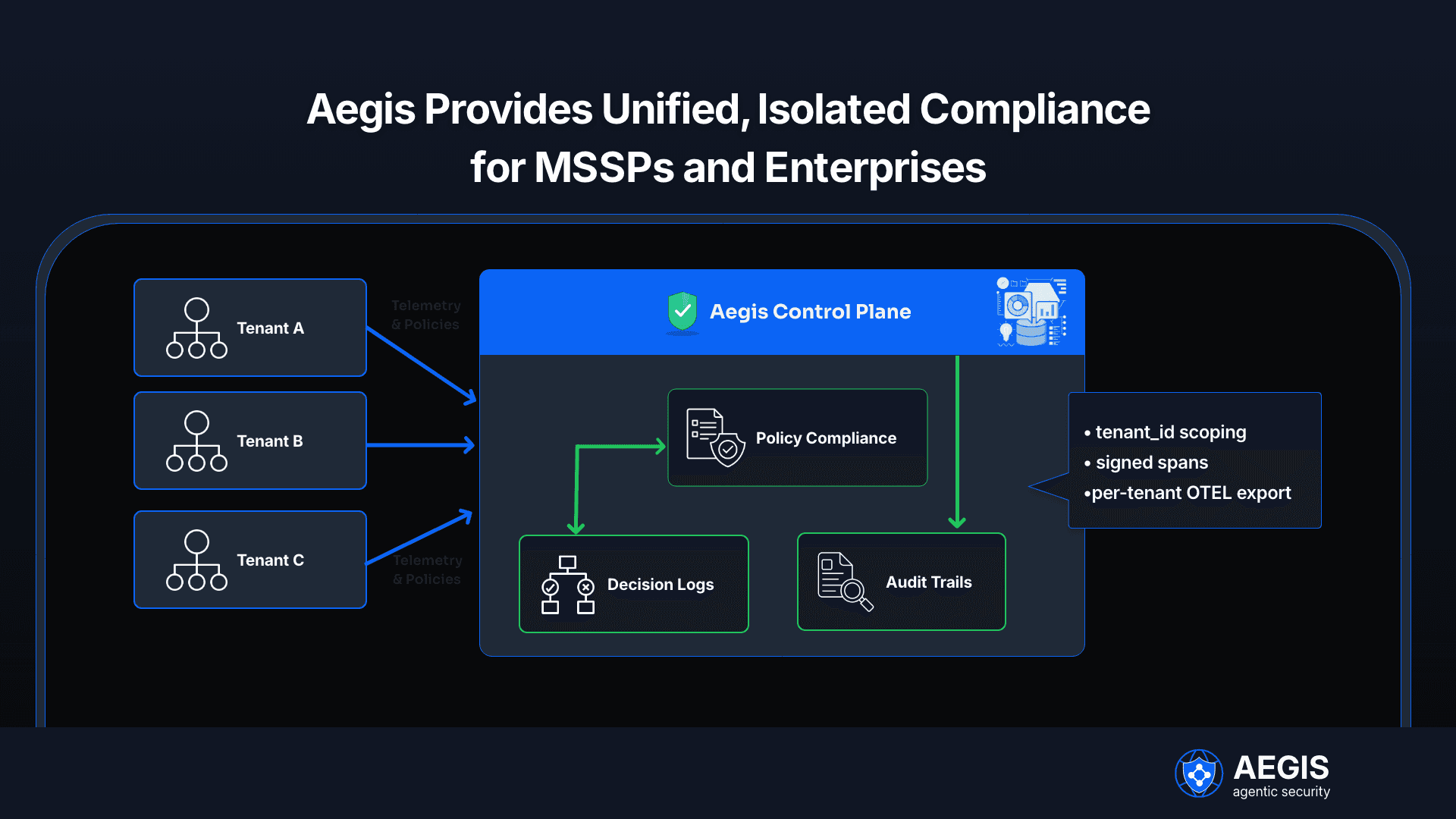
Aegis emits structured OpenTelemetry spans for each decision (agent_id, tool, decision, policy_version, estimated cost) so MSSPs and SOCs can produce tamper-evident audit trails and map decisions to control objectives (e.g., “payments require dual control” for SOX compliance).
Implementation details & common pitfalls
Pitfalls and mitigations
- Policy sprawl → enforce policy naming, modularization, and reuse of policy templates.
- Version collisions → strict bundling and signed manifests for integrity.
- Overbroad denies → shadow mode + parameter histograms before enforcement.
- Approval overload → risk scoring to auto-approve low-risk calls; aggregated approvals for batched changes.
Example policy templates
Use case | Example condition | Policy action |
Payment under $5k | amount <= 5000 | allow |
Payment over $5k | amount > 5000 | approval_needed |
LLM calls budget | daily_cost <= $20 | allow; else deny |
EHR export | destination != internal-ehr | deny |
Slack post outside hours | business_hours == false | approval_needed or sanitize |
Why Aegis?
Runtime enforcement at the agent→tool boundary
Aegis provides a lightweight policy and telemetry fabric that evaluates agent calls in real time. Rather than only deciding “who” can call an API, Aegis inspects parameters, enforces numeric and regex constraints, and supports sanitize and approval_needed responses. This prevents coercion attacks where a planner agent tricks a finance agent into a disallowed transfer.
Approvals, budgets, and telemetry tied together
Aegis’ approvals service integrates with Slack/MS Teams to enable fast human overrides and mints one-time override tokens for retries. Per-agent budgets and rate limits prevent runaway spend on expensive APIs. Every decision emits OTel spans and signed audit records so MSSPs can demonstrate control coverage to customers and auditors.
Operational velocity without gatekeeping
By combining shadow mode, risk tiers, and automated approvals, Aegis enables teams to retain developer velocity (auto-approve low risk) while enforcing strong controls for high-risk actions. Dashboards show % automated and approval queue health, turning governance into a dashboard-driven, iterative process rather than a blocking review board.
FAQs
Q: How do we classify agents?
A: Inventory agents by function and impact (data access, cost, infra control). Assign Product Owner and Security Champion; map to Low/Medium/High risk tiers.
Q: Who writes policies?
A: Policy Stewards (security engineers) author policies; product owners validate business logic; SOC reviews high-risk policy changes.
Q: How long should shadow mode run?
A: Minimum 7 days across production traffic slices; extend to 14 days for heavy variation windows (end-of-month billing, sales events).
Q: How do we measure policy efficacy?
A: Track % calls automated, MTTA, approval queue length, would-block false positive rate, and infra incidents avoided.
Q: Can approvals scale?
A: Yes — use risk scoring to auto-approve low risk, batched approvals for similar requests, and automated approvers for repeatable, low-impact actions.
Conclusion
Agentic AI can deliver real operational value only when governance preserves velocity and safety. The practical approach — inventory, policy-as-code, shadow rollouts, risk-tiered approvals, and runtime enforcement — turns governance from a deployment brake into an operational accelerator. Aegis implements that approach at the runtime layer with approvals, budgets, and auditable telemetry so teams can adopt agents confidently and measurably.
Further reading & sources
Gartner press release on agentic AI project risk and “agent washing.” https://www.gartner.com/en/newsroom/press-releases/2025-06-25-gartner-predicts-over-40-percent-of-agentic-ai-projects-will-be-canceled-by-end-of-2027. (Gartner)
Reuters coverage of Gartner’s warning. https://www.reuters.com/business/over-40-agentic-ai-projects-will-be-scrapped-by-2027-gartner-says-2025-06-25/. (Reuters)