Building an Agent Governance Committee in Your Organization
How to build an Agent Governance Committee and enforce its policies at runtime with Aegis — governance playbook, KPIs, and technical controls.
Building an Agent Governance Committee — Practical Playbook + Aegis Runtime Enforcement
Agentic AI projects are proliferating across enterprises, bringing scale and automation — and a new set of governance, security and compliance risks. This post gives a pragmatic, operational playbook for standing up an Agent Governance Committee (AGC) and shows how Aegis — a runtime policy and observability gateway — functions as the committee’s technical enforcement arm. The goal: consistent policy lifecycle, auditable enforcement, FinOps controls and incident-ready runbooks.
Why a dedicated Agent Governance Committee matters
Agentic workflows cross product, security, legal, FinOps and SOC domains. Without centralized governance, teams build ad-hoc agent projects that diverge on policy, identity and budgets, creating risk and audit gaps. Recent industry research shows a sharp rise in experimentation with agents — 62% of organizations report at least experimenting with AI agents — while analysts warn many early projects will fail without governance and clear ROI tracking. (McKinsey & Company)
Core committee responsibilities
• Define charter, scope and decision authority (security, legal, product, SOC).
• Own the policy lifecycle: draft → shadow → enforce → audit.
• Maintain policy backlog, SLAs for review, and policy owners with change notes.
• Set triage thresholds and approval escalation rules (e.g., payments > threshold require committee escalation).
• Integrate FinOps for per-agent budgets and spend controls.
• Publish governance outcomes and run tabletop exercises.
Governance playbook (operational checklist)
Committee composition & cadence
- Members: security lead, legal counsel, product owner, SOC rep, FinOps, developer lead.
- Cadence: weekly triage + monthly risk review with evidence bundles (policy results, would-deny metrics, approval queues).
- Deliverable: governance playbook, policy cookbook, and dashboard for committee review.
Policies, templates & lifecycle
- Publish standard templates (payment ceilings, egress allowlists, PII redaction).
- Require separation of duties: policy authors ≠ approvers ≠ deployers.
- Shadow mode: tune policies via would-deny metrics for a defined period (e.g., 7 days) before enforcement.
- Retirement: define age for stale policies and agents; remove or re-validate.
KPIs the committee tracks
- Would-deny rate (shadow mode).
- Approval latency and approval overload.
- Policy coverage across critical connectors.
- Per-agent spend and FinOps breaches.
- Cross-tenant conflicts and remediation time.
👉🏻 Add human oversight without slowing down automation
Technical enforcement: where Aegis fits (overview)
Aegis is designed to be the committee’s technical enforcement arm — a lightweight runtime policy and telemetry fabric that sits between agent orchestrators and tools. Architecturally it provides an identity-aware proxy, policy evaluator, approvals service and OpenTelemetry-native telemetry that produces auditable traces for SOC and compliance teams. Aegis is intentionally orchestrator-agnostic and built to integrate with LangChain, LangGraph, AgentKit and similar frameworks.
👉🏻 Explore insurance strategies to mitigate AI-related risks
Deep dive — Aegis capabilities (1/3+ of the article)
This section describes Aegis in operational depth (technical and product).
Identity & least privilege
Aegis enforces agent identity with short-lived JWTs and an agent registry. Each agent has scoped claims (organization, tenant, agent_id, scopes). Policies are written as YAML/JSON policy-as-code and can declare per-agent allowed tools, allowed actions, parameter constraints (regex, ranges) and budget/rate limits.
Runtime policy evaluation & enforcement
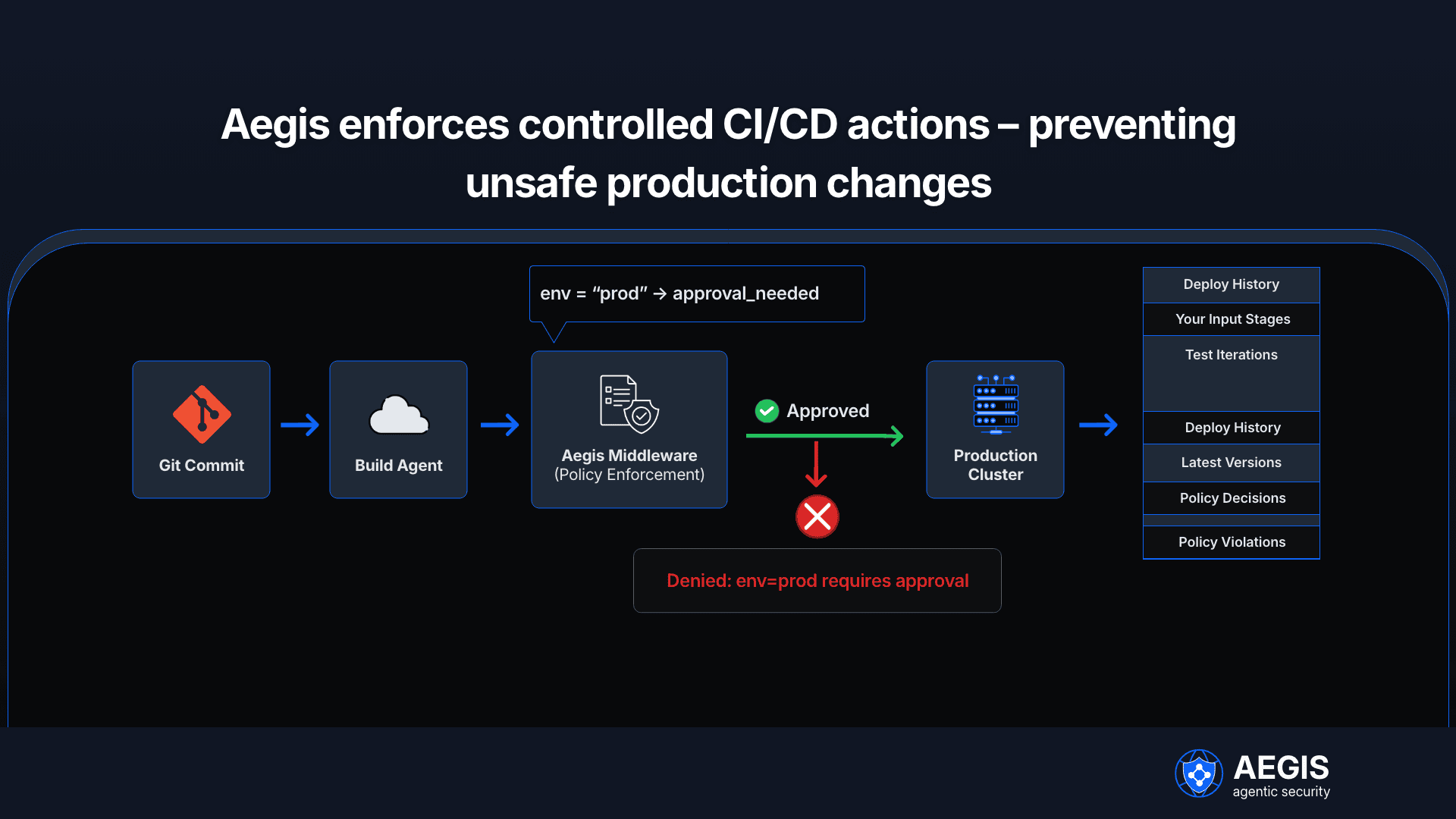
Every agent→tool call is proxied through Aegis. The policy evaluator (OPA/Rego or compiled WASM) performs a context-aware decision: allow, deny, sanitize (parameter redaction), or approval_needed. High-risk calls can pause and create an approval request routed to Slack/Teams; once approved an override token allows a one-time retry. Aegis supports shadow mode for non-disruptive tuning and hot-reloads policy bundles without restarts.
Telemetry & auditability
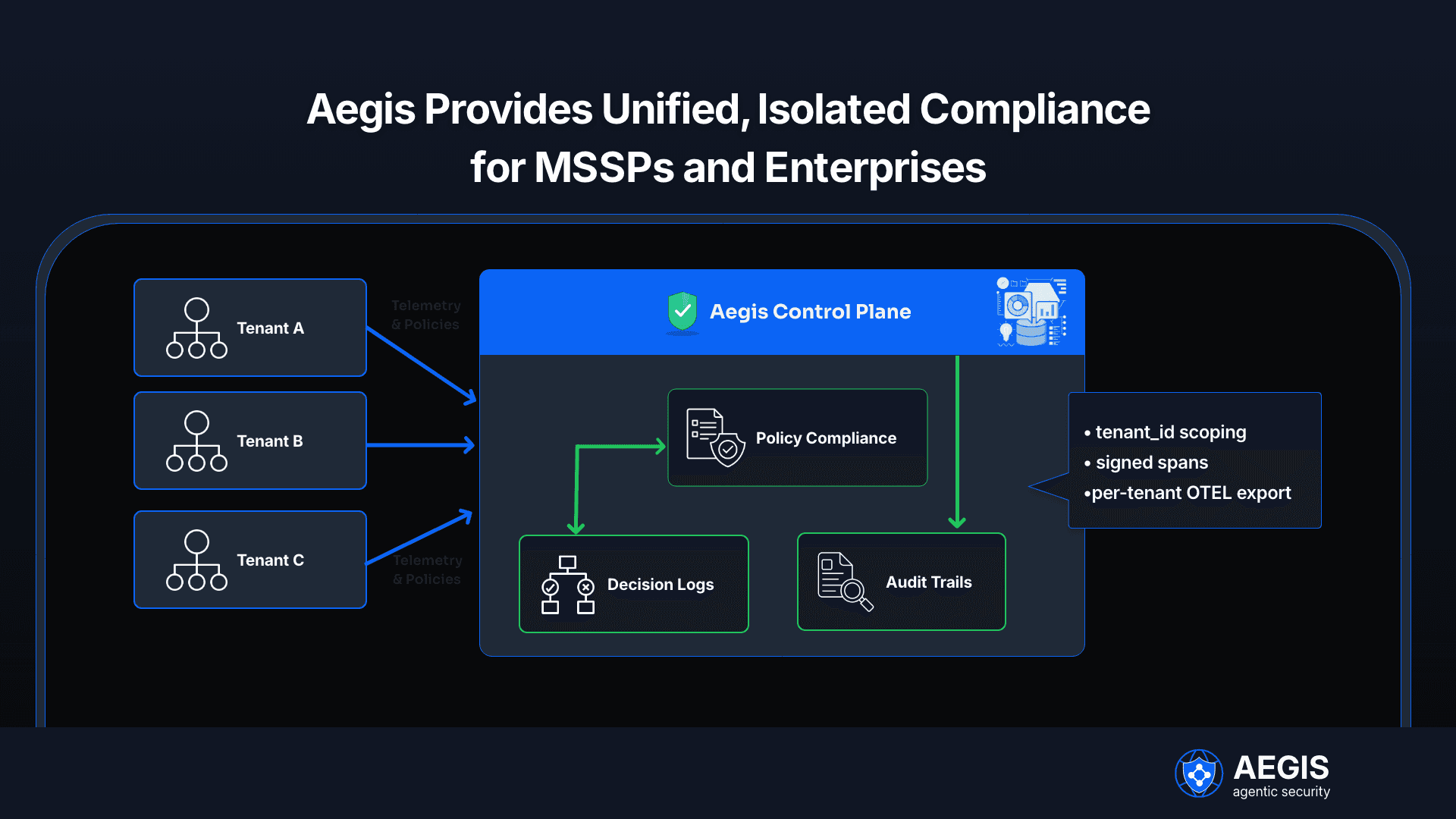
Aegis emits OpenTelemetry spans for each decision, including agent_id, tool, decision_reason, policy_version and estimated cost. These structured traces feed dashboards and SIEMs, enabling monthly evidence bundles for committee reviews and tamper-evidence via signed audit logs when required.
FinOps & budgets
Aegis tracks per-agent budgets (daily, weekly) and enforces budget exhaustion with well-defined error codes (BudgetExceeded). Dashboards show spend by tenant, agent and tool, and alerts surface runaway consumption early.
Developer experience & rollout
Aegis includes CLI/SDKs for Python/Node and middleware for popular orchestrators. Policies include validation schemas and a dry-run simulator to reduce misconfiguration risk. The deployment model supports sidecar/proxy patterns and Helm charts for production rollout.
👉🏻 Equip teams with the skills to manage AI securely
Table: Key Aegis features and operational impact
Feature | What it enforces | Committee value |
Agent identity & short-lived JWTs | Agent provenance, least privilege | Attribution for audits |
Policy-as-code (YAML→OPA) | Parameter validation, budgets, approvals | Repeatable, reviewable rules |
Shadow mode & would-deny metrics | Non-disruptive testing | Data-driven policy flip to enforce |
OpenTelemetry traces | Structured decisions & spans | Evidence bundles for reviews |
Approval workflows | Pause & human override | Escalation control for high risk |
Two comparative tables (technical & governance)
Table 1 — Policy enforcement approaches
Approach | Strengths | Weaknesses |
Local checks in agent code | Simple, fast | Inconsistent, hard to audit |
IAM / API gateway | Identity control | No parameter inspection or approvals |
Service mesh | Observability & mTLS | Not agent-aware; lacks approvals |
Aegis (runtime gateway) | Parameter inspection, approvals, telemetry | Requires sidecar/proxy integration (manageable) |
Table 2 — Governance Playbook checklist (select metrics)
Item | Target / SLA | Evidence |
Policy review SLA | 7 business days | Versioned changelog |
Shadow period | 7 days | Would-deny report |
Approval latency | < 60 minutes (high risk) | Approval audit trail |
Policy coverage | ≥ 80% critical connectors | Dashboard coverage report |
-1.png&w=3840&q=75)
Operational considerations & common pitfalls
- Approval overload: tune thresholds, use budgets and rate limits to reduce human approvals.
- Misconfigurations: require schema validation, dry-run and rollback paths.
- Latency: use OPA prepared queries, in-mem caches, and WASM to target P99 ≤ 20ms.
- Multi-tenant collisions: enforce tenant scoping for bundles and strict versioning.
👉🏻 Ensure critical actions are always reviewed before execution
Implementation roadmap
- Establish Committee charter and KPIs; publish templates for common policies.
- Stand up Aegis in shadow mode for key connectors (payments, storage, LLM APIs).
- Tune would-deny thresholds and adjust policies; map approval workflows to Slack/Teams.
- Flip enforcement, run monthly risk reviews with evidence bundles, and iterate SLAs.
Integrations & references
Integrate committee outputs with your existing security tooling and documentation. For industry context and guidance on PIAs, see New South Wales Information and Privacy Commission guidance on PIAs for AI systems. (ipc.nsw.gov.au) For agentic AI adoption and governance trends consult Capgemini’s report on the agentic era and McKinsey’s 2025 State of AI insights. (Capgemini)
👉🏻 Align AI policies with SOC compliance requirements
FAQ — Practical committee questions
Q: Who should own policy changes?
A: Assign a policy owner per policy; owners must publish change notes and SLA commitments.
Q: How long should shadow mode run?
A: Typical baseline: 7 days, adjusted by traffic volume and business risk.
Q: When do we escalate to the full committee?
A: Use triage thresholds (e.g., payments over threshold, cross-tenant data access). Escalations should include evidence bundles.
Q: How do we avoid approval fatigue?
A: Use budgets, rate limits and contextual thresholds to reduce low-value approvals; tune policies with would-deny insights.
Q: What audit evidence should we keep?
A: Signed spans, policy versions, approval logs, agent registry and token issuance records.
Q: Is Aegis compatible with my orchestrator?
A: Aegis is designed to be orchestrator-agnostic with SDKs/middleware for popular frameworks and a sidecar/proxy deployment model.
👉🏻 Map your AI systems to NIST risk management standards
Closing (operational takeaway)
An effective Agent Governance Committee marries cross-functional decision authority with a technical enforcement fabric. The committee defines the rules; Aegis operationalizes them at runtime — enforcing least privilege, parameter constraints, approvals and FinOps limits while producing the auditable traces compliance and SOC teams require. Start with templates and shadow rollouts, instrument KPIs, and iterate: governance and runtime controls must evolve with agent usage patterns to be effective.
Further reading and resources: Capgemini’s agentic era research, McKinsey’s State of AI 2025, and IPC NSW guidance on PIAs for AI. (Capgemini)