
Aligning Agent Policies with SOC Compliance Standards
Runtime policy-as-code, signed policy history, and SIEM-ready telemetry for secure multi-agent AI deployments.
Aegis - Runtime Security for Agentic AI
Enterprises adopting agentic AI face a hard operational truth: autonomy multiplies business value — and risk. Agents that autonomously call tools (payments, CMS, CI/CD, EHRs) need least-privilege controls, per-call decisioning, and auditability that stands up to SOC reviews. This article unpacks the problem space and explains how Aegis — an agentic security mesh by Aegissecurity— implements policy-as-code, signed policy history, SIEM-ready telemetry, and tamper-resistant audit trails to meet SOC needs without blocking developer velocity.
Why agentic AI changes the security equation
Agentic AI moves beyond single-call LLMs: it chains agents, instruments tools, and makes decisions autonomously. Industry research forecasts rapid uptake — Gartner projects that by 2028 roughly one-third of enterprise apps will include agentic capabilities, up from near zero in 2024, underscoring the need to change how runtime controls are applied. (Gartner)
Operational teams report the tension in plain terms: while adoption accelerates, security teams flag visibility and governance gaps. Surveys show near-universal plans to expand agent use alongside rising concerns about runaway actions, data exfiltration, and unauthorized transactions. (TechRadar)
👉🏻 Standardize and scale security with policy-as-code across all agents
The compliance checklist SOC auditors expect
SOC auditors demand reproducible controls: traceability, separation of duties, signed evidence, and retention windows. For agentic workflows that means:
- Map policies to SOC controls (access control, change management, log integrity).
- Produce decision provenance for every call: agent_id, policy_version, decision_reason, approval_id.
- Maintain tamper-resistant logs and signed policy history for legal evidence.
- Enforce separation of duties (agent identities, reviewer approvals) and retain reviewer comments with changes.
These are the new non-negotiables for regulated enterprises.
The old vs new: manual evidence to policy-driven telemetry
Old approach: scattered logs, manual evidence collection, offline attestations. That breaks under the scale and speed of agent actions.
New approach: policy-as-code, signed policy bundles, and structured OpenTelemetry traces that embed policy_version and decision_reason in every span. Aegis implements this pattern end-to-end: policy bundles are signed and versioned, the gateway emits OTel spans per call, and SIEM-ready JSON logs contain decision metadata for immediate ingestion. This makes audits reproducible and traceable.
👉🏻 Centralize policy control to eliminate inconsistencies and blind spots
How Aegis addresses the problem
Aegis is designed as a lightweight runtime policy and observability fabric for multi-agent AI systems. It sits between orchestrators and tools — a data plane enforcement layer with a control plane for policy lifecycle and signing.
Key capabilities
- Policy-as-code with versioned signed bundles
Policies are authored in YAML/JSON, compiled into signed bundles and stored with immutable version metadata. Each bundle includes notes for reviewer comments and an approval ID chain, creating a tamper-evident policy history. - Runtime enforcement at the agent↔tool boundary
Aegis operates as a sidecar/forward proxy and an external authorizer that evaluates each agent call (agent ID, target tool, parameters, call chain) and returns allow/deny/sanitize/approval_needed decisions in <20ms P99 with prepared queries and caching. - Decision provenance and telemetry
Every call emits OpenTelemetry spans that include agent_id, tool_name, policy_version, decision_reason and optional approval_id. Structured JSON logs are shipped to SIEM (Splunk/ELK/Datadog) in a format auditors can consume. - Approval workflows and override tokens
For high-risk decisions, Aegis can pause and route approval requests to Slack or MS Teams; on approval it issues single-use override tokens that are traceable. - Tamper-resistant logging & retention
Logs and policy history include hash chains and signed manifests. Retention policies align with regulatory windows; exported evidence contains cryptographic attestations suitable for auditor consumption. - Developer UX: dry-run, SDKs, CLI
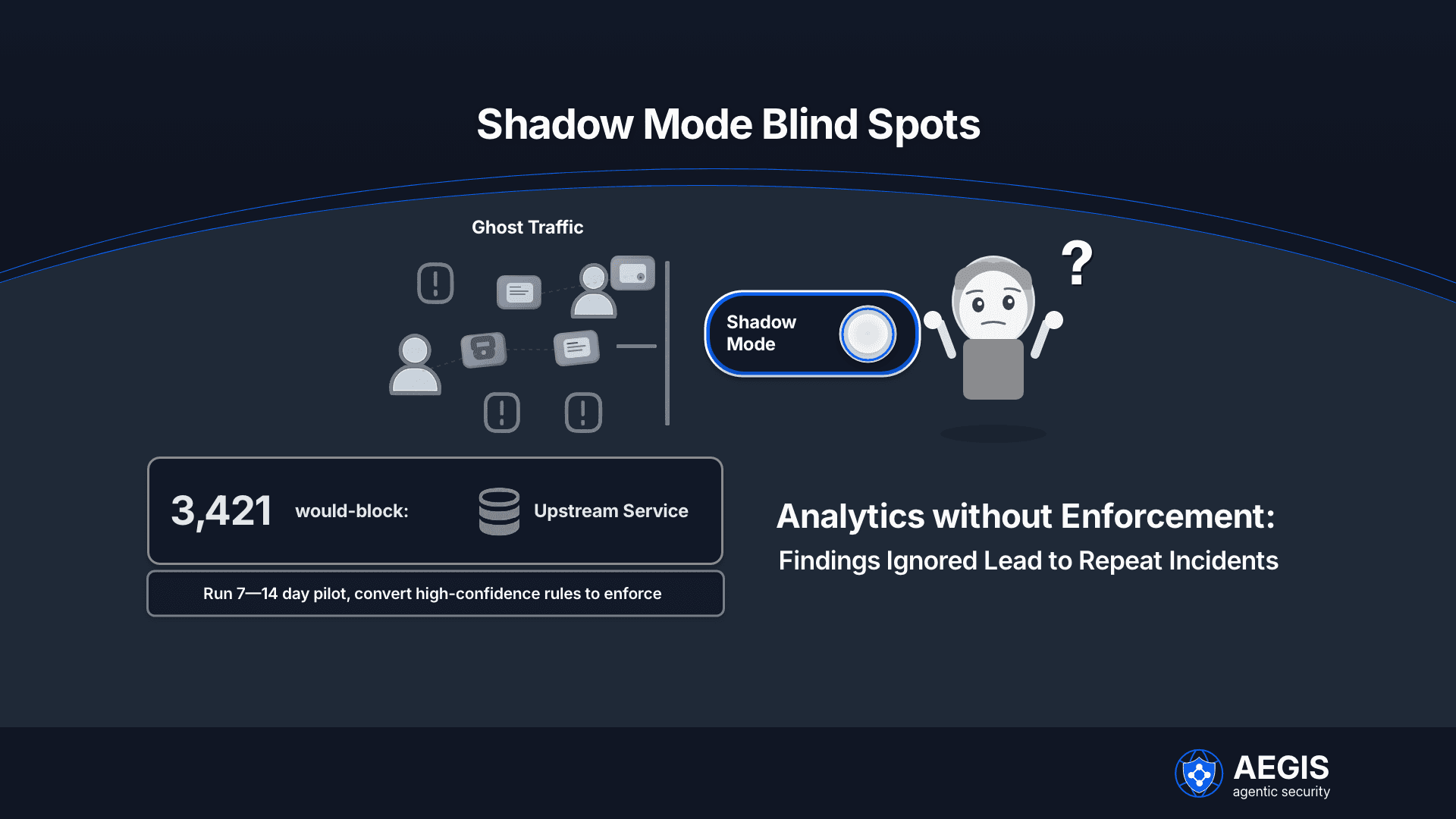
Policies can run in shadow mode for observation, then flipped to enforce after validation. SDKs and middleware simplify integration with LangChain/AgentKit/LangGraph, minimizing developer friction.
Aegis’s architecture and approach enable security teams to enforce least-privilege across agents, prevent inter-agent coercion (planner→finance), and provide SOC-grade evidence without slowing developer iteration.
👉🏻 Align approval workflows with risk levels for smarter decision control
Technical design highlights
Data plane: low-latency decisioning
- Envoy/sidecar intercepts outbound calls and calls an ext_authz service.
- Prepared OPA queries and in-memory caches keep decision latency low (target P99 ≤ 20ms).
- Decisions include allow/deny/sanitize/approval_needed; sanitization performs deterministic DLP (regex redaction) for PII.
Control plane: policy lifecycle & signing
- A policy compiler validates YAML against a schema and produces an OPA bundle plus a signed manifest.
- Bundle store (S3/GCS) serves versioned bundles with ETags and signed manifests for integrity checks.
Observability & audit trail
- Each decision generates an OpenTelemetry span with policy_version and decision_reason fields.
- Logs are structured JSON with hash chains and optional attestation signatures suitable for legal evidence.
- Dashboards show would-block events (shadow mode), enforcement rates, top offenders and budget consumption.
Practical controls — policy examples and enforcement table
Use case | Policy snippet (conceptual) | Enforcement outcome |
High-value payment | finance-agent: max_amount: 5000; approval_needed: amount>5000 | Block & approval workflow if above threshold |
EHR read | clinical-agent: allowed_endpoints: [/ehr/*]; require purpose=care | Deny if export flag or wrong endpoint |
Budget control | llm-agent: daily_budget: $20; rps: 5 | Block when budget exhausted; emit BudgetExceeded record |
Egress allowlist | agent: *; allowed_domains: [internal-api.company.local] | Deny any external exfiltration attempts |
Aegis supports shadow mode so teams can tune regexes, thresholds, and approval policies before enforcement.
.png&w=3840&q=75)
Two comparison tables (policy vs legacy)
Capability | Legacy controls | Aegis (policy mesh) |
Per-call parameter inspection | Rare / ad-hoc | Parameter validation, regex & ranges |
Policy versioning | Manual change notes | Signed bundles, version history |
Approval traceability | Email/Slack threads | Approval IDs embedded in traces |
SIEM readiness | Scattered logs | Structured JSON logs + hash chains |
Compliance artifact | Legacy evidence | Aegis output |
Policy change log | Change request tickets or spreadsheets | Signed policy bundle + reviewer comments |
Decision trace | Partial logs | OTel span with policy_version & decision_reason |
Legal evidence | Exported logs, manual notarization | Tamper-evident logs with hash chain & retention tag |
Implementation guidance (operational checklist)
- Start in shadow mode for 7–14 days; collect would-deny metrics.
- Map critical tools and define agent identities and scopes.
- Author policies with conservative allowlists and small budgets.
- Enable approval workflows for high-risk actions (payments, prod deploys).
- Integrate structured logs with SIEM and configure retention windows required by auditors.
- Maintain signed policy bundles and keep reviewer comments with each version.
-1.png&w=3840&q=75)
Frequently Asked Questions
Q1: How does Aegis prove which policy made a decision?
A: Every decision includes policy_version and decision_reason in the OTel span and structured log. Bundles are signed; the manifest contains reviewer comments and an approval ID chain.
Q2: Can Aegis integrate with existing SIEM and dashboards?
A: Yes — Aegis emits SIEM-ready JSON logs and OpenTelemetry spans compatible with ELK, Splunk, Datadog, Prometheus/Grafana.
Q3: Will runtime evaluation add user-visible latency?
A: Designed to minimize overhead — prepared OPA queries and in-memory caching target P99 ≤ 20ms for decision calls.
Q4: How are approvals handled at scale?
A: Policies can set thresholds to limit approvals; integrations with Slack/MS Teams and single-use override tokens streamline approvals and make them traceable.
Q5: Can I scope policies across tenants (MSSP)?
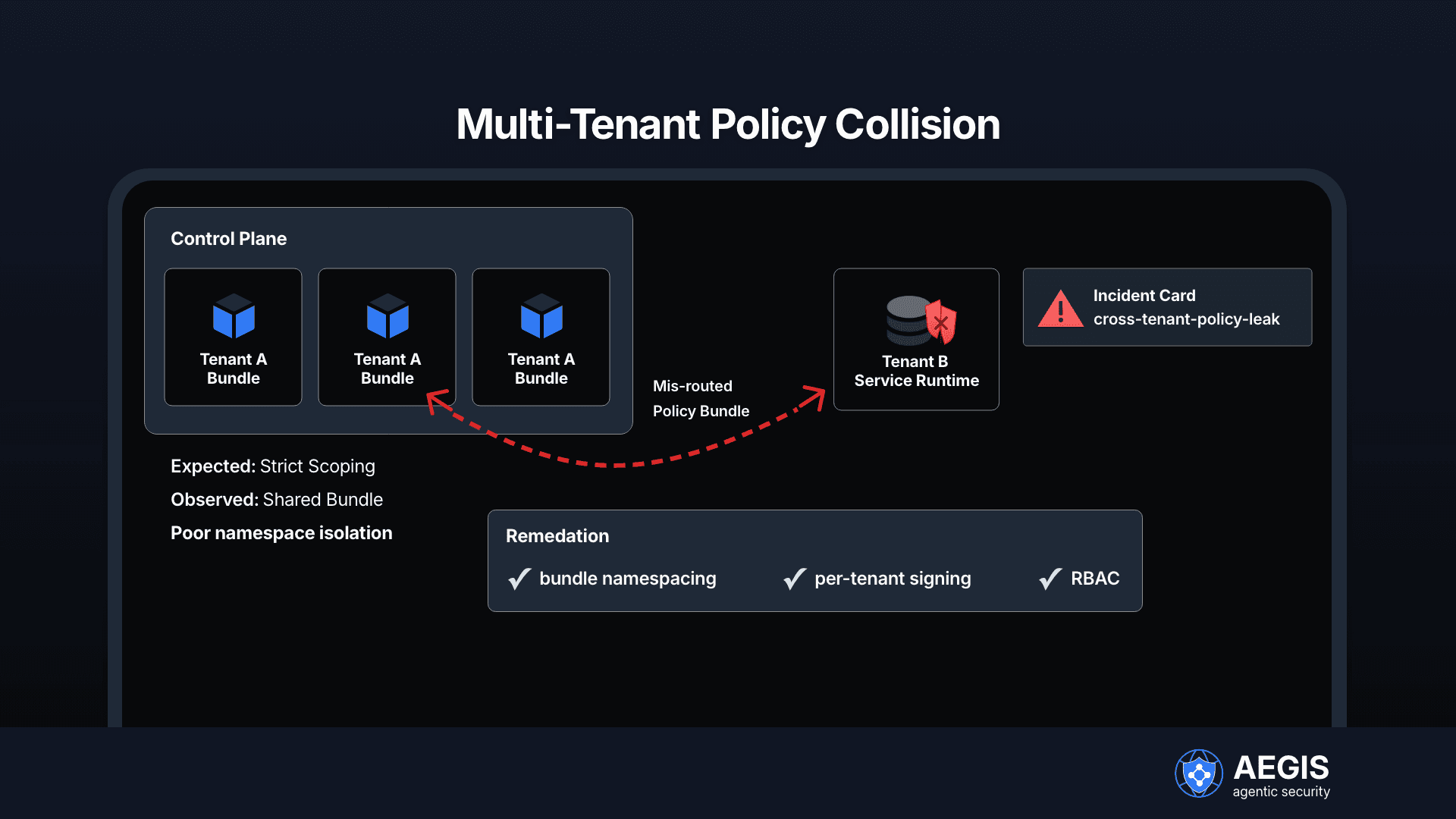
A: Yes — the control plane supports tenant-scoped bundles and region tagging to prevent cross-tenant policy leakage.
Closing notes
Agentic AI brings measurable productivity gains — and new operational and compliance responsibilities. A runtime policy mesh like Aegis implements the controls auditors require (traceability, signed policy history, tamper-resistant logs) while preserving developer velocity through policy-as-code, dry-run modes, and lightweight SDKs.
mage (Diagram placeholder — pain point visualizer): [Simple diagram: left column “Agent risks” (coercion, exfil, cost), center “Aegis runtime checks” (policy, DLP, approvals), right column “Outcomes” (auditable traces, blocked incidents, budgets enforced)]