
Training Teams on Agent Governance and Security
Practical guide to training, policy-as-code pipelines, and runtime enforcement for secure agent deployments with Aegis.
.png&w=3840&q=75)
Aegis: Operationalizing Agent Governance — curriculum, pipelines, and runtime control
Enterprises adopting agentic AI confront a triple problem: teams don’t know how to author safe policies, policies don’t flow into CI/CD reliably, and runtime enforcement plus telemetry is missing. This article prescribes a practical syllabus, lab-driven curriculum, and a policy-pipeline pattern that turns organizational learning into operational controls — using Aegis as the runtime enforcement and observability fabric. The guidance below targets security engineers, platform leads, DevOps, and MSSPs who must move beyond ad-hoc governance to reproducible policy workflows.
Skill gaps blocking agent adoption
Most teams trying agentic workflows stumble on three concrete gaps: policy authoring, telemetry interpretation, and approval workflows. Surveys from 2024–2025 show agent experimentation is widespread but maturity lags — 23% of organizations say they are scaling agentic systems and many cite governance and risk as top barriers. (McKinsey & Company)
Key operational gaps
- Policy authoring: engineers write inconsistent YAML, lacking parameter conditions (amount ranges, regexes) and approval hooks.
- Telemetry fluency: SOC and FinOps teams cannot read would-block dashboards or map spans to incidents.
- Approval fatigue: noisy approval_needed signals flood Slack/Teams when thresholds and budgets aren’t tuned.
Consequence: pilot projects fail or are scrapped despite investment. Gartner and industry reports warn a high fraction of agentic projects will be discontinued without clearer value and controls. (Reuters)
👉🏻 Establish leadership to oversee and guide agent governance strategy
Curriculum and labs for governance
The right curriculum pairs role-based learning with hands-on labs. Below is a syllabus that maps to the 20-point brief for practical enablement.
Core syllabus (role-based)
- Security Engineers: policy-as-code workshops, Rego/OPA basics, policy testing and dry-run.
- Platform Engineers: integration labs with proxies/sidecars, token issuance, secret management.
- App Owners / Devs: SDK middleware usage, shadow mode testing, parameter sanitization.
- SOC / Compliance: telemetry interpretation, incident playbooks, audit signoff.
Hands-on lab matrix (examples)
Lab | Objective | Output |
Policy YAML workshop | Author policy with conditions (amount, regex) | Validated policy + unit tests |
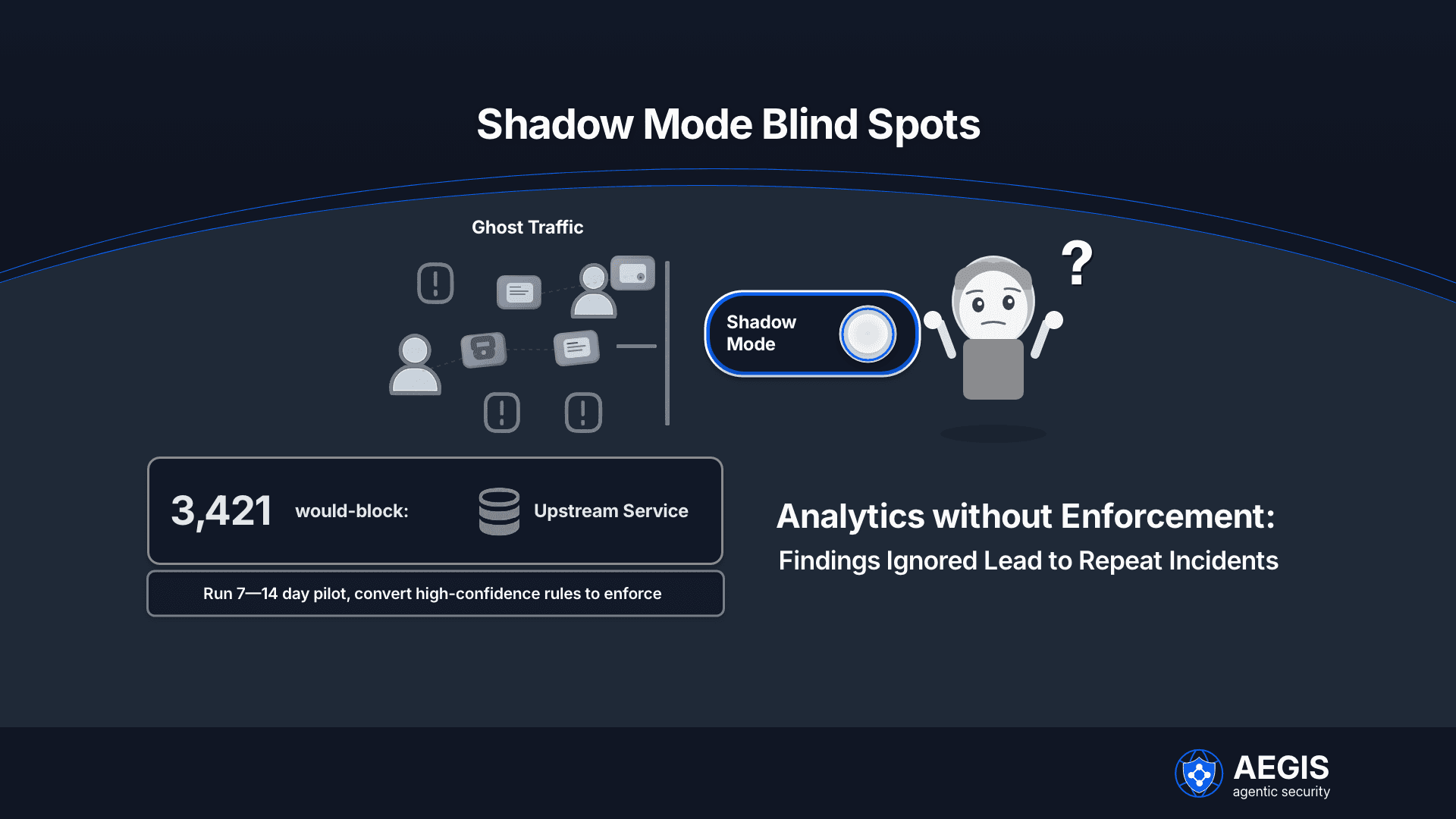
Shadow-mode rollout | Run policies in shadow for 7 days | Would-block metrics dashboard |
Approval flow lab | Configure approval thresholds + Slack integration | Approval playbook & override token test |
DLP & redaction | Test regex redaction on EHR payloads | Sanitized payload traces |
These labs should be delivered using a reproducible environment (Helm chart, sample orchestrator workflow) so teams can repeat and iterate. Use synthetic datasets to validate DLP and parameter rules without exposing production PII.
Operationalizing learning into policy pipelines
Training without enforcement is theater. Turn learning into durable controls with a policy pipeline that integrates version control, CI checks, staged rollout, and telemetry-driven feedback.
4-step policy pipeline
- Author — Policy authored as YAML/JSON in a VCS-backed repo with schema validation.
- Test — Unit tests, Rego/OPA prepared-query simulations, dry-run on staging agents.
- Review & Approve — Approval workflow for policy PRs; include compliance signoff for regulated templates.
- Promote — Bundle compiled policies into OPA bundles, hot-reload into Aegis control plane, flip shadow→enforce.
Automation details
- CI checks must run policy schema validation, Rego linting, and simulated decision-tests for representative calls (e.g., payment create with edge values).
- PRs should attach dry-run metrics (would-block counts) to help reviewers see impact before enforcement.
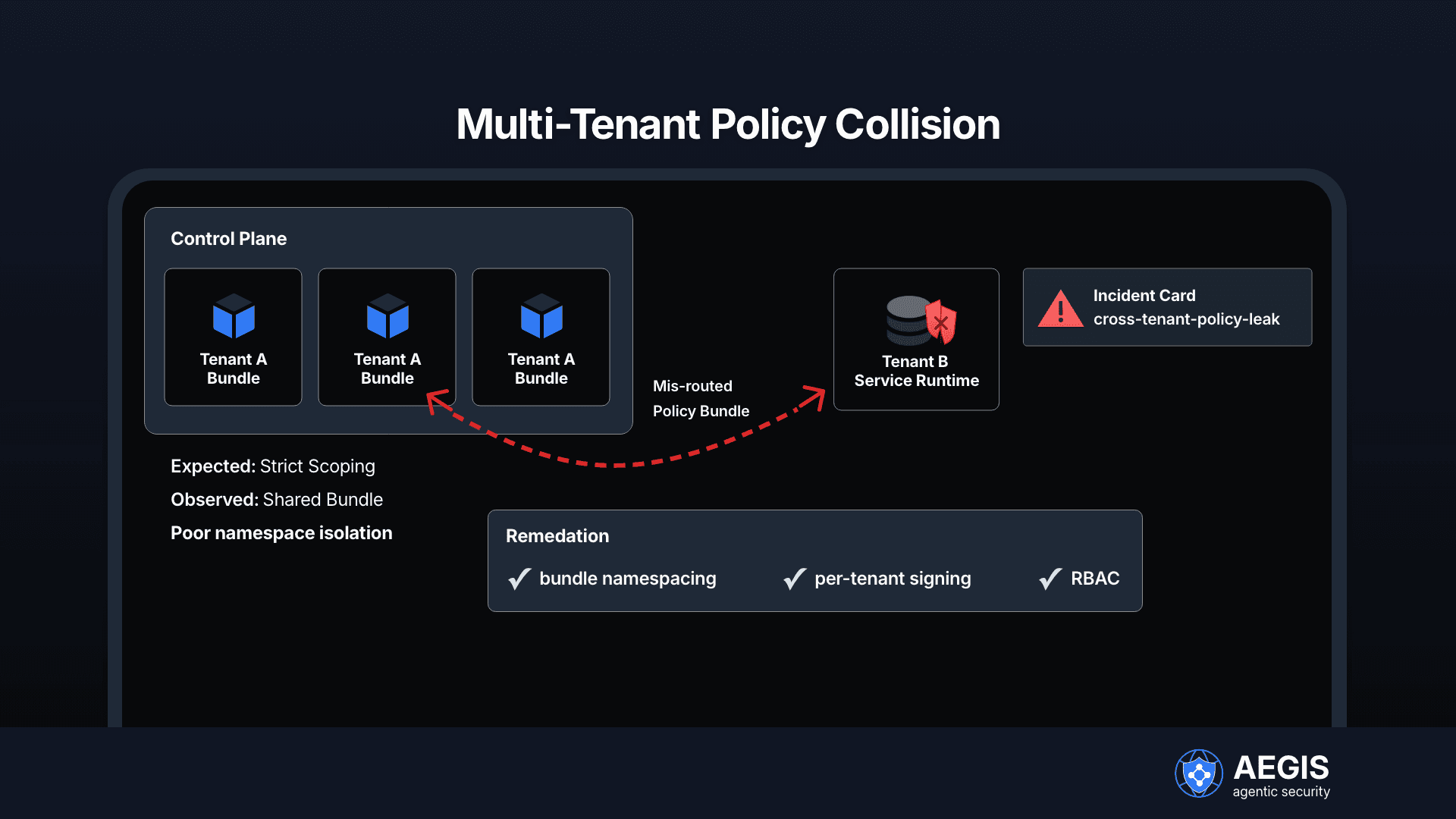
- Keep a policy cookbook with templates for payments, EHR, CI/CD and per-tenant variants that security and app teams can reuse.
Why runtime enforcement matters (Aegis as the solution)
At least one-third of any practical rollout must describe the solution. Aegis is a runtime policy and observability gateway purpose-built for multi-agent systems: it enforces least privilege between agents and tools, inspects parameters, and emits structured telemetry for SOC and compliance. The technical brief defines Aegis as a lightweight "policy & observability fabric" that acts like a sidecar/proxy and an external authorization server.
👉🏻 Ensure critical decisions are always validated by humans
Aegis core capabilities (operational view)
- Agent identity & short-lived tokens: per-agent JWTs with scopes and expiry.
- Policy-as-code → OPA bundles: YAML → compiled bundles, hot-reloadable.
- Decision outcomes: allow, deny, sanitize (redact), approval_needed.
- Telemetry: OpenTelemetry spans, decision reasons, policy version and approval ids for each call.
Aegis enforces parameter constraints (e.g., amount <= 5000) and intercepts chained calls so a planner agent cannot coerce a finance agent into high-risk actions. Example scenario: a finance agent with max_amount: 5000 will have a $50,000 call blocked at the gateway and a PolicyViolation returned.
Observability & SOC integration
Aegis emits structured JSON logs and OTel spans so dashboards can show "would-block vs blocked", top offending agents, and budget exhaustion events. These traces are SIEM-ready, enabling audits that prove which agent, policy version, and approver were involved in a decision — an audit trail necessary for regulatory contexts.
Practical templates & policies
Template | Use case | Key fields |
payments-small | Low-value automated payments | agent, allowed_tools, max_amount |
payments-high-risk | Requires approval | approval_threshold, approver_channel |
ehr-read-only | Clinical read access | allow_paths, purpose=care, redact_patterns |
ci-deploy | CI/CD gating | allowed_envs, image_digest_whitelist, approval_for_prod |
Include in the policy cookbook: example YAML snippets, Rego test cases, and CI examples that fail builds on schema errors.
Measuring success: metrics and KPIs
Define training and operational KPIs aligned to risk reduction and velocity:
- Policy misconfig rate (post-deploy incidents per 1,000 rules)
- Incident reduction attributable to policies (target: measurable reduction in would-block repeat offenders)
- Approval volume reduction (example case: platform team reduced approval volume by 60% with safe defaults).
- Telemetry coverage: percent of agent-tool calls traced (goal: 100% for pilot).
A small table of targets:
Metric | Pilot target |
Policy coverage of critical tools | 80% |
Decision latency addition (P99) | ≤ 20 ms |
Telemetry trace rate | 100% |
Approval false positives | ≤ 5% |
Governance operations: playbooks & change control
Operationalize governance:
- Maintain VCS-backed policy registry with versioning and signed manifests.
- Quarterly policy review cycle and gamified “break the policy” exercises to find blind spots.
- Onboard approvers with a Slack/Teams playbook and sample approval messages for ease of use.
- Configure fail-closed semantics for writes and configurable fail-open for low-risk reads.
Deployment and scaling considerations
Aegis follows a sidecar/forward-proxy pattern with an external authorisation server and OPA evaluator. For scale:
- Use prepared OPA queries and in-memory caches to target P99 ≤ 20 ms.
- Deploy the data plane with high availability; the control plane can tolerate lower availability.
- Use region-tagged bundles to maintain data residency for regulated tenants.
.png&w=3840&q=75)
FAQ — Frequently Asked Questions
Q1: What is the recommended first lab for a security team?
A: Start with a policy-as-code workshop that produces one validated rule for a simple connector (e.g., "stripe:create_payment with amount <= 5000"), run it in shadow mode, and collect would-block counts.
Q2: How long should shadow mode run before enforcement?
A: Run for a pre-defined window (7–14 days) capturing representative traffic. Use CI tests and observed distributions to tune conditions before flip.
Q3: How do we reduce approval fatigue?
A: Use tiered thresholds, per-agent budgets, and decision sampling. Route only high-risk or novel events to human approvers.
Q4: Which telemetry fields are essential for SOC?
A: agent_id, tool, policy_version, decision_reason, approval_id (if any), span_id and parent_chain headers.
Q5: Can policies be rolled back quickly if misconfigured?
A: Yes — keep bundles versioned in VCS and control plane; the pipeline should allow immediate rollback and a safe default policy set.
👉🏻 Streamline approvals with real-time notifications in collaboration tools
Aegis for AI Security
Training teams and building policy pipelines are the shortest path from pilot chaos to safe production for agentic AI. Combine role-based labs, a VCS-backed policy pipeline, and runtime enforcement with instrumentation. Aegis provides the missing runtime fabric — identity, policy evaluation, approvals, and telemetry — so organizations can scale agents with confidence and an auditable trail for compliance.