
Aligning Multi-Agent Systems with NIST AI Risk Management Framework
How Aegis maps runtime policy, telemetry and evidence to the NIST AI RMF for audit-ready, multi-tenant agentic AI deployments.
Aegis - Runtime Security for Agentic AI — Mapping Controls to the NIST AI RMF
Enterprises deploying multi-agent, agentic AI face a new class of runtime risks: parameter injection, inter-agent coercion, stealthy egress, and incident forensics gaps. Aegis is designed as a policy-and-observability fabric that enforces least-privilege at the agent↔tool boundary while producing tamper-evident evidence aligned to the NIST AI Risk Management Framework (AI RMF). This article explains why runtime controls matter, maps Aegis controls to NIST functions, and gives practical steps and artifacts you can use to move from pilot to audit-ready.
Why runtime controls are necessary
Agentic AI systems move decisions from single-call APIs into multi-step workflows where one agent can prompt or coerce another, or call downstream services with complex parameters. Governance that stops at identity or CI/CD is insufficient; regulators and auditors expect evidence that controls operate during execution, not only on design documents. NIST’s AI RMF is the primary voluntary structure organizations use to manage AI risk lifecycle functions (Identify, Protect, Detect, Respond, Govern). (NIST)
Recent industry surveys show meaningful—but uneven—adoption of agentic AI: a growing share of organizations are experimenting or scaling agentic systems while governance lags. For example, major surveys in 2024–2025 report that between ~23% and ~29% of organizations have moved to scale or pilot agentic deployments, with many more experimenting—creating an urgent need for runtime risk controls and audit evidence. (McKinsey & Company)
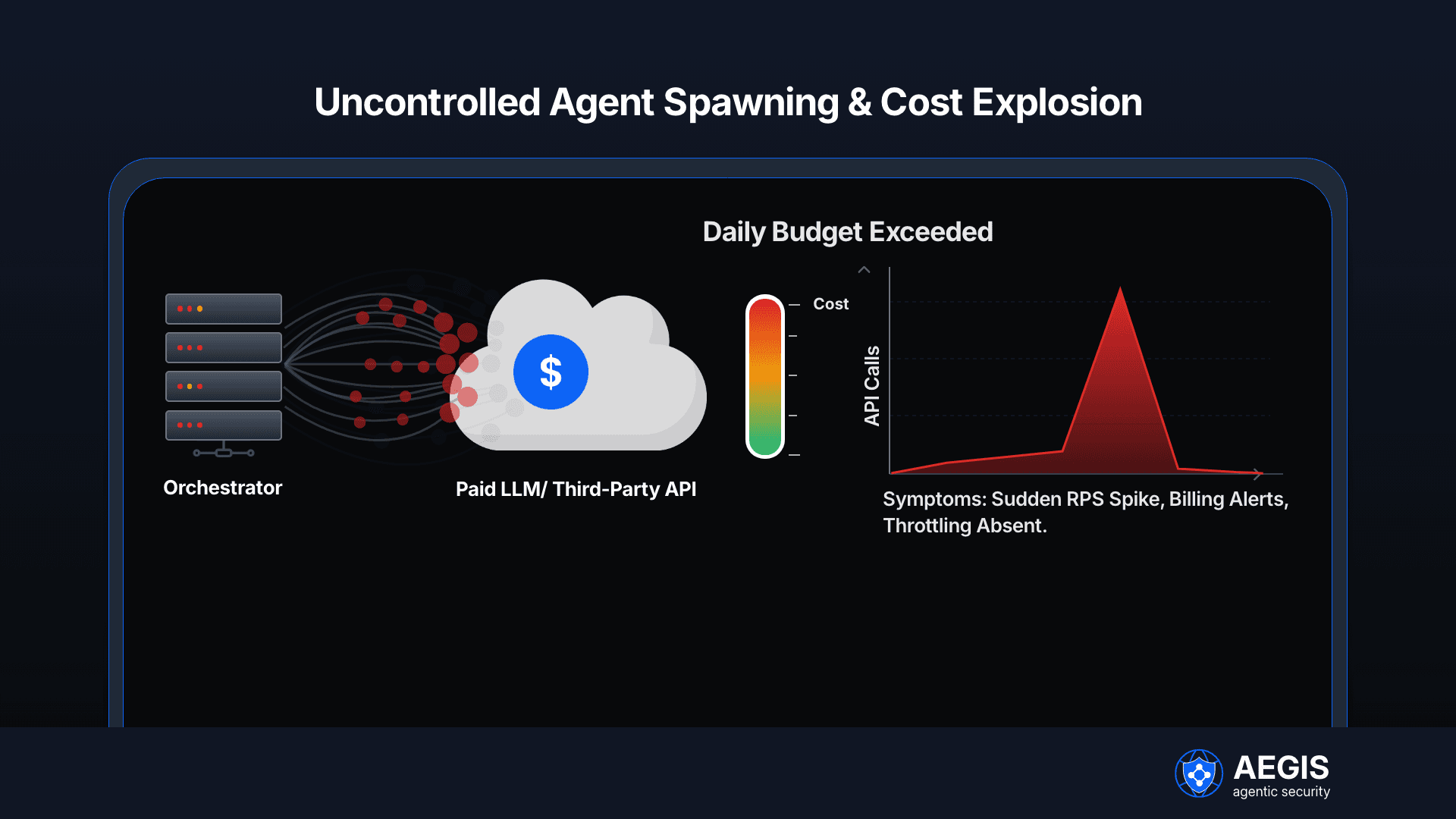
How Aegis maps to NIST AI RMF (high level)
Aegis implements controls, telemetry, and evidence collection that map directly to the RMF functions:
- Identify — inventory agents, tools, and data sensitivity; register agent identities and metadata in the control plane.
- Protect — enforce per-agent RBAC, short-lived tokens, parameter validation and egress allowlists at runtime.
- Detect — emit OpenTelemetry spans and structured logs for all agent→tool calls; surface anomalies and “would-deny” metrics.
- Respond — support approval workflows, token revocation, and replayable incident traces for SOC playbooks.
- Govern — policy lifecycle, versioning, attestation stamps in traces, and evidence bundles for audits.
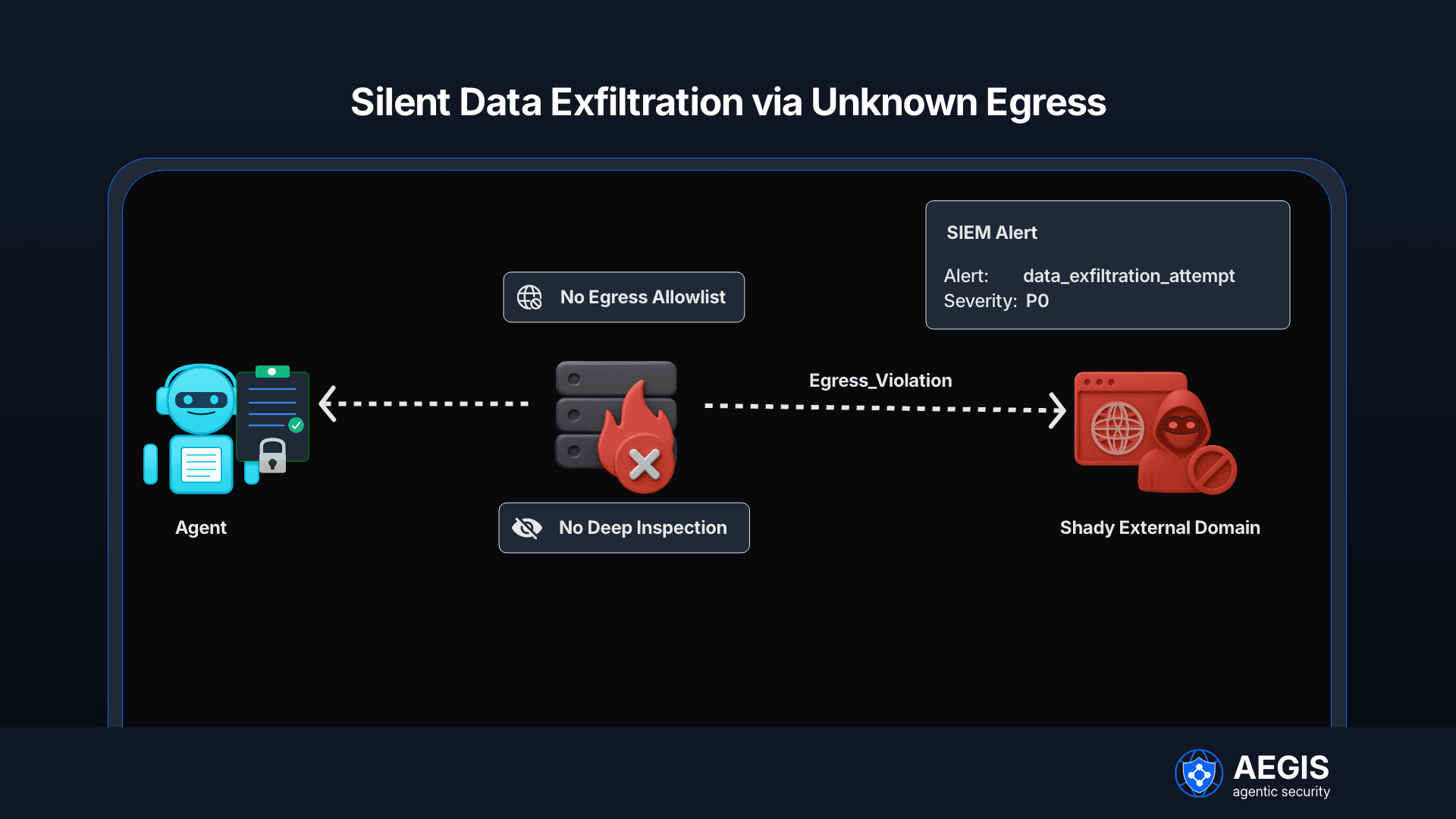
Table 1 below shows a concise mapping of Aegis features to NIST functions and sample evidence artifacts.
NIST Function | Aegis Controls / Features | Evidence produced |
Identify | Agent registry, tool inventory, sensitivity tags | CSV/JSON inventory export, agent metadata with timestamps. |
Protect | Short-lived JWTs, per-agent policy bounds, parameter validators, egress allowlist | Signed policy_version stamped spans, policy diffs, deny responses. |
Detect | OTel spans, blocked/would-deny counters, anomaly metrics | Time-series dashboards, SIEM events, alert streams. |
Respond | Approval workflow, revoke tokens, incident trace replay | Approval records, override token usage logs, replayable span bundles. |
Govern | Policy lifecycle, testing, shadow mode, policy signing | Versioned policy bundles, signed manifests, audit playbooks. |
Concrete Aegis controls: examples that auditors will understand
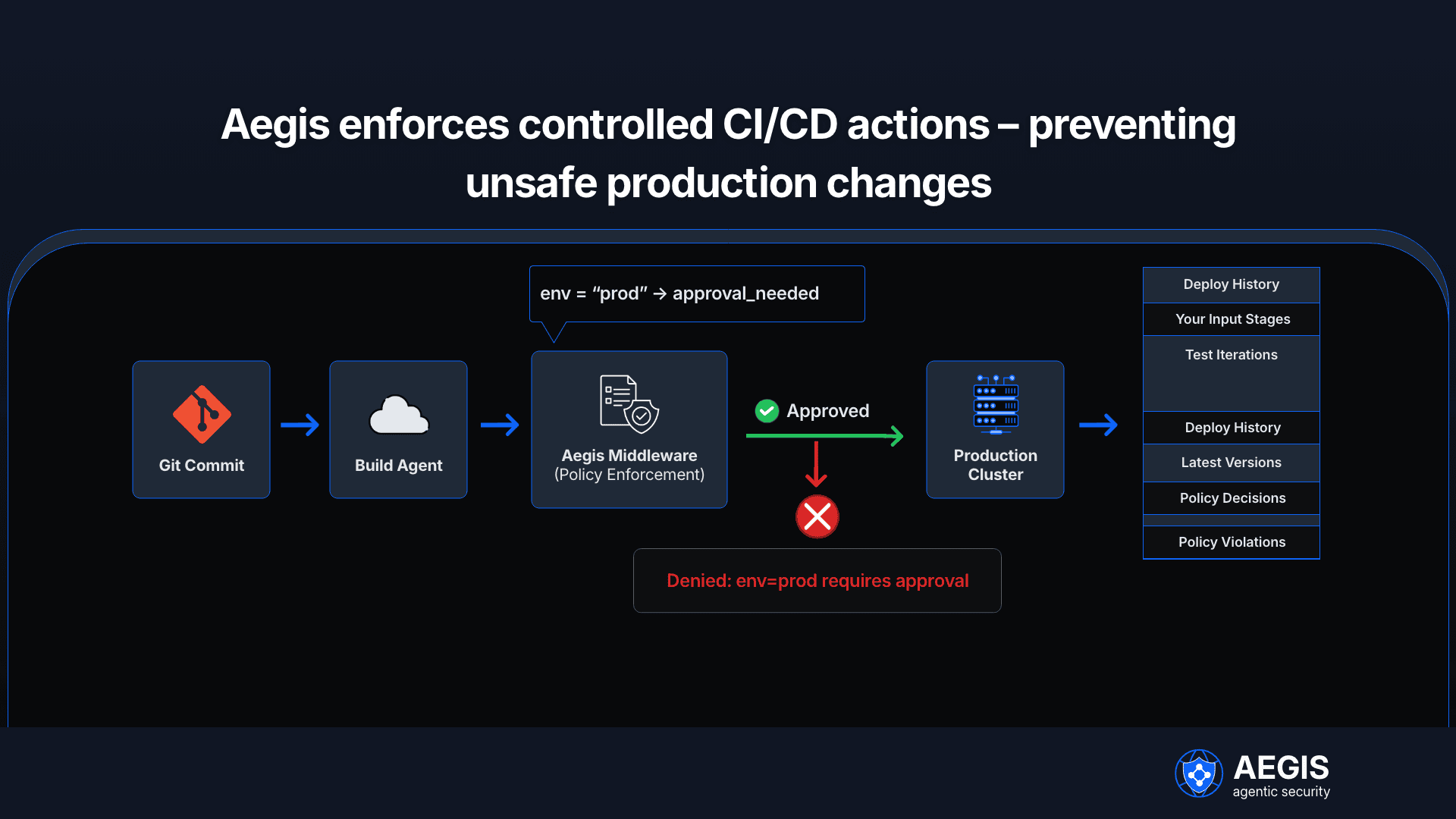
- Protection example — payments control (FinTech): the policy for finance-agent enforces max_amount: 5000 and requires approval_needed above that. When a planner agent attempts to coerce a payment of $50,000, Aegis blocks the call, returns a structured PolicyViolation, emits a signed span containing policy_version, decision_reason, and agent_id, and posts an approval request to the configured human workflow. This provides an immediate protective control and an immutable audit trail for regulators.
- Detection example — telemetry & would-deny metrics: Aegis emits OpenTelemetry spans for each decision that include contextual fields (parent_agent_id, tool_name, parameters_hash, policy_version). SOCs can query would-deny counts (shadow mode) and tune conditions before flipping to enforce. This addresses the common governance gap where teams only have design-time artifacts but no runtime evidence.
- Response example — closed-loop incident: on detecting repeated attempts to export data to an off-region domain, Aegis triggers an incident, revokes the agent’s short-lived token, and produces an evidence bundle (signed span timeline + policy diffs) that maps to the RMF’s Respond and Govern expectations. The evidence bundle includes the replayable trace for post-mortem.
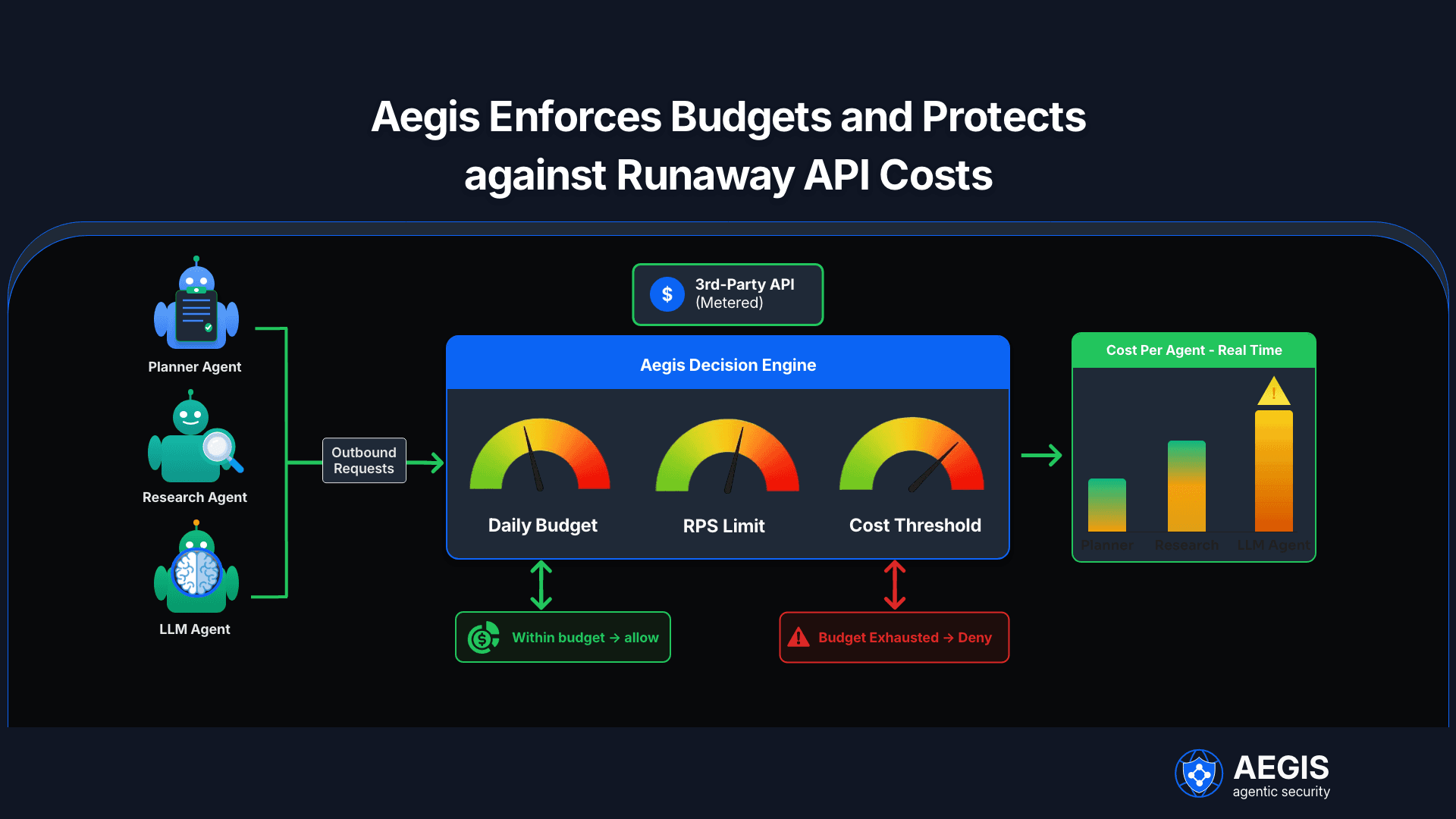
Architecture & deployment patterns (operational focus)
Aegis separates control plane (policy authoring, bundle store, token service, approvals) and data plane (sidecar / forward proxy, ext_authz decision service, OPA evaluator). The gateway enforces decisions in-line while keeping decision latency low via prepared queries, caching, and optional WASM compilation for Rego policies. This design is intentionally similar to service-mesh patterns so it integrates into existing infra without heavy changes.
👉🏻 Align frameworks and policies to build a compliant AI risk posture
Table 2: Pilot readiness metrics (example KPIs)
Metric | Target (pilot) | Notes |
Policy coverage of critical tools | ≥ 80% | Map of critical connectors (payments, EHR, storage). |
Decision latency (P99) | ≤ 20 ms | OPA prepared queries + caching. (McKinsey & Company) |
Telemetry completeness | 100% of agent→tool calls traced | Required for replayable evidence. |
Shadow-mode would-deny conversion | ≥ 90% tuned before enforcement | Operational best practice. |
Preparing for regulator questions about autonomy and oversight
Regulators will focus on traceability, human oversight, and demonstrable controls mapped to recognized frameworks. Use these concrete artifacts when answering regulators:
- Inventory export showing registered agents, tool attachments, tenant and data residency tags.
- Signed evidence bundle for sampled high-risk actions (span timeline + policy_version + approval_id).
- Policy lifecycle records: who edited the policy, validation checks, dry-run results and rollbacks.
- Periodic risk register with likelihood/impact/residual risk for agent classes and connectors.
Operational checklist: from pilot → audit-ready
- Inventory agents & connectors; tag by data sensitivity and criticality.
- Author baseline policies in YAML/JSON; run in shadow mode for 7–14 days.
- Tune parameter validators and regexes using would-deny telemetry.
- Activate enforcement for low-risk policies, keep approval workflows for high-risk actions.
- Export evidence bundles and run tabletop audits with compliance teams.
- Integrate evidence exports into GRC tools; schedule quarterly reassessment.
Integration and multi-tenant considerations
Aegis supports per-tenant routing, policy scoping, and per-tenant evidence exports so MSSPs can separate tenant artifacts. Control-plane isolation and signed manifests prevent policy collision across tenants. For data residency, route agent calls to region-tagged endpoints and enforce per-tenant egress allowlists.
👉🏻 Prepare for global regulations with risk-based AI governance strategies
Sample NIST control mapping (compact)
NIST Category | Example Control | Aegis artifact |
Protect: Access controls | Short-lived tokens + RBAC | Token issuance logs, token revocation events |
Detect: Monitoring | OTel spans, would-deny metrics | Dashboards, SIEM events |
Respond: Recovery | Approval & revoke flows | Approval records, override token usage |
Govern: Policy lifecycle | Policy signing, versioning | Signed bundle manifests, change logs |
Measuring program effectiveness
Effective governance metrics are operational and measurable: percent of high-risk actions covered by policy, mean time to revoke an agent token after detection, percent of would-deny incidents converted to policy updates, and audit evidence completeness rate. These are key for board and regulator reporting.
Where to learn more & next steps
Industry guidance: NIST AI RMF and companion resources provide the framework to map controls and evidence to regulatory expectations. (NIST Publications)
- Operational templates: use the case study and use-case templates (payments, EHR, tenant-isolation) as the basis for pilot runbooks.
👉🏻 Innovate safely by combining risk frameworks with sandbox experimentation
Frequently Asked Questions
Q: How does Aegis produce tamper-evident audit traces?
A: Each decision enriches an OpenTelemetry span with policy_version, decision_reason, agent_id and an attestation signature from the token service or bundle store. Signed manifests and ETags protect bundle integrity.
Q: Can Aegis run with existing orchestrators?
A: Yes — Aegis is designed to integrate with LangChain/LangGraph/AgentKit via middleware and a sidecar/forward proxy pattern; minimal code changes are required.
Q: What if policy evaluation affects latency?
A: Use OPA prepared queries, in-memory caches, and optional WASM compilation to hit P99 targets (≤ 20 ms in typical pilots). Shadow-mode tuning reduces unnecessary approval delays. (McKinsey & Company)
Q: How do we show regulators that human oversight exists?
A: Maintain approval audit trails, include approval_id in spans, and demonstrate policy lifecycle records that show who reviewed/approved policy changes. Evidence bundles make supervisory actions reproducible.
Q: What are common pilot pitfalls?
A: Overly broad denies in initial policies, failing to run shadow mode, and not scoping bundles per tenant. Use the checklist above to avoid these issues.
Q: How do we export evidence into GRC tools?
A: Aegis supports structured exports (signed JSON bundles) and SIEM shipping that GRC tools can ingest for attestations and audit trails.
Practical Next Steps
Start by running a short pilot: register agents, deploy sidecars for two critical connectors (payments and storage), run policies in shadow for 7–14 days, then flip enforcement for low-risk flows. Produce an evidence bundle for at least one high-risk blocked action and run it through your compliance playbook. This set of artifacts—inventory, signed spans, policy lifecycle logs and approval records—aligns directly with the NIST AI RMF expectations and will materially shorten audit cycles.
Further reading: NIST AI RMF materials and recent surveys on agentic AI adoption help frame regulator expectations and market trajectories. (NIST Publications)