
Implementing Human-in-Loop Approval Flows in Agent Architectures
Practical patterns for low-friction HITL approvals, runtime tokens, and auditability for agentic AI deployments.
Aegis — Human-in-Loop Approval Patterns for Agentic AI
Enterprises adopting agentic AI face a persistent tradeoff: automation velocity versus control. Fully autonomous agents accelerate operations but can make irreversible high-risk decisions — payments, infra changes, data exports — that must remain human-governed. This article lays out pragmatic, production-grade patterns for embedding human-in-loop (HITL) approval flows into agent architectures, explains implementation choices (approval_needed signals, short-lived override tokens, queueing and debounce), and shows how Aegis — Aegissecurity runtime policy and observability gateway — implements these patterns to provide safe, auditable agent automation at scale. It also links to practical resources for deeper reading on policy engines and observability.
👉🏻 Introduce approval layers for high-risk AI decisions
Designing low-friction approval flows
Why inline approvals? Traditional email or ticketing breaks context, lengthens mean time to action, and disconnects approvers from the runtime state that matters. Inline approvals keep decision context, links to evidence, and retry semantics in the execution path so agents can pause, await approval, then continue as a single coherent operation.
Key design goals
- Low cognitive load: show only high-signal facts (intent, parameters, risk reason, links to traces/logs).
- Fast retry semantics: a one-time override token should let the agent retry the original call without replaying non-idempotent steps.
- Auditability: every approval, token mint, and retry must be traced and signed into telemetry.
Interactive approver UX
- Post an interactive message to Slack/MS Teams containing: a concise explanation (policy name + rule), parameter diffs, a link to the trace/dashboard, and Approve/Reject/Request Info actions. The approval request should show an approver identity and TTL for decisions.
Evidence and context to include
- Agent identity, agent role, originating prompt or parent agent chain.
- Parameter values that triggered the approval (e.g., amount, destination account, docker image digest).
- Policy version and decision reason (e.g., "amount > threshold; approval_needed").
Implementation patterns: approval_needed and override tokens
Signal model
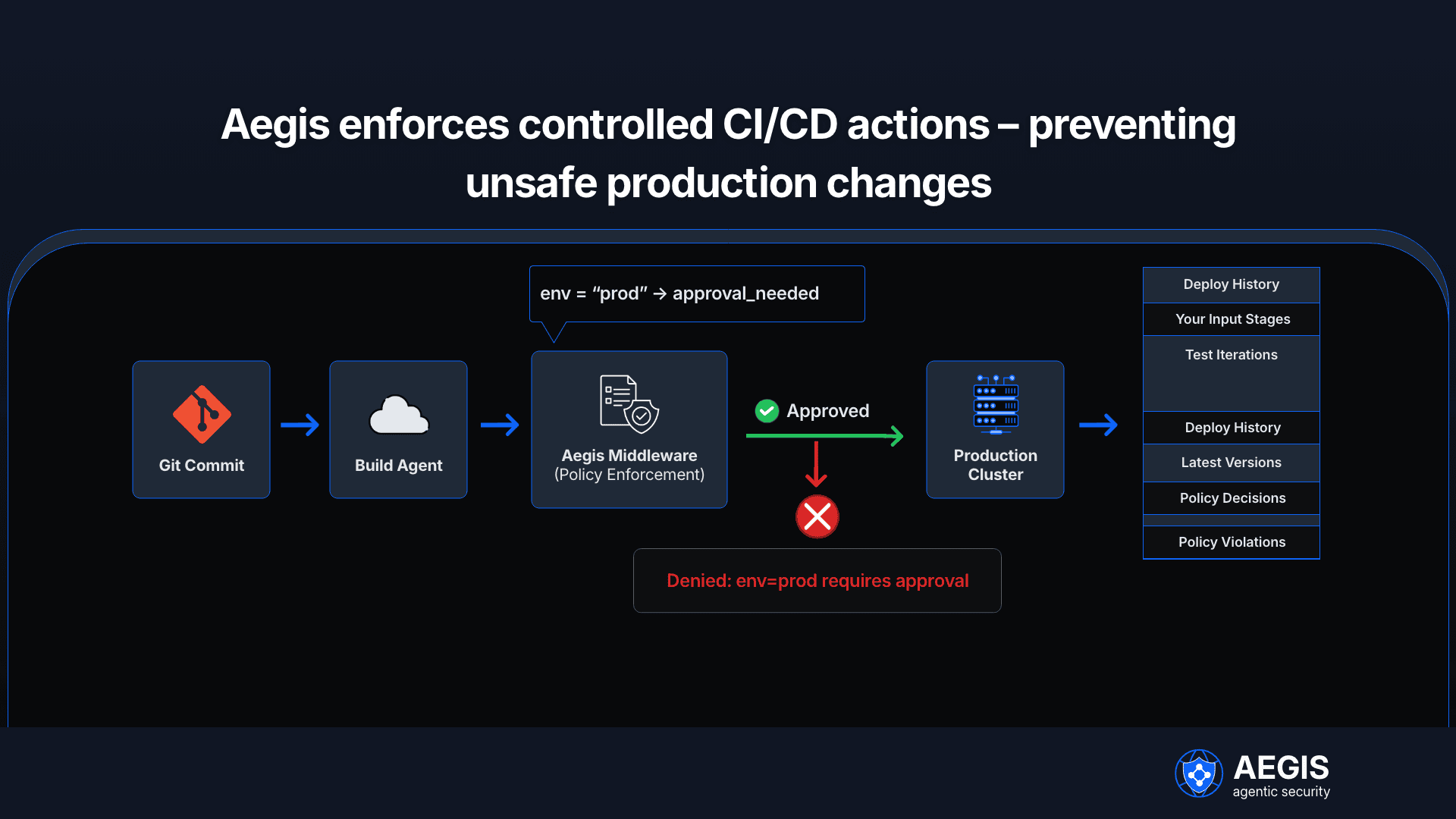
- Policy returns one of: allow, deny, sanitize, approval_needed. approval_needed signals the runtime to pause and generate an approval request.
Flow (runtime)
- Agent issues call to tool via Aegis Gateway.
- Policy evaluator returns approval_needed with a reason and suggested approver routing.
- Approvals service posts interactive message; creates a pending approval record with a unique approval_id.
- Human approver selects Approve → approvals service mints a one-time override token (short TTL, single use).
- Agent retries the call including override token; Gateway verifies token, logs the decision, and proceeds.
Override token properties
- Single-use, cryptographically signed (Ed25519), contains approval_id, agent_id, scope, TTL.
- Verification checks: token signature, jti replay protection, matching approval_id and parameters if supplied.
- TTL should be minimal (e.g., 2–15 minutes depending on operation).
Replay protection and non-repudiation
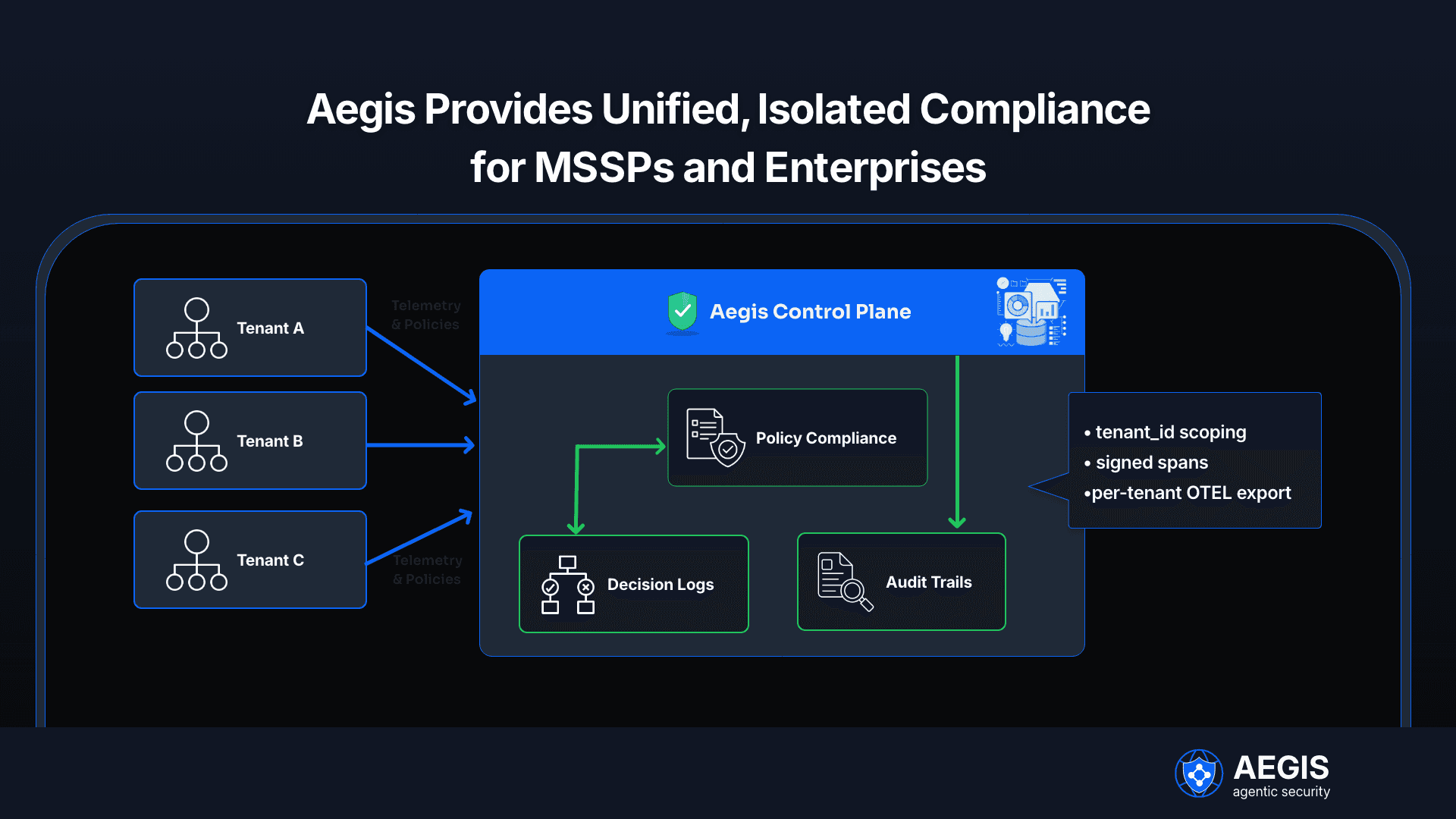
- Log a signed audit entry when token is minted and again when used; store approval metadata (approver_id, timestamp, policy_version) and attach to OpenTelemetry spans.
👉🏻 Enable real-time approvals through Slack or Teams integrations
Practical example: payments
- Policy: if amount <= 5,000 USD → allow; if amount > 5,000 and <= 50,000 → approval_needed (named approver); if amount > 50,000 → deny.
- Approval message includes invoice link, recipient account, and a cost estimate.
Scaling approvals and preventing fatigue
Approval volume issues
- Blindly routing every marginally out-of-bound event to humans creates fatigue. Design rules to group, debounce, and auto-escalate.
Techniques to reduce noise
- Threshold tiers: only escalate when an operation crosses an explicit monetary or risk threshold.
- Debounce and grouping: collapse similar low-risk approvals into a batched decision (e.g., allow approver to pre-authorize a group of transactions within a bounded window).
- Route by severity and role: route low-risk approvals to an auto-approver queue or manager; high-risk to named approvers.
- Shadow mode rollout: run policies in shadow to collect would-block events, tune thresholds and then flip enforcement.
Queue design tips
- Prioritize by severity and age, support filters (by agent, by tool, by requester), and expose a compact context link (trace + diffs).
- Allow one-click overrides with a short TTL token; if approver requests changes, give the approver the option to Reject or Request Info (which posts a structured comment back to the agent’s context).
Approval scaling knobs
Knob | Purpose | Suggested defaults |
Threshold tiers | Reduce low-impact approvals | Tier1: <=$5k auto; Tier2: $5k–$50k approval_needed |
Debounce window | Group repeated similar requests | 30–300 seconds |
Batch approval size | Allow single approval for N similar ops | 5–20 ops per batch |
Expiry (override token) | Limit attack surface | 2–15 minutes |
Auditing approvals and replay protection
Telemetry & observability
- Emit OpenTelemetry spans for: initial policy decision, approval request emission, approval action (approve/reject), token mint, retry with token, final tool call.
- Attach policy_version, approval_id, approver_id, and decision_reason to each span.
Tamper evidence
- Sign audit logs or store incremental hash chains for approval records to ensure non-repudiation. Store policy version alongside approvals so auditors can reproduce the decision context.
Replay & idempotency
- For non-idempotent actions (payments, infra changes), require the client to provide an operation_id and let the gateway ensure idempotent reuse semantics via idempotency keys, combined with the one-time override token on success paths.
Required audit fields for compliance
Field | Why it matters |
approval_id + policy_version | Reconstruct which rule triggered the pause |
approver_id + timestamp | Demonstrate human authorization |
signed token jti | Proves the override was issued and not reused |
operation_id / idempotency key | Prevents duplicate non-idempotent effects |
OTel span with trace URL | Provides runtime evidence for SOC/forensics |
Aegis as the enforcement and approval fabric
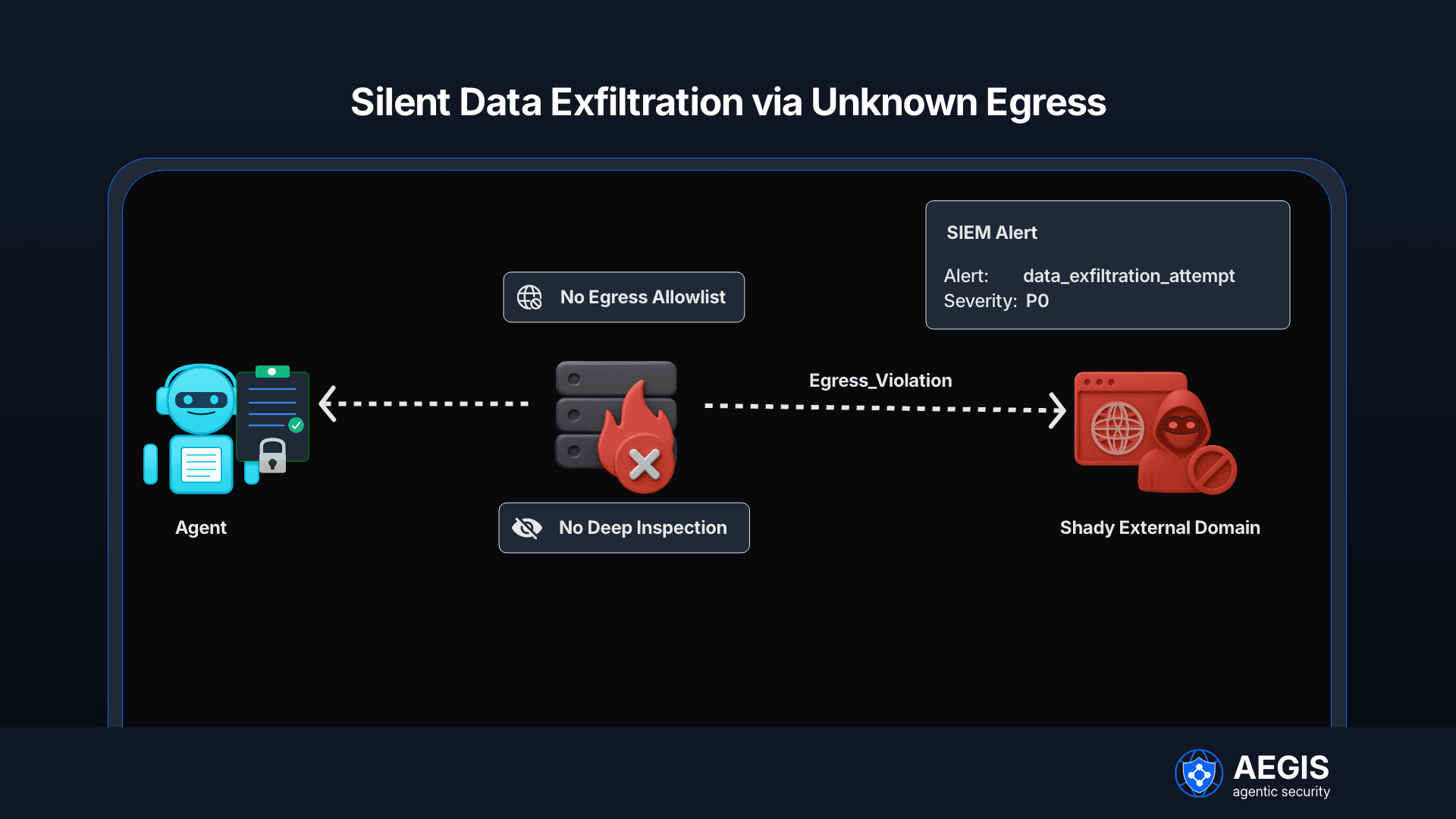
Aegis acts as the runtime policy and observability fabric that operationalizes the patterns above. Three core capabilities make this practical in production.
- Policy-as-code with approval signals
- Policies (YAML/JSON) can return approval_needed with routing metadata. Security teams write rules like: finance-agent: create_payment -> if amount > 5000 => approval_needed approver_group=finance_leads. Aegis compiles policies to OPA bundles for fast evaluation. (See Open Policy Agent performance guidance for tuned evaluation techniques.) (Open Policy Agent)
- Approvals service + one-time override tokens
- Aegis emits compact interactive approval requests to Slack/Teams, minting short-lived Ed25519-signed override tokens on approval. The Gateway verifies tokens and logs structured telemetry so SOC can trace who approved what, when, and why.
- Telemetry & compliance-ready traces
- Aegis integrates with OpenTelemetry to emit spans and metrics for each decision, enabling dashboards for security, FinOps, and compliance teams. OpenTelemetry adoption is widespread and provides the instrumentation backbone for this class of product. (OpenTelemetry)
Table: How Aegis maps features to operational needs
Need | Aegis capability |
Prevent unauthorized payments | Policy limits + approval_needed + override tokens |
Reduce approval fatigue | Debounce, routing, shadow mode |
Audit & compliance | Signed logs, OTel spans, policy versioning |
Low latency enforcement | Prepared OPA queries, hot reload bundles (target P99 ≤ 20ms) |
Practical deployment notes
- Deploy Aegis as a sidecar / forward proxy so agent calls flow through the gateway; for non-HTTP tools use lightweight middleware/SDKs. Policies run in shadow mode for pilot periods to collect would-deny events before enforcing.
Operational playbook (quick checklist)
- Start in shadow mode for 7–14 days; collect would-block events
- Define clear thresholds and named approvers for each high-risk action category.
- Configure TTLs: approval request lifetime (e.g., 24h in UI), override token TTL (2–15m), audit retention (per regulatory need).
- Implement idempotency keys for all non-idempotent operations.
- Expose OTel traces in dashboards for triage and auditors.
Further resources and links
- For policy engine performance and best practices, review Open Policy Agent docs on policy performance. (Open Policy Agent)
- For telemetry foundations that underpin runtime evidence, see OpenTelemetry’s year-in-review. (OpenTelemetry)
Frequently Asked Questions
Q: What exactly is an override token and why not just approve and let the agent continue?
A: Override tokens are short-lived, single-use cryptographic tokens minted by the approvals service. They prevent replay attacks and ensure the approval is tied to a single retry of the original operation with the same parameters.
Q: How do you prevent approval fatigue?
A: Use tiered thresholds, debounce/grouping, shadow mode tuning, and routing logic to ensure only meaningful, high-risk operations require human attention.
Q: Can Aegis run in a multi-tenant MSSP environment?
A: Yes. Aegis supports tenant-scoped policy bundles, per-tenant token claims, and region-tagged routing for compliance; audit trails are tenant-separated.
Q: How fast are policy decisions?
A: With prepared queries, caching, and hot-reloaded bundles, the decision service targets low P99 latency (sub-20ms in optimized deployments). See OPA performance guidance for tuning details. (Open Policy Agent)
Q: What telemetry should I capture for auditors?
A: Capture policy_version, approval_id, approver_id, operation_id, token_jti, and an OpenTelemetry trace URL to reconstruct runtime context.
Q: How should teams roll out approvals without disrupting engineering velocity?
A: Start in shadow mode to collect data, tune thresholds, provide developer SDKs for retry/idempotency patterns, and pilot with a small set of high-risk connectors.