
Zero Trust Principles for AI Agent Architectures
Implement identity-first, per-call enforcement and auditable policy for multi-agent systems using Aegis.
Aegis: Applying Zero-Trust to Agentic AI Architectures
Agentic AI systems—multiple autonomous agents working together—change the security model. Agents multiply machine identities, create complex call chains, and introduce parameter-level risks (e.g., payments, file writes, PII disclosure). Traditional perimeter or static allowlist approaches no longer suffice. Enterprises need identity-first, runtime policy enforcement and tamper-proof observability at the agent↔tool boundary. This post explains why zero-trust principles matter for agents, shows operational patterns, and describes Aegis — a pragmatic runtime policy and observability fabric designed to enforce least privilege, microsegmentation, and audited approvals for multi-agent workflows.
Why zero-trust for agents — the problem space
Agentic systems change the attack surface:
- Many machine identities (one per agent instance or role).
- Dynamic composition (planners, executors, finance, integrator agents).
- Parameter injection risks (amounts, file paths, SQL).
- Cross-agent coercion: a planner agent can try to trick a finance agent into a payment call.
Adoption of zero-trust practices in enterprises is high: a Gartner survey found 63% of organizations have fully or partially implemented a zero-trust strategy, showing operational appetite for identity-first controls. (Gartner)
At the same time, analyst coverage warns that the agentic AI space is immature; Gartner projects many experimental agentic projects will be scrapped unless controls improve. Runtime governance reduces risk and operational friction for pilots and production rollouts. (Reuters)
👉🏻 Strengthen authentication with secure token strategies
Table 1 — Risk drivers for agentic AI
Risk class | Example |
Lateral coercion | Planner causes finance agent to issue high-value transfer |
Parameter injection | Unvalidated prompt becomes a shell command or SQL |
Exfiltration | Agent calls arbitrary external domain to leak data |
Cost runaway | Orchestrator spawns many LLM calls and exceeds budget |
Audit gap | No tamper-proof record tying action → policy → approver |
Core zero-trust principles applied to agents
- Verify every call — authenticate agent principal, check token claims, tenant and role.
- Least privilege by default — deny unless explicitly allowed; restrict endpoints and parameter ranges.
- Continuous authorization — evaluate policies per request (not at onboarding only).
- Microsegmentation — partition tools, tenants and agent classes to reduce blast radius.
- Parameter authorization — authorize fields and ranges (e.g., max_amount ≤ $5,000).
- Observability & signed audit trails — correlate identity, decision, and outcome.
- Resilience & fail modes — fail-closed for writes; circuit breakers for long calls.
- Governance & separation of duty — policy versioning, signed history, approvals.
How Aegis implements these principles
Aegis is a lightweight policy and runtime enforcement layer designed to sit between orchestrators (AgentKit, LangGraph, LangChain variants) and downstream tools. It enforces per-call decisions, inspects parameters, issues short-lived identities, and emits structured, signed telemetry suitable for SOCs and auditors.
Key capabilities:
- Agent identity tokens — short-lived JWTs including tenant, agent_id, scopes, and usage jti to prevent replay. Tokens signed with Ed25519 and verifiable via JWKS.
- Proxy/sidecar data plane — an Envoy forward proxy or sidecar intercepts outbound calls and calls Aegis’s external authorizer (ext_authz pattern). Decisions are returned synchronously and attached to spans.
- Policy as code & compiler — YAML/JSON policies compile into OPA bundles (Rego), supporting conditions (regex, ranges, one-of lists), budgets, rate limits and approval rules.
- Per-call parameter evaluation — policies evaluate agent identity + target tool + parameters (body/query). Example: finance-agent allowed create_payment when amount <= 5000; otherwise return approval_needed.
- Approval workflows — for approval_needed, Aegis pauses the call, posts an interactive request to Slack/MS Teams, and mints a one-time override token on human approval.
- Telemetry & signed audit — each decision emits OpenTelemetry spans with agent_id, tool, decision, policy_version and reason. Logs can be signed (hash chaining) to produce tamper-evident records for compliance.
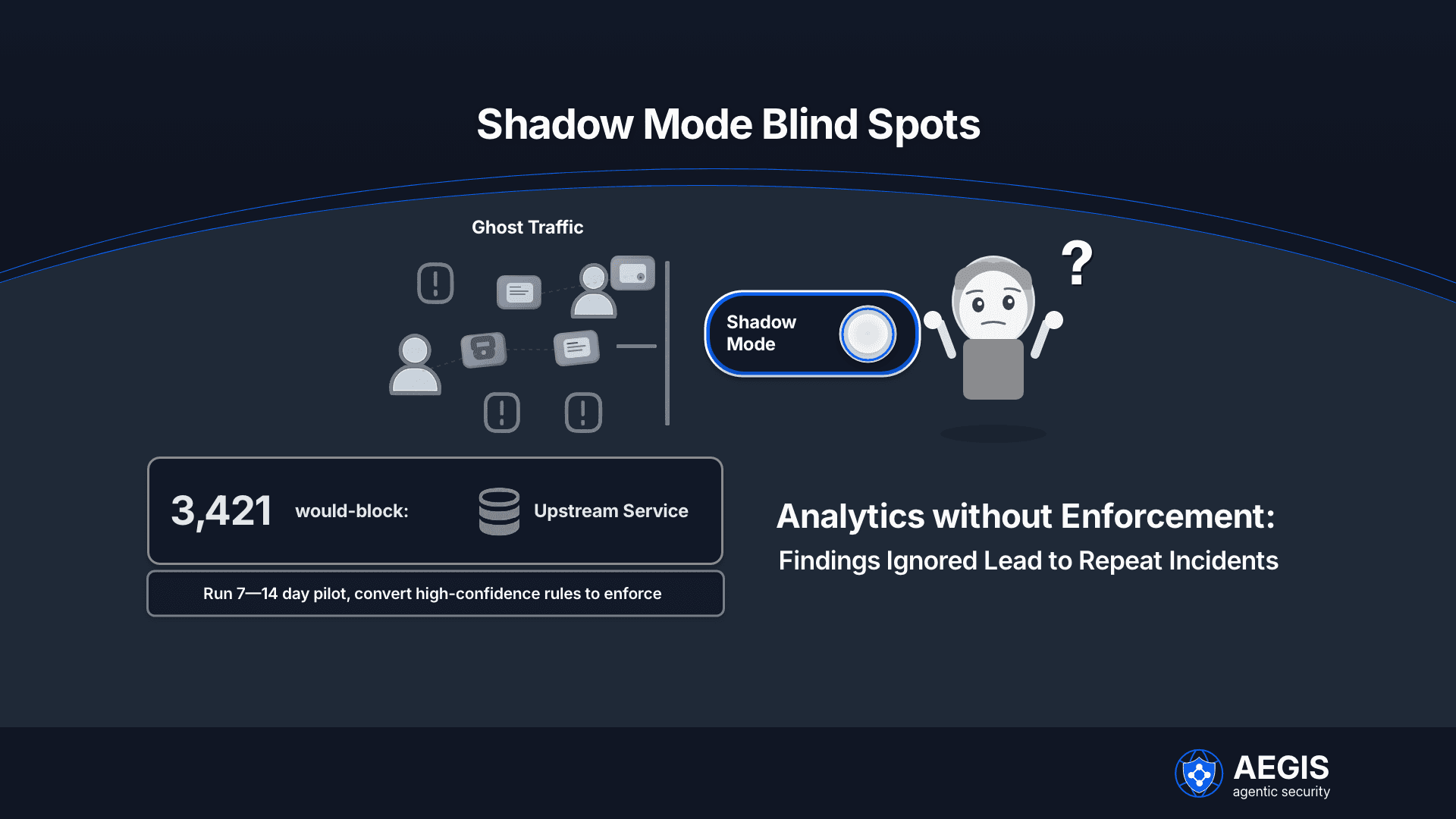
- Shadow mode and dry-run — run policies in observation mode to collect would-deny events before enforcement; this accelerates pilot adoption with low disruption.
Architecture snapshot (textual)
- Orchestrator → Envoy sidecar/forward proxy → Aegis ext_authz service → tools.
- Control plane: policy compiler → bundle store (S3/GCS) → JWKS / token service → console & CLI.
Table 2 — Aegis feature mapping to operational need
Operational need | Aegis feature |
Prevent unauthorized payments | Parameter rules, approval_needed, override tokens |
Reduce data exfiltration | Egress allowlists, DLP redaction, domain blocking |
Cost control | Per-agent budgets, rate limits, spend telemetry |
Audit & compliance | Signed spans, policy versioning, SIEM integration |
Low friction rollout | Shadow mode, dry-run CLI, sample policy cookbooks |
Aegis targets practical constraints: low latency (P99 decision path <20 ms using OPA prepared queries and caching), horizontal scalability for ~10k RPS per region, and an incremental developer experience via SDKs and middleware. The control plane supports versioned policy bundles and hot reload to avoid restarts during updates.
👉🏻 Control access effectively with role-based permissions
Operational patterns & examples
Microsegmentation example
Finance microsegment: only finance-agent tokens can reach the payments connector; planner agents are blocked from that path. Parameter rules constrain currency, allowed account regex and max_amount: 5000. This reduces both accidental and malicious financial actions.
Parameter authorization
Policies explicitly define acceptable payload shapes and ranges. Example policy fragment:
- allowed_tools: stripe-payments
- actions: create_payment
- conditions: max_amount: 5000, currency: ["USD","EUR"], account_regex: "^[0-9]{10,12}$"
.png&w=3840&q=75)
Observability & incident triage
OTel spans include decision_reason and policy_version, enabling SOC playbooks to correlate a blocked high-risk action to the originating agent and last policy change. Signed logs provide an immutable chain for audits.
Deployment considerations (scale, latency, resilience)
- Latency: Use prepared OPA queries, in-memory caches, and optional WASM compiled rules to keep decision latency under 20 ms P99.
- Resilience: Fail-closed for writes by default; configurable fail-open for reads. Circuit breakers for long downstream calls.
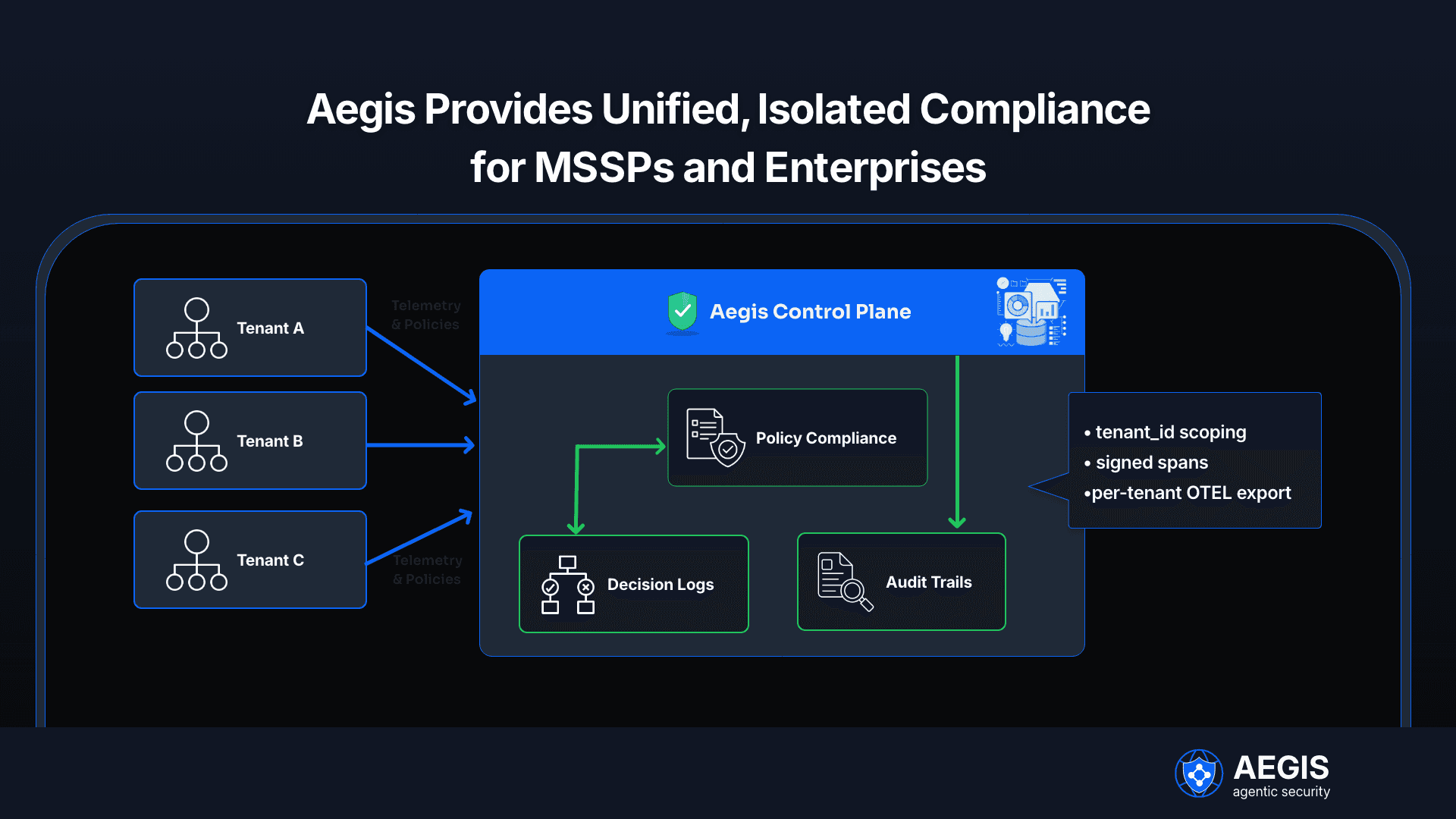
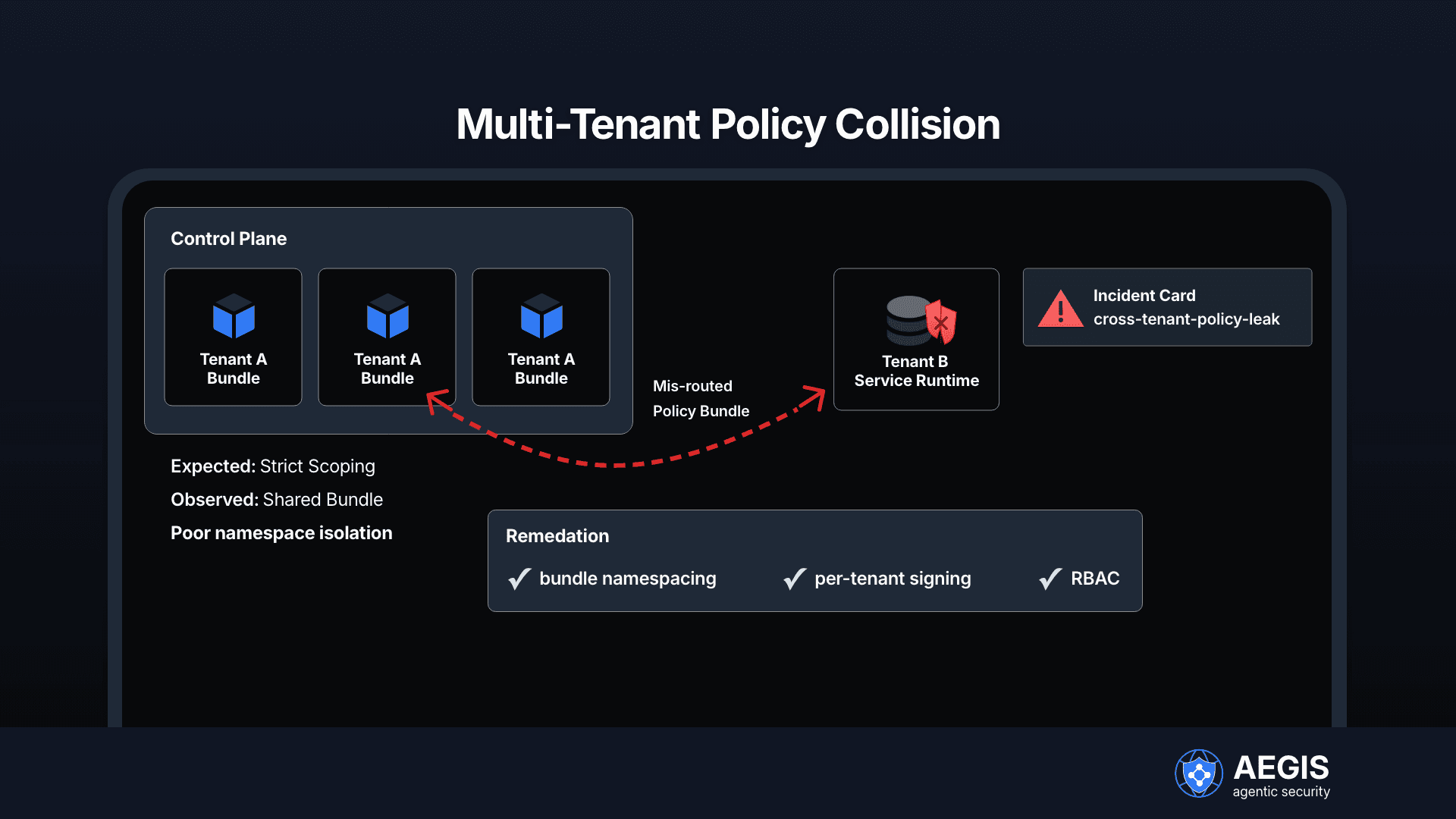
- Multi-tenant isolation: Tenant-scoped bundles, ETags and signed manifests ensure policy bundles cannot cross tenant boundaries.
- Integration: Drop-in middleware for LangChain/LangGraph; Envoy ext_authz for networked connectors; decorators for non-HTTP tools.
Compliance & governance
Aegis supports signed audit trails, policy version history, and separation of duty for policy changes to satisfy compliance reviews. The system can route tenant data regionally to meet residency requirements and produce SIEM-ready structured logs.
👉🏻 Manage agent access and traffic through secure API gateways
Two practical comparison tables
Table 3 — Traditional vs Aegis approach
Dimension | Traditional perimeter/allowlist | Aegis (runtime policy fabric) |
Trust model | Implicit inside perimeter | Identity-first, per-call authorization |
Parameter checks | Ad-hoc in code | Policy-as-code param constraints |
Auditability | Patchwork logs | Signed spans & versioned policy history |
Human approvals | Manual processes | Integrated approval workflow & override tokens |
Table 4 — Sample metrics to monitor in pilot
Metric | Why it matters |
Allow/deny ratio | Tuning policy strictness |
Top would-deny endpoints (shadow) | Identify required policy exceptions |
Avg decision latency (P50/P99) | UX & SLA for interactive agents |
Number of approvals per hour | Human workload & policy granularity |
Spend by agent | FinOps containment |
Frequently Asked Questions
Q: How does Aegis identify an agent?
A: Agents register with unique IDs and receive short-lived, signed JWTs (tenant, agent_id, scopes). Tokens are verifiable via JWKS and use jti for replay protection.
Q: What happens if Aegis is unavailable?
A: Configurable fail modes: fail-closed for writes (safer), or fail-open for low-risk reads. Circuit breakers and local allowlist caches reduce blast radius.
Q: Can policies be tested before enforcement?
A: Yes — shadow/dry-run mode collects would-deny events and telemetry for tuning before flip to enforce.
Q: Does Aegis support human approvals at scale?
A: Approval thresholds reduce unnecessary approvals; integrations with Slack/Teams and override tokens let humans approve one-time retries. Queues and batching reduce fatigue.
Q: How does Aegis prevent parameter injection?
A: Policies validate parameter shapes, ranges, regexes and can sanitize or redact payloads (DLP) before forwarding.
Q: Is Aegis multi-tenant friendly for MSSPs?
A: Yes — tenant-scoped bundles, signed manifests, per-tenant routing and SIEM-ready logs support MSSP use cases.
Closing: practical next steps for pilots
Start with a 2-connector pilot (payments, document store): register agents, deploy proxies in shadow mode, run policies for 7 days, tune via dashboards, then enable enforcement with approval workflows for high-risk actions. Use per-agent budgets and rate limits to control cost exposure.
Aegis provides the missing runtime policy and observability layer enterprises need to move agentic AI from experiments to controlled production—implementing zero-trust principles (identity, least privilege, continuous authorization, microsegmentation and signed audits) for the new era of autonomous agents.