Using API Gateways to Control Agent Egress and Access
How to enforce per-agent egress, tokens, DLP and telemetry for secure agentic AI workflows. Design patterns, checklist and success metrics.
Aegis: API Gateway for Agent Egress Control
Enterprises running multi-agent AI need application-layer controls to stop data exfiltration, enforce per-agent intent, and produce auditable traces. This article explains why application-layer control matters, practical gateway design patterns (sidecar vs edge), an implementation checklist (tokens, DLP, egress rules), how to measure success, and how Aegis—Aegissecurity agentic AI security mesh—maps to these needs with concrete telemetry and enforcement examples.
Why application-layer control matters
Network allowlists and coarse firewalls are necessary but insufficient. Agents are high-level actors: a compromised planner or malicious prompt can craft benign-looking outbound calls that carry sensitive fields (SSNs, API keys, private docs). Application-layer gateways let you reason about which agent made a request, what parameters it passed, and whether the call fits a declared intent.
Key facts: enterprise research shows agentic AI experimentation ramping—McKinsey reports 23% of organizations are scaling agentic systems and a further portion experimenting. (McKinsey & Company) API security studies find widespread API incidents and frequent sensitive-data exposure; surveys put API security failures among the top risks for modern applications. (Akamai)
Application-layer enforcement closes gaps that network controls leave open:
- Attribute decisions to agent identity (not just IP).
- Inspect and sanitize parameters (DLP/redaction).
- Enforce business rules (amount ceilings, allowed channels).
- Emit structured observability (OpenTelemetry spans with agent context).
Gateway design patterns (sidecar vs edge)
Two patterns dominate deployments: sidecar (per-agent proxy) and edge/central gateway.
Sidecar (per-agent)
- Deployed adjacent to the agent process (Envoy/forward proxy).
- Pros: lowest identity ambiguity (agent identity is local), easiest to enforce per-agent rate/budget limits, minimal network hops for intra-cluster calls.
- Cons: operational overhead at scale; upgrades across many sidecars.
Edge / Central gateway
- Single regional gateway that brokers outbound calls.
- Pros: simple central policies, easier DLP at scale, region routing and centralized audit signing.
- Cons: higher trust surface; must authenticate agent identity reliably and handle scale.
Table 1 — Design tradeoffs
Dimension | Sidecar | Edge / Central |
Identity granularity | High (local agent identity) | Medium (relies on tokens) |
Scale ops | Higher (many sidecars) | Lower (fewer gateways) |
Latency | Lowest | Medium (depends on routing) |
Centralized DLP | Harder per node | Easier (single inspection point) |
Implementation checklist (tokens, DLP, egress rules)
Practical checklist for a production gateway:
- Agent identity & short-lived tokens
- Issue per-agent short lived JWTs with claims for org, tenant, agent_id, scopes, expiry and jti.
- Use Ed25519 or RSA keys and a JWKS endpoint for verification. Record jti in Redis for replay protection.
- Per-agent allowlists and egress policies
- Per-tenant domain allowlists and parameter-level rules (e.g., destination_domain in allowed_domains, amount <= max_amount).
- Route by tenant for data residency requirements.
- Policy engine
- Policy-as-code (YAML/JSON → OPA/Rego bundle). Support allow, deny, sanitize, approval_needed.
- Hot reload bundles; prepared queries and in-memory caches for P99 performance targets.
- DLP & sanitization
- Deterministic DLP: regex-based redaction of SSN, email, DOB; optionally strip attachments.
- Return sanitized payloads or PolicyViolation with explicit reason.
- Approval workflows
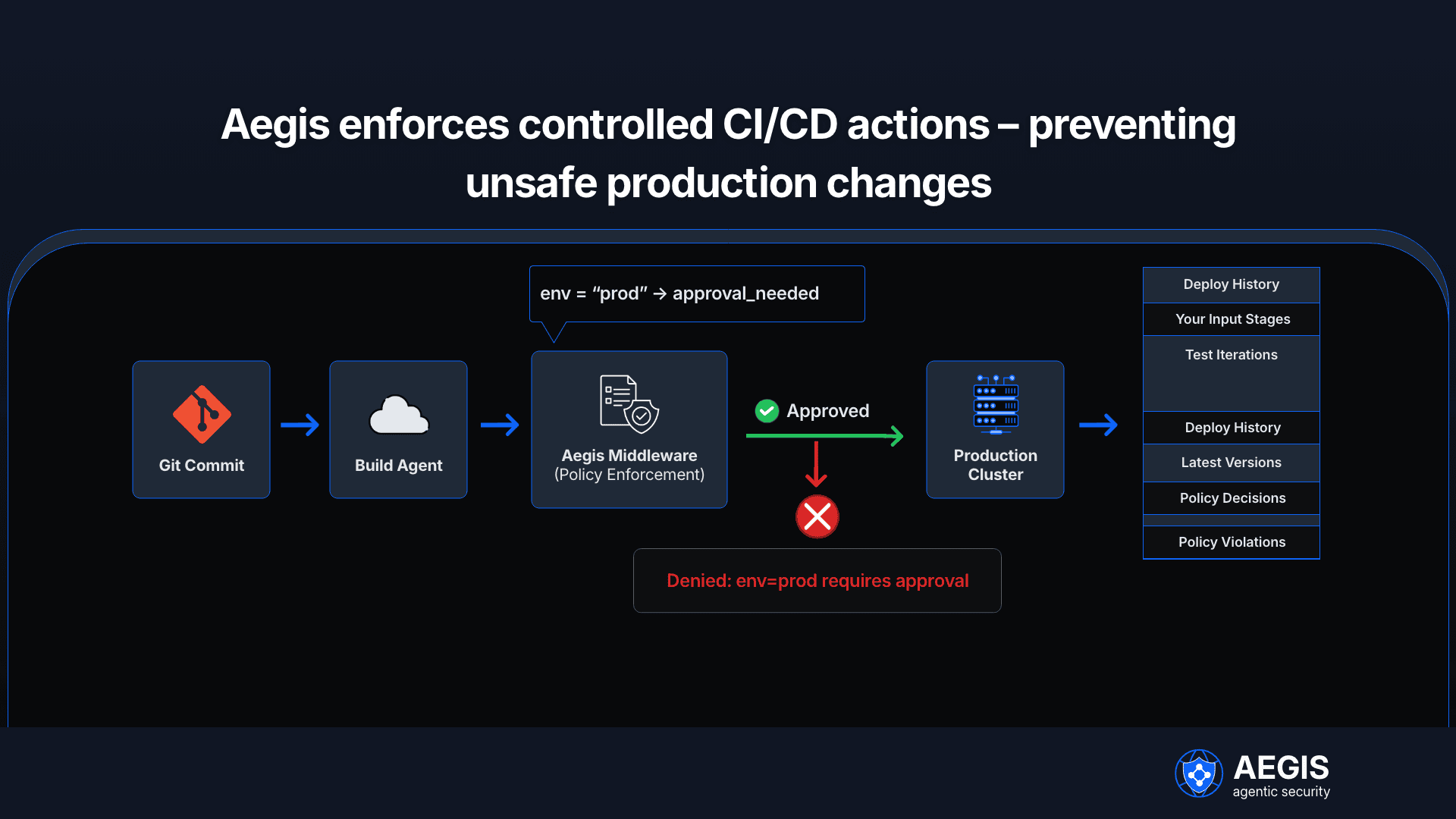
- approval_needed decision posts interactive requests to Slack/Teams; on approval mint one-time override tokens.
- approval_needed decision posts interactive requests to Slack/Teams; on approval mint one-time override tokens.
- Observability & audit
- Emit OpenTelemetry spans and structured JSON logs for every decision containing agent_id, tool, decision, policy_version, reason, latency, estimated cost.
- Optionally sign audit logs (hash chain) for tamper evidence.
- Operational controls
- Shadow mode, dry-run, and policy validation; policy versioning, rollback and staged rollout.
P99 targets & metrics
Metric | Target |
Decision latency (P99) | ≤ 20 ms. (Akamai) |
Telemetry coverage | 100% of agent→tool calls traced |
Policy coverage for pilot | ≥ 80% critical tools |
How Aegis fits
Aegis is a runtime policy & observability gateway designed specifically for agentic AI. Its role is to be the deterministic enforcement and telemetry fabric between orchestration (AgentKit, LangGraph, etc.) and external tools (APIs, connectors, file stores). Below are concrete capabilities and how they operate in production:
👉🏻 Limit exposure and contain impact with least privilege principles
Identity & tokens: Aegis mints short-lived, signed JWTs that encode organisation, tenant, and agent identity plus scopes. These tokens are the primary binding between an agent process and its runtime privileges; the gateway verifies tokens via JWKS and enforces jti replay protection.
Policy-as-code & enforcement: Security teams author policies in YAML/JSON which Aegis compiles into OPA bundles. At runtime, Envoy’s ext_authz calls Aegis’ decision service; the service evaluates prepared Rego queries and returns allow|deny|sanitize|approval_needed. This keeps policy evaluation fast (in-memory caches and prepared queries target sub-20ms evaluations). (traceable.ai)
Egress controls & DLP: Aegis enforces per-agent egress allowlists and content checks—blocking unknown domains, stripping attachments, or redacting PII in payloads. For data residency, policies can route tenant traffic to region-tagged endpoints. These application-layer checks are what prevent silent exfiltration that network rules miss.
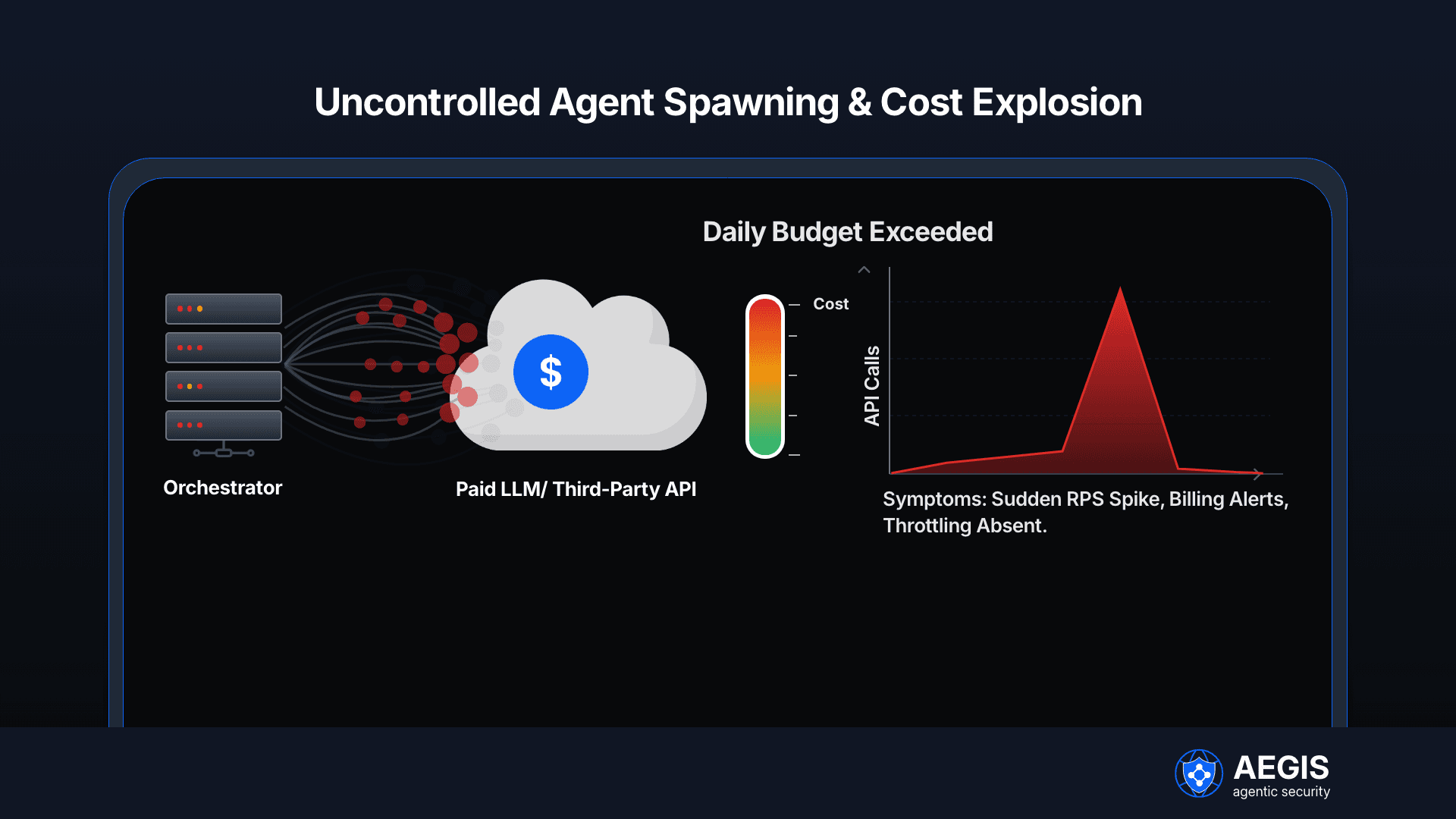
Telemetry & audit: Every decision emits an OpenTelemetry span and a structured JSON audit log containing agent_id, parent_agent_id (if present), tool, policy_version, decision_reason, latency, and estimated cost. Spans and signed logs feed dashboards for SOC, compliance, and FinOps. Example OTel fields are below.
👉🏻 Prevent overuse and abuse with intelligent rate and cost controls
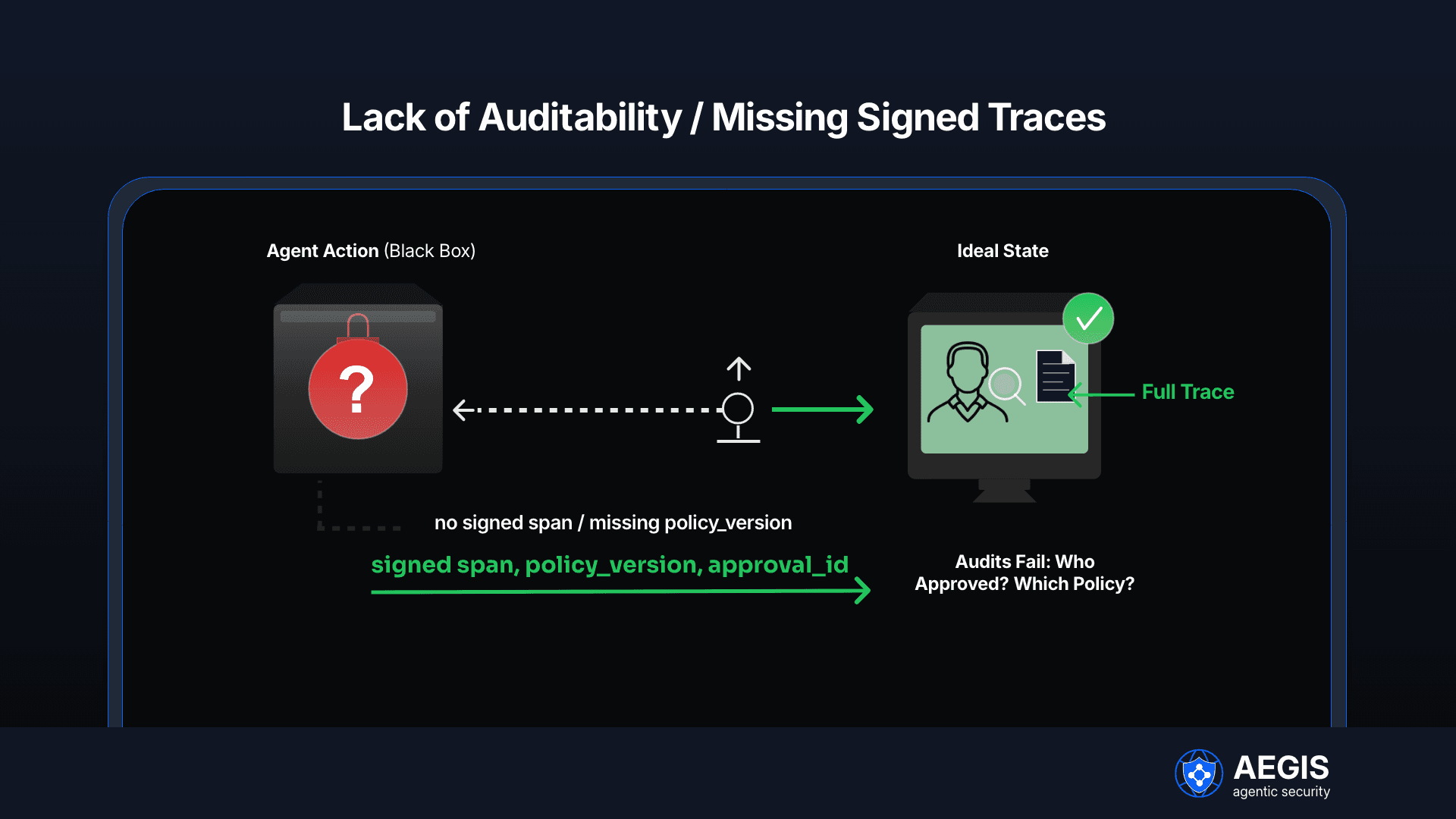
Table — Sample OpenTelemetry span (fields)
field | example |
trace_id | 4bf92f3577b34da6a3ce929d0e0e4736 |
agent.id | finance-agent |
tool.name | stripe-payments |
policy.version | v2025-07-18-rc2 |
decision | deny |
reason | amount > max_amount |
approval_id | null |
duration_ms | 12.3 |
Aegis includes developer SDKs and a CLI to register agents, push policies, run dry-run simulations, and tail logs—reducing friction for integration into LangChain/LangGraph middleware. Shadow mode lets teams observe would-block events before enabling enforcement.
👉🏻 Strengthen authentication with dynamic, short-lived security tokens
Measuring success
Baseline metrics to collect before/after Aegis deployment:
- Count of outbound calls to non-allowlisted domains (should fall to zero).
- Number of would-deny events in shadow mode (used to tune policies).
- Incidents of policy violations that resulted in prevented high-risk actions (payments > threshold).
- Cost reduction from per-agent budgets and rate limits (FinOps impact).
- Audit completeness (percentage of agent→tool calls with signed audit entries).
Recommended KPIs:
- Egress violations prevented per week.
- Percentage drop in PII exposures in outbound payloads.
- Mean decision latency and P99 latency (target ≤ 20 ms).
- Number of approval workflows and resolution time.
Real world context: API security reports and breach analysis in 2024–2025 consistently list insecure APIs and data exfiltration as leading causes of incidents—validating the need for application-layer gateways that inspect payloads and enforce intent. (Akamai)
Image placeholder — Pain point visualizer: "Where exfiltration happens"
Operational considerations & rollout
- Start in shadow mode for 7–14 days, collect would-block metrics, and refine regex/parameter rules.
- Prioritize critical connectors (payments, EHR, file stores) for initial policy coverage.
- Use per-agent budgets and rate limits to reduce approval queue noise.
- Ensure high-availability for the decision service; fail-closed for writes and configurable fail-open for read-only checks.
Frequently Asked Questions
- Should policies live with code or centrally?
Centralize policies in Aegis for consistency and auditability; allow developer-owned policy templates for scope and speed. - What about latency impact?
Use prepared OPA queries, in-memory caches and optional WASM compilation—Aegis targets ≤ 20 ms P99 decision latency. (traceable.ai) - How do approvals scale?
Add thresholds, budgets and rate limits to reduce unnecessary approvals; roll up low-risk approvals to automated overrides. - Can Aegis redact attachments?
Yes—deterministic DLP and sanitization can strip or redact attachments and sensitive fields at the gateway. - How do we prove tamper-proof audits?
Sign audit logs (hash chains) and store manifests in immutable storage; include policy_version and approval_id in spans. - How to start a pilot?
Choose 1–2 critical connectors (payments or EHR), run Aegis in shadow mode for 7–14 days, tune policies, then switch enforcement on.
Closing
Agentic AI introduces new operational and security vectors that demand application-layer enforcement. Aegis provides identity-bound tokens, per-agent policies, DLP, approvals and telemetry—closing gaps that traditional network rules and IAM leave open. For more about the industry fit and the solution, see Aegissecurity industry and solution pages and company overview. (McKinsey & Company)