
Agentic vs Generative AI: Key Differences and Why They Matter
Clear, technical guide: differences, risks, control taxonomy, and a pragmatic migration playbook with Aegis Gateway examples.
Agentic vs Generative AI: Why the distinction matters — and how to control it
Enterprises are moving past proof-of-concepts and asking a practical question: when does a language model become an autonomous actor, and what controls must be added when it does? This post defines core differences between generative and agentic systems, presents a control taxonomy for agentic deployments, and gives a migration playbook from generative prototypes to safe, auditable agentic production — illustrated with Aegis Gateway as a concrete solution for runtime policy, identity and telemetry.
What each model does best
Core strengths
Generative AI (LLMs used to produce content) excels at one-off tasks: summaries, text generation, code snippets, and assisted authoring. These systems are typically stateless: each request is independent and judged on prompt provenance and model outputs.
Agentic AI (AI agents / LLM agents) orchestrates multi-step workflows, uses external tools (APIs, connectors, CI/CD, payment systems), keeps state, plans, and executes actions to meet goals. Agentic systems can automate end-to-end processes — for example, triaging tickets, initiating payments under policy, or performing deployments — and therefore deliver higher operational ROI when done safely. Market research shows rapid growth in agentic investments and forecasts meaningful enterprise adoption over 2024–2025. (Fortune Business Insights)
Fundamental risks
Generative applications primarily need prompt provenance and content governance. Agentic systems expand the attack surface: tool-call parameters, cross-agent coercion, egress behavior, and persistent identities require new controls. Gartner warns many agentic projects lack maturity and that “agent washing” is common; governance failures will cause a significant share of projects to be scrapped without controls. (Reuters)
👉🏻 Explore how autonomous agents can redefine your operations
.png&w=3840&q=75)
Control taxonomy for agentic systems
To operationalize safe agentic deployments, treat controls across identity, policy, telemetry, and human-in-the-loop approvals.
Identity: persistent agent identities and scopes
Agents require stable identities (agent IDs / short-lived JWTs) with explicit scopes and budgets. Identity is not only “who” but also “what this agent may do” — e.g., finance-agent may call payments:create with amount ≤ 5,000. Aegis prescribes agent registration, per-agent JWT claims (org, tenant, agent, scopes) and replay protection to prevent forged requests. See Aegis Gateway design for agent registry and token service.
Policies & enforcement: per-tool, per-parameter rules
Agentic workflows need policy-as-code: YAML/JSON that expresses allowed tools, permitted actions, parameter constraints (regexes, numeric ranges), rate limits and budget rules. Runtime enforcement must evaluate each call and return allow/deny/sanitize/approval_needed decisions with minimal latency. Aegis compiles policies to OPA bundles and enforces at the agent↔tool boundary (sidecar/proxy model), enabling per-call inspection and deterministic DLP.
Telemetry & observability
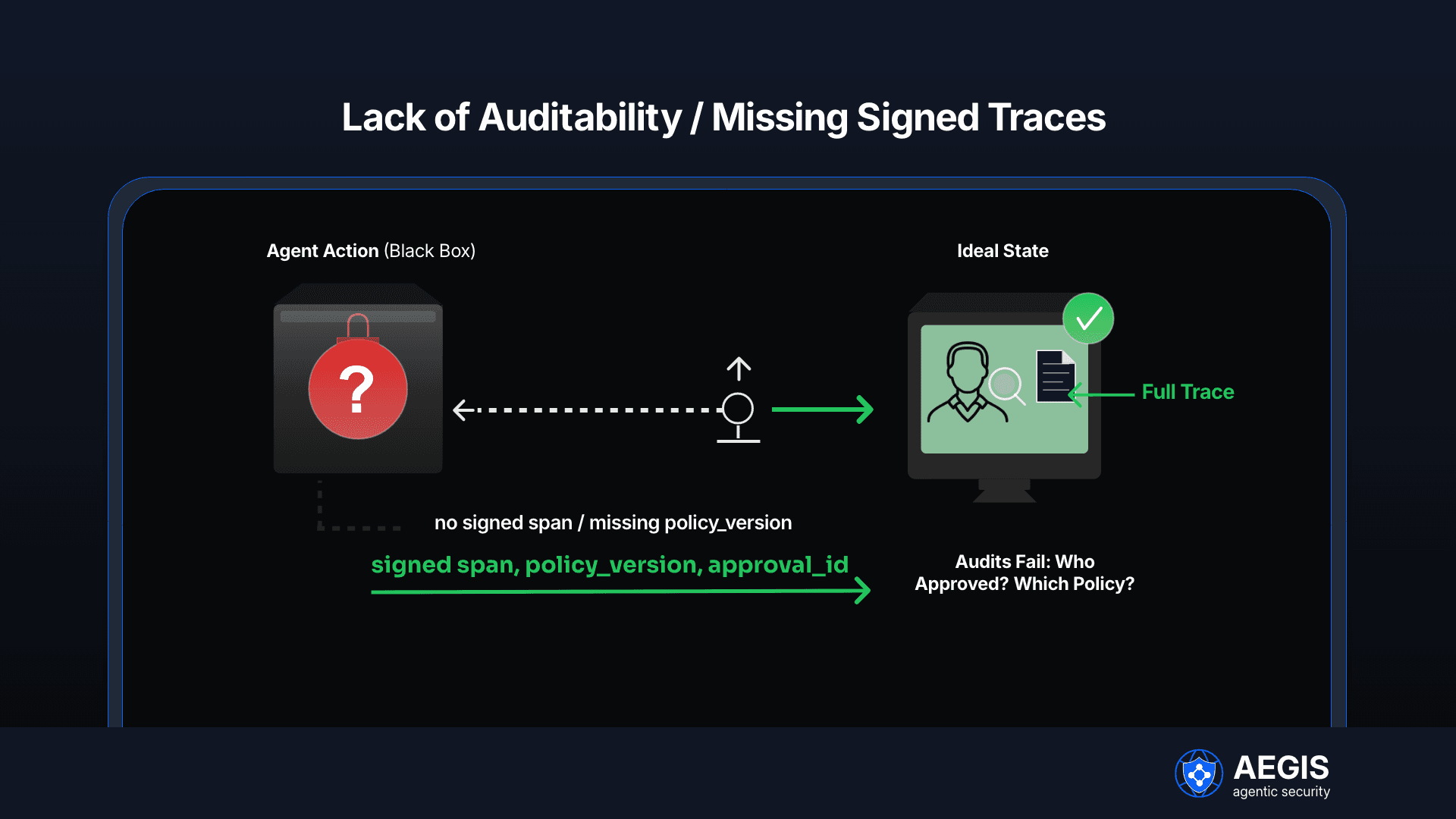
Per-call traces are required: agent_id, tool, decision, policy_version, reason, latency and estimated cost. OpenTelemetry spans and structured logs feed dashboards and SIEMs so SOCs and FinOps teams can track blocked calls, would-block events (shadow mode), and cost per agent. Aegis emits structured telemetry suitable for Grafana/Prometheus and SIEM ingestion.
Human oversight & approval workflows
High-risk actions (payments above a threshold, production deploys, bulk data exports) require approval flows. Policies should support approval_needed decisions that pause execution, notify approvers (Slack/Teams), and issue a one-time override token upon human approval. Approval scaling is solved via thresholds, budgets, and queueing to reduce human fatigue.
Fail-safe patterns
- Sandboxed execution and circuit breakers for tool calls.
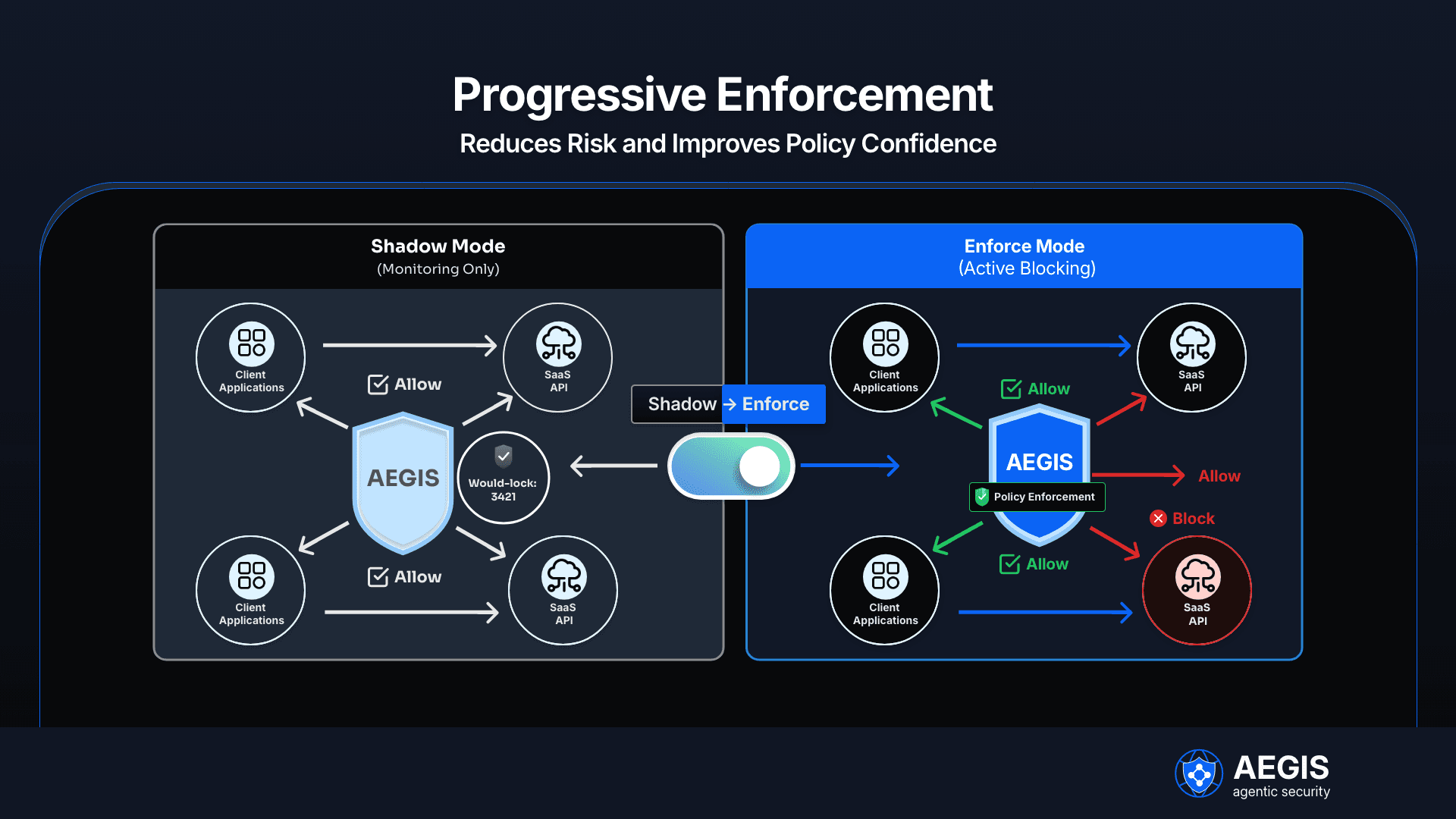
- Shadow mode: collect would-deny metrics before enforcement.
- Parameter sanitization (sanitize/redact) for PII in outbound requests.
- Per-agent budgets and soft throttles for expensive APIs.
These are built into the Aegis MVP: shadow mode, DLP redaction, and budget enforcement.
Aegis Gateway — Runtime Agentic AI Security Solution
Aegis Gateway is a runtime policy and observability fabric designed for multi-agent AI. It sits between orchestrators (AgentKit, LangGraph, custom orchestrators) and tools, enforcing least-privilege, inspecting parameters, and generating auditable traces — effectively an “Istio + OPA for agents.”
👉🏻 Upgrade from conversations to execution with AI agents
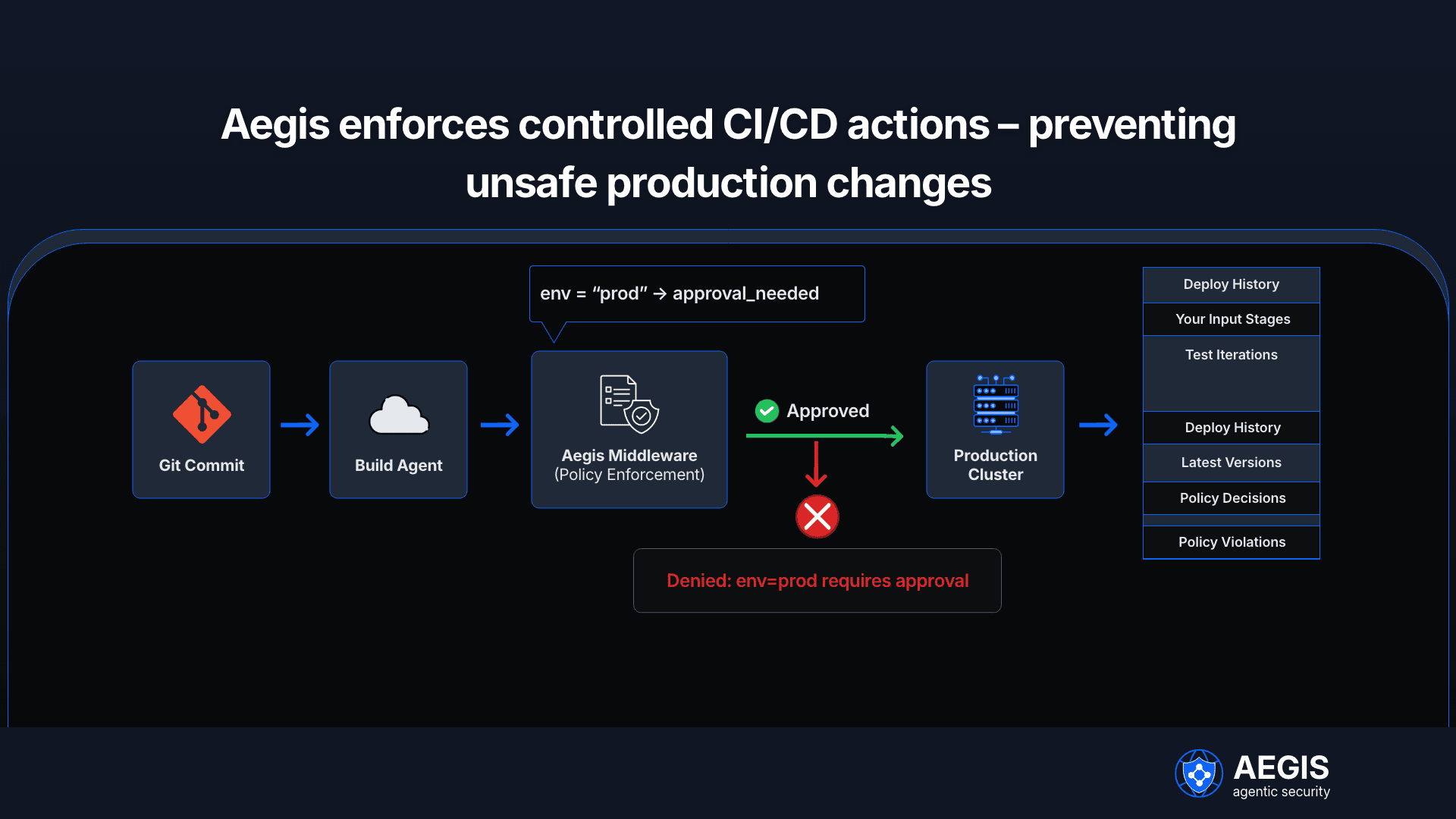
Key design points:
- Sidecar/forward proxy (Envoy) or middleware placement to proxy outbound calls.
- Agent registry + short-lived signed JWTs identifying org, tenant and agent.
- Policy-as-code compiled to OPA bundles; hot-reloadable control plane.
- Decisions: allow, deny, sanitize, approval_needed; deterministic DLP for PII redaction.
- OpenTelemetry spans and structured JSON logs for SIEM and FinOps dashboards.
- Developer tools: CLI/SDKs (Python/Node), dry-run simulation and policy validation.
All of the above are core to Aegis MVP and map directly to the control taxonomy described earlier.
Aegis Gateway in practice - Understand it with 2 quick examples
- Payment guardrail: finance-agent policy: allow create_payment if amount ≤ 5,000; approval_needed otherwise. On an attempted $50,000 transfer the Gateway blocks and emits a PolicyViolation with an OTel span.
- EHR access control: clinical-agent may read /patients/{tenant}/records with purpose=care and calls limited to internal EHR domain; any export attempts are blocked and redacted.
Migration playbook — from generative prototype to agentic production
- Start small: convert a single generative flow into a micro-agent with human-in-the-loop controls.
- Deploy Aegis in shadow mode: capture would-deny events, tune regexes and budgets.
- Define a policy baseline: identity templates, per-tool allowlists, parameter constraints and approval rules.
- Run scenario tests: multi-step test suites that exercise chained calls, parent_agent headers, failure modes and timeouts. Agentic testing must simulate parameter injection and chain coercion attacks.
- Flip to enforce: after a week of shadow telemetry and test pass, enable enforcement for low-risk agents and progressively for higher-risk ones.
- Operationalize: dashboards for SOC, periodic policy review, policy versioning, and an incident runbook.
Table 1 — Risk & control mapping
Risk | Runtime Control | Aegis Feature |
Unauthorized payments via chaining | Per-agent max_amount, approval_needed | Per-agent policy + approvals service. |
Data exfiltration | Egress allowlist, DLP | Proxy egress control + deterministic redaction. |
Cost spikes | Per-agent budget, rate limits | Budget enforcement + telemetry. |
Table 2 — Runtime decision outcomes
Decision | Meaning | Use case |
allow | Call forwarded unchanged | Low-risk read to internal API |
deny | Blocked with PolicyViolation | Disallowed domain or parameter out of range |
sanitize | Redact sensitive fields, forward | Remove PII from Slack posts |
approval_needed | Pause and request human approval | High-value payments, production deploys. |
Operational metrics to monitor
- Action success rate, rollback frequency, block/allow ratio.
- Approval latency & approval queue depth.
- Cost per action and per-agent budget burn rate.
- Policy coverage and shadow→enforce conversion rate.
Aegis recommends instrumenting these as OpenTelemetry metrics and surfacing them in dashboards.
👉🏻 Bring clarity and control to every AI-driven decision
Best practices checklist (governance)
- Agent identity & registration enforced.
- Policy-as-code with validation & versioning.
- Shadow mode rollouts prior to enforcement.
- Approval workflows for high-risk actions.
- Egress allowlists and deterministic DLP.
Frequently Asked Questions
Q1: How is agentic different from generative AI?
A: Generative AI produces content; agentic AI plans and acts using tools, keeps state, and requires runtime controls (identity, parameter validation, egress control).
Q2: Will runtime policy enforcement add latency?
A: A well-designed system targets low overhead (Aegis aims for decision latencies under 20ms P99 using OPA prepared queries and caching).
Q3: Can I run policies in shadow mode?
A: Yes — use shadow mode to collect would-deny events and tune policies before turning on enforcement.
Q4: How do approvals scale for many agents?
A: Use thresholds to reduce unnecessary approvals, route approvals to team queues, and issue one-time override tokens on approval to minimize human load.
Q5: What are common failure modes?
A: Misconfigured policies (overly broad deny), shadow mode blind spots, and lack of chain introspection (parent_agent validation) — all addressed by policy validation, simulation, and parent-agent headers.
Q6: Who should own agent governance?
A: Cross-functional teams: SOC, Dev, Product and FinOps jointly own policies, telemetry and approval flows — treat agentic production as a product + security program.