Minimising Blast Radius: Least Privilege for AI Agents
Explore how Aegis Gateway enforces runtime policies, observability, and identity boundaries for secure multi-agent AI systems.
Securing Agentic AI with Aegis Gateway
Building a Runtime Policy Mesh for Multi-Agent Systems
The rapid evolution of agentic AI has pushed enterprises to deploy autonomous systems that perform complex operations — from financial transactions to code deployments. However, the same autonomy that drives efficiency introduces security and compliance challenges that traditional IAM or service meshes can’t address.
Aegis Gateway, an AI Security Mesh by Aegissecurity, is built to enforce runtime policies, identity boundaries, and observability across multi-agent architectures. It acts as a policy and telemetry fabric between agents and tools, ensuring that every agent action is authorized, auditable, and aligned with organizational compliance standards.
The New Security Problem in Agentic AI
The Rise of Multi-Agent Architectures
In 2024, searches for “agentic AI” grew by over 800% year-over-year, reflecting explosive enterprise interest in orchestrators like LangGraph, CrewAI, and AgentKit. Yet, in a recent Architecture & Governance Magazine survey, over 50% of technology executives cited security and compliance as the top barrier to adopting agentic workflows (source).
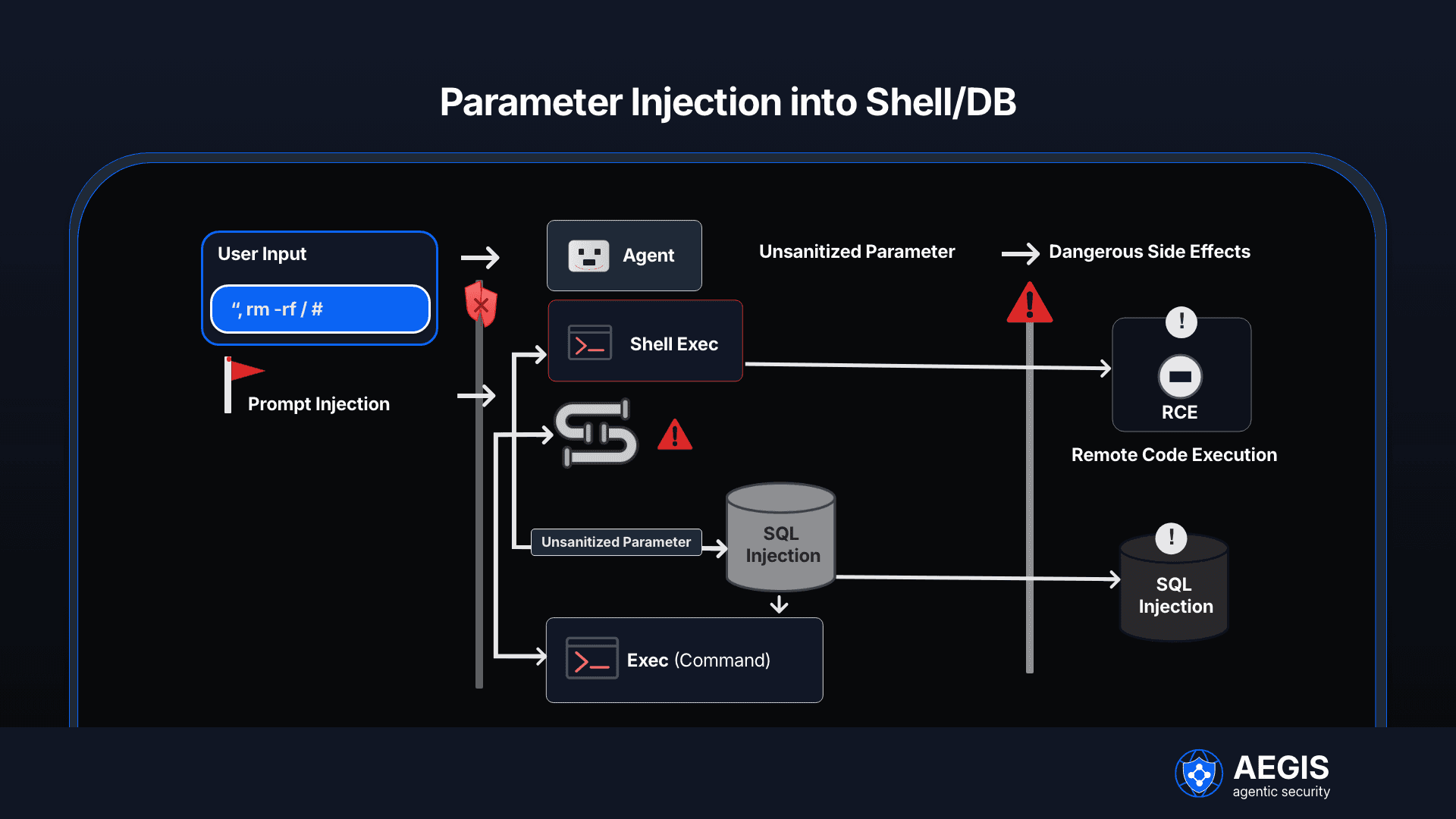
Unlike monolithic LLM apps, these multi-agent systems feature autonomous agents capable of invoking APIs, sharing data, and making decisions with minimal human oversight. Without strict runtime controls, a planner agent could coerce another agent—like Finance or DevOps—into unsafe operations such as triggering payments or altering infrastructure.
👉🏻 Apply zero trust principles to secure every agent interaction
Why IAM and Static Validation Fall Short
Traditional IAM models answer “who can call this API?” but not “what can this autonomous agent do with it?” Static checks or hardcoded validators inside agent code provide no centralized governance, auditability, or consistent enforcement across teams.
Aegis Gateway fills this gap with a runtime enforcement layer — analogous to Istio + OPA for AI agents — securing the agent↔tool boundary with least-privilege policies and rich observability.
Inside the Aegis Architecture
Aegis Gateway’s architecture consists of two planes — a Data Plane for runtime enforcement and a Control Plane for policy management and administration.
Data Plane: Runtime Enforcement and Decisioning
Every outbound call from an agent to a tool (API, SDK, or function) passes through a sidecar or forward proxy (Envoy). This proxy intercepts requests and forwards them to an external authorization service that uses Open Policy Agent (OPA) to evaluate the policy bundle.
Decisions can be:
- allow — proceed with the call
- deny — block unauthorized or out-of-scope actions
- sanitize — redact sensitive data fields
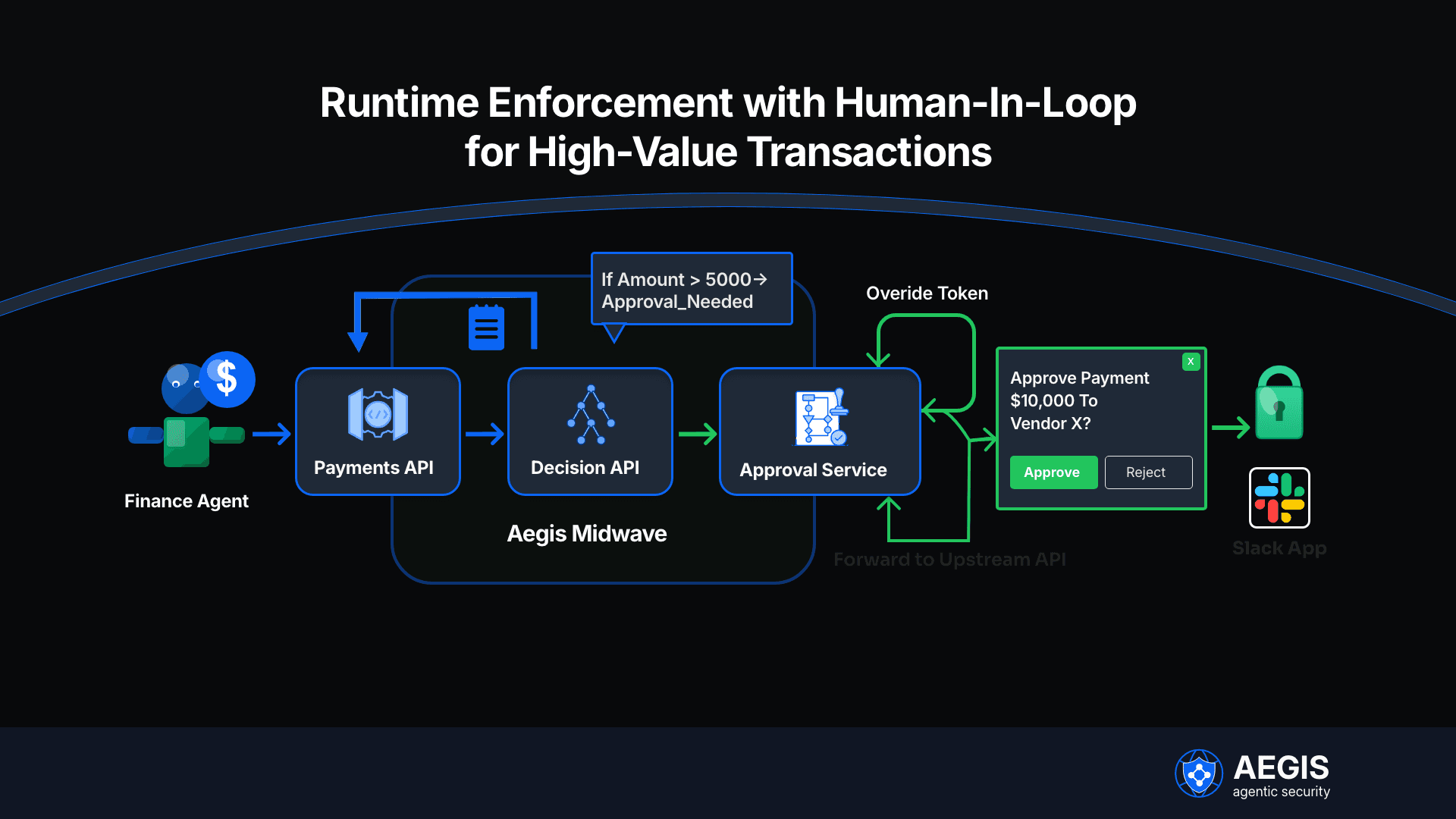
- approval_needed — pause and request human authorization via Slack or Teams
For high-risk workflows, Aegis issues one-time override tokens post-approval, ensuring traceability. Each decision emits structured OpenTelemetry spans, enabling SOC teams to visualize agent behaviors in real time.
👉🏻 Reduce risk by separating responsibilities across agent workflows
Control Plane: Policy-as-Code and Governance
Security teams define agent policies as YAML/JSON documents. These are compiled into OPA bundles with versioning and rollback support. Each policy defines:
- Agent identity and tool access lists
- Parameter constraints (e.g., amount ≤ $5000)
- Conditional logic (regex, ranges, time windows)
- Required actions (allow, deny, sanitize, approval_needed)
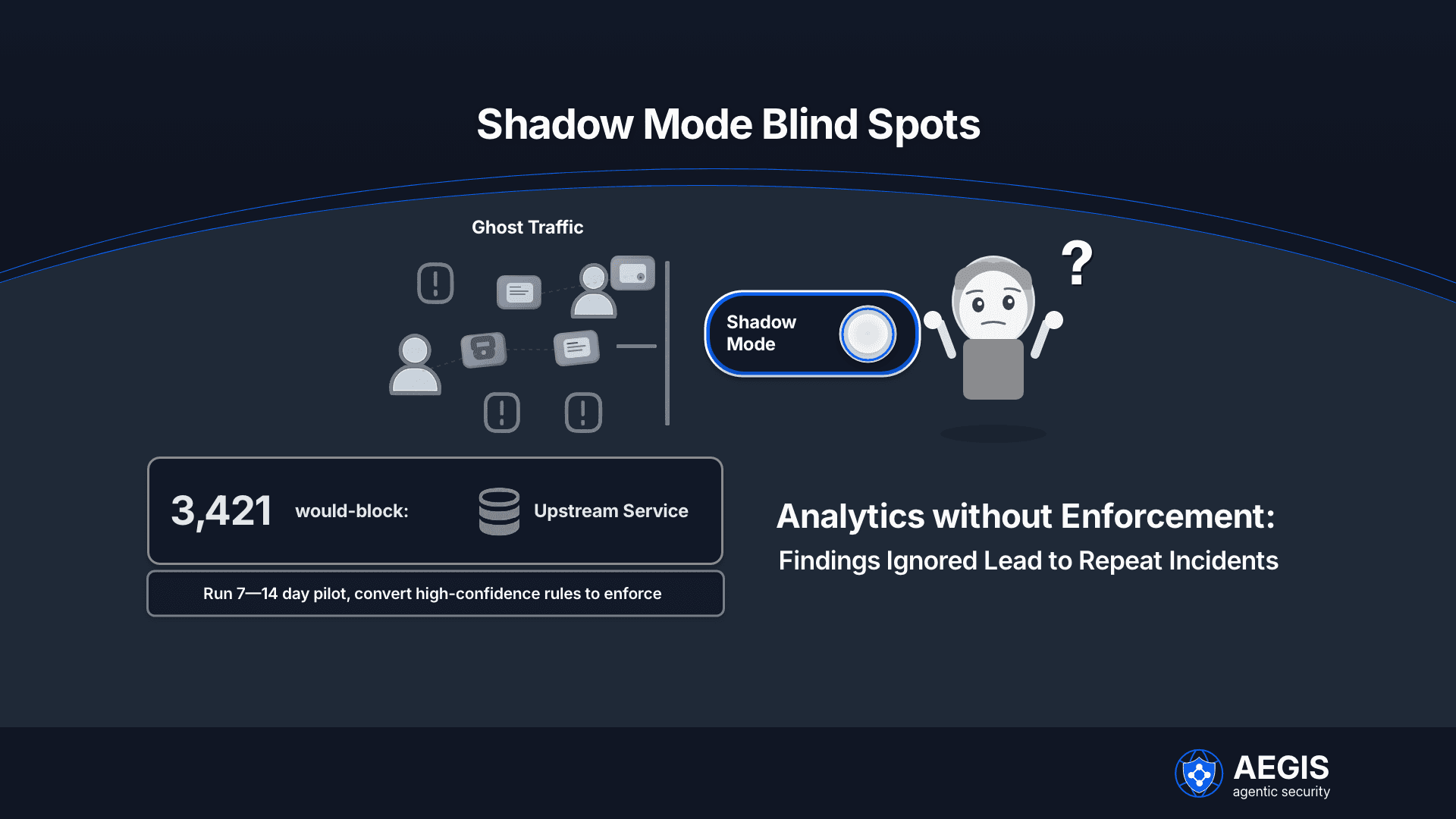
The Console API and CLI/SDK allow teams to validate, publish, and simulate policies before deployment. “Shadow mode” enables observation of would-block events without enforcement, minimizing operational risk during rollout.
Enforcing Identity Boundaries and Egress Control
Agent Identity and Tokenization
Each agent in Aegis receives a short-lived JWT, signed using Ed25519. Tokens include organization, tenant, and agent claims, ensuring every action is traceable to a unique identity. Replay protection is enforced using Redis-backed JTI stores.
Egress Governance
Aegis enforces strict outbound allowlists, ensuring agents can only communicate with pre-approved domains (e.g., api.openai.com, slack.com). Any attempt to contact an unlisted domain triggers a deny event and compliance alert, mitigating data exfiltration risks.
Observability, Compliance, and FinOps Integration
Aegis isn’t just an enforcement layer — it’s also an observability mesh.
OpenTelemetry and Audit Trails
Every decision is instrumented via OpenTelemetry traces that record:
- agent_id
- tool name and parameters
- decision outcome
- policy version
- latency and estimated cost
These traces feed into dashboards (Grafana, Prometheus) for real-time analytics. Compliance teams can replay historical traces and demonstrate that each high-risk action was authorized.
👉🏻 Strike the right balance between speed and policy enforcement
FinOps and Budget Control
Aegis helps organizations prevent runaway costs from uncontrolled agent behavior. Security or finance teams can:
- Define per-agent daily budgets (e.g., $20/day)
- Apply per-tool rate limits (e.g., 5 RPS)
- Track spend across tenants
Table: Example FinOps Policies in Aegis
Agent | Tool | Daily Budget | Rate Limit | Action on Exceed |
finance-agent | stripe-payments | $500 | 3 RPS | approval_needed |
llm-agent | openai-api | $20 | 5 RPS | deny |
devops-agent | deploy-service | N/A | 2 RPS | approval_needed |
Real-World Use Cases
1. FinTech: Secure Payment Workflows
A planner agent might instruct the finance agent to issue a $50,000 payment. Aegis evaluates the policy:
agent: finance-agent
allowed_tools:
- name: stripe-payments
actions:
- create_payment
conditions:
max_amount: 5000
approval_needed_over: 5000
The gateway blocks the request and emits a PolicyViolation span — preventing unauthorized transfers.
2. Healthcare: PHI/PII Protection
When an agent attempts to access EHR systems, Aegis performs deterministic DLP redaction (e.g., regex removal of SSNs or DOBs). Calls to unauthorized endpoints trigger denials, ensuring HIPAA compliance.
3. SaaS: API Cost Governance
Aegis enforces per-agent budgets and rate limits, protecting organizations from runaway LLM API bills and providing transparent spend dashboards for FinOps review.
4. DevOps: Controlled Automation
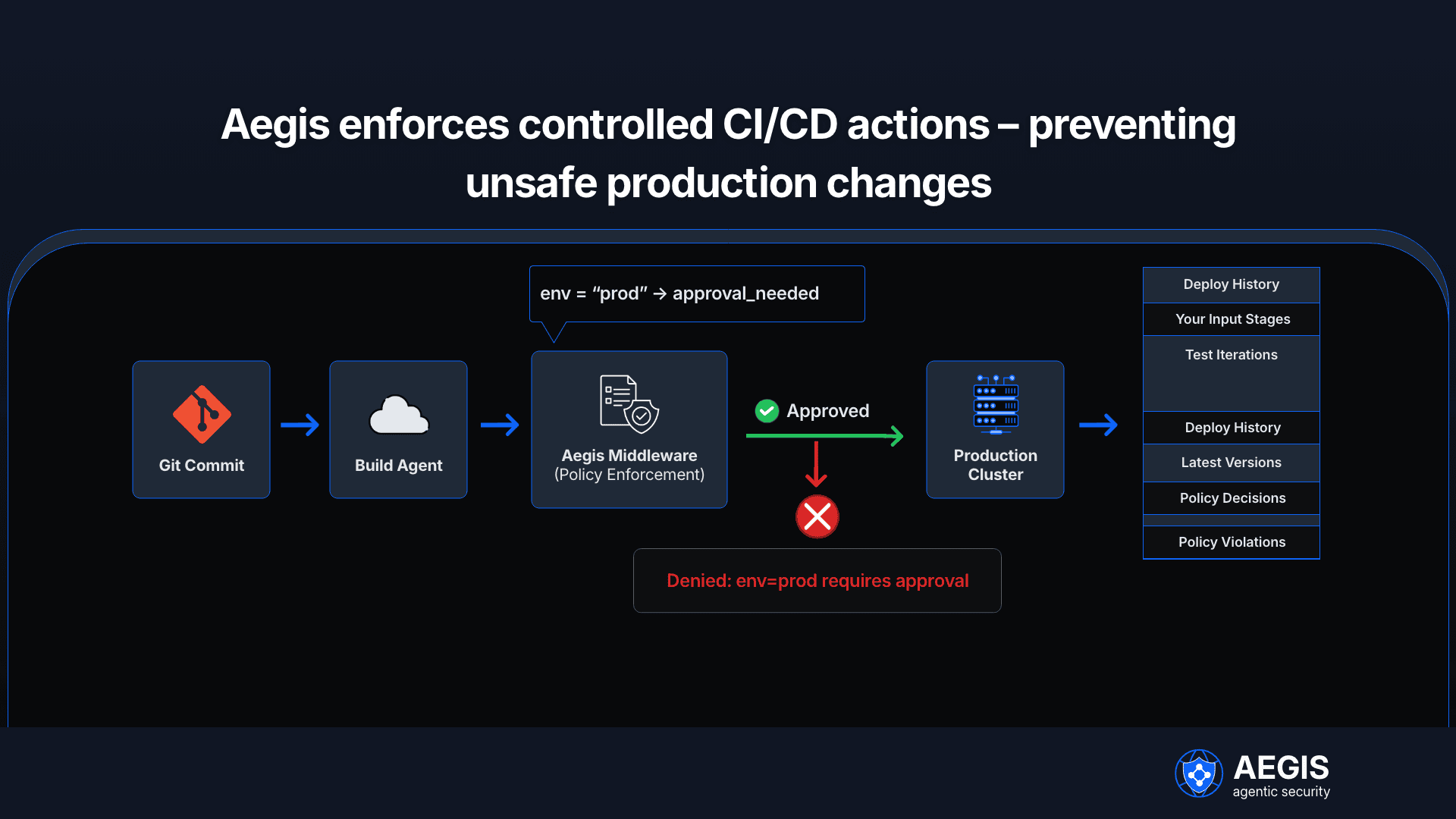
Policies restrict deployment agents to staging environments unless approved for production. Each production action requires human confirmation, closing the gap between automation and accountability.
5. MSSP: Multi-Tenant Compliance
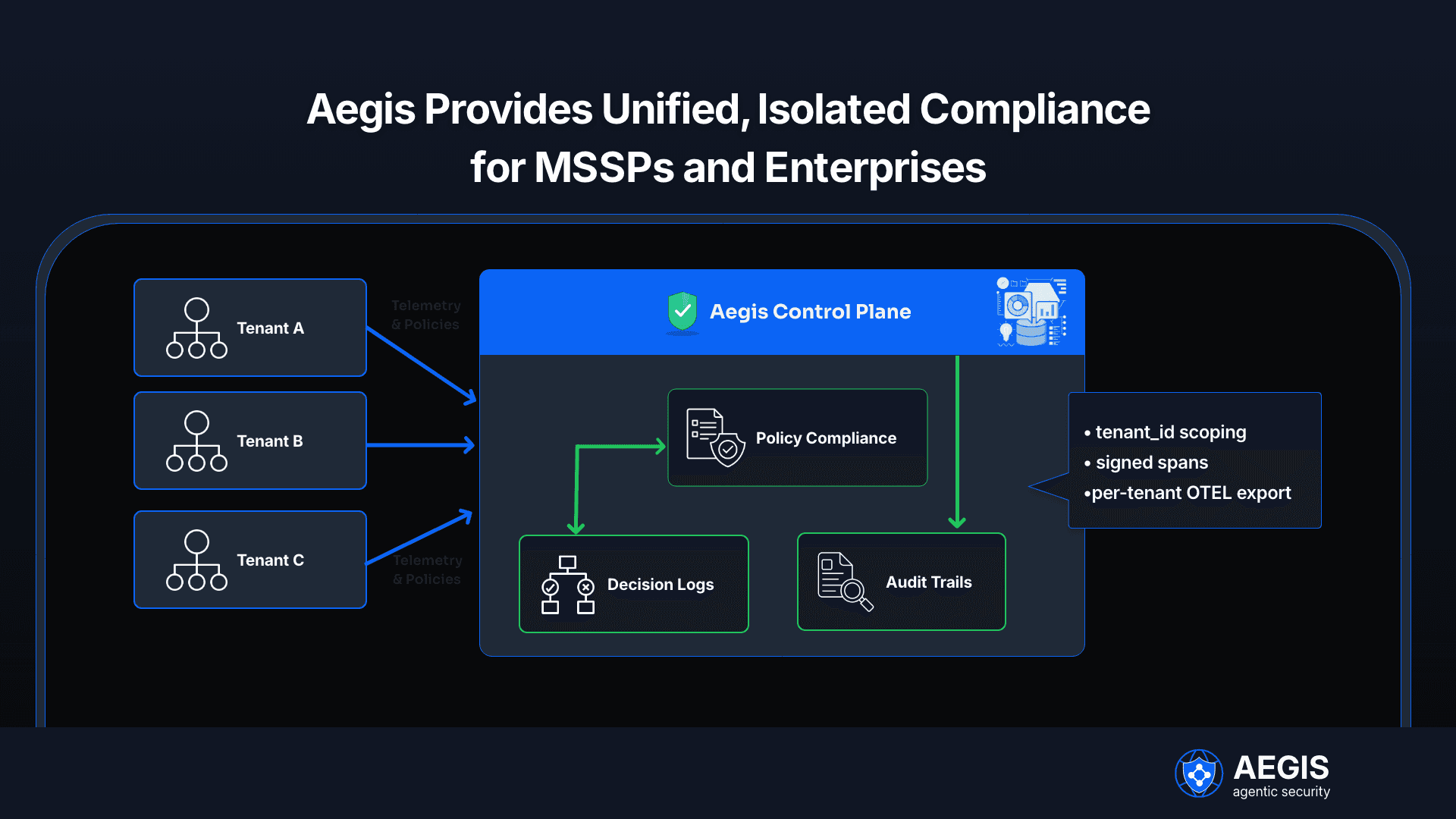
For managed service providers, Aegis supports tenant-scoped policies and regional routing, preventing cross-tenant interference and ensuring localized data governance.
Key Technical Differentiators
Capability | Traditional IAM | Service Mesh | Aegis Gateway |
Runtime policy enforcement | ❌ | ⚠️ Basic | ✅ |
Parameter-level validation | ❌ | ❌ | ✅ |
Cross-agent identity boundaries | ❌ | ❌ | ✅ |
Human-in-loop approvals | ❌ | ❌ | ✅ |
Multi-tenant policy isolation | ❌ | ⚠️ Partial | ✅ |
OpenTelemetry observability | ⚠️ Limited | ✅ | ✅ + decision context |
Unlike conventional meshes, Aegis understands AI agent semantics — who invoked the tool, what parameters were sent, and whether the call aligns with operational and compliance policies.
Deployment and Scalability
Aegis is designed for low-latency enforcement (<20 ms at P99) and horizontal scalability up to 10,000 RPS per region.
Typical enterprise deployments use:
- Data Plane: Go-based Envoy ext_authz service with OPA evaluator
- Control Plane: FastAPI backend for policy compilation and storage
- Observability Stack: OpenTelemetry SDKs feeding Grafana/Prometheus dashboards
- SDKs: Python and Node.js for easy integration with LangGraph, CrewAI, and AgentKit
All components are stateless, containerized, and deployable via Helm or Terraform.
Operational Benefits
- Security: Enforces least privilege between agents and tools.
- Compliance: Provides tamper-proof audit logs and approval trails.
- FinOps: Prevents uncontrolled API spend with budgets and throttles.
- Developer Velocity: Drop-in SDKs and shadow mode reduce friction.
- Observability: 100% of calls traced, with decision-level metrics.
Frequently Asked Questions
1. How does Aegis differ from traditional IAM or API gateways?
IAM controls who accesses an API; Aegis controls what actions autonomous agents can take, including contextual parameter checks and runtime approvals.
2. What’s the performance impact of runtime policy checks?
Aegis uses OPA prepared queries and in-memory caching, maintaining sub-20 ms latency at P99 even under high load.
3. Can Aegis integrate with existing orchestrators?
Yes. SDKs and middleware are available for LangChain, LangGraph, CrewAI, and AgentKit, requiring minimal code changes.
4. How does Aegis handle human approvals?
When a policy triggers approval_needed, Aegis posts an interactive message to Slack or Microsoft Teams. Once approved, a one-time override token allows the action to proceed.
5. Is Aegis suitable for multi-tenant environments like MSSPs?
Absolutely. Aegis enforces tenant-scoped policies and region-specific routing to isolate data and ensure compliance across tenants.
6. What observability data does Aegis provide?
OpenTelemetry traces, metrics, and structured JSON logs — all exportable to SIEM systems like Splunk, ELK, or Datadog for centralized security monitoring.
Final Thoughts
As enterprises adopt agentic AI, runtime policy enforcement becomes non-negotiable. Aegis Gateway delivers a unified approach to securing agent autonomy, ensuring that every tool call — whether financial, operational, or analytical — is intentional, auditable, and compliant.
By merging policy-as-code, real-time authorization, and telemetry, Aegis transforms the way organizations govern AI agents — enabling innovation without sacrificing control.