
Using AI Agents for Finance & Payments Automation
How Aegis enforces per-agent policies, budgets and approvals to secure AI-driven payment workflows.
Aegis: Securing Agentic Payments with Runtime Policy Control
The payments problem today
Agentic automation is moving from lab experiments into finance stacks. Enterprises use planner and executor agents to draft invoices, reconcile accounts and call payment APIs — but the same orchestration that speeds work also amplifies risk. Manual payment workflows are slow and costly; automated multi-agent workflows are fast but open new failure modes: parameter injection, privilege coercion between agents, and runaway spend when LLMs or connectors are invoked without limits.
Two quick data points frame the scale: 78% of organizations reported using AI in 2024, demonstrating broad adoption pressure, while analysts warn that over 40% of agentic AI projects may be canceled by 2027 if governance is not addressed. (Stanford HAI)
👉🏻 Optimize procurement and supply chains with coordinated agents
Why existing IAM and RPA aren’t enough
IAM controls "who" can call what, and RPA automates GUI tasks — neither inspects the intent and parameters of agentic calls at runtime. Key gaps:
• Parameter-level validation: IAM cannot prevent an agent from sending a $50,000 amount string to a payments API if the agent’s runtime call appears authenticated.
• Inter-agent coercion: Planner agents can craft prompts that cause finance agents to execute high-risk transfers.
• Cost & budget governance: FinOps needs per-agent spend ceilings and telemetry to stop runaway LLM or connector costs.
These gaps lead to governance blind spots and compliance exposure — the precise reason runtime policy enforcement is required for production agentic finance.
👉🏻 Simplify contract workflows with automated AI agents
How agentic workflows change finance automation
Risks
Agentic workflows introduce three risk classes to payments:
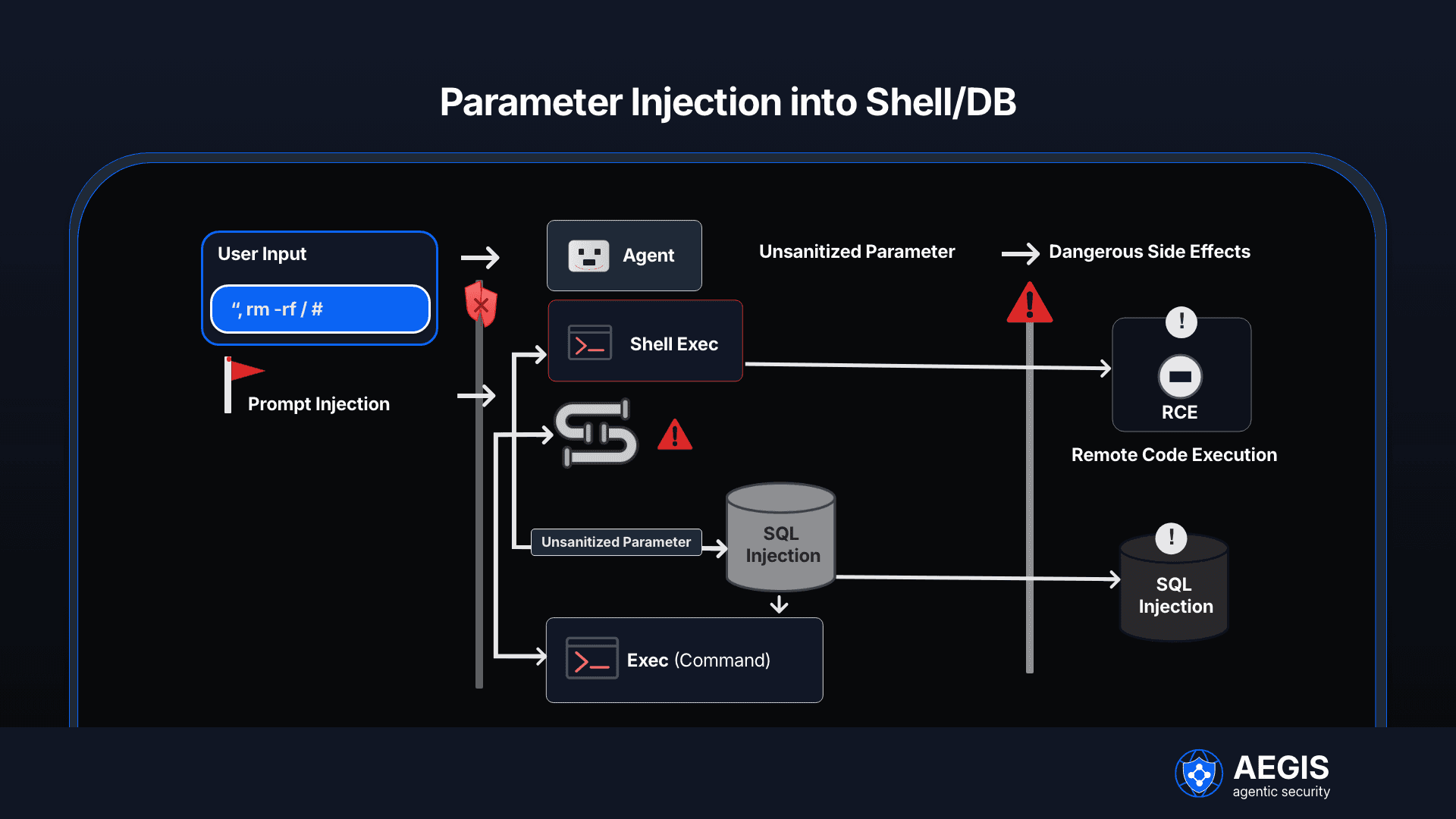
- Privilege escalation via chaining — a low-privilege planner coerces a higher-privilege finance agent into an unauthorized transfer.
- Parameter injection — unvalidated prompt text flows into API parameters (amounts, payees, account IDs).
- Unbounded cost & volume — agents spawn repeated calls to LLMs and paid connectors, creating unexpected spend.
.png&w=3840&q=75)
When correctly governed, agentic automation reduces manual handoffs, accelerates reconciliation and lowers human error — but only if policies and observability accompany the automation.
👉🏻 Boost pipeline with agents generating leads and quotes
The Aegis pattern for secure payments
Introduce Aegis Gateway (short)
Aegis is a runtime policy and observability gateway that enforces per-agent identity, parameter constraints, budget caps and approval workflows at the agent↔tool boundary. It acts as "Istio + OPA for agents": a lightweight enforcement layer that blocks disallowed calls, emits auditable traces and supports shadow rollouts.
Architecture (short)
Aegis sits between the orchestrator and tools: agents call the Aegis Gateway (sidecar/proxy or middleware), which evaluates policy and either allows, denies, sanitizes, or pauses for approval. Telemetry (OpenTelemetry spans) and structured logs feed dashboards and SIEMs for SOC/FinOps review.
Policy examples
Two minimal policy fragments (conceptual):
Policy intent | Condition | Action |
Max amount per agent | agent == finance-agent, amount <= 5000 | allow |
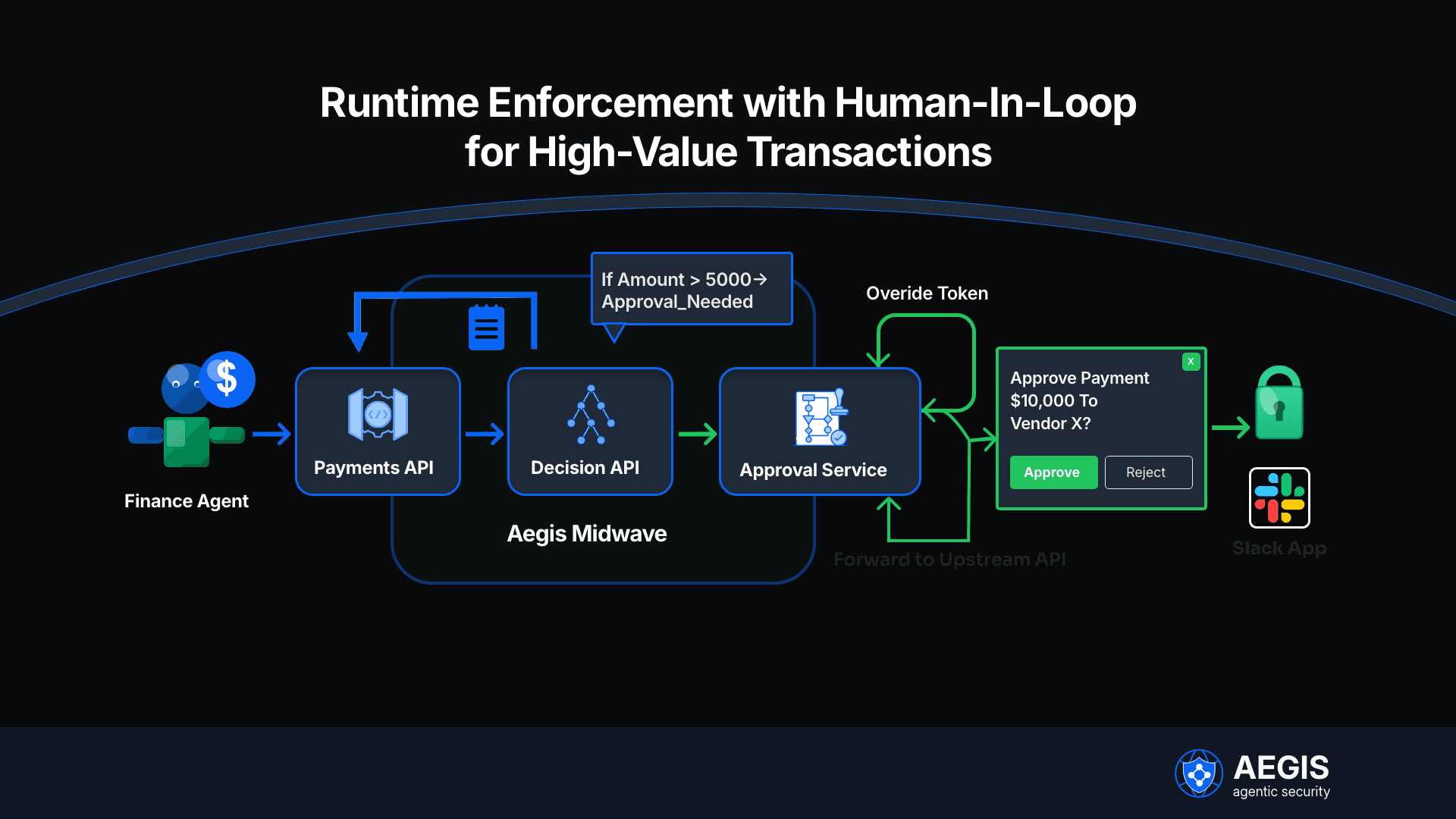
High-value approval | amount > 5000 | approval_needed (Slack/Teams) |
Aegis supports regex validation for account IDs and currency codes, per-agent daily budgets (stop at budget exhaustion) and LLM API cost caps to prevent runaway spend. Shadow mode collects would-block metrics before enforcement.
Observability & attestations
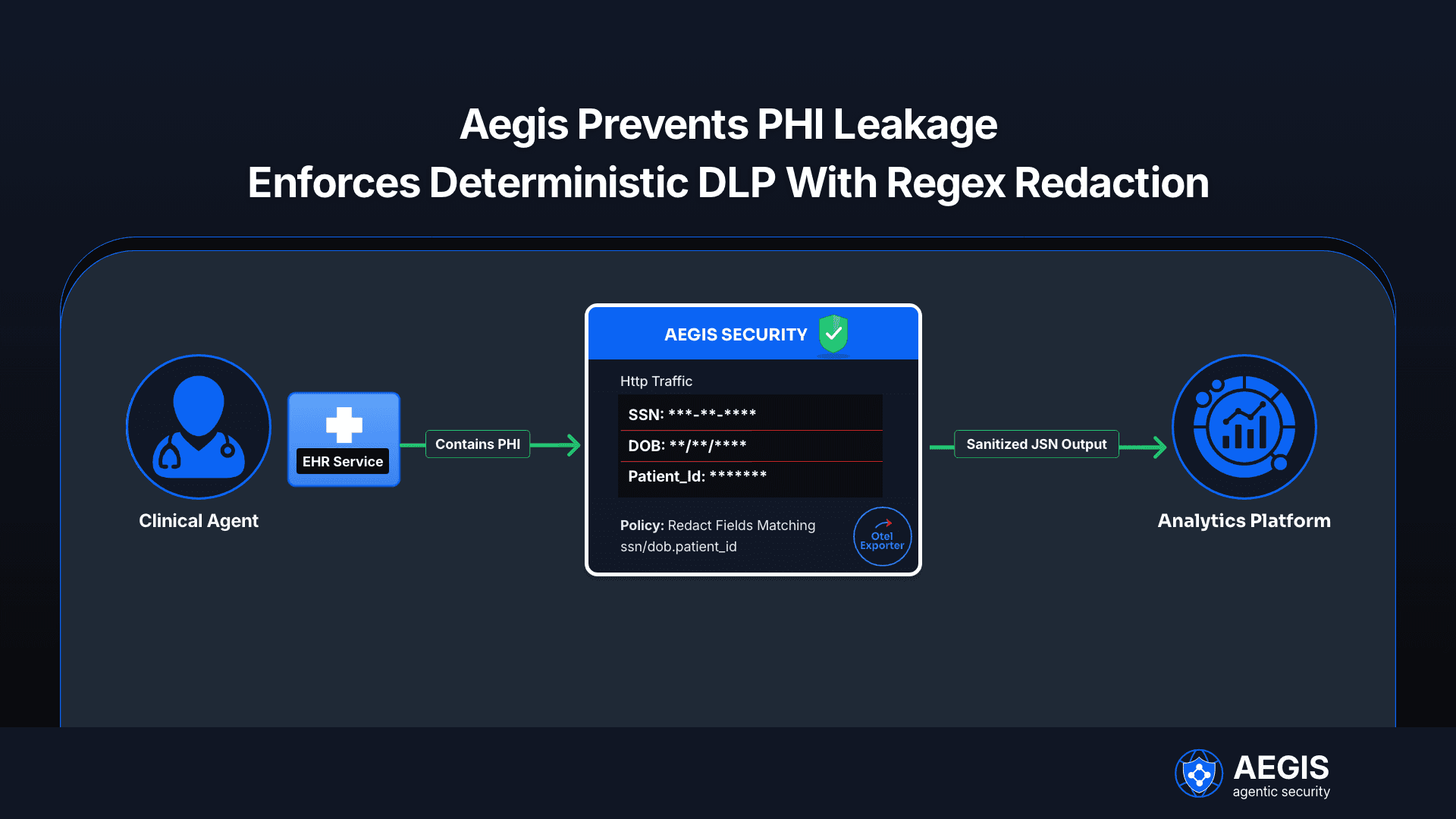
For each decision Aegis emits: agent_id, tool, decision, policy_version, reason, latency and an OpenTelemetry span. Auditors can trace which policy version applied and which human approved overrides.
Real-world examples and metrics
before vs after Aegis pilot
Metric | Before (manual/ungoverned) | After Aegis enforcement (pilot) |
Average payment approval latency | 4 business hours | 6 minutes (automated drafts + approvals) |
Policy violations (would-have occurred) | — | 12/day (shadow mode) |
Runaway spend incidents | 2 per month | 0 |
Time to investigate suspicious transfer | 3 days | 45 minutes (trace linked to agent & policy) |
Concrete scenario: a planner asks a finance agent to send $50,000. Aegis evaluates the finance-agent policy with max_amount=5000, blocks the call, returns { "error":"PolicyViolation", "message":"max_amount exceeded" }, and emits a span containing the policy violation and telemetry for later audit. This pattern prevents planner→finance coercion and preserves accountability.
Common Aegis policy primitives
Primitive | Example use |
max_amount | cap transfers per agent |
regex | validate account IDs (e.g., ^[A-Z0-9]{10,24}$) |
approval_needed | require human flow for thresholds |
daily_budget | stop LLM/tool calls after cost cap |
egress_allowlist | restrict domains (prevent exfiltration) |
Implementation checklist and roll-out
A recommended rollout path balances safety and speed:
- Inventory & register agents — create agent IDs and map intended tools.
- Shadow mode — run policies in shadow for 7–14 days to collect would-block metrics and parameter distributions.
- Tune policies — adjust regexes, thresholds and budgets based on observed data.
- Enforce — flip critical policies to deny/approval_needed.
- Integrate approvals — connect Slack/Teams workflow and enable override tokens for one-time retries.
- Monitor & iterate — use Aegis telemetry to refine rules and add new policies.
Operational notes: keep approval thresholds tuned to reduce human fatigue, and use budgets to reduce noisy approvals from high-volume LLM calls. The Aegis MVP aims for low latency (P99 ≤ 20 ms) so policy checks don't disrupt interactive workflows.
Integration considerations
• Proxy model: Envoy ext_authz or SDK middleware for LangChain/LangGraph.
• Policy engine: compile policy-as-code into OPA bundles and hot-reload without restarts.
• Identity: short-lived JWTs that carry org/tenant/agent claims; enforce ed25519 signatures and jti replay protection.
• Telemetry: emit OTel spans and structured logs for SIEM and FinOps dashboards.
Business impact & metrics to watch
Track these KPIs during a pilot:
• Blocked high-risk transfers (count & percentage)
• Time to resolution for suspicious transfers
• Per-agent cost reduction for LLM/connectors
• Policy coverage across critical connectors (target ≥ 80% for pilot)
FAQ — Frequently Asked Questions
- Can Aegis inspect encrypted payloads?
Aegis requires agent-side middleware or a proxy termination point to inspect request bodies — encrypted payloads must be decrypted at the proxy for full parameter inspection. - How does shadow mode work?
Shadow mode evaluates policies and logs would-deny events without blocking; teams use the collected metrics to tune policy thresholds before enforcing. - Will policy evaluation add latency?
Aegis uses prepared OPA queries, in-memory caches and lightweight proxies to target P99 decision latency ≤ 20 ms for a minimal impact on agent performance. - How are approvals handled at scale?
Aegis integrates with Slack/Teams to post interactive approval flows and issues one-time override tokens after human approval; budgets and thresholds limit low-value approvals. - Does Aegis support multi-tenant MSSP deployments?
Yes — Aegis can scope policy bundles per tenant, route data regionally and produce tenant-scoped audit trails suitable for MSSP workflows. - How do we prevent policy misconfiguration?
Use schema validation, dry-run simulation and versioned policy bundles with rollbacks. Start in shadow mode, then enforce.
Final recommendations
Agentic automation offers measurable efficiency for finance operations — but it must be paired with runtime enforcement, policy-as-code, observability and approvals. Aegis provides the bridge between orchestration and safe execution: per-agent identity, parameter checks, budget controls and auditable traces. For technical teams piloting agentic payments, follow a shadow→tune→enforce cadence and instrument every policy decision into FinOps and SOC workflows.