Streamlining Contract Lifecycle Management with Agents
How Aegis enforces runtime policy, template whitelists, and approvals to safely scale agentic contract automation.
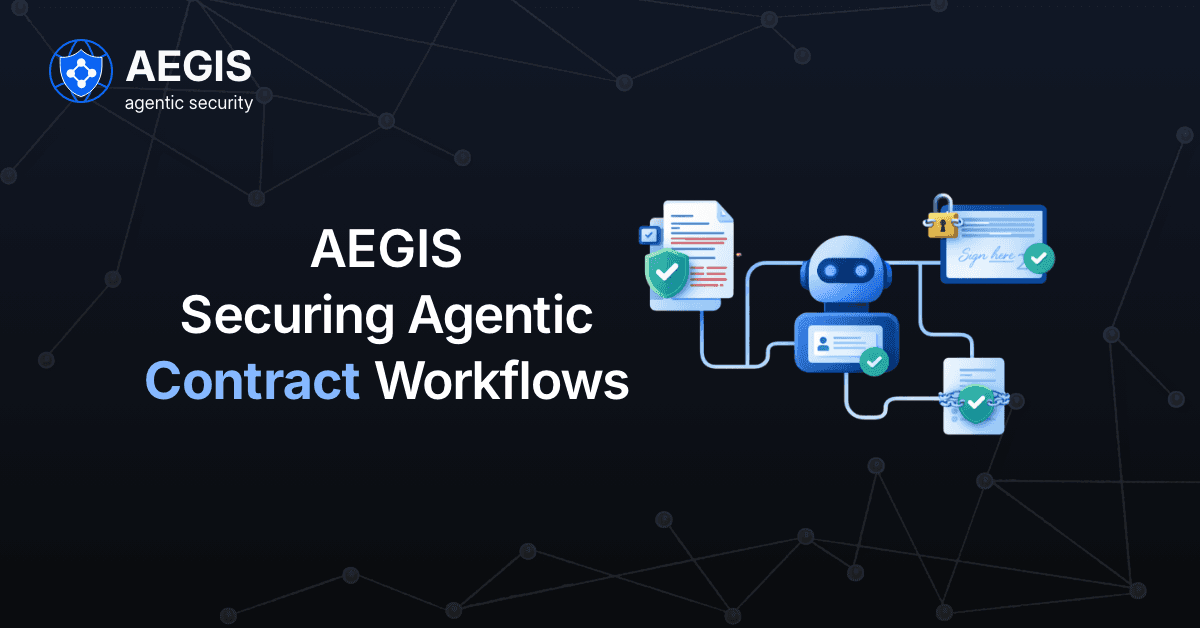
Aegis: Securing Agentic Contract Workflows
Contract lifecycle automation (CLM) and agentic AI promise major efficiency gains — but they also surface new high-risk failure modes: non-compliant clause insertion, accidental PII leaks, and unauthorized signatures. This article explains the risks that autonomous agents introduce to contract drafting, defines practical policy patterns for mitigation, and details how Aegis — a runtime policy and observability gateway — enforces template whitelists, redaction, and signing rules without blocking developer velocity.
Contract automation adoption is accelerating: the global CLM software market was estimated at ~$1.6B in 2024 and continues strong growth into 2025. (Grand View Research) Enterprise adoption of agentic AI is material — surveys show 23–29% of organizations are scaling or already using agentic systems, with many more experimentally deploying agents. (McKinsey & Company) These trends make it urgent for security and legal teams to adopt runtime controls that understand agent semantics — not just API identity.
Contract risk in agentic drafting
Agentic drafting changes the threat model for contracts in three ways:
- Parameterized clause insertion at scale — agents assemble clauses from templates or free text and can inadvertently introduce non-standard language that creates legal exposure (e.g., broad indemnities).
- Data exposure through redlines and exchange — agents often embed contextual data (PII, pricing terms) into drafts and third-party connectors (email, SharePoint), increasing exfiltration risk.
- Automated signature flows — agents can trigger signing workflows; without authority checks this enables invalid or non-binding approvals.
Real examples observed in pilots include an agent inserting a two-year automatic renewal clause where the template required explicit customer opt-in, and another that forwarded an attachment containing unredacted SSNs to an external vendor. These are not hypothetical: industry reporting highlights both growing agent adoption and the security gaps teams report when governance lags. (TechRadar)
👉🏻 Increase accuracy and speed in document workflows with multi-agent AI
Attack vectors and failure modes
- Prompt/parameter injection: user or external inputs get embedded into clause templates, bypassing intended checks.
- Privilege coercion: a planning agent compels a drafting agent to include or sign clauses outside its permission envelope.
- Unknown egress: agents route contract drafts through unsanctioned endpoints (consumer cloud drives, public pastebins).
Mitigation requires runtime enforcement at the agent↔tool boundary: validate clause types, inspect parameter payloads for PII, enforce signing authority, and produce immutable audit evidence.
.png&w=3840&q=75)
Policy patterns that work
A small set of policy patterns covers the majority of contract risks when applied at runtime. These patterns are best expressed as policy-as-code and evaluated per call.
Template enforcement
- Whitelist templates: only allow agent to use a curated set of clause templates (by template_id).
- Clause schema validation: require defined fields (e.g., termination_period ∈ {30,60,90}) and regex validation for monetary values or account IDs.
- Approval gates for risky clauses: if a clause deviates from template or includes flagged terms (e.g., “indemnify”, “unlimited”), return approval_needed and route to human review.
Signer rules
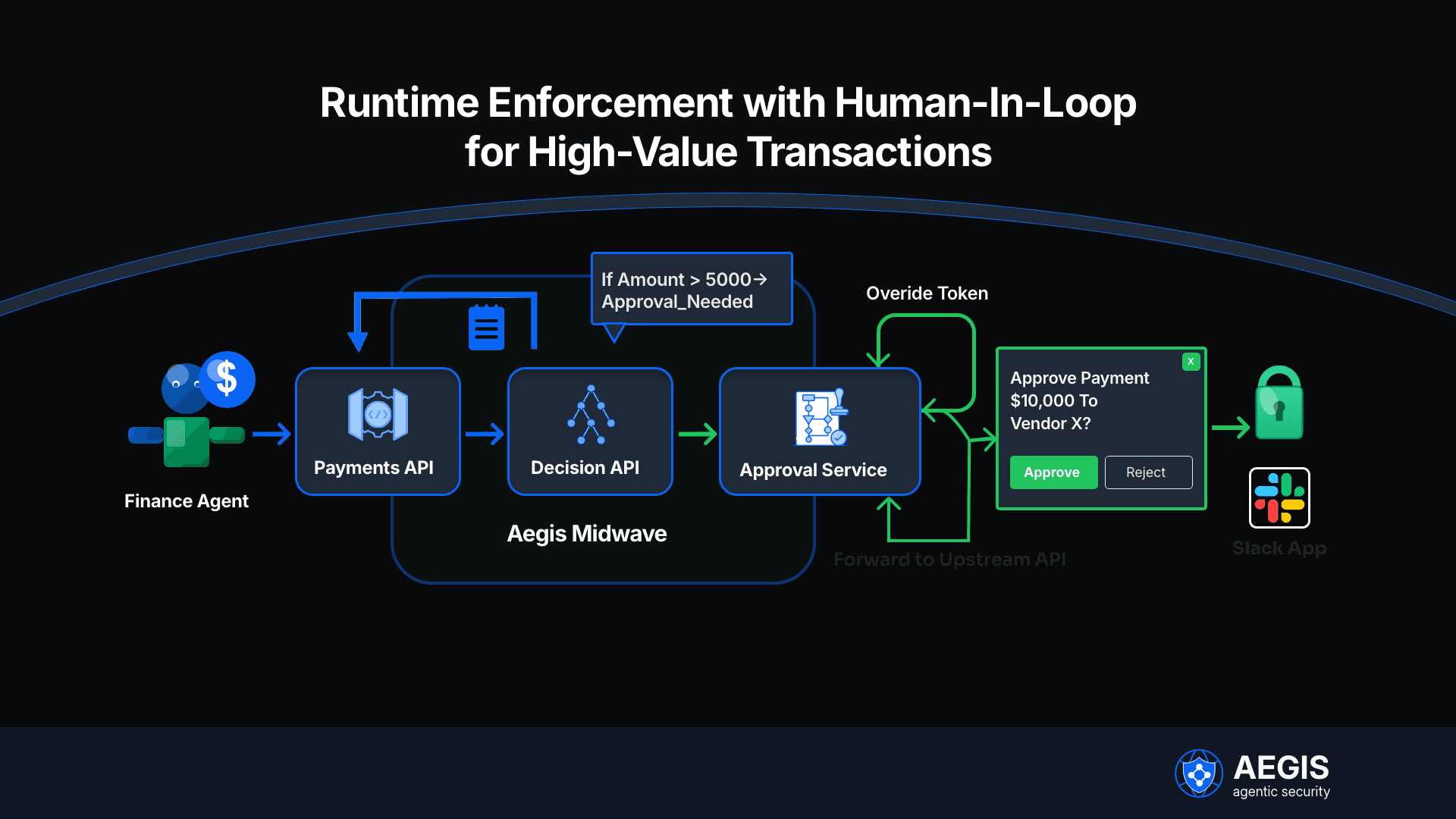
- Authority matrices: enforce signing authority per tenant, deal size, and role. Example rule: signer_role == 'signatory' AND deal_value <= 10000 → allow else approval_needed.
- One-time override tokens: after human approval, issue a single-use token to permit a retryed signing action, preserving audit trace.
Below is a compact mapping of clause types to enforcement actions — a practical reference teams can adopt.
Clause Type | Enforcement Action | Example Condition |
Standard NDA clause | Allow | template_id in whitelist |
Termination (non-standard) | approval_needed | if termination_notice not in {30,60,90} |
Indemnity (unlimited) | deny/approval_needed | indemnity_limit == null OR indemnity_limit > threshold |
Payment terms (external payee) | sanitize + approval_needed | redact payee_id unless verified |
Aegis as the runtime solution
Aegis is built to operate at the agent↔tool boundary as a lightweight enforcement and observability gateway. Its core responsibilities match the policy patterns above and are implemented with operational constraints enterprises expect: low latency, policy versioning, and tamper-proof telemetry.
How Aegis enforces contract safety
- Template whitelist enforcement: Aegis checks template_id and the clause payload against a tenant’s approved data.json bundle. Non-whitelisted templates are blocked or moved to approval_needed. Policy versions are stored for audit and rollback.
- Deterministic DLP / sanitization: regex-based PII redaction (SSN, emails) runs in the decision path. If outbound connectors are used (email, SharePoint), payloads leaving the gateway are sanitized or blocked until safe.
- Signing authority & override tokens: signing requests are validated against per-tenant signer matrices. High-value deals automatically trigger human approval flows; on approval Aegis mints a one-time override token for the signing call and logs the approval id and policy_version.
Runtime attributes that matter
- Identity per agent: short-lived JWTs bind each agent to tenant, role and expiry claims — preventing token reuse across agents.
- Low overhead: policy evaluation uses prepared queries and in-memory caches targeting P99 latencies in the low tens of milliseconds to avoid blocking interactive drafting.
- Audit & telemetry: every decision emits OpenTelemetry spans with policy version, decision_reason and agent_id — enabling SOC and legal teams to produce tamper-resistant trails.
Practical example: An agent drafts a contract with a novel indemnity clause. Aegis evaluates the clause payload, detects an indemnity_limit == null, returns approval_needed, emits an approval request to Slack, and blocks the egress of the draft until explicit legal signoff. Once legal approves, Aegis issues an override token and records the signed audit trail.
👉🏻 Automate finance workflows to reduce errors and improve efficiency
Operationalizing Aegis in CLM pipelines
Adopting Aegis should map to a simple rollout path:
- Shadow mode: run policies in observe mode for 7–14 days to collect would-block metrics and tune regex/thresholds.
- Template onboarding: register approved templates and clause schemas; push tenant bundles.
- Approval tuning: configure thresholds (deal_size, clause types) to limit alert fatigue.
- Enforce + iterate: flip enforcement on, review blocked flows weekly and refine.
Sample rollout metrics to track
Metric | Target (pilot) | Rationale |
Would-block to actual block ratio (shadow) | < 2:1 | ensures tuning avoids false positives |
Policy evaluation P99 latency | ≤ 20 ms | keep drafting interactive |
Approval queue avg time | ≤ 2 hours | maintain business velocity |
% of drafts sanitized before egress | 100% for PII fields | regulatory compliance |
Aegis integrates with enterprise orchestrators and CLM platforms via lightweight middleware and a proxy model (sidecar or forward proxy). See integration and solution pages for deployment patterns and tenant examples on AegisSecurity site.
👉🏻 Drive smarter supply chain operations with autonomous multi-agent systems
Example policy cookbook (compact)
Use case | Policy snippet (intent) |
Block non-standard termination | deny unless template_id in tenant_templates AND termination_days ∈ {30,60,90} |
Redact PII on export | sanitize fields matching SSN/email before egress |
Enforce signing authority | approval_needed if deal_value > signer_max OR signer_role mismatch |
Conclusion
Agentic contract automation delivers measurable time savings, but only if governance keeps pace. Runtime policy enforcement — template whitelists, deterministic DLP, signer authority checks and auditable approvals — prevents costly legal exposure while preserving developer velocity. Aegis provides the lightweight enforcement layer teams need to scale agentic CLM safely: low-latency decisions, policy versioning, and structured telemetry for compliance and FinOps.
Frequently Asked Questions
Q: How does Aegis avoid blocking legitimate drafts during rollout?
A: Run policies in shadow mode to gather would-block events, tune regexes and thresholds, then move to enforcement with staged templates.
Q: Can Aegis redact PII embedded in clause text automatically?
A: Yes. Deterministic regex redaction and sanitization run as a policy action; sensitive fields can be redacted before any outbound connector sees them.
Q: How does Aegis integrate with existing CLM tools?
A: Aegis is deployment-agnostic: it proxies outbound calls from agents to connectors (email, SharePoint, signing APIs) and provides SDKs/middleware for orchestrators.
Q: What audit evidence does Aegis produce for compliance teams?
A: Signed OpenTelemetry spans and structured logs that include agent_id, policy_version, decision_reason and approval_id where applicable.
Q: How are approvals handled at scale?
A: Policies can set tunable thresholds to reduce approvals; Aegis routes approval_needed events to Slack/Teams and issues one-time override tokens for approved calls.
Q: Where can I learn more about industry adoption and CLM market sizing?
A: Market research and AI adoption reports provide context on rapid CLM growth and agentic AI adoption trends. See industry and solution resources for Aegissecurity deployment examples and further reading.