
Tracking and Allocating Agent Costs Across Departments
Practical guide to tracking agent spend, enforcing policies, and automating chargeback with Aegis for secure multi-agent AI.
Aegis: Practical Guide to Tracking Agent Costs, Enforcing Runtime Policy, and Automating Chargeback
Enterprises adopting agentic AI face two immediate operational problems: runaway cloud and API spend, and a lack of auditable controls at runtime. This post explains how to track and allocate agent-driven spend across departments, combine cost telemetry with per-call policy enforcement, and automate showback/chargeback — using Aegis as the implementation pattern for a secure, FinOps-aware agent mesh.
Why cost governance matters now
Agentic workflows call billed services (LLMs, third-party APIs, payment processors) at scale and often programmatically. That raises three concrete risks for enterprises:
- Uncontrolled spend when orchestrators spawn many agents or retry loops call expensive APIs.
- Loss of visibility: central invoices don’t map calls to departments, projects, or tenants.
- Project failure: rising costs and unclear ROI are a top reason projects are scrapped. Gartner expects over 40% of agentic AI projects to be scrapped by 2027 partly due to cost and unclear value. (Reuters)
Finance and FinOps teams now require per-agent cost attribution, automated allocation rules, and exportable reports that integrate with billing systems. Security and compliance teams require audit trails that connect specific agent decisions — and the policies that governed them — to cost events.
👉🏻 Keep deployments sustainable with smarter budgeting and cost controls
Core principles for agent cost allocation
A repeatable operational model needs a small set of high-leverage controls:
- Mandatory agent tagging at registration — every agent record must include department, project, cost center, and tenant metadata.
- Per-call cost attribution — attach tags and an estimated cost to every billable call (e.g., LLM token cost, connector multiplier).
- Allocation rules engine — support fixed, proportional, and hybrid chargeback rules for shared agents or resources.
- Daily aggregation and exports — produce daily CSV/API exports for FinOps and GL mapping.
- Budget enforcement & alerts — allow department admins to set budgets and receive alerts or automatic throttles to prevent overspend.
These controls let teams move from manual spreadsheets and central invoices to automated, auditable chargeback.
👉🏻 Measure the business impact of AI agents with ROI-driven analysis
How Aegis implements cost-tagged telemetry and allocation
Aegis is a runtime policy and observability gateway for multi-agent AI systems that embeds cost governance into every decision path. The core approach combines agent identity, policy enforcement, and OpenTelemetry-style traces that carry cost metadata.
Agent registration & mandatory tagging
When an agent is registered in Aegis, the control plane enforces schema validation so department, project, cost_center, and tenant_id are mandatory fields. Registrations without these tags are rejected. This provides a canonical mapping for all downstream cost attribution.
Per-call cost estimation and tagging
Aegis intercepts every agent→tool call at the gateway. For each billable call it emits a structured span that includes:
- agent_id, tenant_id, department, project
- tool, endpoint, parameters
- decision (allow/deny/sanitize/approval_needed)
- estimated_cost_usd (using per-connector multipliers)
- policy_version and decision_reason
These spans are ingestable by FinOps pipelines. They allow cost rollups by day, department, or tenant, and support anomaly detection for unusual spend patterns.
👉🏻 Improve operational efficiency with cost-aware AI governance practices
Allocation rules & chargeback automation
Aegis provides a rules engine for allocation: fixed (assign full cost to one tag), proportional (split by configured weights), or hybrid (base fee + proportional split). Rules can be applied per-agent, per-connector, or globally. Outputs include:
- Daily CSV exports with GL code suggestions for accounting teams.
- API endpoints for automated showback/chargeback ingestion into billing systems.
- Alerts for top spenders and anomalous pattern detection.
.png&w=3840&q=75)
Budget enforcement and FinOps integration
Budgets can be set per-department or per-tenant. Aegis enforces soft limits (alerts) and hard limits (deny when budget exhausted). For high-risk or high-cost actions Aegis links cost attribution to the approval flow — e.g., an approval request will show estimated incremental cost and the approving role must sign off before an override token is issued.
Audit trail & compliance
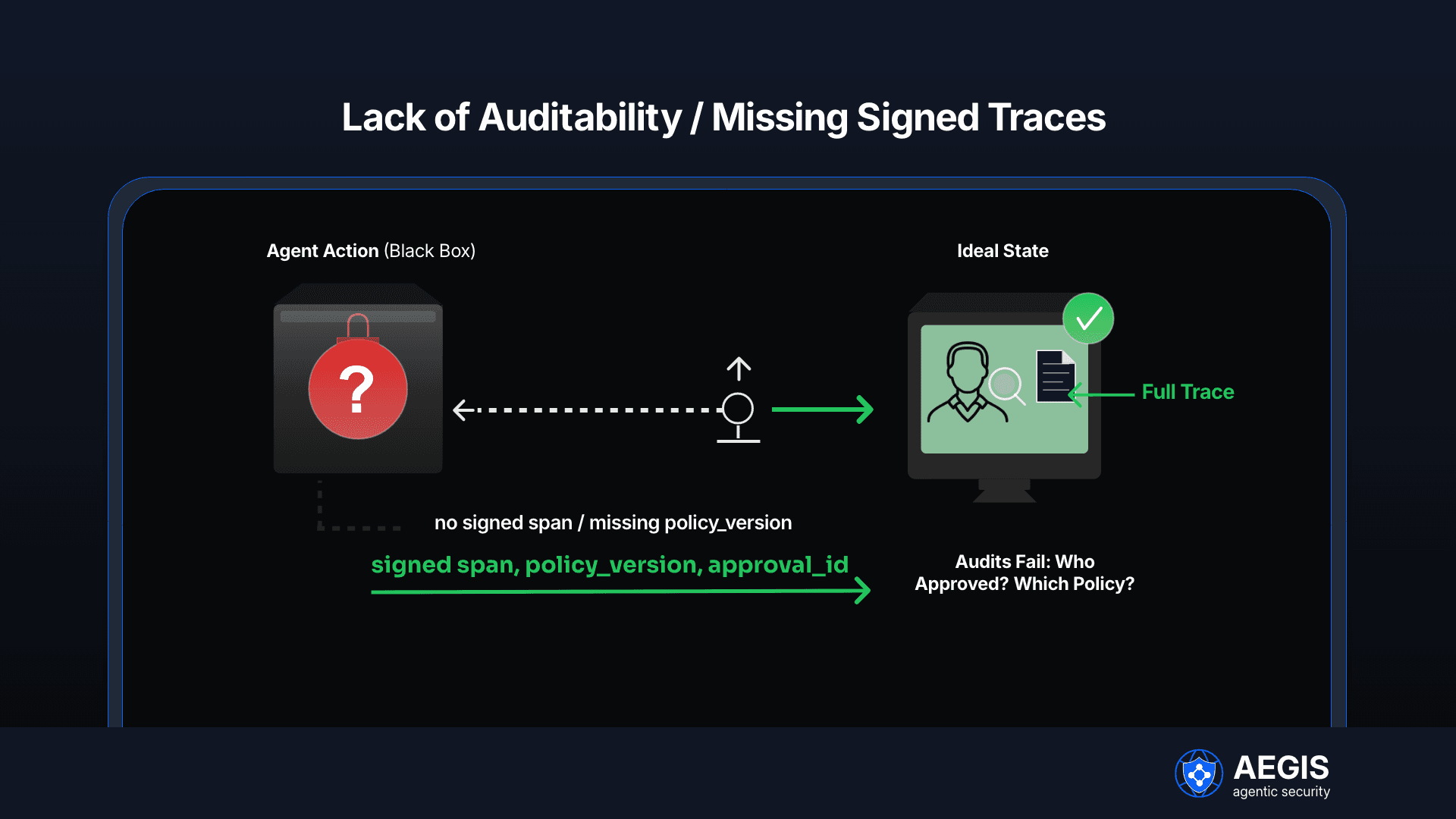
All decisions and cost attributions are auditable: signed spans, policy version, and an approval record (if applicable). This provides traceability from the invoice line back to the policy and agent decision for SOC and compliance reviews.
Operational patterns: step-by-step implementation guide
Step 1 — Registration & tag enforcement
Enforce tag schema at agent creation. Provide onboarding templates that map departments → cost centers and optional GL codes. Include sample CLI commands and policy snippets in the onboarding asset.
Step 2 — Connector cost models
Define per-connector multipliers (e.g., LLM cost per 1k tokens, external API per-call surcharge) and attach them to connectors in Aegis. Document these in a cost catalog so finance can audit assumptions.
Step 3 — Allocation rule creation
Create rules:
- Simple: fixed cost to caller department.
- Shared: split 70/30 between product and infra teams.
- MSSP: multi-tenant proportional split with tenant-level overrides.
Step 4 — Daily aggregation & exports
Schedule daily jobs that aggregate spans into cost buckets and output CSV + API payloads for your billing system. Include reconciliation fields: agent_id, policy_version, span_id, timestamp, raw_cost, allocated_cost, GL_code.
Step 5 — Budget enforcement & alerts
Set daily/weekly budgets and configure alert thresholds (e.g., 75%, 90%, 100%). When hard limits are reached, either throttle or return a PolicyViolation: BudgetExceeded error to the orchestrator.
Common allocation rules
Rule type | When to use | Example |
Fixed | Single owner department | Finance agent calls → cost → Finance |
Proportional | Shared agents or infra | 60% product / 40% infra |
Hybrid | Base fee + split for external costs | $10/month base + proportional API spend |
Example daily metrics snapshot
Metric | Value (sample day) |
Total agent calls | 12,420 |
Billable calls | 3,112 |
Total estimated cost (USD) | $4,860 |
Top agent (by cost) | llm-research-agent — $1,920 |
Agents hitting budget | 3 departments |
Integrations and scaling considerations
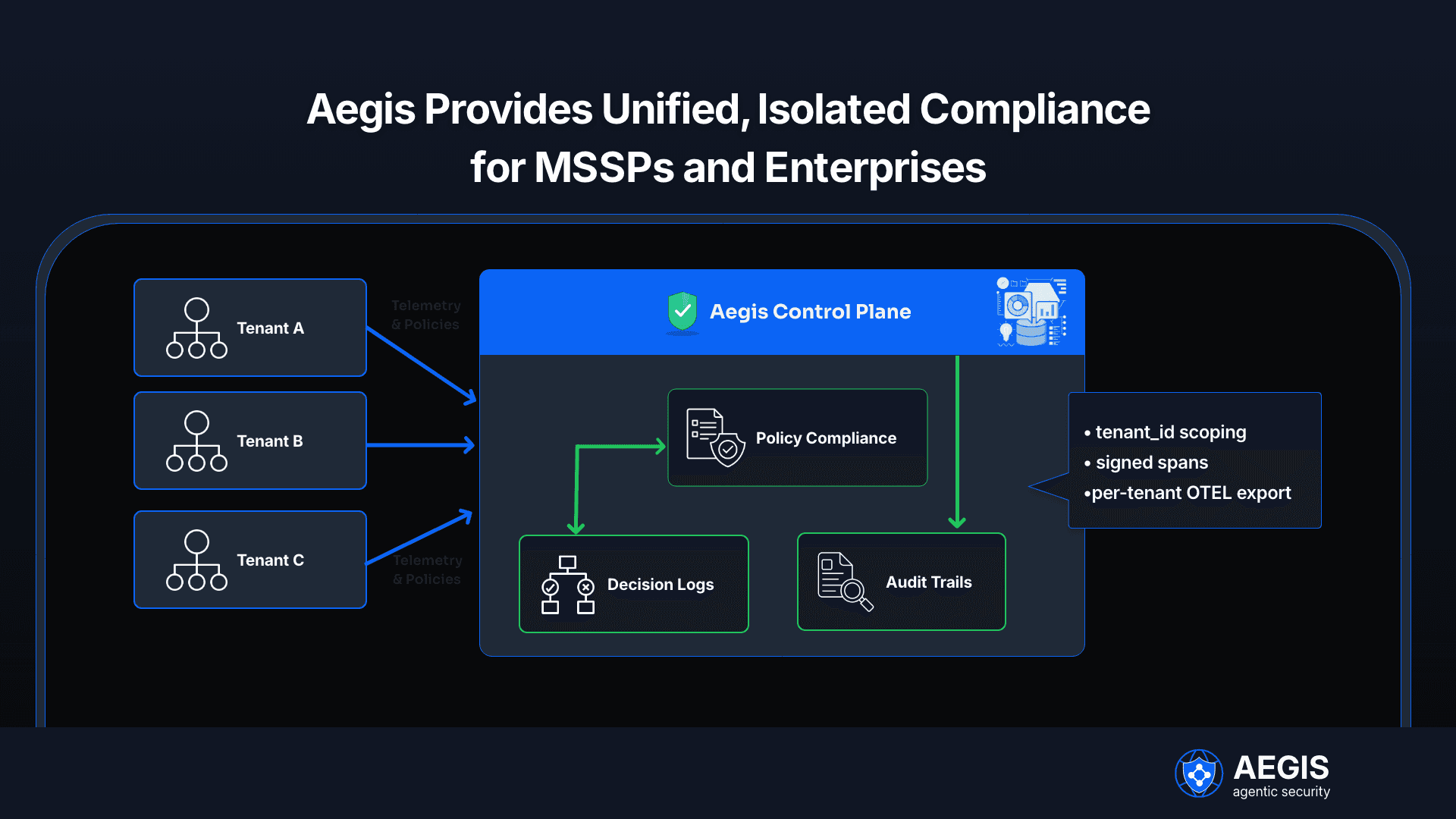
- Multi-tenant models for MSSPs: Aegis supports per-tenant bundles and tenant-scoped policy versions to prevent policy collision across customers.
- Performance: Use prepared OPA queries and in-memory caches to meet low latency P99 targets (design target ≤20 ms for decision calls).
- Failure modes: Fail-closed for write actions and configurable fail-open for low-risk reads; add circuit breakers to avoid cascading failures.
- Reporting & GL mapping: Provide sample GL code mapping and schema for accounting exports so finance teams can ingest quickly.
Example operational playbook
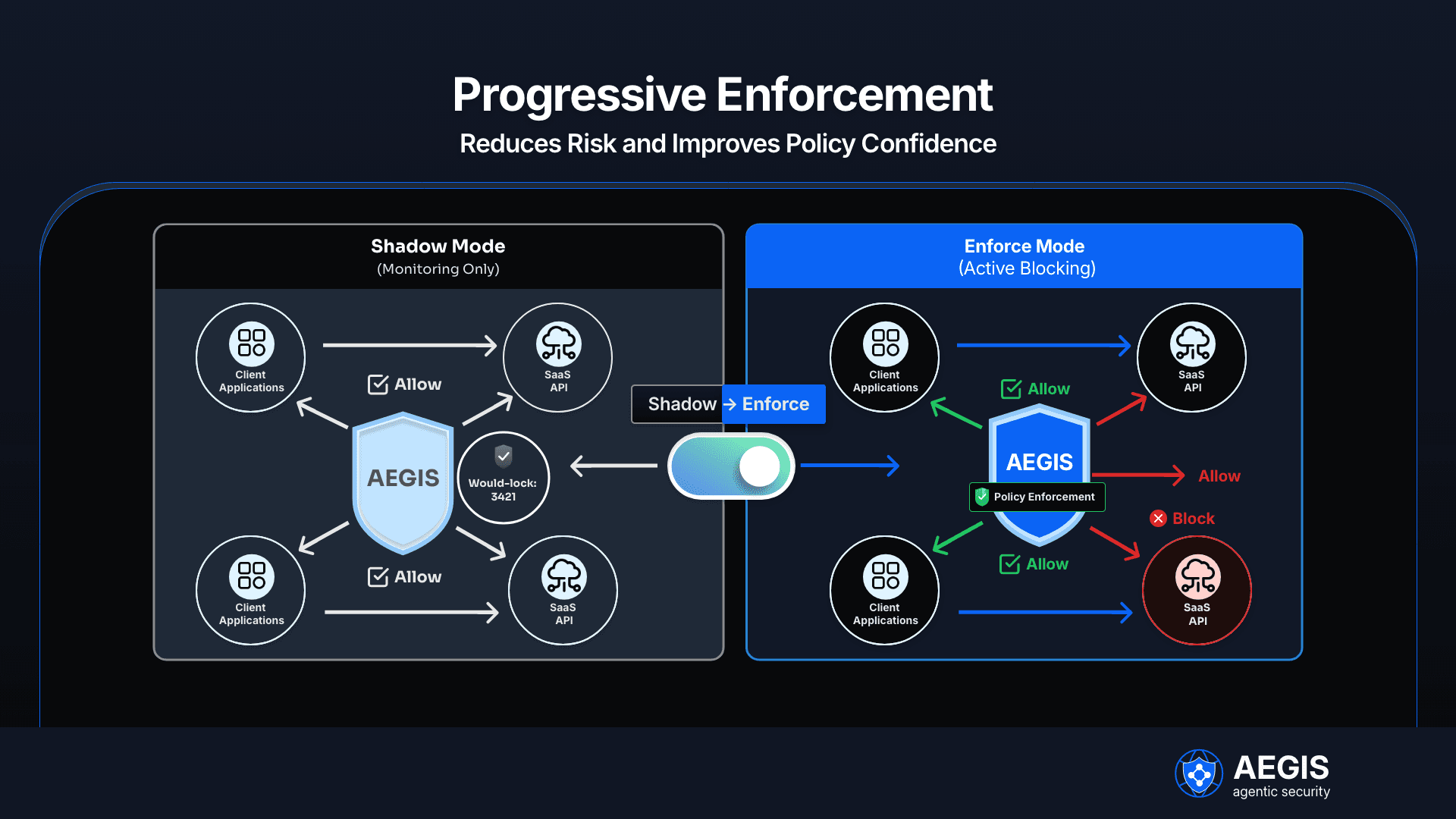
- Deploy Aegis sidecar + control plane in shadow mode.
- Run for 7 days collecting would-block metrics and cost spans.
- Tune policies and allocation rules.
- Flip enforcement on for non-production tenants, then production.
- Run monthly reconciliations with finance and adjust multipliers.
FAQs
Q: How do you estimate cost per-call for LLMs?
A: Use token accounting and per-1k token pricing. Aegis applies connector multipliers and supports manual overrides for negotiated pricing.
Q: Can Aegis export to existing billing systems?
A: Yes — daily CSV and REST API exports with GL code mappings are supported for automated ingestion.
Q: What allocation methods are supported?
A: Fixed, proportional, and hybrid rules with tenant-level exceptions.
Q: How does Aegis prevent runaway spend?
A: By enforcing per-agent budgets, rate limits, and hard deny responses when budgets are exhausted, plus alerts for anomalous behavior.
Q: Is the telemetry auditable for compliance?
A: Yes — spans include policy_version, decision_reason, and optional attestation signatures for non-repudiation.
Closing notes and references
Agentic AI adoption is accelerating but remains fragile: cost overruns and unclear value are primary failure modes. Enterprises must combine FinOps discipline with runtime policy and traceability. Embedding cost-tagged telemetry into a runtime enforcement mesh (Aegis) gives security, operations, and finance teams a single source of truth for agent spend and decisions.
Selected external references:
- Reuters coverage of Gartner's projection that over 40% of agentic AI projects will be scrapped by 2027. https://www.reuters.com/business/over-40-agentic-ai-projects-will-be-scrapped-by-2027-gartner-says-2025-06-25/. (Reuters)
- Deloitte on FinOps trends and cloud cost control practices. https://www.deloitte.com/us/en/insights/industry/technology/technology-media-and-telecom-predictions/2025/tmt-predictions-finops-tools-help-lower-cloud-spending.html. (Deloitte)
- Gartner on enterprise adoption forecasts for agentic AI and application penetration. (Gartner)