
Leveraging FinOps Principles for AI Agent Operations
Learn how Aegis enables real-time FinOps automation, policy enforcement, and cost visibility for AI agent operations.
Leveraging FinOps Principles for AI Agent Operations
AI agents are no longer confined to experimental sandboxes. Enterprises across industries are embedding agentic AI into core workflows—from DevOps automation to payment processing. Yet as autonomy increases, so does financial unpredictability. Cost overruns, opaque resource usage, and cross-functional ownership gaps make traditional FinOps models insufficient. The challenge is not just visibility—it’s enforcing accountability and control in real time.
This post explores how FinOps principles can be adapted for AI agent operations, and how Aegis, Aegissecurity Agentic AI Security and Policy Gateway, brings these principles to life through automated enforcement, telemetry, and real-time budgeting.
.png&w=3840&q=75)
Why FinOps Needs a Redesign for Agentic AI
From Human-Centric Budgets to Autonomous Spending
Conventional FinOps assumes human actors make predictable spending decisions. In contrast, autonomous AI agents act continuously and autonomously, invoking APIs, spinning up compute instances, or calling paid connectors at machine speed. This introduces an entirely new spend pattern—microtransactions at scale.
In 2025, over 61% of enterprises experimenting with multi-agent architectures reported unexpected cost spikes due to unmonitored API usage and uncontrolled agent replication (Gartner, 2025). Annual budgeting cycles simply can’t keep pace with this velocity.
👉🏻 Reduce waste and improve value with disciplined cost management
Breaking Down the Old Silos
Historically, finance and engineering operated in silos—finance set budgets annually while engineering optimized resources post hoc. In AI-driven ecosystems, this delay is fatal. FinOps for agents must be real-time, cross-functional, and policy-driven, uniting finance, DevOps, and security around shared telemetry and budget ownership.
The FinOps Framework for Agentic Systems
1. Real-Time Visibility and Ownership
Every AI agent should have an owner tag, budget ID, and cost traceability. FinOps teams must be able to attribute every API call or model invocation to a responsible team or project.
Element | Description | Example |
Owner Tag | Mandatory metadata linking each agent to a cost center | owner=finops-team |
Budget Allocation | Dynamic budgets enforced at runtime | $500 daily per agent |
Telemetry Source | OpenTelemetry spans with cost data | cost_per_call, tool_name, decision |
2. Iterative Budgeting
Replace annual budgets with weekly or daily adaptive limits. For high-velocity experiments, automated throttles and revocation paths keep experimentation safe without halting innovation.
3. Policy-Driven Controls
FinOps for agents isn’t just about dashboards—it’s about active enforcement. Policies must define who can spend, how much, and under what context (e.g., environment, connector type, time window).
Aegis: Policy & Observability Fabric for AI Agent FinOps
Aegis serves as the runtime enforcement and observability gateway that operationalizes FinOps for AI. Designed for multi-agent environments, it acts as a financial policy mesh—combining budget control, telemetry, and compliance into one layer.
How Aegis Works
Aegis sits between AI orchestrators (like LangGraph or AgentKit) and the tools they invoke. Each request passes through the Aegis Gateway, where it’s evaluated against defined policies for authorization, budget, and spend impact. It can automatically deny, throttle, or request human approval for actions exceeding thresholds.
👉🏻 Prove the value of AI investments with measurable business outcomes
Core FinOps Capabilities in Aegis
- Per-Agent Budgets & Real-Time Enforcement
- Define cost ceilings per agent or tenant.
- Automatically revoke or throttle API keys when budgets are exhausted.
- Display live dashboards of spend trends.
- Usage Tagging and Cost Tracing
- Tag every transaction with agent ID, policy version, and cost metadata.
- Emit OpenTelemetry data for integration with enterprise FinOps tooling.
- Iterative Budgeting & Shadow Mode
- Run cost-control policies in “shadow mode” to assess impact before enforcement.
- Enable fast feedback loops for finance teams.
- Incident Automation for Cost Anomalies
- Auto-generate FinOps incidents when spend exceeds thresholds.
- Provide pre-defined playbooks (revoke tokens, throttle agents, notify owner).
Aegis’s combination of runtime control and observability helps turn FinOps from reactive reporting into active governance.
👉🏻 Unlock new revenue opportunities with business models powered by agentic AI
Implementing FinOps for Agentic AI in 30 Days
A pragmatic approach to adopting FinOps for agents involves incremental rollout. Below is a structured 5-step plan aligned with Aegis capabilities:
Step | Action | Outcome |
1 | Tag all agents with owner, cost center, and purpose | Foundational visibility |
2 | Deploy Aegis Gateway in proxy mode | Begin tracing and policy simulation |
3 | Define cost policies (per-agent budgets, tool restrictions) | Prevent uncontrolled spend |
4 | Enable anomaly alerts & dashboards | Real-time FinOps insights |
5 | Run quarterly cost-worthiness reviews | Continuous optimization |
Real-World Use Cases Enabled by Aegis
FinTech: Payment Ceiling Enforcement
Aegis policies prevent unauthorized payment initiations:
- Finance agents can issue payments ≤ $5,000.
- Higher amounts require human approval via Slack or Teams.
- Every event is logged with cost telemetry and policy version.
SaaS: Per-Agent Budget Limits
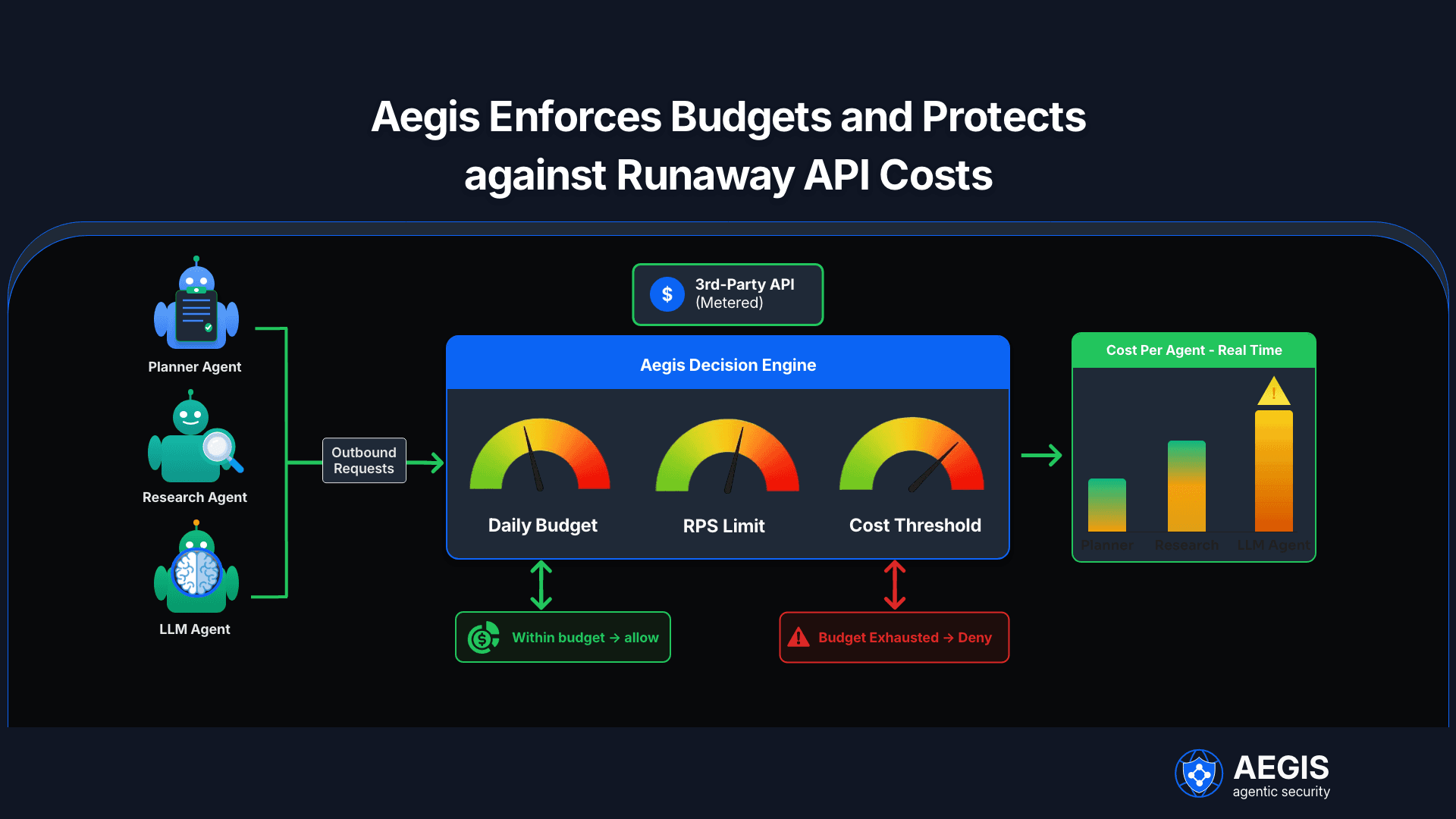
Third-party API calls often drive unexpected spend. Aegis enforces:
- Daily per-agent budgets (e.g., $20/day).
- Rate limits (e.g., 5 RPS per API).
- Auto-block on budget exhaustion with contextual logs.
Healthcare: Controlled Data Export
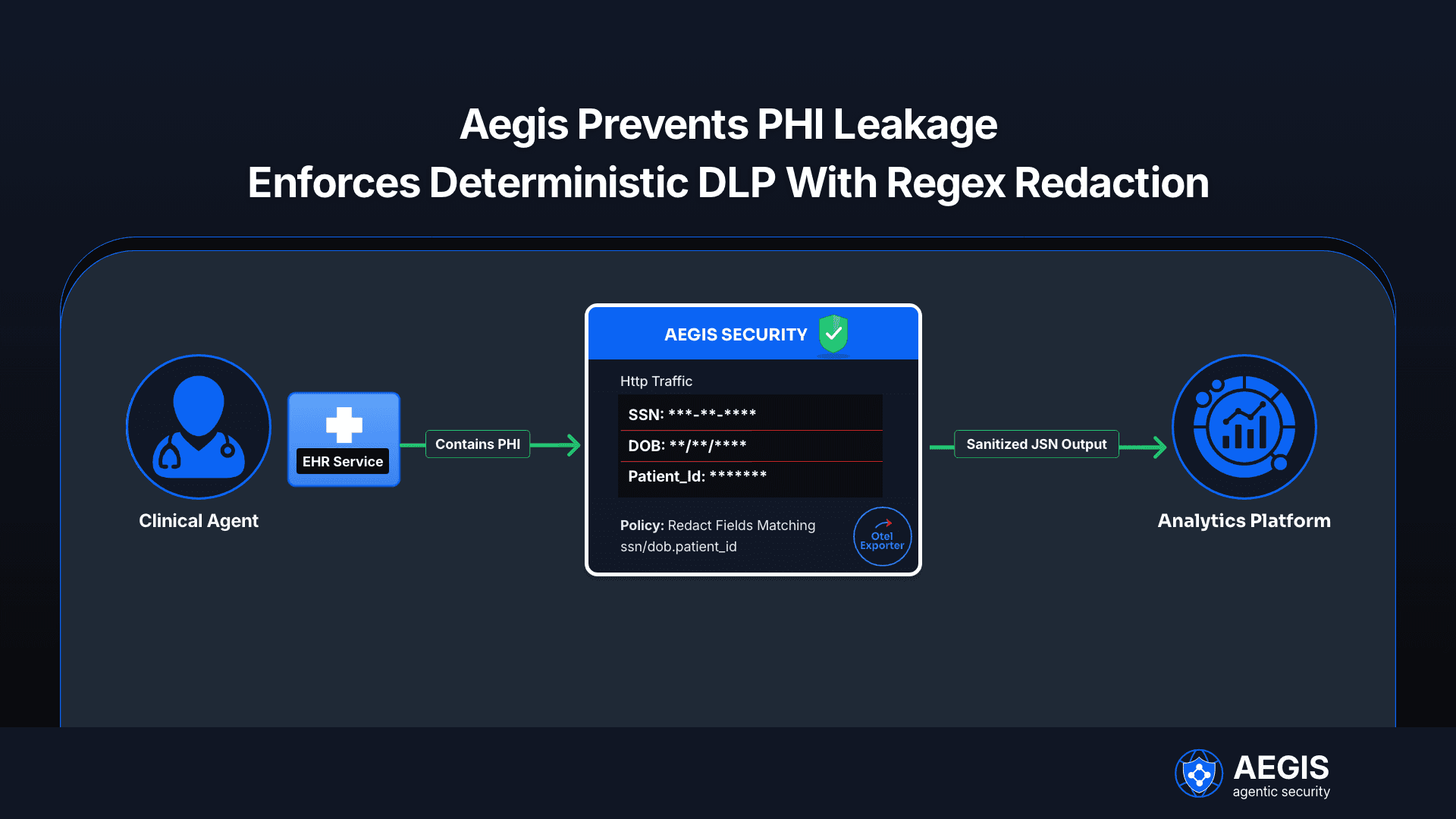
Aegis enforces PHI governance:
- Redacts identifiable fields (e.g., SSNs, DOB).
- Blocks agents attempting off-region exports.
- Maintains compliance logs for audits.
Continuous Optimization with FinOps Telemetry
Cost-Aware Design and Developer Incentives
FinOps principles only work when engineering teams participate. Aegis integrates cost data into developer tooling via SDKs, providing real-time cost-per-call estimation. This enables teams to make informed architectural choices—model selection, caching, or connector throttling—to reduce per-transaction cost.
Building Shared KPIs
Key metrics (e.g., cost per agent, cost per transaction, budget deviation) should feed directly into executive FinOps dashboards. Aegis exports structured telemetry compatible with standard observability stacks.
KPI | Description | Source |
Cost per Agent | Total cost divided by active agent count | Aegis OpenTelemetry |
Budget Utilization Rate | % of budget consumed per period | FinOps Dashboard |
Policy Violation Count | Number of blocked or approval-needed events | Aegis Logs |
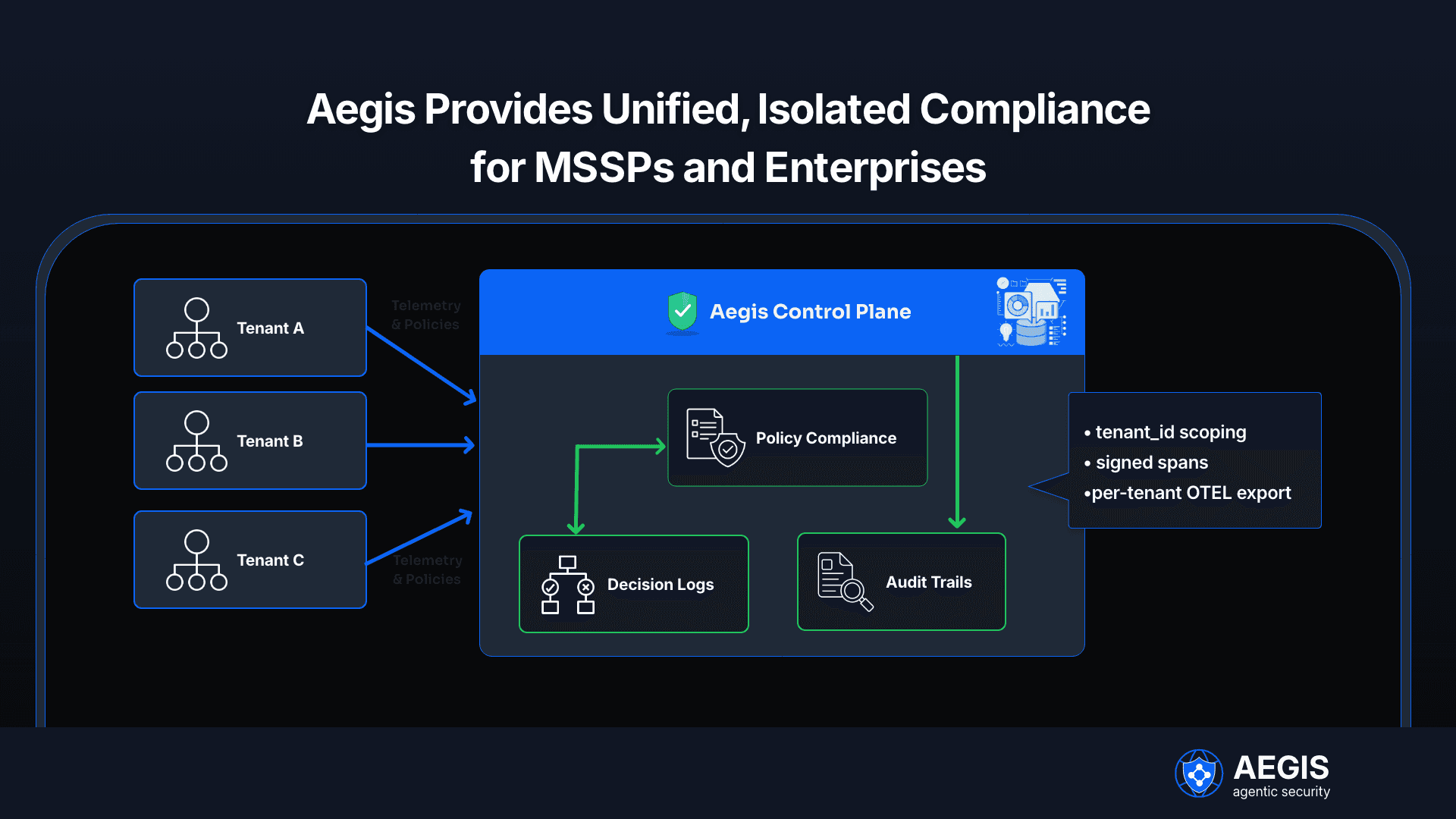
Governance and Compliance Alignment
Real-Time Audit Trails
Aegis produces tamper-proof audit logs for every agent action—enabling SOC and compliance teams to demonstrate control over AI spend and actions. Logs include:
- Agent identity and policy version
- Decision rationale
- Approval workflow trace (if applicable)
Shadow Mode Governance
Before enforcing cost ceilings or deny rules, teams can observe potential impacts through shadow mode. This helps FinOps leaders tune enforcement without risking service disruption.
Integration with FinOps APIs
Aegis’s APIs integrate with existing FinOps platforms for automated chargebacks, policy synchronization, and budget escalation workflows. This promotes unified financial governance across AI and non-AI workloads.
Why Aegis Is the FinOps Enabler for Agentic AI
Traditional tools can’t reconcile AI’s autonomy with financial discipline. Aegis bridges this gap by combining:
- Policy-as-code for deterministic enforcement
- Real-time telemetry for financial transparency
- Multi-tenant cost governance for scalability
Its agent-aware architecture ensures that each transaction—no matter how small—remains visible, attributable, and controllable. Security engineers and FinOps leaders can finally operate from a shared source of truth, aligning cost, compliance, and control.
Frequently Asked Questions
1. How does Aegis differ from traditional FinOps tools?
Aegis doesn’t just observe spend—it enforces financial policies at runtime for AI agents, ensuring proactive control instead of post-spend reporting.
2. Can Aegis integrate with existing FinOps dashboards?
Yes. Aegis emits OpenTelemetry-compatible metrics that plug into Grafana, Datadog, or custom FinOps platforms.
3. What’s the overhead of Aegis policy enforcement?
With in-memory caching and precompiled policies, decision latency remains under 20 ms at P99, keeping performance suitable for real-time AI workloads.
4. Does Aegis support shadow or test modes for FinOps policies?
Absolutely. Teams can run policies in shadow mode to analyze cost impacts before switching to enforcement.
5. How can Aegis help with compliance audits?
Aegis logs every decision and approval, generating tamper-proof audit trails—critical for SOC 2, ISO 27001, and financial governance reviews.
6. Is Aegis suitable for multi-tenant environments?
Yes. It supports tenant-scoped policies, cost segregation, and secure telemetry—ideal for MSSPs and SaaS providers managing multiple clients.