
ROI Analysis: Business Value of Multi-Agent AI Deployment
Practical ROI model and pilot plan for multi-agent AI governance, FinOps controls, and runtime security with Aegis.
Measuring Agent ROI: FinOps, Governance, and the Case for Aegis
Adopting agentic AI promises automation gains — but the real question for security, FinOps and engineering leaders is: what net value do agents deliver after you account for hidden costs (third-party API spend, approval load, governance tooling, and risk)? This post lays out a practical ROI model for multi-agent deployments, shows how to instrument and measure value, and explains how Aegis — a runtime policy and observability gateway — materially improves payoff by preventing risky actions, controlling spend, and producing auditable telemetry.
Why the old ROI model fails
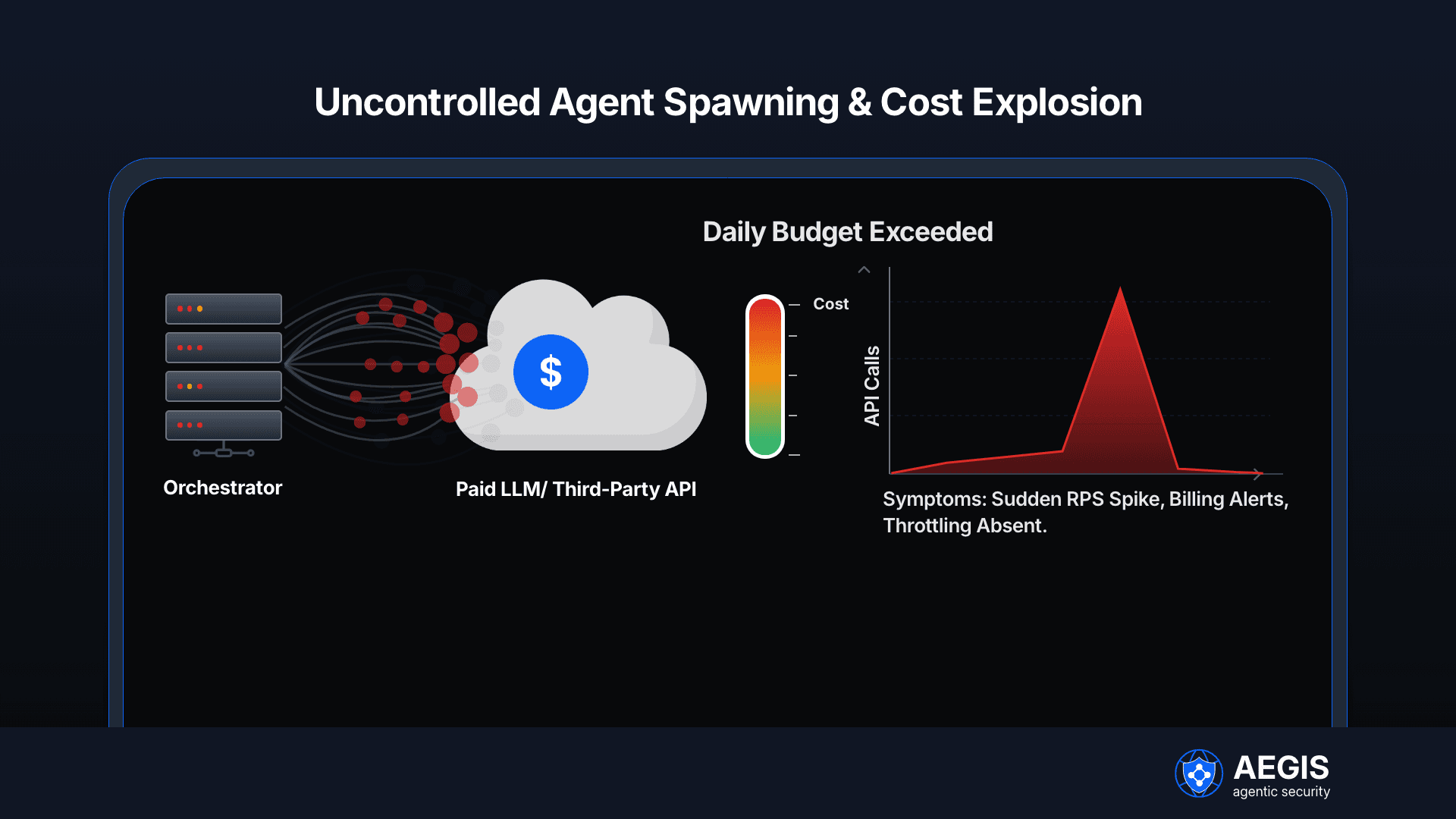
Traditional ROI for automation counts productivity gains and reduced headcount. For agentic AI, that’s only the start. Real deployments reveal additional cost buckets:
- model and inference spend (LLM API calls, embeddings)
- third-party connector costs (paid APIs like payment gateways)
- approval human time and workflow overhead
- governance tooling and policy engineering
- incident remediation and compliance fines
Industry signals back this up: analysts warn many agent projects will be scrapped if value and governance are not addressed — over 40% of agentic AI projects may fail by 2027 due to costs and unclear business value. (Reuters)
FinOps teams report that AI spending has doubled in many organizations as they move models to production, making control and visibility essential to ROI. (Portkey)
👉🏻 Control costs while scaling your AI agent deployments
A practical agent ROI model (step-by-step)
- Baseline measurement (pre-agent)
- Monthly incidents, avg cost per incident, approval turnaround, API invoices.
- Monthly incidents, avg cost per incident, approval turnaround, API invoices.
- Run pilot in shadow mode (observe would-blocks)
- Collect would-block counts, would-prevented-loss estimates, and per-agent API spend.
- Collect would-block counts, would-prevented-loss estimates, and per-agent API spend.
- Model savings and costs
- Automation savings (time × salary avoided)
- FinOps savings (reduced LLM and API spend via budgets)
- Governance costs (policy control plane, sidecars, approval integration) — many are upfront.
- Automation savings (time × salary avoided)
- Risk-adjusted benefit
- prevented_loss = prob_of_misaction × avg_cost_incident × number_actions_prevented
- prevented_loss = prob_of_misaction × avg_cost_incident × number_actions_prevented
- Payback and sensitivity
- Compute payback period and run sensitivity for 10× agent scale.
- Compute payback period and run sensitivity for 10× agent scale.
Table: Sample baseline and pilot numbers (illustrative)
Line item | Baseline / month | Pilot / month | Delta (savings) |
Incidents prevented (count) | 0 | 3 | 3 prevented |
Avg cost per incident | $40,000 | $40,000 | $120,000 prevented |
LLM/API spend | $18,000 | $14,040 | $3,960 saved (22%) |
Human approvals overhead (hrs) | 120 | 40 | 80 hrs saved |
Governance & tooling amortized | $0 | $5,000 | ($5,000) cost |
(Example reflects a FinTech pilot that prevented would-be fraudulent transfers and cut LLM spend by ~22% in month one.)
👉🏻 Build a strong business case for securing your AI ecosystem
Key metrics to collect (instrumentation)
- incidents_per_month (pre/post)
- avg_cost_per_incident
- API_spend_per_agent (daily / monthly)
- approval_turnaround_time
- would_block_count (shadow mode)
- policy_coverage (% of critical connectors)
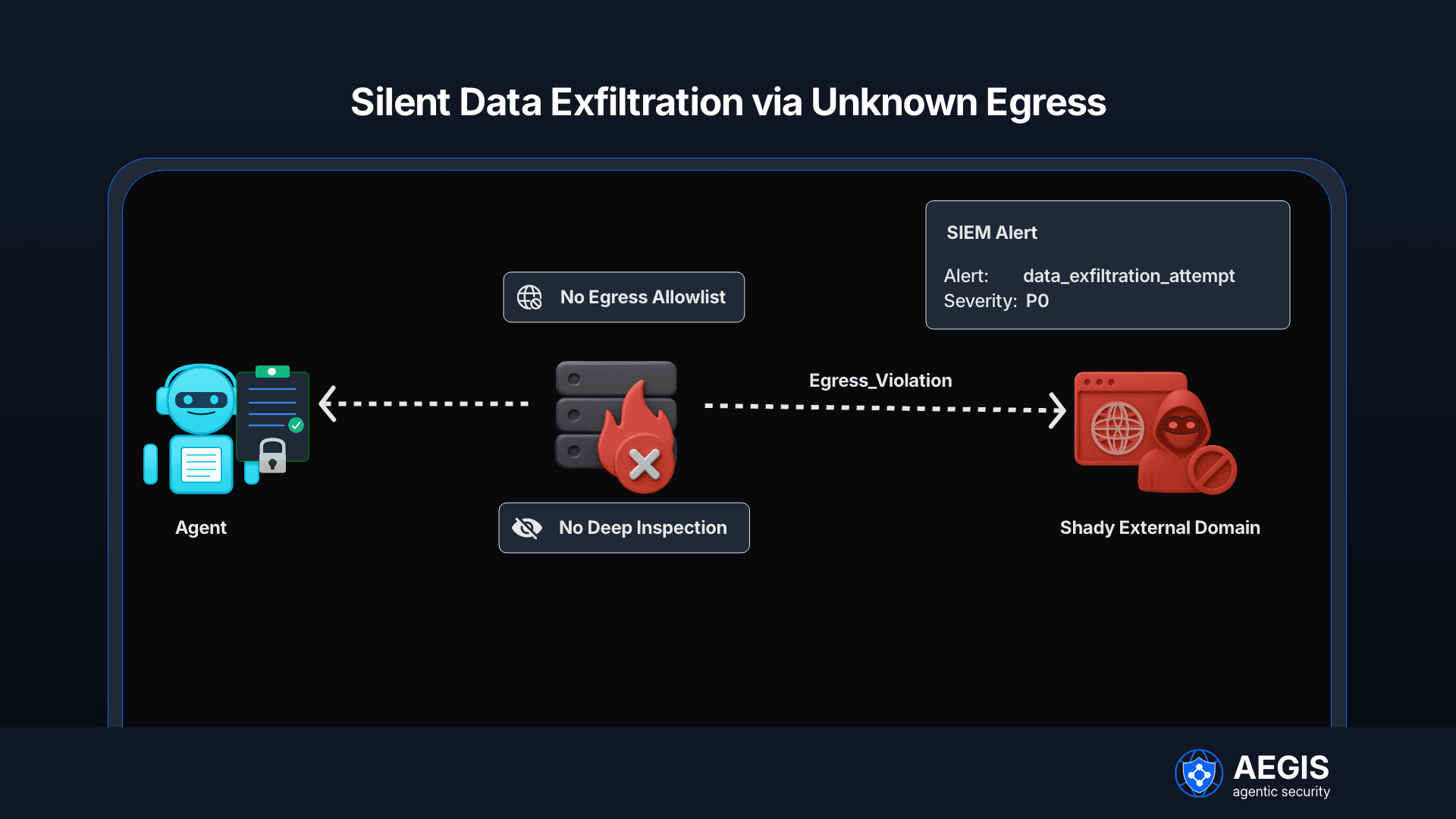
Collect these from logs, billing exports, SIEM, and orchestration telemetry. The FinOps Foundation and industry FinOps guides stress allocating, reporting and anomaly detection specifically for AI spend — integrate those outputs into your FinOps pipelines. (finops.org)
Why governance is an asset, not just a cost
Objection: “Governance costs eat ROI.” Reality: many governance items are one-time or frontloaded (policy development, sidecar deployment), and they reduce expected incident costs dramatically. Calculate a risk-adjusted ROI by estimating the probability an agent causes a breach and expected remediation. For example, if policy enforcement reduces breach probability by even 0.5% and the average remediation is $500k, the expected savings quickly offset governance amortization.
Aegis: the runtime control plane that turns governance into measurable ROI
At least one-third of operational ROI comes from preventing unauthorized actions, enforcing budgets and producing auditable telemetry. Aegis delivers precisely those capabilities:
- Identity & per-agent privileges: register agents with unique IDs and short-lived JWTs; issue scopes and budgets per agent. This prevents runaway agents and makes spend attributable.
- Runtime policy enforcement: a gateway that intercepts agent→tool calls and uses policy evaluation (OPA/Rego) to allow/deny/sanitize or require approval. Blocking a fraudulent payment is an immediate avoided loss.
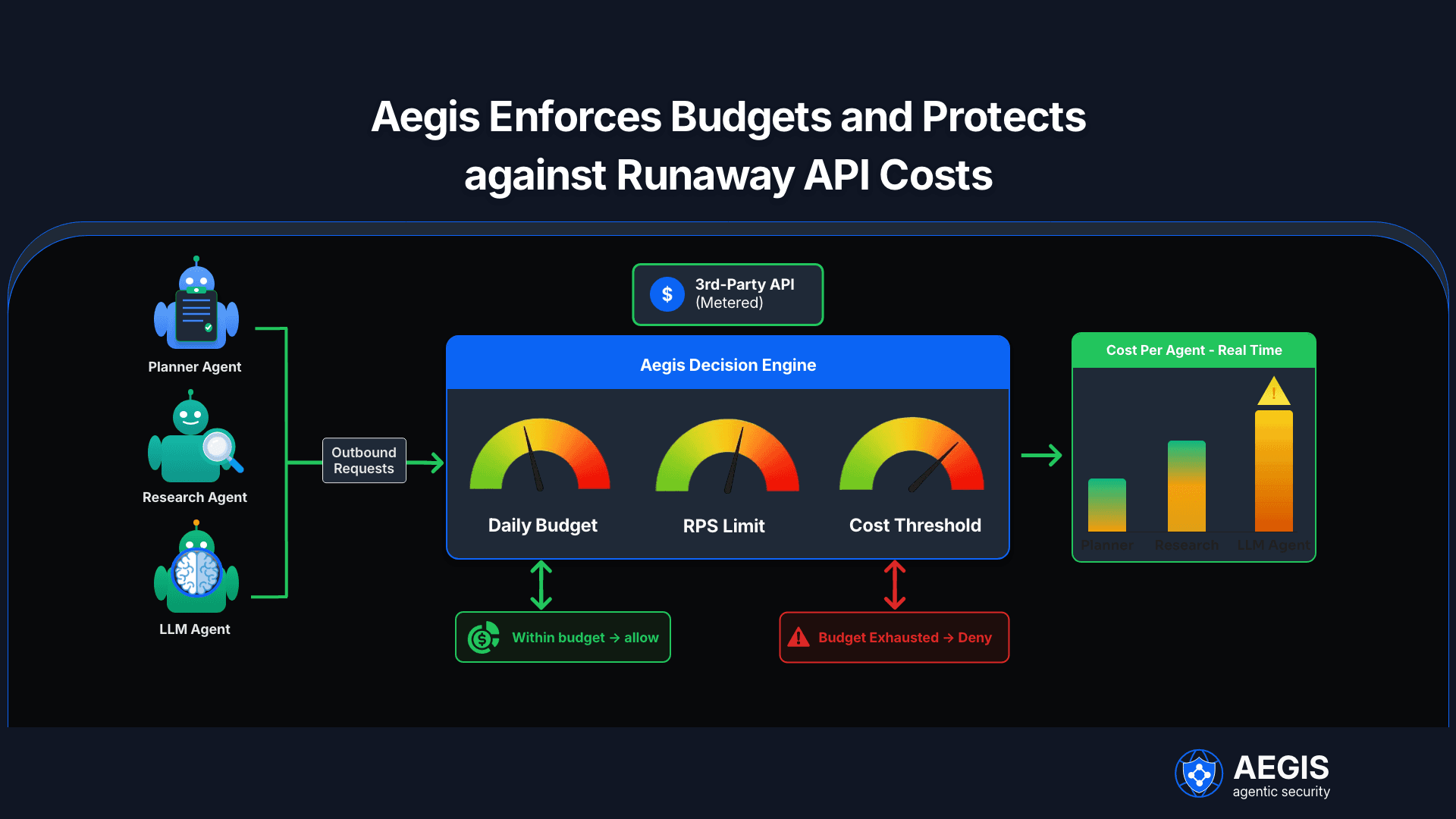
- Budgeting & FinOps controls: per-agent daily budgets and rate limits stop runaway LLM and connector spend; dashboards break down cost per agent and per tool.
- Shadow mode & measurements: run policies in shadow to capture would-blocks; use those as a direct input to your ROI model and pilot milestones.
- Telemetry & audit trails: OpenTelemetry spans with policy_version, decision_reason and approval_id feed SIEM and compliance reports — crucial for regulators and SOC.
- 👉🏻 Unlock new revenue models powered by agentic AI
Two practical tables for procurement and sensitivity
Table: Procurement milestones tied to measurable outcomes
Milestone | Metric | Acceptance criteria |
Pilot launch (30 days) | Shadow mode metrics collected | ≥14 days of would-block data for top 5 connectors |
Mid-pilot (60 days) | FinOps reduction | ≥10% reduction in LLM/API spend for pilot agents |
Go-live (90 days) | Incident prevention | Demonstrated would-prevented losses > governance costs |
Table: Sensitivity scenario — what if agents scale 10×?
Variable | Current pilot | 10× scale (no control) | 10× scale (with Aegis controls) |
Monthly LLM/APIs spend | $14k | $140k | $42k (budgeting + rate limits) |
Approval workload (hrs) | 40 | 400 | 80 (policy thresholds reduce approvals) |
Expected incidents | 3 | 30 | 3 (blocked by runtime enforcement) |
Implementation pattern: shadow → pilot → enforce
- Shadow mode (30 days): run policies as observers, collect would-block counts and telemetry. Use this to set thresholds and budget values. Aegis supports dry-run and shadow modes to gather safe signals.
- 30–90 day pilot: tie procurement to telemetry (blocked incident counts, LLM spend). Use a pilot charter and the ROI spreadsheet to quantify value.
- Enforce and expand: roll policies into enforcement, reuse policy templates, and scale with multi-tenant controls.
Operational tips for security and FinOps teams
- Instrument early: ensure every agent-tool call emits structured telemetry with agent_id and cost estimate.
- Set per-agent budgets: stop spend automatically when budgets exhaust to avoid billing surprises.
- Prioritise high-risk connectors: payments and EHR connectors should be first policies to enforce.
- Use approval tokens for high-risk flows: require human sign-off for overrides and mint one-time tokens on approval.
- Automate reporting into procurement: map blocked incidents to contract milestones.
FAQ (practical)
Q: How do I estimate probability of an agent-caused breach?
A: Use historical incident rates for similar automation, multiply by complexity weight, and validate with shadow mode would-blocks. Combine with expected remediation cost for expected loss.
Q: How to price human approval time?
A: Multiply average approval time by approver salary (including overhead) and scale by expected approval frequency; run sensitivity for different thresholds.
Q: What sample KPIs should MSSPs track?
A: payback period, prevented_loss_per_policy, cost_per_automated_task, approvals_per_1000_actions, policy_coverage_ratio.
Q: Is governance mostly one-time cost?
A: Many governance costs (policy design, sidecar deployment) are frontloaded; ongoing costs shrink as templates and reuse across tenants scale.
Q: How long to run a pilot?
A: 30–90 days. Start with 30 days of shadow mode, then a 60-day enforceable pilot to capture FinOps and incident prevention signals.
Closing: measure both automation value and risk mitigation
A fair evaluation of agent ROI must include prevented loss, FinOps savings, and governance amortization. Shadow mode pilots instrumented with would-block telemetry are the most reliable way to produce defensible ROI numbers. Aegis — as a runtime policy and observability gateway — turns governance from a cost center into a measurable lever: it prevents unauthorized actions, enforces per-agent budgets, and produces the telemetry auditors and FinOps teams need to justify continued investment.
Further reading and data sources cited: Gartner/Reuters coverage on agentic AI project risk, FinOps Foundation guidance on AI spend, and recent market reports on agent adoption and developer trust. (Reuters)