
Top Open-Source Agentic AI Libraries to Watch
Compare top open-source agent frameworks, security tradeoffs, and runtime hardening with Aegis for safe production deployments.
Open-Source Agentic AI Libraries: Security & Hardening with Aegis
Agentic AI—systems that plan and execute multi-step workflows—moved quickly from research demos to enterprise pilots in 2024–2025. Enterprises report rising experimentations and scaled pilots: 23% of organizations say they are scaling agentic systems while another 39% are experimenting. (McKinsey & Company) This growth is paralleled by warnings: Gartner predicts many projects will be abandoned without strong governance. (Reuters) This article gives a concise shortlist of OSS agent frameworks, a practical security lens (threats + hardening), and a deep operational look at Aegis—the runtime policy mesh designed to safely run multi-agent workflows.
👉🏻 Get started with the right stack to build your first AI agent
Why choose an OSS agent framework?
Engineering benefits
Open-source agent frameworks (LangChain, LangGraph, AutoGen, Semantic Kernel and smaller projects) accelerate development: reusable RAG components, connectors, planning primitives, and community integrations shorten time-to-prototype. LangChain’s repo and ecosystem are widely adopted as a practical example. (GitHub)
Security tradeoffs
OSS reduces vendor lock-in but increases the surface area you must evaluate: default credential handling, memory persistence, plugin isolation, remote code execution risk, and patch cadence. Recent research (AgentPoison) demonstrates how memory/RAG poisoning can backdoor agents by injecting malicious artifacts into long-term memory—an explicit risk when using RAG-based agents. (NeurIPS Proceedings)
👉🏻 Decide between open flexibility and closed control for your agents
.png&w=3840&q=75)
Shortlist & quick comparisons
Below is a compact evaluation you can use during due diligence. Columns reflect maturity, security posture, extensibility, docs, and integration effort.
Project | Maturity | Security posture (default) | Extensibility | Docs / Community |
LangChain | High | Medium — many connectors, variable defaults | High | Very active, many examples. (GitHub) |
LangGraph | Mid | Medium — orchestration primitives; still evolving | High (graph-based) | Growing; lower adoption than LangChain. (GitHub) |
AutoGen (Microsoft) | Mid | Medium — multi-agent features, depends on deploy | High | Official backing; orchestration focus. |
OpenAI Agents SDK | Low–Mid | Low — simpler primitives; relies on developer guardrails | Medium | Good quickstarts; less ecosystem. |
Semantic Kernel | Mid | Medium — planning constructs; host responsibilities | Medium | Strong for .NET/Polyglot use-cases. |
SmolAgents & tiny OSS | Low | Often low — easier to audit but less feature-complete | Low–Medium | Small communities; easier surface for audits |
Practical scoring helps prioritize which OSS to pilot and which to sandbox. For each candidate run a focused security checklist: credential vaulting, dependency SBOM, memory store encryption, plugin sandboxing, and patch cadence review.
👉🏻 Power smarter agents with contextual retrieval using vector databases
Hardening patterns for agent frameworks
Pre-deployment: supply chain & design checks
- Inventory transitive dependencies; require SBOM and supply chain scanning.
- Use short-lived credentials and a secrets vault for connectors.
- Choose memory backends with encryption and field-level redaction.
Runtime patterns
- Egress allowlists and domain whitelists for external APIs.
- Parameter validation at the boundary (schema + regex checks).
- Human approvals for high-risk actions (payments, infra changes).
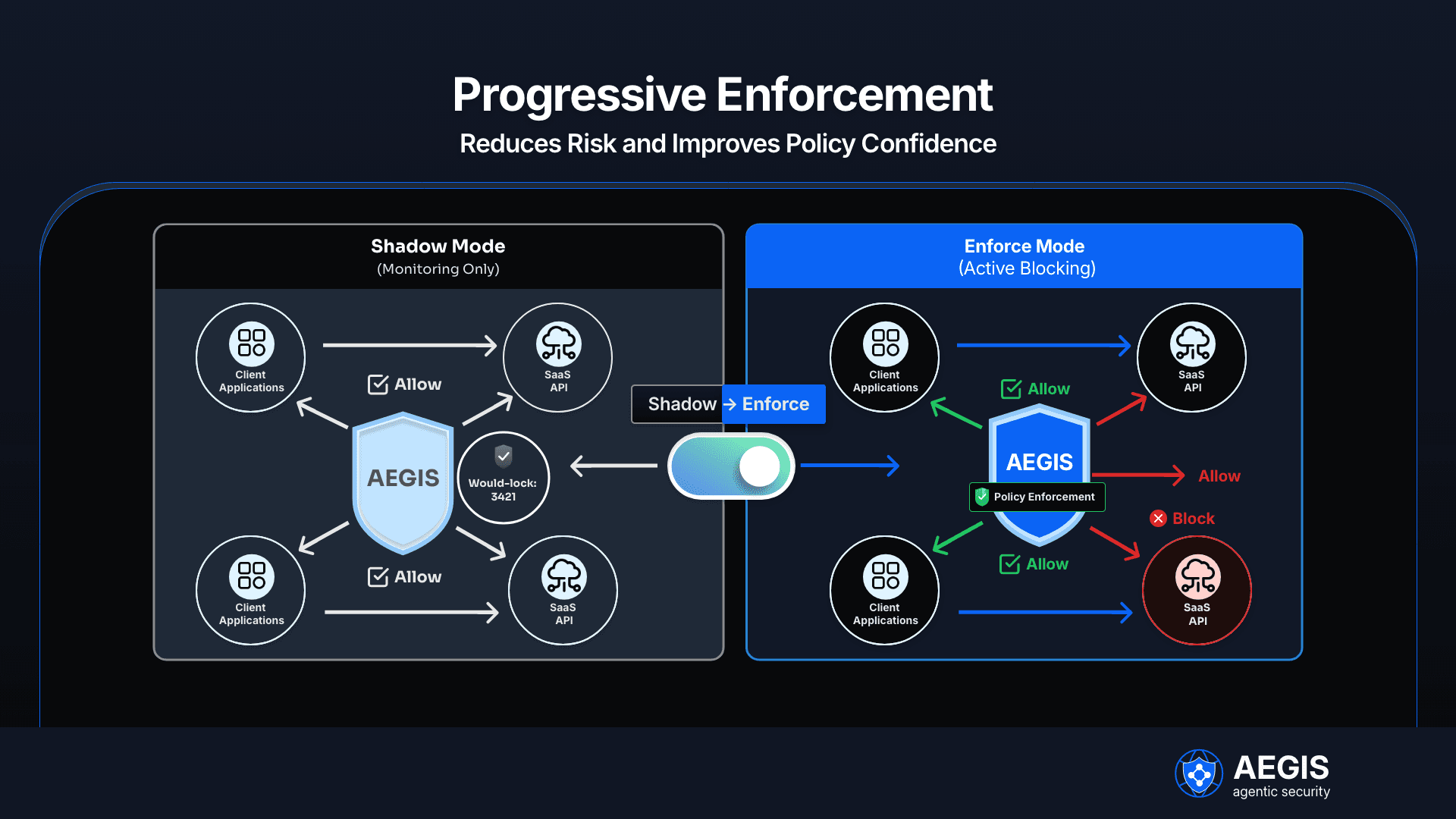
- Shadow mode rollouts to observe would-deny events before enforce.
Attack example and mitigation (AgentPoison)
AgentPoison shows how an attacker can poison a RAG memory store so that retrievals produce malicious demonstrations. Mitigations: restrict user-editable memory sources, sanitize inputs, use deterministic DLP on memory writes, and enforce per-record integrity checks. Aegis can enforce these controls at runtime by inspecting memory writes and blocking or sanitizing suspicious inserts. (NeurIPS Proceedings)
Aegis as the runtime hardening layer
What Aegis is?
Aegis is a runtime policy and observability gateway for multi-agent systems—a policy mesh that sits between orchestrators (LangChain, LangGraph, AgentKit) and external tools to enforce least privilege, sanitize parameters, and emit auditable telemetry. The Aegis specification describes a lightweight sidecar/forward proxy (Envoy ext_authz) plus an external authorisation server using OPA bundles.
How Aegis integrates (operational flow)
- Agent or orchestrator issues a tool call.
- Aegis identifies agent identity (short-lived JWT), inspects target, and evaluates policy in OPA. (Open Policy Agent)
- Decision returned: allow, deny, sanitize, or approval_needed; each decision emits OpenTelemetry spans and structured logs.
- Human approvals (if required) are routed to Slack/MS Teams; override tokens allow a one-time retry.
Concrete Aegis controls (examples)
- Per-agent payment ceilings: enforce numeric ranges on payment amounts and block policy violations.
- Memory write DLP: deterministic regex redaction on PII before persisting RAG memory.
- Egress & domain enforcement: only allow calls to approved endpoints (e.g., api.openai.com), preventing exfiltration.
Why Aegis matters for OSS stacks
OSS frameworks are flexible but often assume the developer will implement guardrails. Aegis externalises these guardrails into an orchestrator-agnostic, policy-as-code mesh—reducing per-project bespoke security work and enabling centralized audit trails for SOC and compliance teams. This reduces the blast radius of misconfigured agents (e.g., preventing a Planner agent from coercing a Finance agent into an unauthorized transfer).
Risk Checklist
Due Diligence Item | Why it matters | Quick test |
Credential handling | Prevent leaked creds in connectors | Confirm vault use; short tokens |
Memory encryption | Prevent RAG poisoning / exfiltration | Test access controls and encryption-at-rest |
Plugin isolation | Avoid remote code execution | Run connectors in sandbox or container |
Patch cadence | Reduce exploit window | Check release frequency & CVE response |
Aegis Feature Matrix
Aegis Capability | Benefit | Notes |
Policy-as-code (YAML→OPA) | Fast policy rollout & audit | Versioned bundles, dry-run |
Runtime enforcement (allow/deny/sanitize) | Blocks risky calls immediately | Ext_authz pattern (Envoy) |
OpenTelemetry spans | Compliance & SOC visibility | SIEM friendly, signed spans |
Approval workflows | Human in loop for risky ops | Slack/MS Teams integration |
Practical adoption checklist (operations)
- Start in shadow mode for 7–14 days; collect would-deny telemetry.
- Harden memory sources: disallow arbitrary public writes; require encryption and integrity checks. (NeurIPS Proceedings)
- Enforce egress allowlists and per-agent budgets to prevent runaway spend.
.png&w=3840&q=75)
FAQs
Q: Which OSS agent framework is most secure out of the box?
A: None is perfectly secure by default. LangChain offers many integrations and mature tooling but requires careful defaults for credentials and memory stores. Always run a focused runtime policy layer like Aegis and supply-chain scans.
Q: What is the single biggest runtime risk?
A: Memory/RAG poisoning and unconstrained tool access (e.g., allowing an agent to call arbitrary domains). NeurIPS and arXiv research shows memory poisoning is exploitable. (NeurIPS Proceedings)
Q: Can Aegis block a call mid-flight?
A: Yes — decisions are made before tool invocation (allow/deny/sanitize). High-risk calls can return approval_needed and pause until human override.
Q: How does policy-as-code fit CI/CD?
A: Policies are stored and versioned; CI can validate schema, run dry-run simulations, and promote bundles during release.
Q: Is Aegis vendor lock-in?
A: Aegis is designed to be orchestrator-agnostic and integrate with multiple OSS frameworks via SDKs and sidecars; policies compile to standard OPA bundles for portability.
Closing (practical takeaway)
Open-source agent frameworks accelerate innovation but raise new operational security challenges—memory poisoning, parameter injection, uncontrolled egress, and cost overruns. Combine careful OSS selection (use the shortlist and due-diligence checklist above) with a runtime policy mesh like Aegis to enforce least privilege, sanitize sensitive traffic, and produce auditable telemetry. Implement shadow rollouts, per-agent budgets, and approvals to safely move from pilot to production while keeping SOC and compliance needs satisfied. For concrete patterns and sample policies, see the Aegis brief and MVP spec.