
Building Your First AI Agent: Tools, Frameworks, and Languages
Practical guide to building safe, auditable AI agents—runtime policies, approvals, telemetry and deployment patterns.
Aegis: Runtime Security for Agentic AI
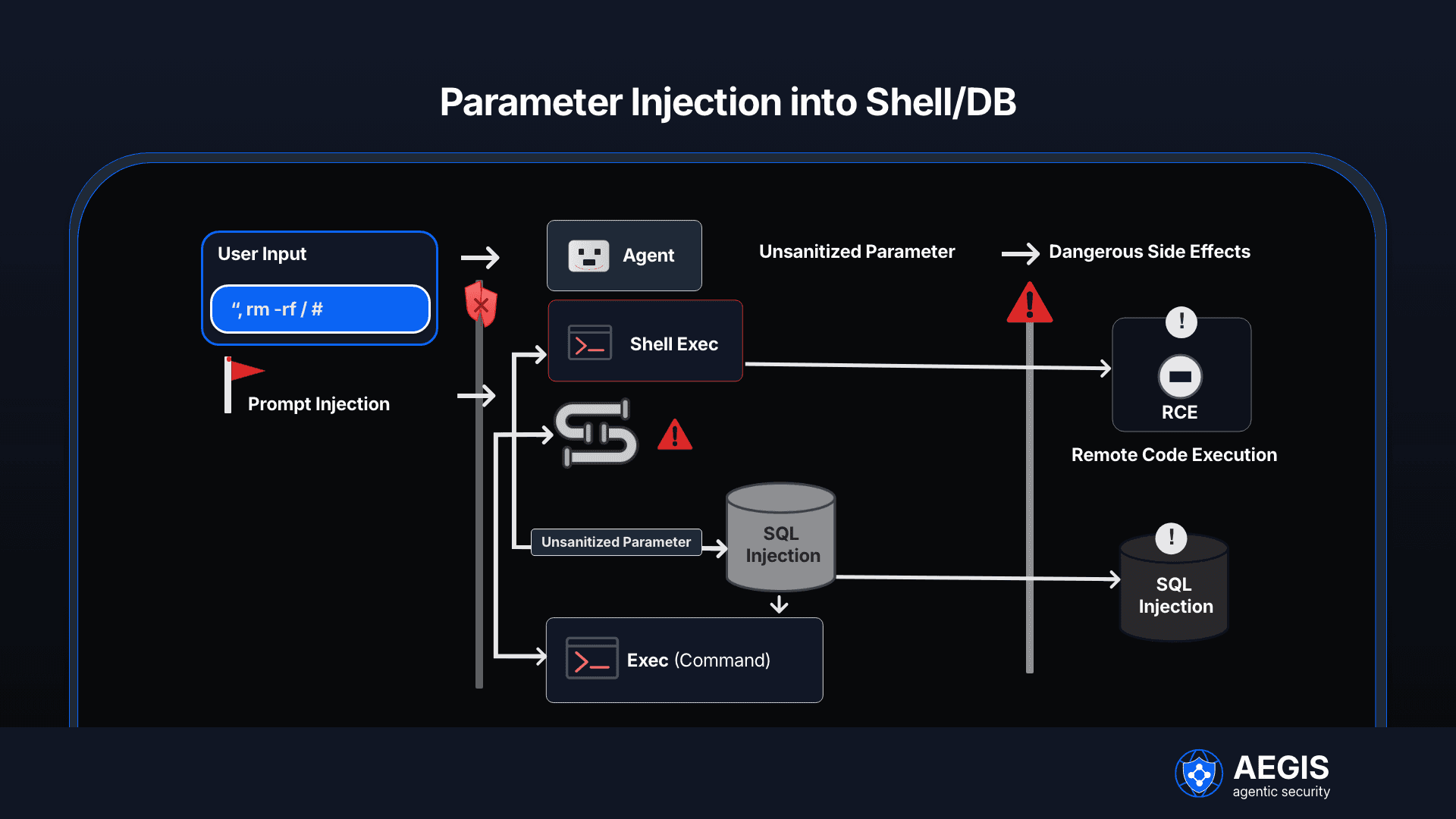
Enterprises moving agentic AI from lab to production face a set of repeatable operational and security problems: parameter injection, privilege escalation between agents, uncontrolled spend and a lack of tamper-proof audit trails. This post gives a practical how-to for a first agent deployment, a build checklist, and a clear explanation of Aegis — the runtime policy and observability gateway that enforces least-privilege, approvals, and structured telemetry for multi-agent systems. It combines actionable engineering guidance with product detail so security, DevOps, and platform teams can act.
Pick your first agent and scope
Choose a narrowly scoped starter agent
Start small. Pick a single, well-scoped automation that has clear inputs, outputs and measurable risk. Good starters: “Invoice-checker” (fetch invoice metadata and propose payments), “Deploy-stager” (prepare staging deploys only) or “EHR-reader” (read-only patient lookup with strict redaction). Limit scope to one connector and one tenant for the first run.
Example use cases (quick)
- Finance: enforce max transfer amounts, require human approval above thresholds.
- DevOps: allow staging deploys; require approval for production.
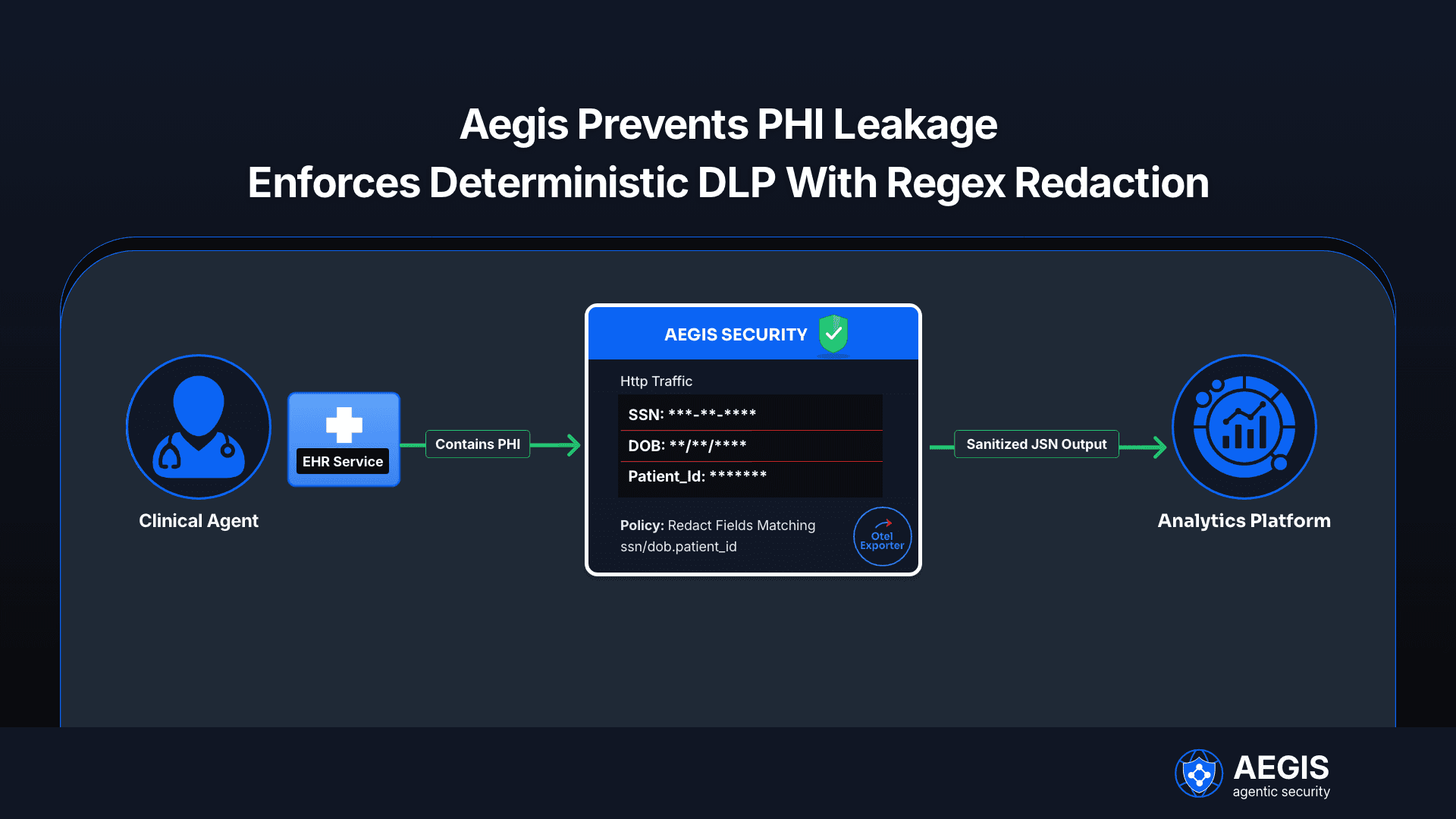
Healthcare: read-only EHR access, redact PHI before any outbound.
These examples map directly to policy constructs and approval flows described later.
👉🏻 Discover open-source libraries accelerating agentic AI innovation
Build checklist
Identity & policy (core)
- Assign agent_id and tenant_id; issue short-lived tokens per agent.
- Policy-as-code: create a minimal YAML/JSON policy with allow/deny rules and an approval threshold for risky actions. Example fields: allowed_tools, actions, conditions (e.g., max_amount).
- Register agents in an agent registry; support hot-reload for policy bundles. The Aegis MVP design uses short-lived JWTs with agent scope and claim metadata to bind identity to decisions.
Telemetry & testing
- Instrument every decision with OpenTelemetry spans (include agent_id, tool, decision, policy_version, latency). OpenTelemetry adoption is rising and is the de-facto standard for tracing distributed policy decisions. (OpenTelemetry)
- Unit test tool adapters; write integration tests for end-to-end flows. Use dry-run/shadow mode to collect would-deny metrics before enforcement. Aegis advocates a “shadow mode” for 1–2 weeks prior to flipping enforcement.
Additional checklist items (practical)
- Retrieval: index relevant corpora for RAG and evidence-based responses.
- Secrets: keep secrets out of prompts; use secret managers and short tokens.
- Error handling: circuit breaker, retries with exponential backoff.
- DLP: deterministic redaction for PII before outbound calls.
- Budgeting: enforce per-agent cost thresholds and rate limits.
- Schema validation: validate tool inputs with strong typing.
- State: keep short, replayable state for audits.
Rollback: design compensating actions for irreversible steps.
👉🏻 Bridge your agents with APIs and SaaS for real-time execution
Going to production
Shadow mode and rollout
Deploy policies in shadow mode to capture would-block events, tune regexes and thresholds, and identify noisy approvals. Shadow telemetry gives visibility into false positives and policy gaps without disrupting workflows. Aegis’s design explicitly supports shadow mode, policy dry-run and hot-reloadable bundles.
Compliance & auditing
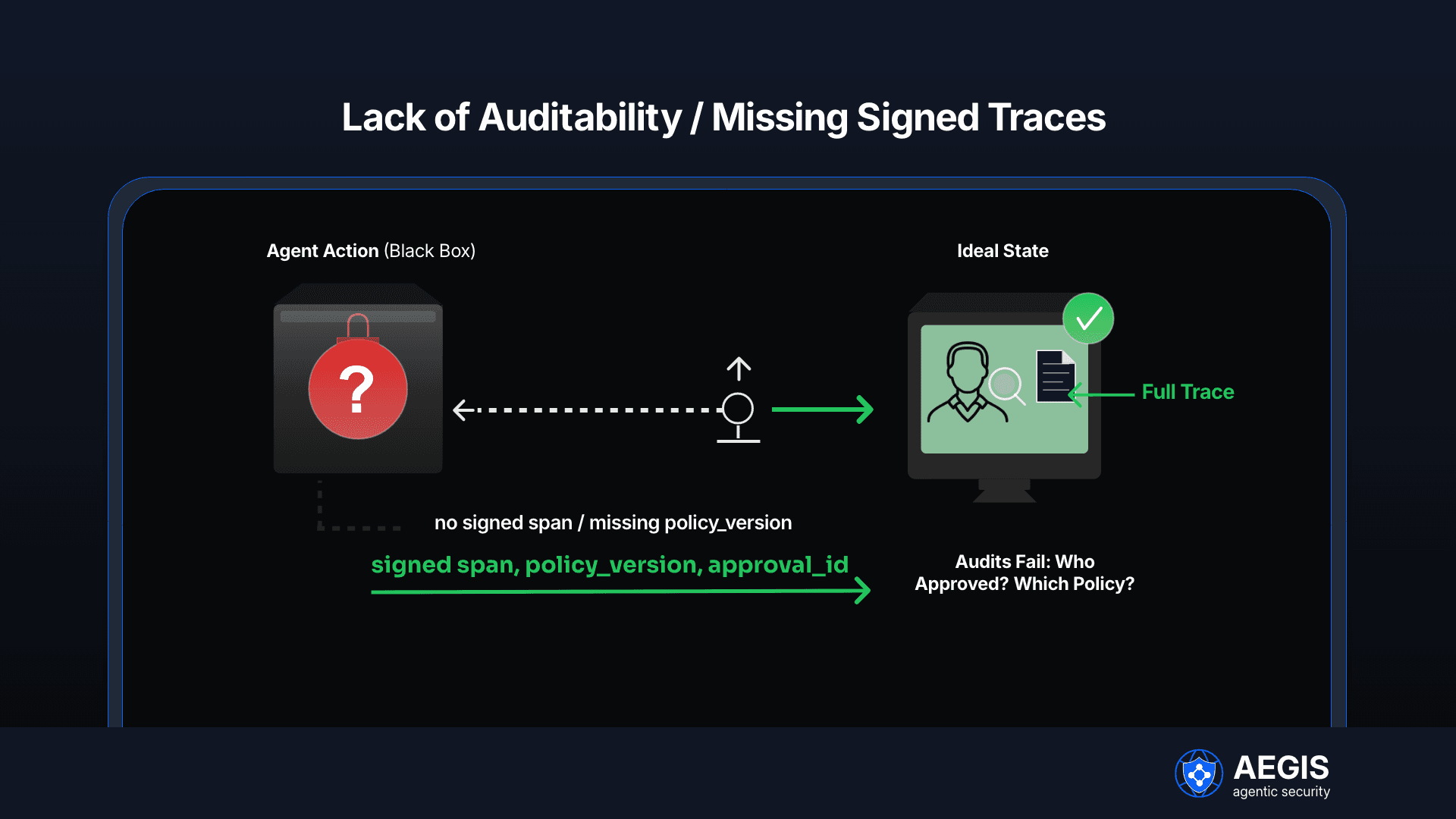
Your production design must produce tamper-resistant logs that link agent_id → policy_version → decision → approval_id (when present). Export structured JSON logs and OpenTelemetry spans to SIEM/Grafana. For regulated industries (finance, healthcare), include an audit signing or immutable storage for policy histories.
How Aegis enforces safety
What Aegis Exists
Aegis is a runtime policy and observability gateway that sits between your orchestrator and downstream tools. It enforces per-agent least privilege, inspects call parameters, applies deterministic DLP and triggers approval workflows when a policy marks an action as high risk. Architecturally it is an “Istio + OPA for agents”: a lightweight proxy/sidecar and decision service plus a control plane for policy management.
👉🏻 Decide between SaaS and self-hosted platforms based on your needs
Runtime enforcement model
- Sidecar / forward proxy inspects outbound requests.
- External authorization server evaluates policy bundles (compiled from YAML/JSON to OPA data/rego). Decisions: allow, deny, sanitize (redact), approval_needed.
- For approval_needed, Aegis sends a human request (Slack/Teams) and, if approved, mints a one-time override token for retry. The decision path includes signed attestation and emits OTel spans for every step.
Telemetry and compliance
Every agent-tool call becomes a traceable, auditable event: agent_id, caller chain, decision, policy_version and latency. Dashboards show blocked events, budget usage, and top-offending agents/tools. Export to SIEM and retain policy version history for compliance audits. The architecture details and MVP telemetry goals are included in Aegis technical documentation.
Operational patterns and performance
Latency and scalability
Evaluate policy decisions at low latency (target P99 ≤ 20ms). Use OPA prepared queries, in-memory caches, and optionally WASM compilation for hot paths. OPA guidance and Envoy ext_authz patterns provide performance best practices for low overhead proxies. (Open Policy Agent)
Cost governance & FinOps integration
Attach per-agent budgets and rate limits. Stop calls when budgets are exhausted and emit granular cost traces. This prevents runaway spend from agents auto-spawning or repeatedly calling expensive LLMs. Surveys show cloud cost control is a top concern; controlling agent spend is a practical requirement. (TechRadar)
Two practical tables
Item | Recommendation | Why |
Agent identity | agent_id + tenant_id + short JWT | Strong binding for audit & least privilege |
Policy format | YAML → compiled OPA bundle | Policy-as-code, fast evaluation |
Telemetry | OpenTelemetry spans + SIEM logs | Correlate decisions, support audits |
Approval flow | Slack/Teams integration + override token | Human-in-loop for high risk actions |
Metric | Target (MVP) |
Policy decision latency (P99) | ≤ 20 ms |
Policy coverage (pilot) | ≥ 80% of critical connectors |
Telemetry completeness | 100% of agent-tool calls traced |
Developer DX | Policy authoring < 5 minutes |
Integration & developer experience
Aegis provides client SDKs (Python/Node) and middleware for popular orchestrators so teams don't need to rewrite agents — a small adapter or decorator is enough. CLI tools support policy validation, dry-run simulations and rollbacks. The control plane compiles and signs policy bundles and the data plane hot-reloads them with no restart.
Resources and next steps (links)
- Open Policy Agent performance notes: https://openpolicyagent.org/docs/policy-performance
- OpenTelemetry project: https://opentelemetry.io
Frequently Asked Questions
- How do I start with a single agent safely?
Start in shadow mode, register the agent_id, issue short tokens, and write a minimal policy that only allows the single connector and basic actions. Tune after 1–2 weeks of shadow telemetry. - What does an approval flow look like?
High-risk decisions return approval_needed. Aegis posts an interactive message to Slack/MS Teams. Once approved, an override token is minted for the one retry; all steps are logged. - How do you prevent parameter injection?
Use schema validation on tool inputs, per-field regex constraints in policies, and deterministic DLP to strip suspicious fields before forwarding calls. - Will policy checks add unacceptable latency?
Properly implemented prepared queries, in-memory caches and hot-reloadable bundles keep decision latency low (target P99: ≤ 20ms). Benchmark in your environment using Envoy + ext_authz patterns. (Open Policy Agent) - How do I handle multi-tenant policy isolation?
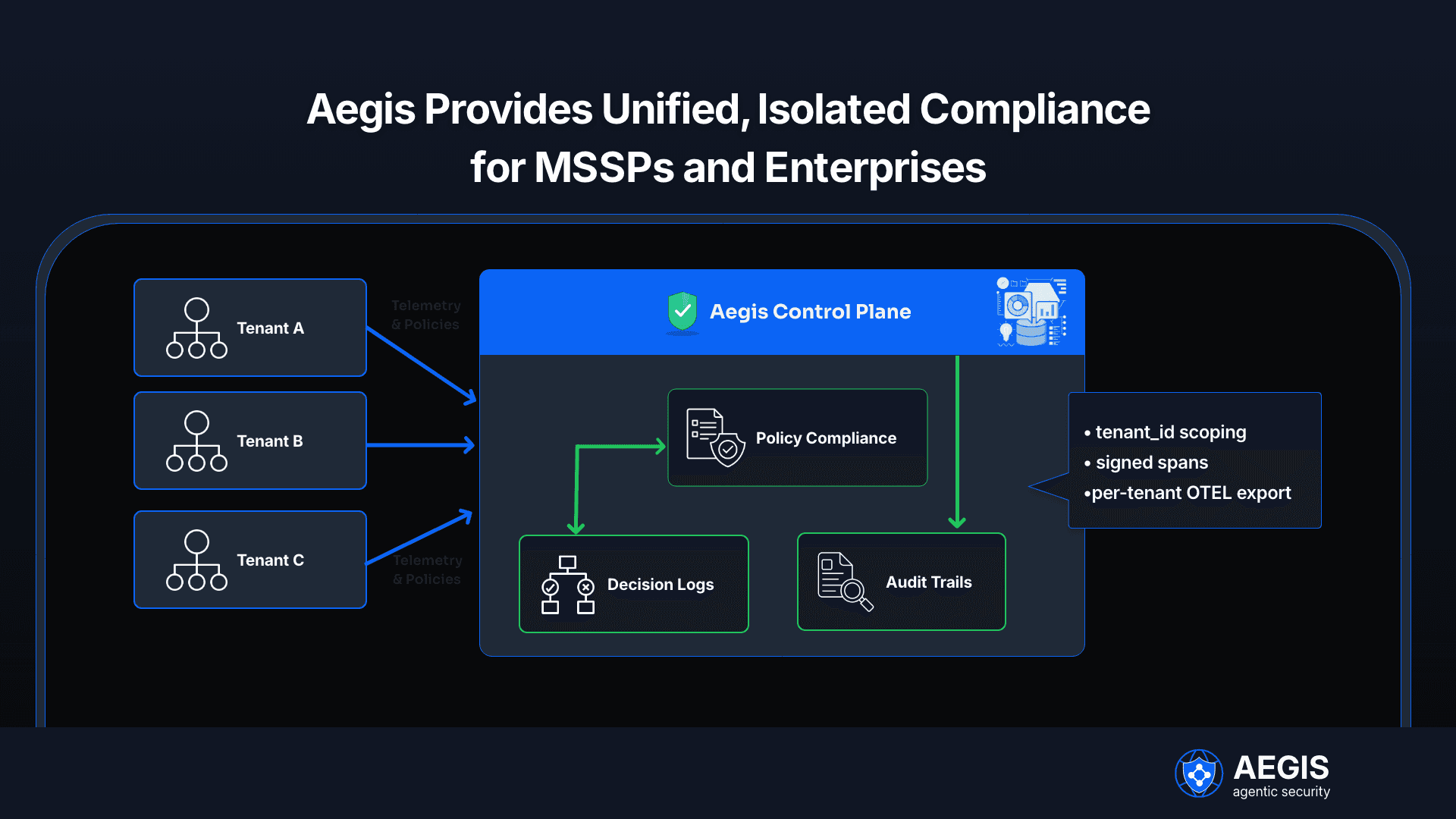
Compile per-tenant bundles and scope evaluation by tenant_id. Maintain versioned policies and ensure bundle metadata enforces tenant boundaries to avoid cross-tenant leakage. - Can Aegis help control FinOps spend?
Yes — policies can encode budgets, rate limits and per-agent daily caps. Aegis emits cost traces so FinOps teams can attribute and act.