
The Role of Retrieval-Augmented Generation (RAG) in Agent Workflows
Practical guide to using Retrieval-Augmented Generation (RAG) in agent workflows and how Aegis enforces evidence, provenance, and runtime policy.
%2520in%2520Agent%2520Workflows-1.png&w=3840&q=75)
Agentic RAG: Why retrieval-first agents reduce hallucinations and how Aegis enforces safe workflows
Introduction — In agentic systems, correctness is evidence-driven. Retrieval-Augmented Generation (RAG) — the combination of retrieving context and generating using that context — is a core pattern to reduce hallucinations and enable auditable agent decisions. This article walks through RAG fundamentals, how RAG should be embedded into agent workflows (agentic RAG), operational checklists, and a focused description of how Aegis — Aegissecurity runtime policy and observability gateway — enforces provenance, governance, and parameter safety for multi-agent deployments.
RAG fundamentals
Why RAG reduces hallucination
RAG splits the problem: retrieve likely-relevant facts, then condition generation on them. Recent literature and reviews show RAG systems significantly lower factual errors in domain tasks by grounding outputs in retrieved evidence rather than, or in addition to, the LLM’s parametric memory. Empirical studies and industry reviews from 2024–2025 highlight RAG pipelines as a primary mitigation for hallucination in structured outputs and domain-specific responses. (arXiv)
Key components
- Retriever: dense/sparse index returning candidate passages.
- Ranker: orders passages by relevance / trust score.
- Generator: conditions output on top-k evidence and indicates provenance.
- Evidence interface: structured blocks (source ID, snippet hash, score) attached to candidate outputs for auditing and human review.
Practical tip: optimize your retriever for the task — recall-heavy for open-ended research, precision-focused for emergent decisioning — and always attach source IDs and snippet hashes to the generator’s output for traceability. (Mindee)
👉🏻 Enable seamless collaboration across agents to complete tasks faster
RAG in agentic workflows
Agentic RAG: retrieve before you plan or act
In agentic contexts the sequence matters: retrieve → plan → decide → act. Agents that fetch evidence before creating a plan produce fewer incorrect actions because planners and executors see the same evidence snapshot. This “retrieval-first” approach also makes it possible to snapshot the chain-of-evidence for audits and rollback, and to present compact evidence blocks in human approval flows. Recent industry surveys show security and compliance remain top concerns for enterprise agent adoption — strengthening the case for built-in evidence and governance. (forumvc.com)
Evidence management and provenance
Operational requirements for proof and traceability:
- Store source IDs, snippet hashes and retrieval scores with every retrieved item.
- Snapshot evidence at the moment of decision and attach to telemetry (OpenTelemetry spans) so SOC and compliance can reconstruct full decision trees.
- Retain the index pointer (not raw PII) and use controlled retention policies to meet residency requirements.
Aegis enforces this model at runtime: it can require agents to include evidence blocks for any high-risk action, log the evidence snapshot, and deny actions when provenance is missing or signatures don’t match expected indices.
Poisoning defense & index hygiene
RAG introduces poisoning risk: malicious content in indices can mislead agents. Defenses include:
- Index hygiene: frequent re-indexing, provenance tagging, and chunking documents into semantically meaningful pieces.
- Source validation: whitelist authors, validate certificates, and run automated checks for anomalous embedding distributions.
- Shadow testing: run RAG agents against known-good queries to detect divergence or odd ranking behavior over time.
Operationally, cache “hot” retrievals for latency but validate caches against index changes to avoid stale or poisoned evidence. (ACL Anthology)
.png&w=3840&q=75)
Operational checklist
Metrics and observability
Track metrics that measure RAG effectiveness and operational risk:
- Evidence accuracy (percent of retrieved items that support the output).
- Action success rate: compare actions with vs without evidence attached.
- Shadow-mode would-block rate: how often a policy would have blocked an action if enforced.
- Latency budget for retrieval + policy check (P99 target).
Example metrics table:
Metric | Description | Target |
Evidence accuracy | % retrieved documents that are factually relevant | ≥ 90% for regulated workflows |
Policy decision latency (P99) | Time to evaluate policy + decision | ≤ 20 ms (goal) |
Shadow would-block rate | % of calls that would be blocked in enforce mode | used for tuning |
Audit coverage | % of actions with attached evidence snapshot | 100% for high-risk actions |
Sources recommend prioritizing telemetry to tie evidence snapshots to traces — enabling SOC teams to reconstruct decisions. (Orca Security)
Governance and policy
Governance practices for agentic RAG:
- Enforce which indices an agent can query by policy.
- Sanitize sensitive fields before retrieval (regex DLP on PII).
- Use domain-specific embeddings and chunking strategies to improve relevance.
- Tune retrievers for recall vs precision per task and budget for retrieval costs.
Aegis’s policy fabric allows security teams to declare which indices each agent may query, attach conditions (e.g., redaction required), and enforce these decisions in real time at the agent↔tool boundary. This reduces the chance of blind retrievals being used to justify unsafe actions.
👉🏻 Optimize agent performance with robust state handling techniques
How Aegis Delivers Runtime enforcement and auditability
Aegis is designed as a lightweight runtime policy and observability gateway that sits between orchestrators and tools, acting like “Istio + OPA for agents.” It enforces least privilege, verifies evidence snapshots, and generates auditable traces for compliance teams. The product architecture separates a data plane (proxy/sidecar + decision service) from a control plane (policy management, bundles, and token service), enabling low-latency policy checks and full auditability.
Key Aegis capabilities (operationally focused)
- Agent identity & per-agent policies: agents register with a unique ID and short-lived tokens; policies declare allowed tools, parameter constraints, budgets and approval thresholds.
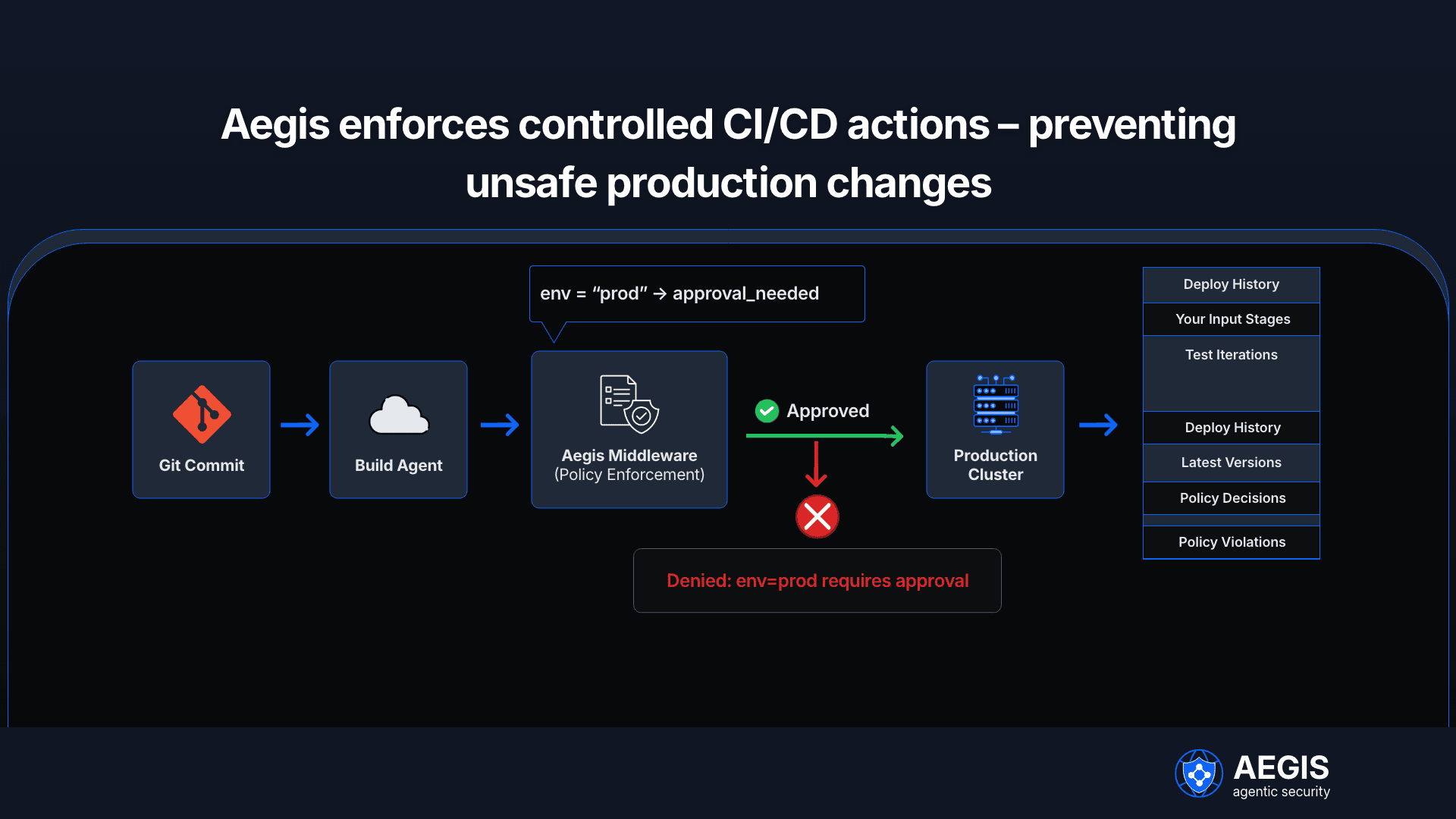
- Runtime enforcement & DLP: the gateway inspects calls for evidence snapshots and parameters; it can allow, deny, sanitize (redact) or pause for human approval (approval_needed).
- Telemetry & traceability: Aegis emits OpenTelemetry spans with agent_id, policy_version, decision_reason and evidence pointers — compliant with SOC workflows.
- Shadow mode and dry-run: teams can collect would-block metrics to tune retrievers and policies before enforcement flips to “on.”
Aegis in an agentic RAG pipeline
- Retriever returns top evidence; evidence IDs and snippet hashes are attached to the request.
- Planner forms a proposed action using the evidence.
- Before execution, Aegis evaluates policy: is the evidence acceptable? is the tool allowed? do parameters match constraints? If high risk, hold for approval; otherwise allow.
- Aegis logs the snapshot and decision, and emits a signed span for archive.
This flow enforces provenance and prevents common attack vectors such as tool coercion (planner convincing a finance agent to make unauthorized payments) and silent exfiltration. Example scenario: a planner tries to coerce a finance agent into a $50,000 transfer — Aegis blocks the call if the finance-agent policy caps amounts at $5,000 or requires approval above that threshold.
Table — Aegis enforcement outcomes
Situation | Aegis action | Telemetry emitted |
Agent calls disallowed tool | Deny + PolicyViolation | span + policy_version + reason |
High-value payment | Pause → approval_needed | approval_id + pending span |
Missing evidence snapshot | Deny or require re-retrieval | evidence_missing flag |
PII detected in parameters | Sanitize + allow/deny per policy | sanitized_fields list |
For technical teams: Aegis targets P99 policy evaluation latencies ≤ 20 ms using OPA prepared queries, hot-reloaded bundles, and caches. The control plane compiles YAML policies into OPA bundles, simplifying policy-as-code for security engineers.
Deployment and scaling notes
- Shard indices by tenant for privacy and performance; enforce tenant-scoped policies to avoid cross-tenant leakage.
- Cache hot evidence but validate cache coherence when indices update.
- Use shadow mode for an initial 7-day tuning window, then progressively enforce with staged rollouts.
- Integrate approval channels (Slack/Teams) for human overrides and emit one-time override tokens to retry safely.
Practical checklist (quick)
- Attach evidence IDs & snippet hashes to every retrieval.
- Enforce per-agent index permissions.
- Run policies in shadow mode; collect would-block metrics.
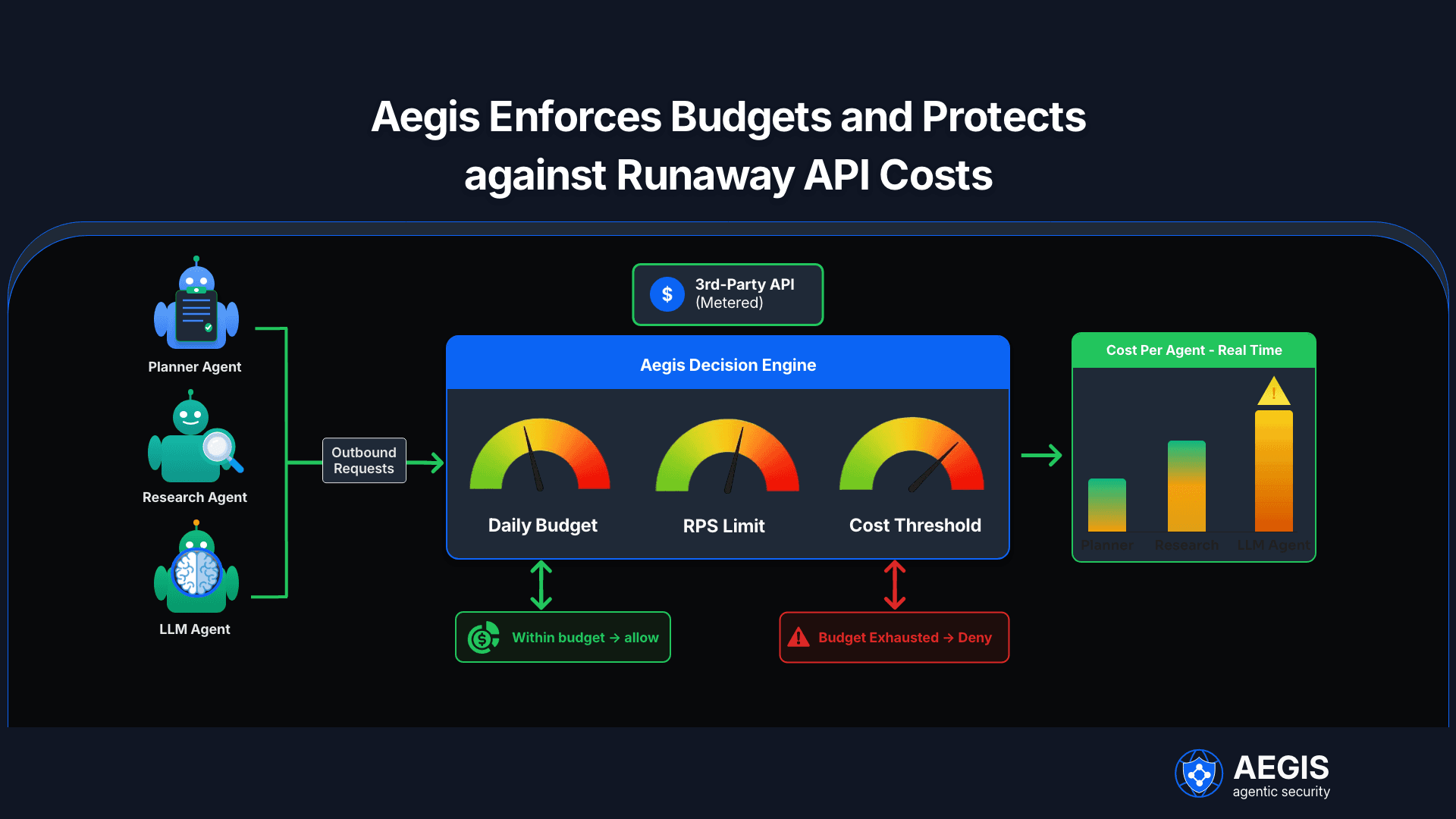
- Set budgets and rate limits to prevent runaway costs.
- Log signed OpenTelemetry spans including policy_version and approval_id.
👉🏻 Design scalable data pipelines for multi-agent environments
Frequently Asked Questions
Q: How does RAG affect latency for real-time agents?
A: Retrieval + generation adds latency; mitigate with caching for hot queries, smaller context windows, and prepared index shards. Target P99 policy evaluations under 20 ms with prepared OPA queries.
Q: Can indexes be poisoned to mislead agents?
A: Yes — defend with index hygiene, source validation, embedding anomaly detection, and shadow testing. (ACL Anthology)
Q: What evidence should an agent attach?
A: Source ID, snippet hash, retrieval score, and a compact text snippet. Store snapshot references (not full PII) in your audit trail. (Mindee)
Q: How does Aegis integrate with orchestrators?
A: Aegis offers middleware/SDKs for common orchestrators and can be deployed as a sidecar or forward proxy to intercept tool calls with minimal app code changes.