
Data Orchestration Patterns for Multi-Agent Systems
Practical patterns for secure, declarative orchestration of multi-agent systems with Aegis runtime policies and observability.
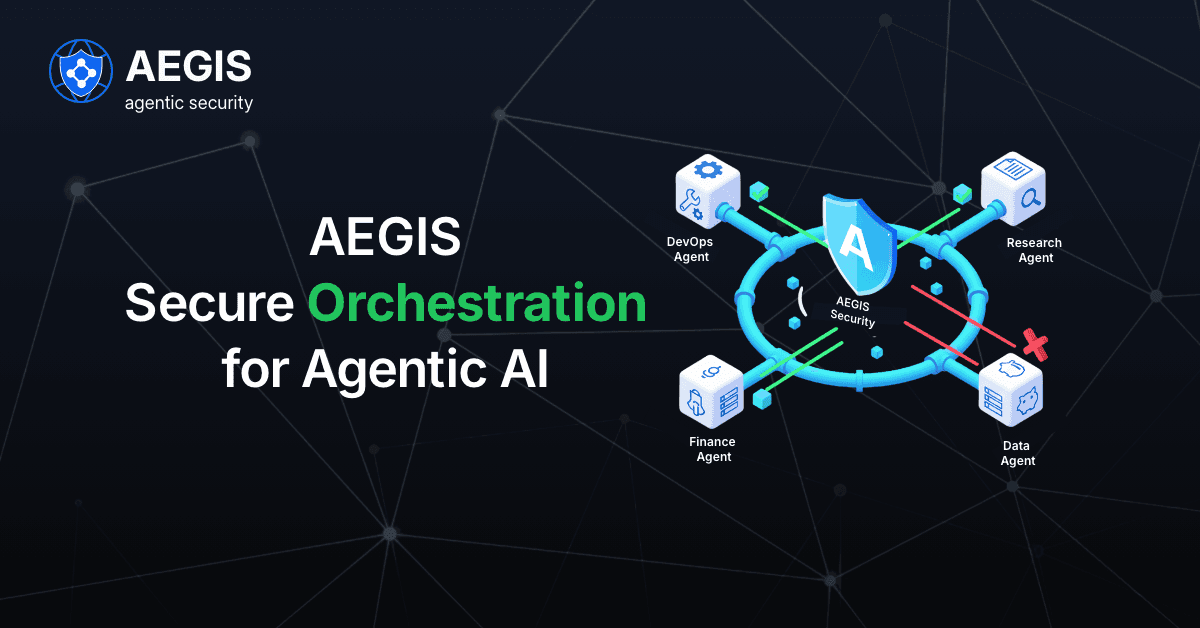
Aegis: Secure Orchestration Patterns for Agentic AI
Agentic AI — autonomous agents working together to complete multi-step tasks — is moving fast from experiment to production. That velocity exposes real operational and security gaps: race conditions in complex workflows, untrusted handoffs, parameter injection, and opaque audit trails. This article summarizes common anti-patterns, prescribes declarative workflow and data-contract patterns, and explains how Aegis — a runtime policy and observability gateway — enforces least privilege, validates call chains, and produces auditable traces for regulated and multi-tenant environments. The technical recommendations and examples are drawn from the Aegis product brief and design files.
Common orchestration anti-patterns
Monolithic orchestrator and brittle choreography
Many teams start with a single orchestrator that issues direct tool calls on behalf of agents. That pattern centralizes control but also concentrates risk: a single misconfigured step can cause lateral coercion (one agent forcing another to act), data leakage, or runaway spend.
Webhook spaghetti and implicit contracts
Choreography built on ad-hoc webhooks and unversioned payloads produces brittle systems. Webhooks are often fire-and-forget; missing idempotency and dead-letter handling leads to duplication and inconsistent state across agents and tools. The result: race conditions and hard-to-debug failures.
👉🏻 Enable seamless collaboration across multiple AI agents
Insufficient runtime policy checks
IAM alone (who can call what API) is not enough for agentic workflows. Policies must evaluate call parameters (amount ranges, destination patterns), parent/child chains, and contextual conditions (time, tenant, budget). Without this, planners can coerce finance flows, or agents can exfiltrate data via unmanaged egress.
Statistics: enterprise adoption of agentic systems is increasing — recent industry surveys show ~23% of organizations scaling agentic AI and many more experimenting — driving demand for runtime governance. (McKinsey & Company)
Declarative workflow patterns and data contracts
Why declarative orchestration
A declarative workflow engine expresses explicit handoffs and versioned data contracts between nodes. With a declarative graph:
- each transition can be validated against a schema,
- policies can be evaluated at step boundaries,
- rollout is safer (shadow mode → enforce).
Pattern: orchestrator emits a workflow graph; each node call is annotated with parent_agent_id and a schema version. Consumers validate inputs and emit structured traces. Aegis validates node calls and enforces per-step policies to prevent lateral coercion.
Parent/child call validation (chain-of-trust)
Chain-of-trust enforces that agent B acts only on explicit, validated instructions from agent A. Practical measures:
- include parent_agent_id and parent_request_id headers,
- require signed attestation or short-lived JWTs with agent claims,
- enforce schema version checks and idempotency tokens.
.png&w=3840&q=75)
Declarative contract example (schema-level checks)
Field | Contract rule | Enforcement action |
amount | integer, max 5000 | deny if >5000 |
account_id | regex ^acct_[0-9a-f]{8}$ | sanitize / deny |
parent_agent_id | required | deny if missing |
(Example policy above maps directly to Aegis policy bundles that compile to the runtime evaluator.)
Operational controls: retries, dead-letter queues, idempotency
Operational resilience is essential; security controls must not create brittle systems. Best practices:
- Use durable queues (message queue or task store) for handoffs so retry, backoff and visibility are built-in.
- Embrace idempotent operations by requiring a client-supplied idempotency key per workflow action.
- Dead-letter queues (DLQs) capture malformed or repeatedly failing messages for manual triage and audit.
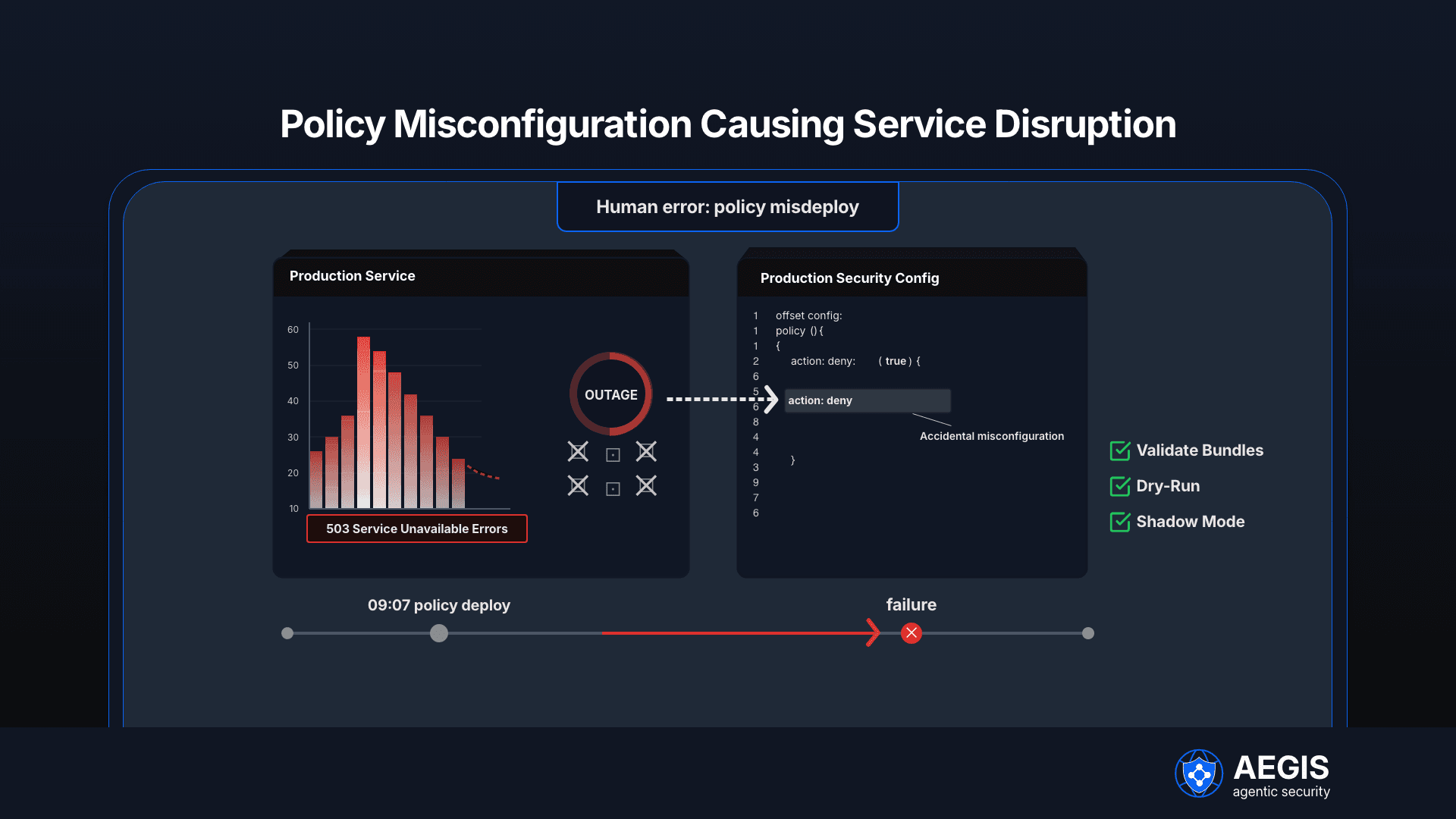
- Run policies in shadow mode first to gather "would-block" telemetry and tune thresholds before enforcing.
Operational control checklist
Control | Purpose | Recommended threshold |
Idempotency keys | Prevent duplication | Required per write action |
Dead-letter queue | Triage failing messages | Capture after 3 retries |
Retry policy | Backoff and jitter | Exponential backoff, max 5 retries |
Shadow mode | Policy tuning | 7–14 day observation window |
These controls work in concert with a runtime gateway like Aegis that inspects calls, enforces idempotency rules, and emits traceable telemetry.
👉🏻 Map complex agent interactions with graph-based models
How Aegis fits: runtime enforcement, telemetry, and developer workflow
Approximately one third of operational concerns for agentic systems are security and governance. Aegis addresses these by providing a lightweight policy-and-observability fabric tailored to multi-agent architectures. Below are the technical capabilities and how they map to real-world needs.
Runtime policy enforcement and identity
Aegis sits as a gateway (sidecar or forward proxy) between orchestrators and tools. It performs:
- Agent identity verification (short-lived JWTs with agent/tenant claims).
- Parameter inspection and OPA-based policy evaluation (allow, deny, sanitize, approval_needed).
- Block or redact unsafe parameters and return standardized PolicyViolation errors.
Example scenario: a planner requests a finance transfer of $50,000. Aegis checks the finance-agent policy (max_amount=5000) and blocks, emitting an OTel span and a PolicyViolation response.
Observability and auditable traces
For compliance and SOC workflows, Aegis emits structured OpenTelemetry spans and signed audit events that include: agent_id, tool, decision, policy_version, and approval_id. Dashboards surface blocked events, top offending agents, and cost-by-agent metrics for FinOps.
👉🏻 Control execution flow with structured DAG orchestration
-1.png&w=3840&q=75)
External standards alignment: OpenTelemetry adoption is widespread in cloud-native stacks; projects report near-50% adoption among end-user companies, making Aegis’s use of OTel a practical integration point for observability. (OpenTelemetry)
Developer and operator experience
Aegis provides:
- Policy-as-code (YAML/JSON) that compiles to OPA bundles and hot-reloads.
- CLI/SDKs for LangChain/LangGraph and similar orchestrators to minimize integration effort.
- Shadow mode for safe rollout, dry-run simulations, and policy version history with rollbacks.
Enterprise use cases (operational + compliance)
- High-risk payments (FinTech): enforce per-agent ceilings, require approval for high-value transfers, and attach an approval_id to retries.
- PHI/PII protection (Healthcare): deterministic DLP rules at the parameter level; redact SSN/dob fields; deny egress to unapproved domains.
- DevOps gating (CI/CD): block production deploys unless explicit production-approved agent and approval token are present.
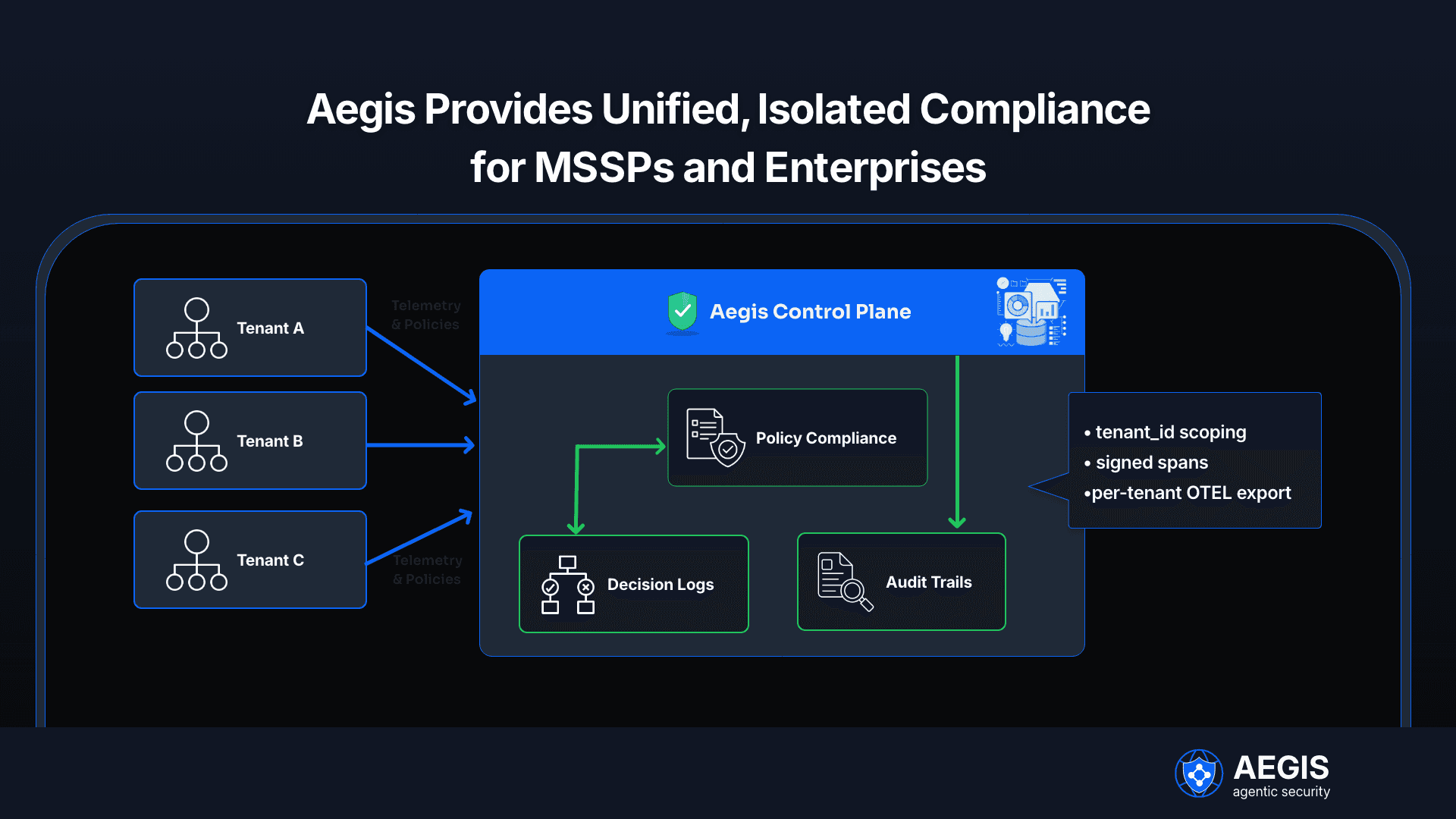
- Multi-tenant MSSP operations: tenant-scoped bundles and signed traces for SIEM ingestion.
Implementation checklist and metrics
Adopt the following phased approach:
- Inventory critical tools and map required policy coverage.
- Deploy Aegis in shadow mode; collect would-block telemetry for 7–14 days.
- Tune regex/amount thresholds; enable idempotency and DLQs.
- Flip to enforce mode; integrate signed spans to the SIEM.
Key MVP metrics to track (targets from Aegis brief): policy enforcement latency (P99 ≤ 20 ms), policy coverage ≥ 80% for critical tools, and 100% of agent-tool calls traced in the pilot.
Two quick comparison tables
Capability | Legacy orchestration | Declarative + Aegis |
Parameter inspection | Ad-hoc, custom | Centralized, policy-as-code |
Auditability | Sparse logs | Signed OTel spans + audit history |
Approvals | Manual, inconsistent | Policy-driven, integrated |
Egress control | Network-only | Tool + parameter-level control |
Policy decision outcomes | Meaning |
allow | proceed, trace emitted |
deny | block, PolicyViolation response |
sanitize | redact fields, allow with safe payload |
approval_needed | pause, send approval request, issue override token on approve |
Frequently Asked Questions
Q: Can Aegis integrate without rewriting orchestrator code?
A: Yes — Aegis offers middleware/SDKs for common orchestrators and supports a proxy/sidecar model so most traffic can be routed through the gateway with minimal agent changes.
Q: How do approvals scale?
A: Policies can set thresholds to reduce unnecessary approvals, route approvals to automated channels (Slack/Teams), and issue one-time override tokens to limit human involvement.
Q: Does runtime policy enforcement add significant latency?
A: Properly tuned OPA prepared queries and in-memory caches aim for P99 decision latencies under 20 ms. Aegis targets minimal proxy overhead through caching and optional WASM compilation.
Q: How does Aegis support multi-tenancy?
A: Bundles are tenant-scoped with versioning and signed manifests to prevent cross-tenant policy bleeding. Control plane stores per-tenant bundles and supports hot-reload.
Secure the handoffs, not just identities
As agentic AI moves into production, the security focus must shift from "who calls what" to "what was requested, why, and under whose authority." Declarative orchestration, explicit data contracts, and a runtime enforcement fabric like Aegis close the loop: they prevent lateral coercion, enforce parameter-level controls, and produce the traces auditors and SOC teams need. Adoption is accelerating (enterprise surveys and industry reports highlight growing agentic deployments and security concerns), so building these patterns into your deployment plan now will reduce both operational friction and compliance risk. (McKinsey & Company)