The Role of Regulatory Sandboxes in Agentic Innovation
How regulatory sandboxes enable safe agentic AI innovation through monitored experimentation—and how Aegis powers compliant telemetry and control.
The Role of Regulatory Sandboxes in Agentic AI Innovation
Enterprises are rushing to deploy agentic AI—autonomous agents that execute tasks across APIs, systems, and workflows. Yet regulators remain cautious, worried about unpredictable outcomes, data misuse, or ethical breaches. This tension—between innovation and accountability—has given rise to regulatory sandboxes: controlled environments that allow organizations to test agentic systems under regulatory supervision.
In 2025, over 40 national regulators—from the UK’s Financial Conduct Authority to the European Data Protection Supervisor (EDPS)—have launched sandbox initiatives focused on AI, data privacy, and fintech innovation. These programs let companies test cutting-edge AI systems while meeting safety and compliance expectations.
Within this new model, Aegis by Aegissecurity provides the telemetry, policy enforcement, and auditable decision records that align precisely with sandbox requirements. It bridges the gap between experimentation and regulatory confidence.
What Regulatory Sandboxes Are—and Why They Matter for Agentic AI
Regulatory sandboxes are supervised experimentation zones where organizations can trial emerging technologies with real or synthetic data, within predefined guardrails. Their goal: accelerate innovation without exposing users or systems to unacceptable risk.
Controlled Experimentation for AI Systems
Traditional pilots often occur behind closed doors, with minimal oversight. Regulators learn of outcomes after the fact—too late to influence or correct. In contrast, sandboxes establish a continuous feedback loop between innovators and supervisors. Firms can demonstrate compliance mechanisms in real time and receive faster clearance for broader deployment.
Key features of an AI sandbox include:
Feature | Description |
Defined Scope | Clear boundaries on functionality, data types, and experiment duration |
Telemetry Requirements | Continuous monitoring of AI behavior and decision traces |
Reporting Cadence | Regular reports shared with regulators, including incident summaries |
Escalation Paths | Clear protocols when risk thresholds are breached or anomalies detected |
Exit Criteria | Objective metrics to determine when the system can move to production |
This environment makes sandboxes ideal for agentic AI, where dynamic reasoning and multi-agent collaboration introduce new categories of risk. Regulators can observe how agents reason, escalate, and comply—without waiting for an audit six months later.
👉🏻 Strengthen your risk posture with NIST-aligned AI practices
Technical Controls Sandboxes Require
To operate within a regulatory sandbox, organizations must provide transparent telemetry, policy traceability, and proof of governance. These aren’t just bureaucratic boxes—they’re technical enablers of safe innovation.
Telemetry, Approvals, and Policy Versioning
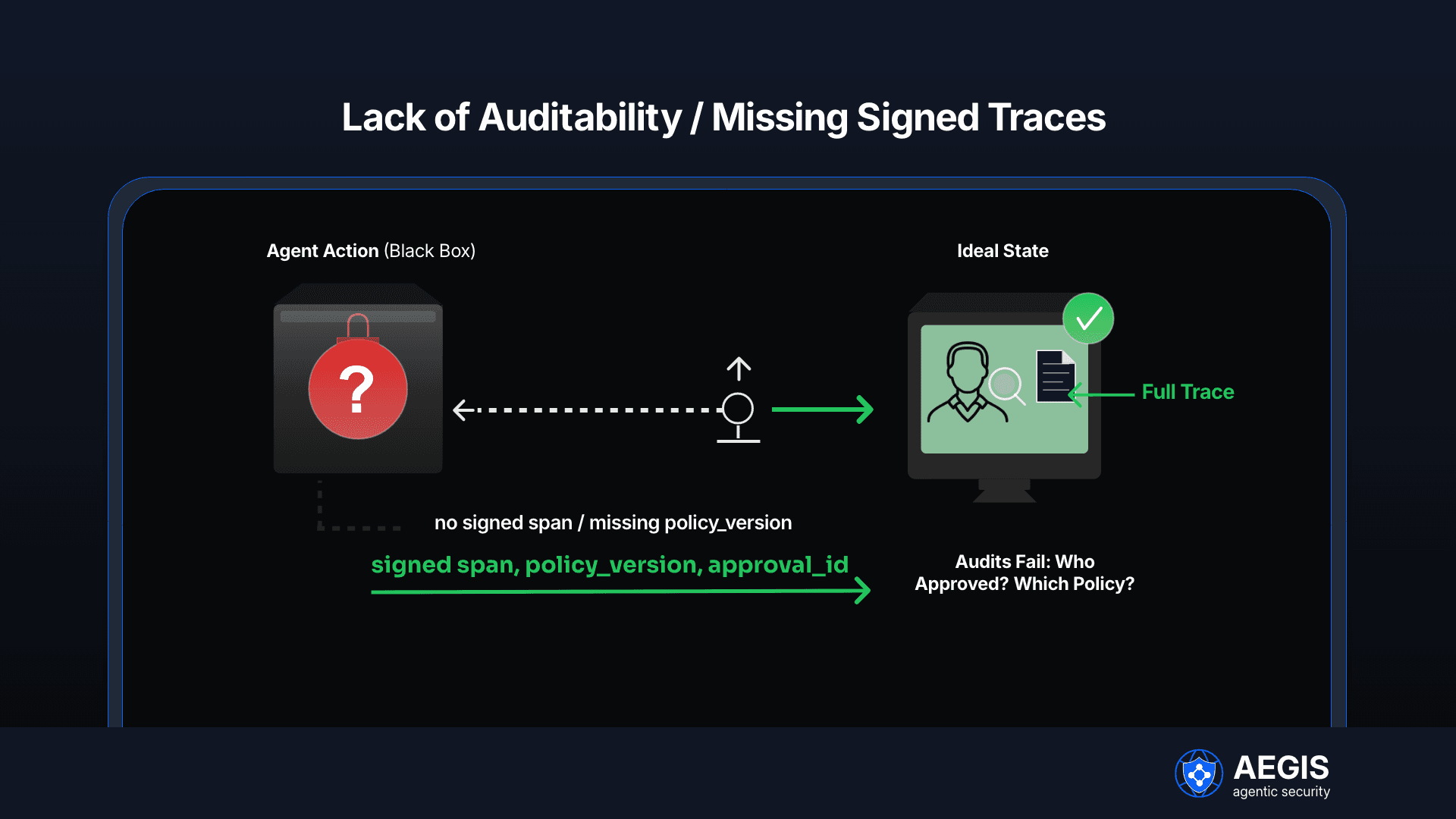
In a sandbox, every AI action must be observable and attributable. This means:
- Telemetry: Each agent call must emit structured logs (who acted, what tool was used, parameters, and decision outcome).
- Approvals: High-risk actions—like financial transfers or PII exports—must pause for human sign-off.
- Policy Versioning: Every decision must be traceable to the exact policy version active at runtime.
These requirements match the core of Aegis Gateway’s architecture, which enforces policy-as-code, real-time decisioning, and signed telemetry artifacts.
👉🏻 Get ahead of regulation with future-ready AI governance
.png&w=3840&q=75)
Aegis acts as a runtime policy and observability fabric. Each AI agent call passes through a sidecar or proxy where policies—written in YAML or JSON—are evaluated by Open Policy Agent (OPA). Every allow, deny, or approval-needed decision generates OpenTelemetry spans, feeding structured data into compliance dashboards and sandbox reports.
This approach ensures that every decision is both explainable and verifiable, meeting regulator expectations for accountability and auditability.
👉🏻 Lead AI adoption with strong governance and clear accountability
Case Studies and Sandbox Playbook
Real-world sandboxes illustrate how agentic AI innovation can progress safely under watchful regulatory eyes. Let’s explore three examples.
FinTech Sandbox: Payment Authorization Controls
A fintech firm participating in a UK regulatory sandbox pilots agentic payment automation. The rule: any transfer above $10,000 requires regulator-visible approval.
Old model: Manual review and spreadsheet logs, often delayed by days.
Sandbox model with Aegis:
- Aegis enforces per-agent limits (max_amount: 10000).
- High-value requests trigger a Slack approval workflow.
- Regulator dashboard shows signed traces for each transaction.
Outcome: Approval latency dropped by 70%, and time-to-clearance for the production launch shortened from six months to two.
Healthcare Sandbox: Safe EHR Automation
A healthcare provider collaborates with the EDPS in a data-protection sandbox to validate agentic EHR automation.
Aegis enforces deterministic DLP (redacting SSNs, DOBs) and blocks data exports beyond approved regions. Signed logs confirm that no PHI left the EU data boundary during the test.
This transparent auditability convinces regulators to grant “safe-to-scale” certification—allowing deployment across multiple hospitals.
SaaS/DevOps Sandbox: Shadow Enforcement
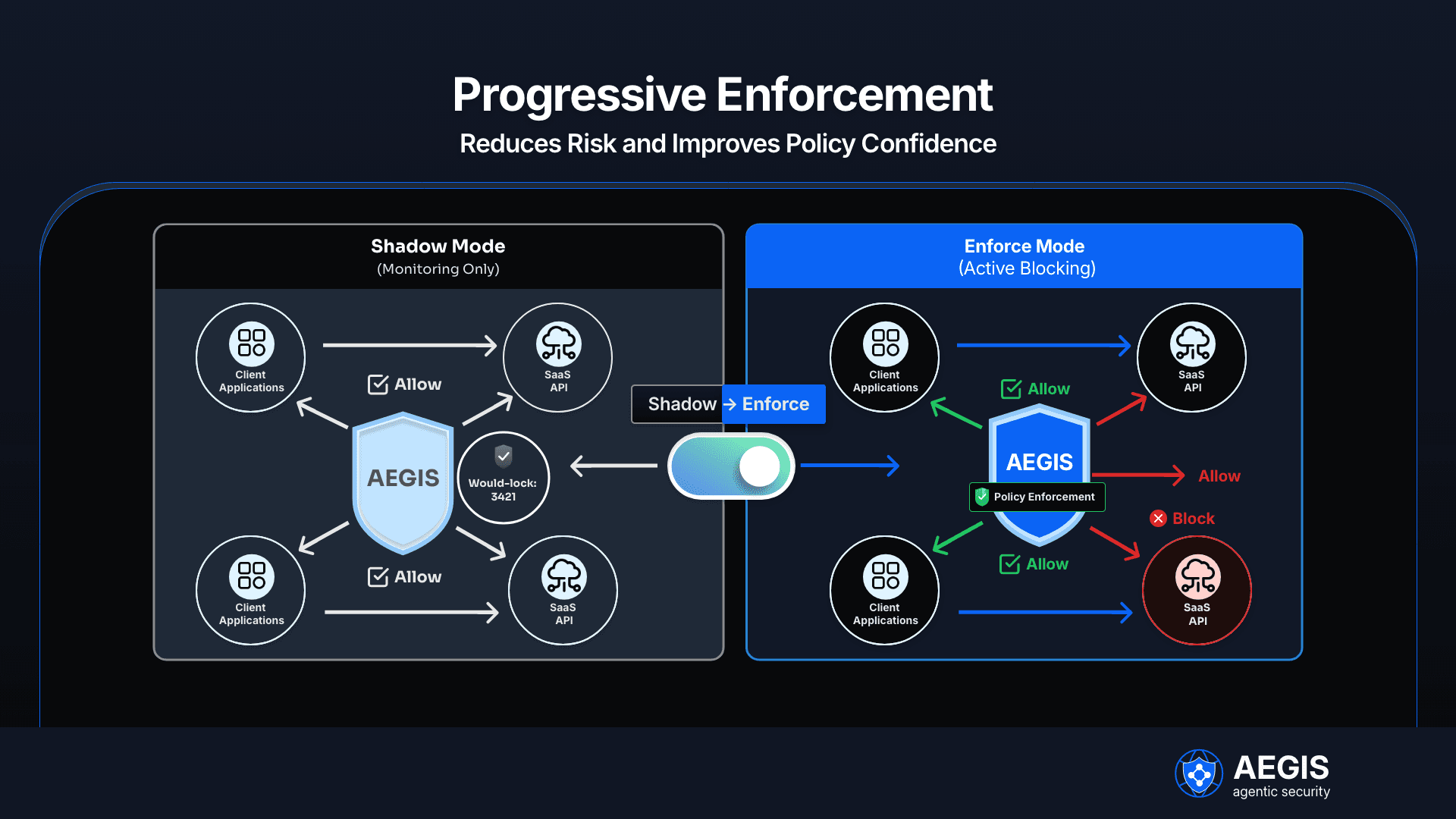
A SaaS vendor tests a shadow enforcement mode—observing what would happen if policies were active but without blocking traffic. Over a week, Aegis identifies 87 would-block events tied to parameter misconfiguration.
By adjusting policies before enforcement, the team avoided potential service disruption—a model case of sandbox learning before enforcement.
Aegis - Accelerating Sandbox Acceptance
Regulatory sandboxes thrive on data-driven trust—and Aegis is built to deliver it. Acting as a security and observability mesh for multi-agent systems, Aegis provides the compliance-grade infrastructure sandboxes demand.
1. Continuous Evidence Generation
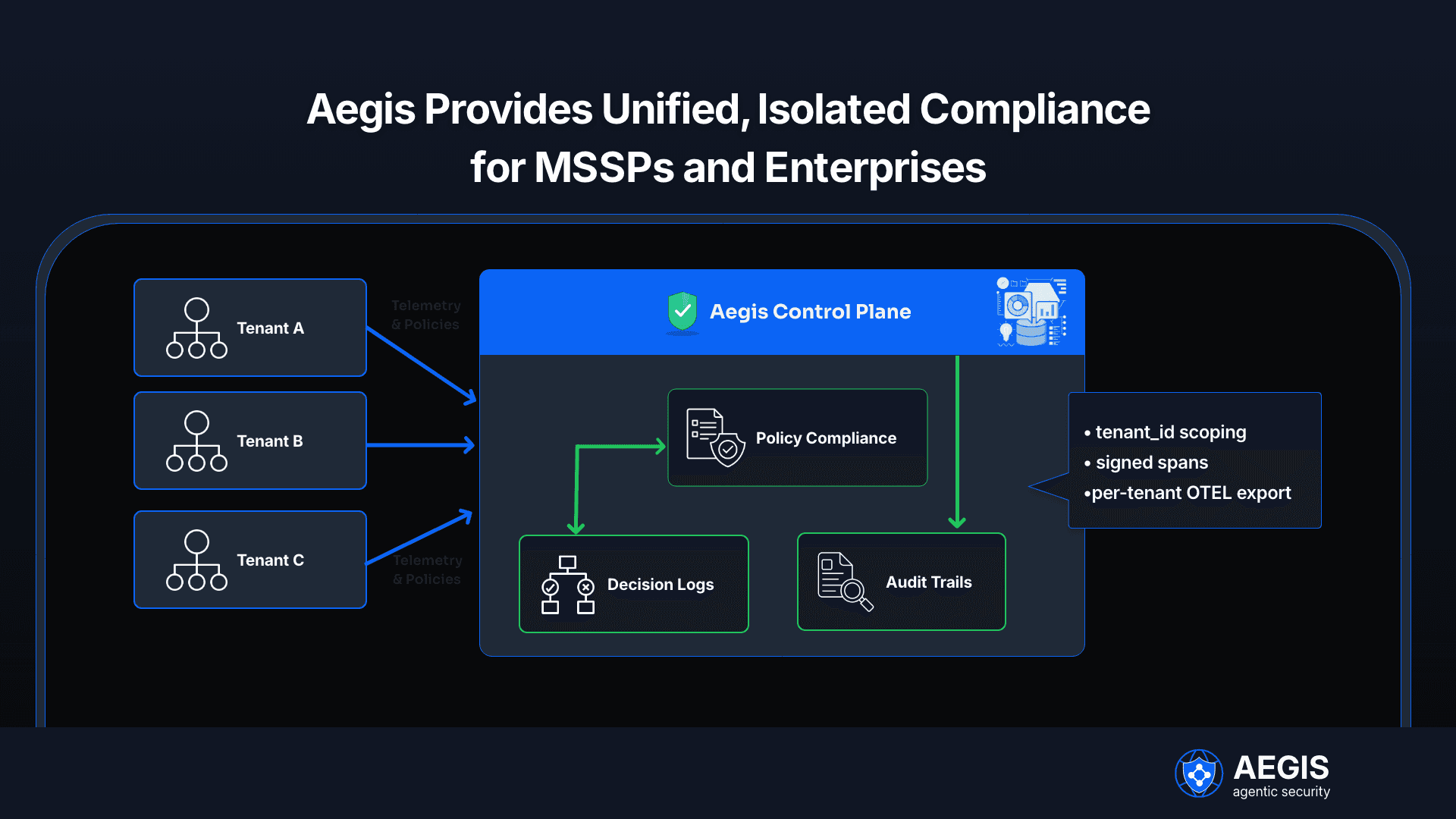
Every decision Aegis makes is signed, structured, and exportable. Logs include agent ID, tool, parameters, decision reason, and policy hash. These become regulator-ready artifacts, supporting automated compliance reports or external audits.
Artifact Type | Purpose | Example Output |
Signed Trace | Immutable record of agent action | agent=finance, decision=deny, reason=max_amount_exceeded |
Policy Bundle Hash | Verifies the policy version applied | bundle_hash=abcd1234 |
Approval Log | Human-in-loop confirmation | approval_id=5678, approver=soc_team |
DLP Proof | PII redaction verification | redacted_fields=["ssn", "dob"] |
These outputs reduce regulator workload and make sandbox results credible and repeatable.
2. Policy-as-Code for Sandbox Governance
Aegis enables security and compliance teams to codify sandbox boundaries as policies:
agent: finance-agent
allowed_tools:
- name: stripe-payments
actions:
- create_payment
conditions:
max_amount: 10000
approval_needed: true
Policies can be updated or rolled back instantly, and sandbox-specific configurations (e.g., data residency or approval thresholds) are isolated per environment.
3. Real-Time Compliance Dashboards
Aegis’s observability plane emits OpenTelemetry data for regulators and enterprise SOCs alike. Dashboards show decision ratios, approval frequencies, and anomaly spikes.
This provides shared visibility between innovator and regulator—key for sandbox trust.
4. Safe Exit to Production
Once sandbox tests pass defined thresholds (e.g., <0.1% policy violations, stable approval cadence), Aegis can promote those same policies into production.
This continuity ensures that what worked in the sandbox remains enforceable in live environments, accelerating time-to-market while maintaining compliance assurance.
The Regulatory Sandbox Playbook for Agentic AI
For teams preparing to enter or design a sandbox, consider the following checklist.
Category | Key Practice | Aegis Capability |
Scope Definition | Identify agent workflows, tools, and data classes to include. | Policy registry and per-agent configuration |
Telemetry Setup | Enable full trace collection with signed spans. | OpenTelemetry integration, SIEM export |
Approval Design | Define thresholds for human oversight. | Slack/Teams approval workflows |
Compliance Outputs | Produce regulator-facing evidence packs. | Structured JSON, redaction proofs |
Exit Criteria | Quantify readiness for production. | KPIs: violation rate, approval frequency, latency |
Best practice: engage regulators early, align sandbox metrics with policy telemetry, and involve both SOC and legal stakeholders during sandbox design.
Economics and Organizational Benefits
From a business perspective, regulatory sandboxes reduce time-to-clearance and commercial uncertainty.
By partnering with regulators early and instrumenting experiments via Aegis, firms can demonstrate:
- Reduced approval cycles (by up to 60%)
- Lower compliance costs through automation of evidence generation
- Faster transition from test to scale, using the same Aegis enforcement plane
Sandboxes de-risk innovation by turning compliance into a continuous process, not a post-launch audit.
Organizations adopting this model report improved regulator confidence and smoother multi-jurisdictional rollouts—particularly for multinational AI initiatives constrained by regional data laws.
Frequently Asked Questions
1. What is a regulatory sandbox for AI?
A regulatory sandbox is a controlled environment supervised by regulators where companies can test innovative AI solutions with real data under defined safeguards.
2. How does Aegis support sandbox requirements?
Aegis provides real-time policy enforcement, telemetry, and signed audit trails that meet sandbox reporting and accountability needs.
3. Can Aegis handle data residency and cross-border rules?
Yes. Aegis supports per-tenant routing and policy scoping to ensure data remains within regional boundaries.
4. How do regulators benefit from Aegis’s telemetry?
Regulators gain transparent, structured insights into agent decisions, reducing manual reporting overhead.
5. Is Aegis limited to sandbox environments?
No. While ideal for sandbox validation, Aegis policies and telemetry can seamlessly extend to production systems.
6. What KPIs define sandbox success?
Key metrics include regulator sign-off rate, time-to-clearance, policy violation rate, and the number of sandboxed flows promoted to production.