
The Role of Cloud Providers in Multi-Agent AI Ecosystems
Practical guide to running agentic AI securely in cloud environments: runtime policy mesh, sidecars, data residency and FinOps controls.
Aegis: Cloud Playbook for Agent Security
Enterprises deploying multi-agent AI systems need a new layer of runtime governance: a fast, auditable policy mesh that treats agents like first-class principals. This guide explains operational responsibilities for cloud providers, practical architecture patterns, and an implementation-focused blueprint for Aegis — Aegiscurity runtime policy and telemetry gateway for agentic AI workloads. It assumes you run agent orchestrators (LangGraph, AgentKit, custom stacks) on cloud compute and need deterministic controls for egress, identity, cost, and compliance.
Why cloud primitives matter for agents
Agent workloads create new attack surfaces and operational risks: parameter injection, silent egress, uncontrolled spawn-and-bill, and lateral coercion between agents. Recent industry research shows a meaningful portion of organizations are scaling or experimenting with agentic AI: McKinsey reports 23% of respondents are scaling agentic systems and another 39% are experimenting, highlighting how quickly this model is being adopted. (McKinsey & Company)
Cloud providers are not neutral here — their networking, KMS, object stores, and regional primitives directly determine what you can enforce at runtime. Aegis treats cloud features as first-order controls: sidecar proxies for enforcement, object stores for signed bundles, KMS for token signing, and VPC egress for data-residency enforcement.
👉🏻 Evaluate deployment models to match your scalability and control needs
Key responsibilities for cloud + runtime mesh
Cloud primitives to leverage
Networking and isolation
Use private endpoints, VPC peering and per-tenant VPCs to isolate agent traffic. Route agent egress through regional NATs and sidecar Envoy instances to enforce allowlists and replay protection.
Storage, signing, and manifests
Store compiled policy bundles in object storage (S3/GCS). Publish a signed manifest with an ETag and KMS signature so sidecars can validate integrity before hot-reloading bundles.
Identity and key management
Short-lived JWTs minted by the control plane should include org, tenant, agent_id and scope claims and be signed with Ed25519 keys stored in the cloud KMS. Use JWKS endpoints for stateless verification and a Redis JTI store for replay protection.
Observability & FinOps
Emit OpenTelemetry spans for every decision: agent_id, tool, policy_version, cost_estimate. Integrate cloud metrics and billing APIs to compute per-agent spend and expose budgets as policies (e.g., daily_budget: $20).
👉🏻 Compare open and closed solutions to choose the right path forward
Aegis architecture
Aegis is a runtime policy and telemetry gateway that sits between agent orchestrators and tools. It uses a sidecar/forward-proxy pattern (Envoy ext_authz) for transparent enforcement, and a compact control plane to manage policy bundles, tokens, and approvals.
Data plane — sidecars and decision service
Sidecars deployed alongside agent processes intercept outbound calls. For HTTP, Envoy’s ext_authz calls Aegis’s decision API with structured metadata. The decision service loads tenant-scoped OPA bundles (compiled from policy-as-code YAML) and returns allow / deny / sanitize / approval_needed decisions. Decisions carry attestations and an optional signed claim for auditability.
👉🏻 Integrate agents seamlessly with your existing tech stack
Control plane — bundles, token service, approvals
Control plane compiles YAML policies into OPA bundles, signs manifests and stores them in S3/GCS. A token service exchanges organisation keys for short-lived JWTs. Approval flows (Slack / MS Teams) generate one-time override tokens for manual authorizations.
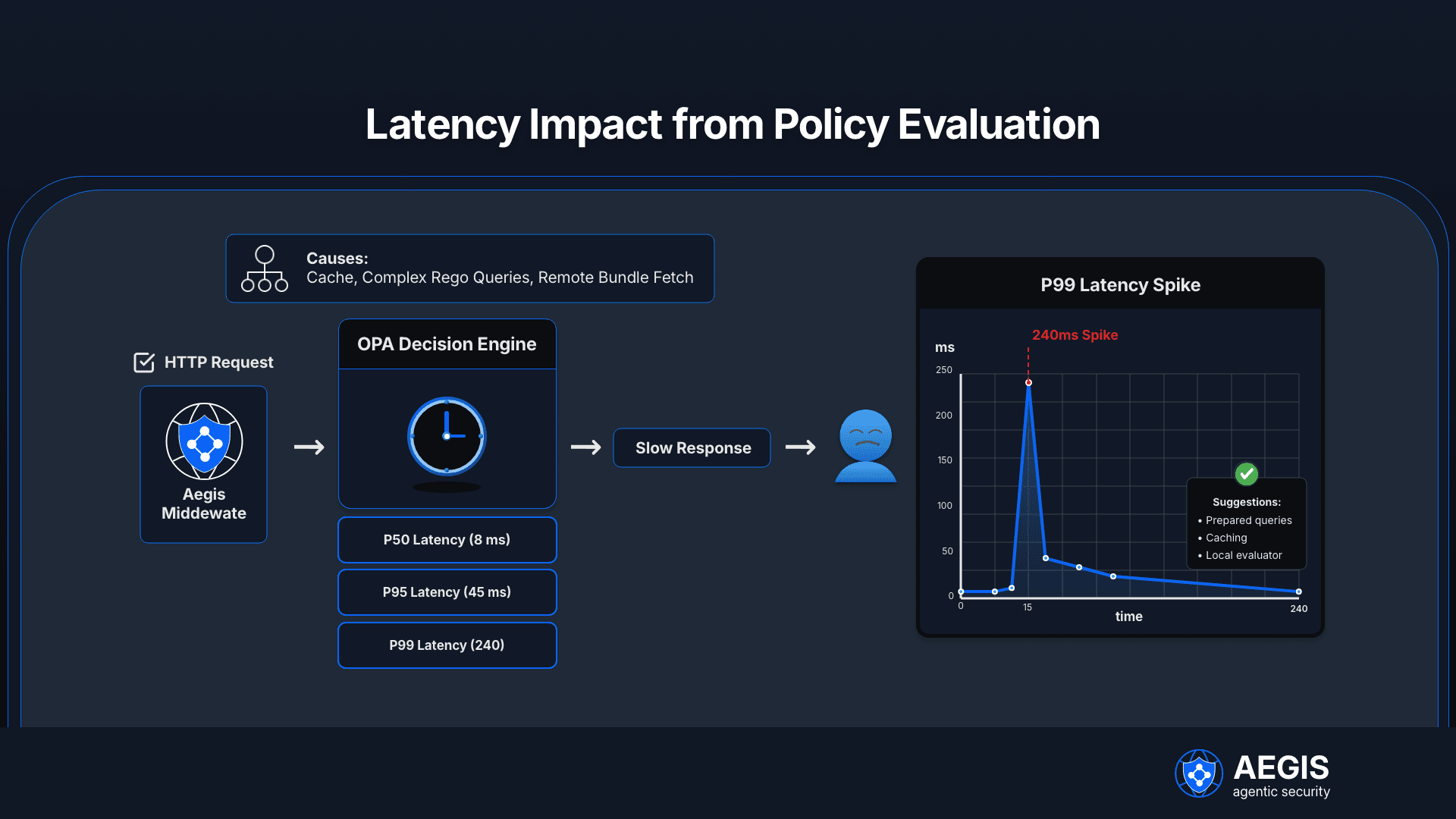
Table 1 — Core Aegis data-plane metrics
Metric | Target (MVP) | Why it matters |
Decision latency (P99) | ≤ 20 ms | Interactive agents need tight tail latency |
Policy coverage | ≥ 80% of pilot tools | Ensure high-risk connectors are protected |
Traces per call | 100% | Required for audit and SOC review |
Per-agent budget enforcement | Yes | Prevent runaway spend (FinOps) |
Deployment patterns and cloud integration notes
Sidecar + Helm + Terraform
Deploy Aegis control plane on managed Kubernetes using a Helm chart. Provide Terraform modules for cloud primitives: S3/GCS buckets, KMS keys, service account bindings, logging sinks and managed Redis for jti replay. The data plane is stateless; scale horizontally to meet P99 SLAs.
Multi-cloud and region routing
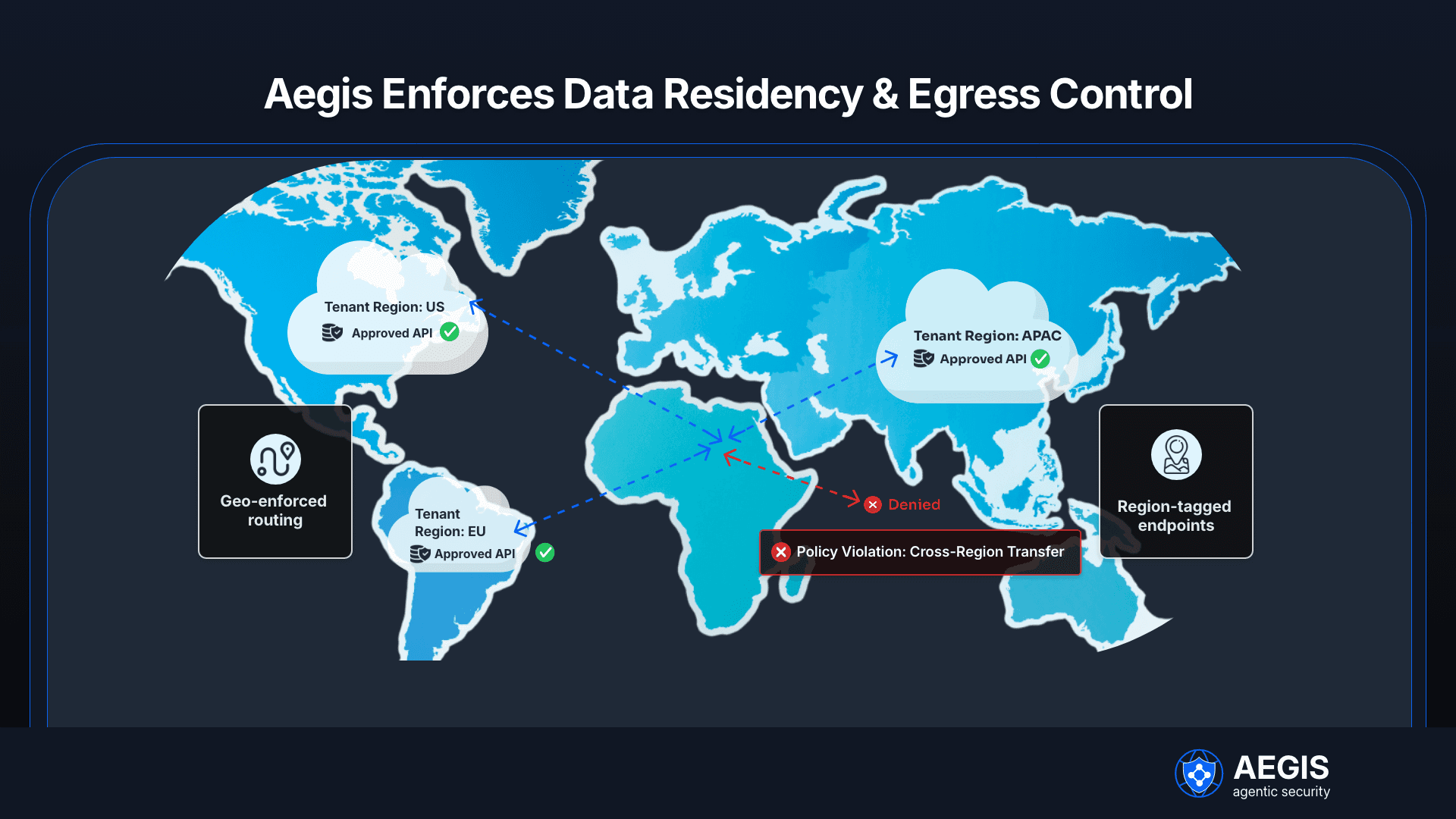
Implement per-tenant region tags and egress routing. Route requests to region-tagged endpoints, and fail closed if region mismatch is detected. An interop test matrix should validate bundles across S3 and GCS, ensure KMS sign/verify compatibility, and check SIEM logging integrations.
Table 2 — Cloud feature mapping for Aegis
Cloud Primitive | Aegis Use | Implementation note |
Object store (S3/GCS) | Bundle manifests, versioning | Use signed ETags; prefer versioned buckets |
KMS | Sign tokens & manifests | Rotate keys; use customer-managed keys where required |
Private endpoints / VPC | Egress control, SIEM ingestion | Route sidecar egress through private NAT |
Managed Redis / cache | JTI replay protection, bundle cache | Use regional clusters for low latency |
Operational considerations
Shadow mode and policy rollout
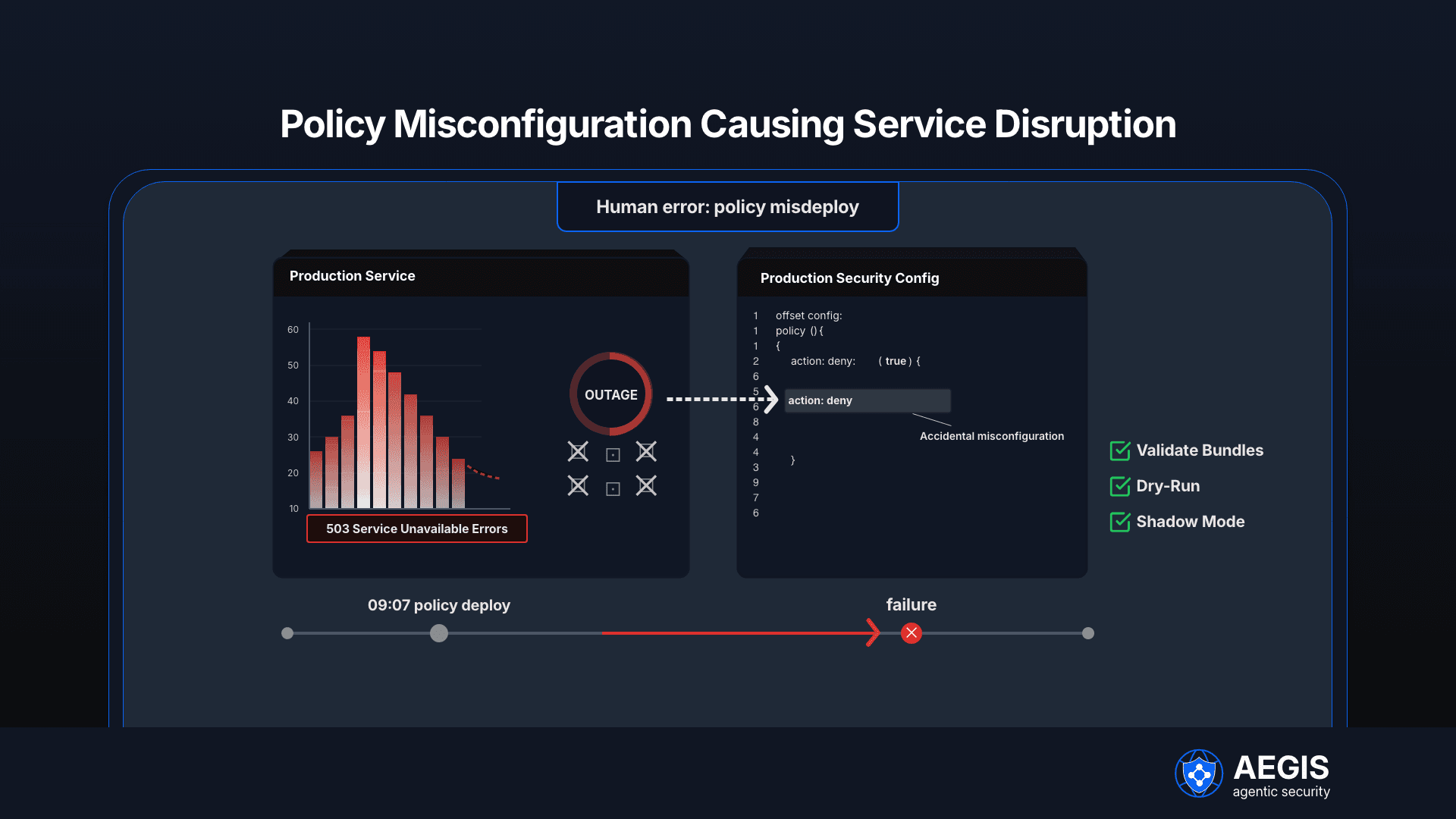
Run policies in shadow mode to collect would-deny metrics, tune regex/conditions, then promote. Use dry-run simulations and sample policies to accelerate adoption.
Approval scaling and noise reduction
Design policies with thresholds to avoid approval fatigue. For example, require approval for payments > $5k but allow automated payments ≤ $5k. Use batched approvals for related actions and expose auto-escalation rules.
Performance and scaling
Target ~10k req/sec per region; use prepared OPA queries, in-memory caches and optional WASM compilation for high throughput. Instrument P99 latency continuously and autoscale decision service instances based on request rate.
Use cases — operationally framed
- FinTech: per-agent payment ceilings + mandatory approvals for exceptional transfers.
- Healthcare: deterministic DLP redaction of PHI and region-bound EHR routing.
- SaaS: per-agent budgets and rate limits for expensive LLM calls; FinOps dashboards.
- DevOps: gate deploys to production with approval and image digest checks.
These use cases align with enterprise research showing rapid experimentation with agentic systems and a need for runtime governance; analysts warn many projects fail if value and risk controls aren’t in place. Gartner projects that over 40% of agentic projects may be canceled by 2027 without proper cost and risk controls. (Reuters)
FAQ — Practical questions
- Where should policy bundles live?
Store compiled bundles in versioned object stores (S3/GCS) with signed manifests and ETags; serve via CDN/private endpoints for low-latency hot reload. - How do you handle cross-region latency?
Route agent traffic to local decision endpoints; use regional caches for bundles and replicate policy bundles across regions. - How do you prevent cross-tenant policy bleed?
Use tenant-scoped bundles, enforce strict key separation in KMS and perform bundle validation on load; table-driven tests should verify scoping. - What about FinOps?
Integrate cloud billing APIs to estimate per-call cost; expose budgets as policy conditions that can block or throttle when exhausted. - How to scale approvals?
Use thresholding, batching, and role-based approvers. Provide override tokens that expire quickly and are single-use.
Closing checklist & next steps
- Helm chart for control plane, Envoy sidecar config and sample OPA bundles
- Terraform modules: buckets, KMS keys, logging sinks, managed Redis
- CI for bundle signing & manifest generation
- Shadow-mode rollout plan and FinOps budget rules
- SOC dashboards (OpenTelemetry → SIEM) and tamper-proof audit storage