Connecting Agents to Databases, APIs, and SaaS Tools
Enforce least-privilege, parameter validation, and egress control for agentic AI with Aegis Gateway.
Aegis Gateway: Runtime Policy & Observability for Agentic AI
As agentic AI moves into production, the connector boundary — where agents call databases, REST/GraphQL APIs, and SaaS tools — becomes the most critical control point. Unrestricted egress and loose parameter handling create injection, unauthorized-action, and data-exfiltration risks. This article explains why connectors are the weakest link, why traditional approaches fail, and how Aegis — a runtime policy and observability fabric — enforces least privilege, parameter constraints, and auditable telemetry for multi-agent systems. (Product details and design come from internal Aegis specifications and use-case documents.)
Why connectors are the weakest link
Enterprise agents must complete real workflows: post to SaaS, write to databases, or call payment APIs. Many orchestrators treat those calls as “dumb” HTTP requests with no centralized runtime governance. Two key risks emerge:
- Parameter injection: freeform user or prompt text is passed into critical parameters (amounts, SQL fragments, file paths), enabling prompt injection or command execution.
- Unrestricted egress: overly-broad tokens or agent accounts can call any external domain, creating exfiltration channels.
Key adoption context: surveys indicate enterprise agent adoption is accelerating; estimates show many organizations scaling or experimenting with agentic AI, increasing governance urgency. Enterprises frequently lack runtime policies that inspect parameters or enforce per-agent identities.
👉🏻 Understand agent protocols to build interoperable systems
.png&w=3840&q=75)
Metric | Relevance |
23% scaling; 39% experimenting | Adoption of agentic AI — governance urgency (industry survey). |
100% trace requirement | Pilot customers require full decision traces for compliance (Aegis requirement). |
Traditional approaches and why they fail
Legacy patterns attempt to control connectors via:
- Hard-coded validation in agent code (ad-hoc validators).
- Broad-scope service accounts or IAM tokens shared among agents.
- Manual policy reviews and offline QA, with sparse telemetry.
These fail operationally because they do not provide centralized, enforced rules at runtime, and they leave no tamper-evident audit trail. They also scale poorly for MSSPs or multi-tenant environments where policies must be scoped and versioned per tenant.
👉🏻 Enhance accuracy with real-time contextual data retrieval
Comparison: Legacy vs Aegis
Concern | Legacy approach | Aegis Gateway approach |
Per-agent identity | Shared tokens / broad roles | Short-lived tokens per-agent, per-call |
Parameter inspection | Local validators (inconsistent) | Centralized policy-as-code with field-level rules |
Egress control | Network-level allowlists only | Per-agent egress allowlists + tool constraints |
Audit & telemetry | Sparse logs | OpenTelemetry spans, signed audit trail |
Deployment DX | Requires code changes per agent | Drop-in middleware + sidecar/forward proxy |
Runtime enforcement architecture (sidecar, token service, OPA)
Aegis implements a runtime enforcement fabric comprised of:
- Sidecar / forward proxy (Envoy pattern): routes outbound agent calls through an ext_authz decision path.
- Decision service: external authorization server (Go) that loads compiled policy bundles and evaluates calls via OPA/Rego.
- Token service: mints short-lived JWTs per agent and per call; tokens include claims for org, tenant, agent and scopes.
- Telemetry engine: emits OpenTelemetry spans for every decision (agent_id, tool, decision, policy_version, latency).
This model enforces a least-privilege boundary at the agent↔tool interface and supports hot-reloadable policies, shadow mode, and approval workflows. Implementation details and latency targets (P99 ≤ 20ms) are documented in internal specs.
👉🏻 Scale agent ecosystems efficiently with cloud infrastructure
Policy-as-code example (YAML)
agent: finance-agent
allowed_tools:
- name: stripe-payments
actions:
- create_payment
conditions:
max_amount: 5000
currency: ["USD","EUR"]
account_id: "^[A-Z0-9]{10,20}$"
hours_of_day: ["08:00-18:00"]
actions:
on_violation: deny
on_high_risk: approval_needed
This schema compiles into OPA bundles and supports dry-run (shadow) mode for telemetry-first rollouts.
Use cases and code snippets
Per-agent connector whitelist
Policy example: restrict finance-agent to only call Stripe-related endpoints; block planner agents from initiating payments.
Parameter validation and sanitization
Aegis can apply deterministic DLP (regex redact SSN, redact emails), numeric range checks, and structured error responses on deny. Example flow: Planner asks Finance to “pay vendor $50,000”. Aegis intercepts, sees amount=50000, compares against policy max_amount=5000, returns PolicyViolation and emits an OTel span with reason.
Developer DX: integrating with LangChain/LangGraph
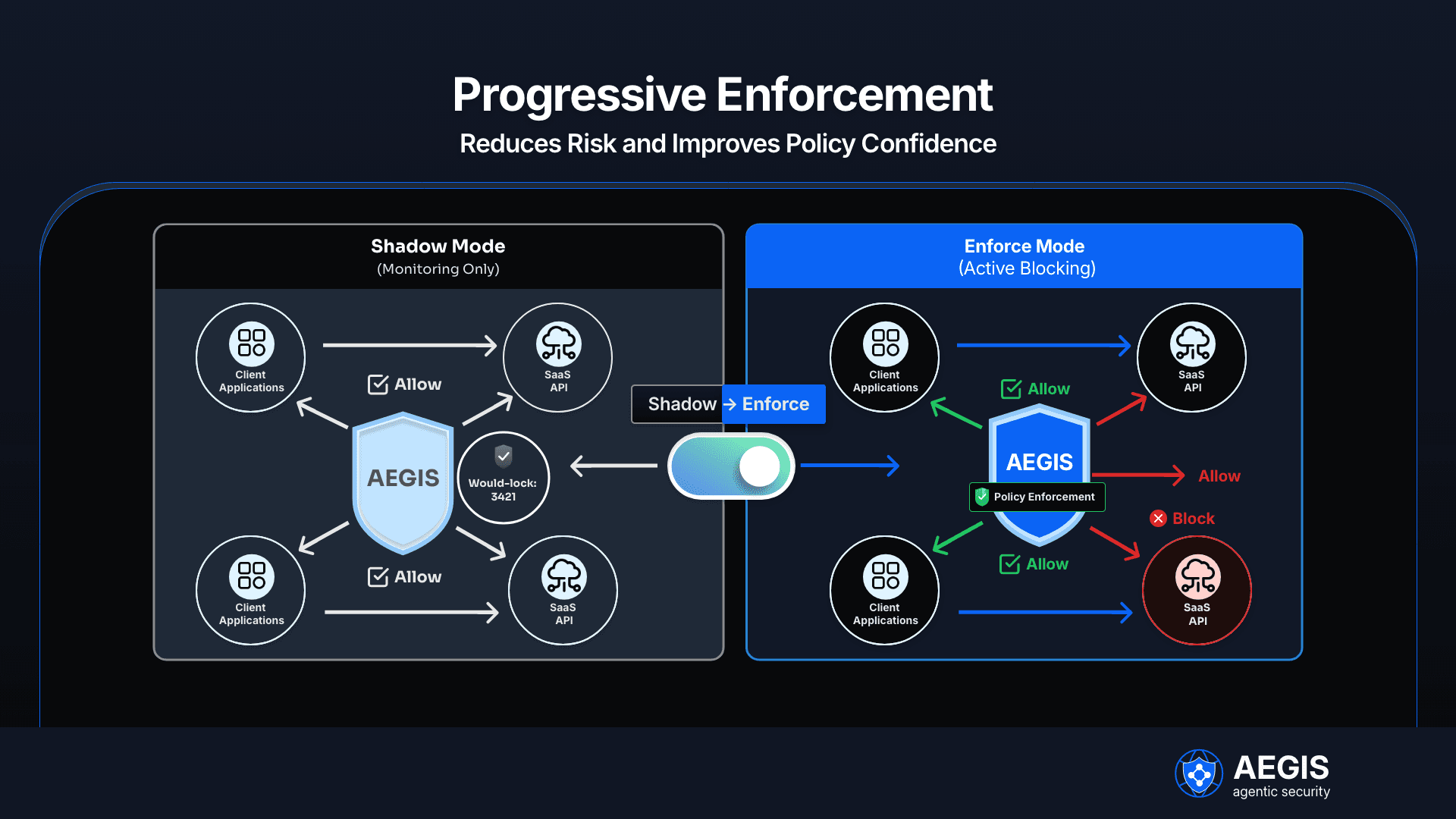
Aegis provides runtime SDK middleware for popular orchestrators (Python/Node). The middleware replaces direct HTTP fetches with aegis_secure_fetch() calls, injects agent tokens, and forwards calls to the local sidecar. Shadow mode and CLI dry-run make policy tuning iterative and low risk. (See internal SDK design notes.)
Example decision-response JSON (deny)
{
"decision": "deny",
"reason": "PolicyViolation: amount > max_amount",
"policy_version": "v2025-10-10",
"span_id": "abcd1234",
"remediation": "request_approval"
}
Operational checklist (shadow run, dashboards, rollbacks)
- Start in shadow mode: collect would-deny events for 7 days.
- Tune regexes and thresholds: iterate on parameter distributions.
- Enable enforcement for low-risk endpoints first.
- Set budgets & rate quotas per agent to limit runaway spend.
- Approval workflows: route approval_needed events to Slack/MS Teams; mint one-time override tokens on approval.
- Monitoring: dashboards for allow/deny ratios, top offenders, budget burn, and P99 latency.
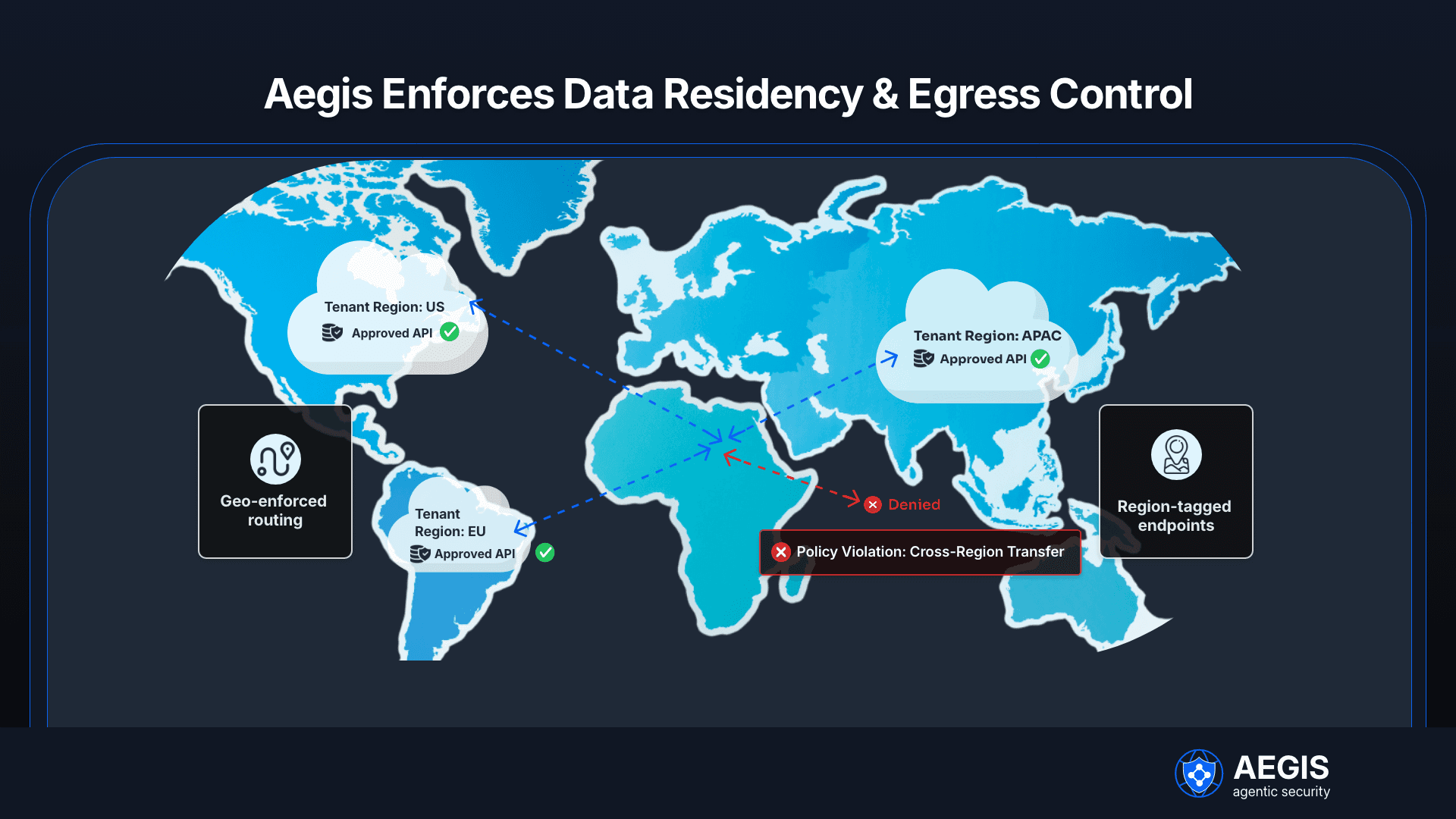
Table: Operational metrics to track
Metric | Alert threshold | Purpose |
Would-deny rate (shadow) | >5% | Adjust rules before enforcement |
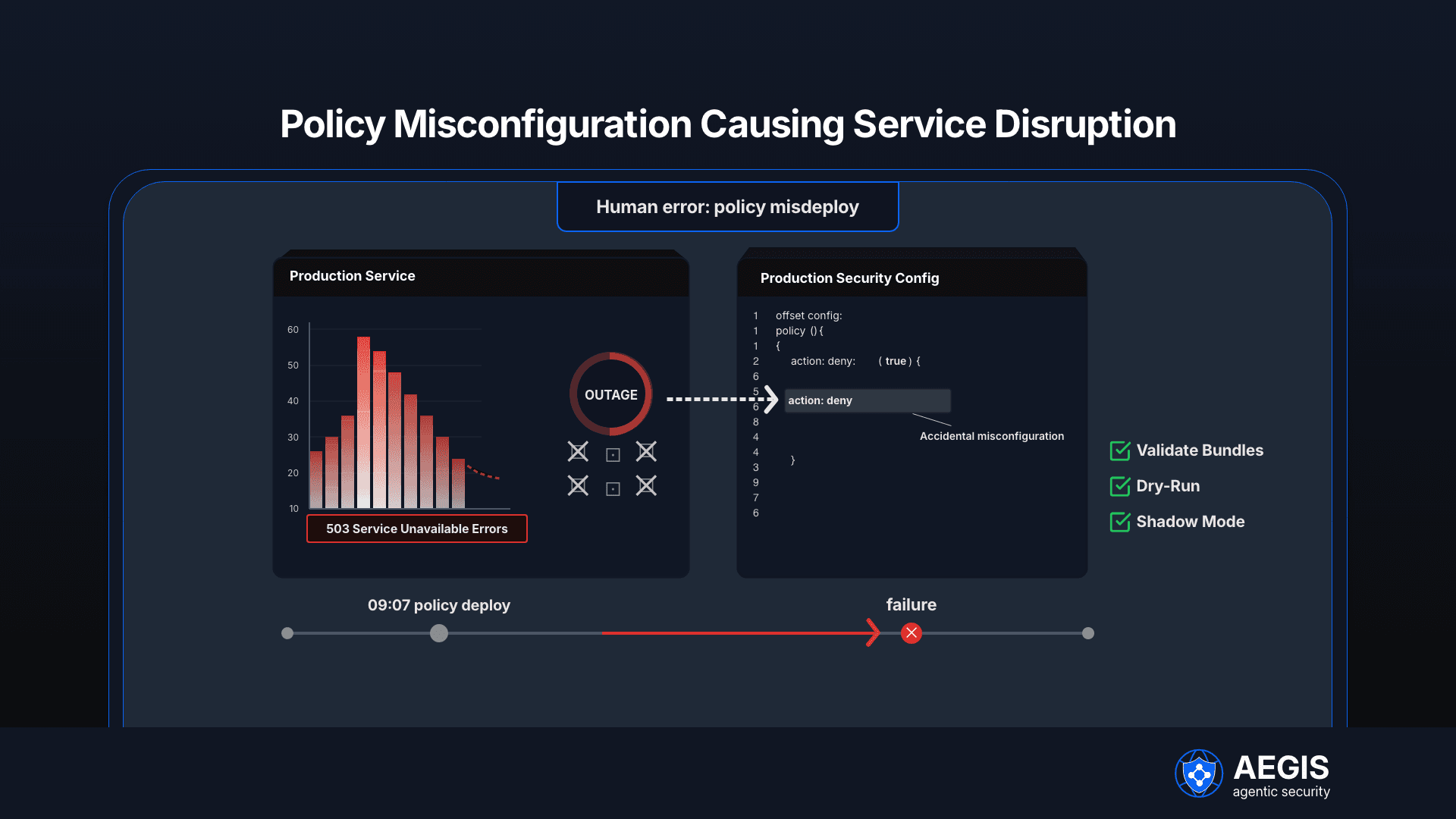
Deny rate (enforce) | >2% sustained | Investigate policy misconfig |
Approval queue length | >100 pending | Tune thresholds, batch approvals |
Policy eval latency (P99) | >20 ms | Performance tuning (caches/WASM) |
How Aegis fits — product summary
Aegis Gateway is a runtime policy and observability fabric that sits between agent orchestrators and external connectors, enforcing per-agent identity, parameter constraints, and egress allowlists. It compiles security policies authored in YAML/JSON into OPA bundles, evaluates each agent call, and returns deterministic decisions: allow, deny, sanitize, or approval_needed. Telemetry is exported as OpenTelemetry spans for SOC, compliance, and FinOps workflows. Key capabilities include:
- Per-agent identity and short-lived tokens (prevents shared-scope tokens).
- Field-level parameter validation and DLP (regex, ranges, sanitization).
- Per-agent budgets and rate quotas for cost governance.
- Shadow mode and dry-run tooling to safely adopt enforcement.
- Signed audit trails and policy versioning for regulatory evidence.
Aegis’s architecture and MVP feature set are designed for regulated, multi-tenant enterprises (finance, healthcare, energy) that require low-latency decisions, tight auditability, and developer-friendly integration points.
Table: Policy examples mapped to outcomes
Use case | Policy action | Runtime outcome |
Payment > threshold | approval_needed | Pause + human approval + override token |
Export to external domain | deny | Block + audit span |
Sensitive field present | sanitize | Redact PII before outbound call |
Budget exhausted | deny (budget_exceeded) | Stop calls + notify FinOps |
Frequently Asked Questions
Q1: How does Aegis differ from IAM or service meshes?
A1: IAM determines who can authenticate; service meshes handle connectivity and observability. Aegis enforces semantic runtime policy on each agent-to-tool call (field-level validation, approval flows, per-agent budgets) and provides signed, structured audit trails.
Q2: Can policies be tested safely?
A2: Yes — Aegis supports shadow/dry-run mode that records would-deny events and emits telemetry without blocking production calls.
Q3: What integrations exist for orchestrators?
A3: Aegis offers lightweight middleware SDKs for popular orchestrators and a token manager to minimize code changes. Sidecar + middleware patterns mean minimal app refactor.
Q4: How are approvals handled at scale?
A4: Policies can set thresholds to minimize unnecessary approvals; approval requests route to Slack/MS Teams, and approved calls receive one-time override tokens. Queues and batching reduce human overhead.
Q5: What observability outputs are provided?
A5: OpenTelemetry spans per request, structured JSON logs for SIEM, dashboards for decision metrics, and policy version history for audits.
Q6: How long does policy evaluation add to latency?
A6: Target P99 is ≤20 ms using OPA prepared queries and caching; optional WASM compilation can improve throughput for extreme scale.
Closing operational notes
Adopting runtime enforcement requires pairing developer DX and security guardrails: provide SDKs for drop-in instrumentation, start with shadow mode, tune policies with telemetry, then flip enforcement on. Aegis’s approach — per-agent identity, policy-as-code, short-lived tokens, and OTel telemetry — delivers the controls required for regulated, multi-tenant deployments while keeping developer friction low.