The Impact of Emerging Standards like MCP and AP2
Learn how emerging standards like MCP and AP2 redefine interoperability in multi-agent AI systems and how Aegis secures cross-protocol enforcement.
.png&w=3840&q=75)
The Impact of Emerging Standards like MCP and AP2 on Agent Interoperability and Security
The rapid growth of autonomous AI agents has outpaced the maturity of the standards that govern their communication. In 2025, the multi-agent ecosystem spans orchestrators like LangGraph, CrewAI, and OpenAI’s AgentKit—each using its own protocol semantics. The result? A patchwork of message formats, inconsistent identity models, and security blind spots.
Emerging interoperability frameworks such as MCP (Multi-Agent Communication Protocol) and AP2 (Agent-to-Agent Protocol) promise to normalize this chaos. They define shared message envelopes, authentication semantics, and telemetry fields to help agents and tools understand each other across frameworks.
Yet, as with any new protocol layer, standardization introduces both opportunity and risk. Security teams must adapt their enforcement strategies to this changing terrain—ensuring consistent policy outcomes regardless of which agent protocol is speaking.
👉🏻 Make smarter platform decisions by comparing features that matter most
.png&w=3840&q=75)
Why Protocols Matter for Agent Ecosystems
Interoperability has always been the backbone of distributed systems—from TCP/IP for networking to gRPC for microservices. In the AI agent world, MCP and AP2 aim to play that same role for communication between autonomous entities.
The Challenge: Fragmented Protocols
Until recently, every orchestrator defined its own message schema:
- Proprietary agent IDs and parent chain headers.
- Custom parameter encodings and signatures.
- Divergent telemetry formats for tracing decisions.
This fragmentation made tool interoperability, policy enforcement, and observability incredibly difficult. Security teams had to maintain adapters for each proprietary protocol, often without consistent authentication or context propagation.
👉🏻 Preserve flexibility with platforms designed for interoperability and growth
The Security Angle
When agents can issue API calls or control other agents, inconsistency is a security liability. Without a normalized identity and parameter model, it becomes impossible to guarantee least privilege or prevent privilege escalation between agents—a key driver behind the creation of Aegis Gateway, Aegissecurity AI security mesh.
MCP and AP2 Primer
Understanding MCP (Multi-Agent Communication Protocol)
MCP defines a minimal envelope that wraps every agent message with:
- tool_name
- params
- parent_agent_id
- capabilities
- trace_context
This shared schema allows a receiver to apply consistent policies, regardless of the orchestrator. MCP also encourages agents to sign messages with short-lived tokens and include standardized OpenTelemetry (OTel) spans for observability.
Understanding AP2 and A2A Variants
AP2 (or A2A) extends MCP concepts to agent-to-agent delegation, emphasizing secure intent passing. It defines:
- Canonical “parent_chain” headers for provenance.
- Identity claims for both initiator and executor.
- Capability descriptors for role scoping.
- Negotiated schema versions for forward compatibility.
Together, these standards create a foundation for cross-vendor interoperability—but they don’t solve runtime enforcement or telemetry consistency on their own.
Designing Enforcement for Multiple Protocols
Even with MCP and AP2, organizations need a unified enforcement layer that can interpret, normalize, and govern all agent communication in real time.
The Legacy Approach
Traditional security tooling relied on:
- Static API keys or IAM roles.
- Manual validation in agent code.
- Point-to-point audit logs.
This works for a handful of APIs but breaks down across autonomous agents interacting dynamically. Policy drift becomes inevitable, and visibility is lost.
👉🏻 Build strategic partnerships that maximize the value of your agent investments
The Aegis Approach: Protocol-Agnostic Enforcement
Aegis Gateway—developed by Aegissecurity—solves this by abstracting away protocol differences at the data plane. It sits between agents and their tools, acting as a runtime policy and observability gateway.
When an agent sends an MCP or AP2 message, Aegis:
- Normalizes fields (tool, params, agent identity, parent chain).
- Evaluates the policy via Open Policy Agent (OPA) or lightweight Rego.
- Enforces actions (allow, deny, sanitize, or approval_needed).
- Emits OpenTelemetry spans for every decision.
This standardization lets Aegis validate security posture even across evolving protocol versions.
Adapter Patterns and Examples
To manage diverse agent protocols, Aegis uses an adapter model—modules that translate protocol-specific fields into normalized policy inputs.
Example: MCP Message Normalization
MCP Field | Aegis Policy Input | Description |
tool_name | input.tool | The downstream API or connector |
params | input.params | Parameters for the call |
parent_agent_id | input.call_chain.parent | Tracks which agent initiated this call |
capabilities | input.permissions | Declared abilities of the calling agent |
trace_context | input.telemetry.trace_id | Links the decision to distributed traces |
With these mappings, Aegis can apply consistent rules like:
allow {
input.agent == "finance-agent"
input.tool == "stripe-payments"
input.params.amount <= 5000
}
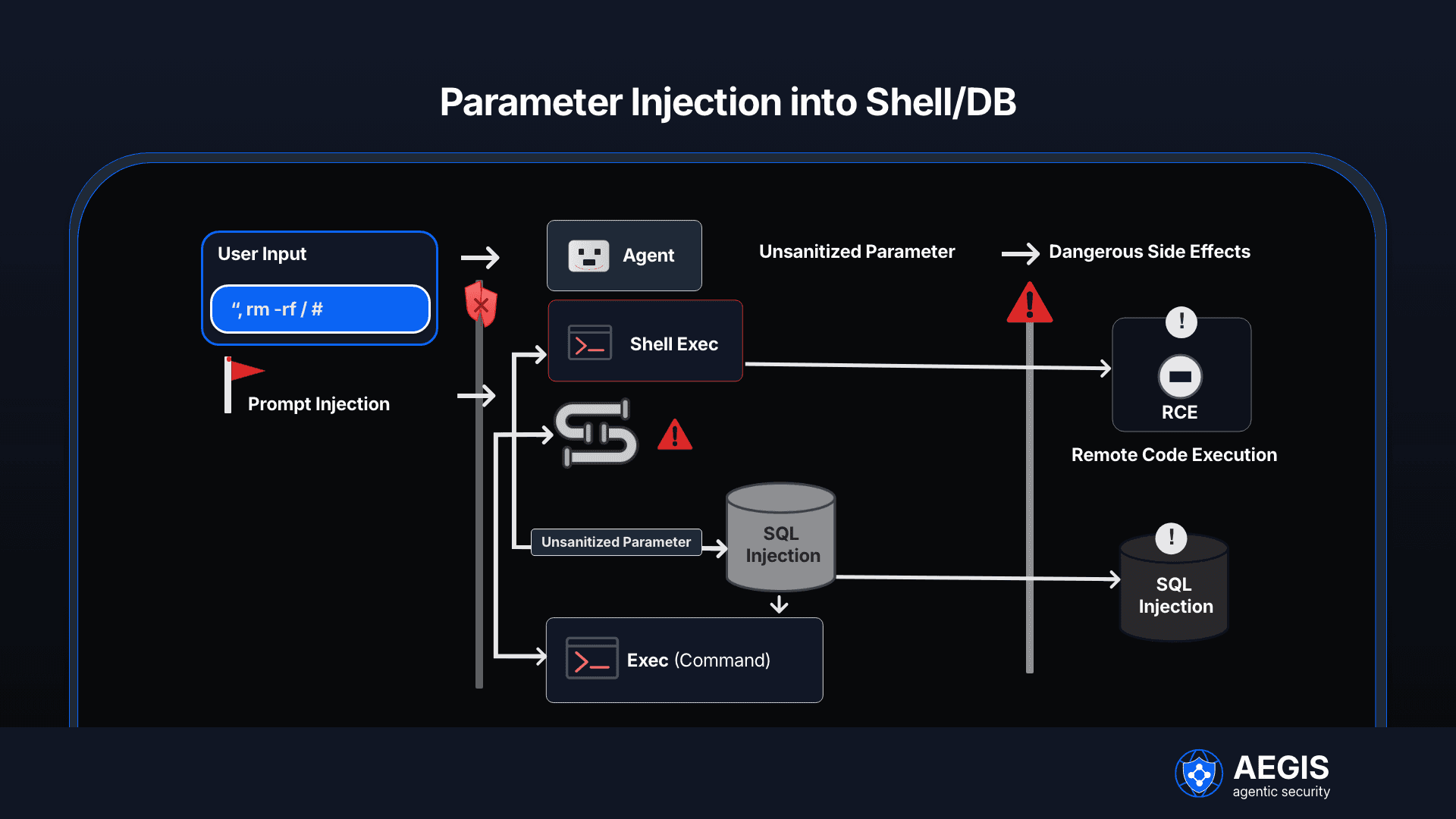
If the amount exceeds limits, the Gateway can trigger a human approval workflow before execution.
Example: AP2 Delegation Enforcement
In an AP2 message, Aegis inspects both initiator and executor claims to ensure valid delegation:
- Deny if parent-agent mismatch.
- Log if schema version is unknown.
- Require approval if action scope exceeds capability descriptor.
Diagram Placeholder
Insert: A diagram showing AP2 agent chain validation through Aegis Gateway (initiator → executor → tool).
How Aegis Enables Secure Interoperability
At least one-third of this conversation belongs to Aegis’s core capabilities—because its design is the practical realization of what MCP/AP2 standards envision.
1. Policy-as-Code Meets Multi-Protocol Reality
Policies in Aegis are defined in YAML/JSON and compiled to OPA bundles. They express contextual enforcement, not just permissions:
- Conditional approvals (approval_needed for payments > $5,000).
- Rate limits (5 RPS, daily budget $20).
- Parameter sanitization (regex or DLP filters).
- Context-aware denials (e.g., disallow off-region data transfers).
This makes it possible to enforce consistent security posture across agent ecosystems—without rewriting logic per orchestrator.
2. Observability and Governance
Aegis emits structured telemetry for every call:
Metric | Example | Purpose |
agent_id | finance-agent | Identify who initiated the call |
decision | deny | Track policy effectiveness |
latency | 10ms | Monitor enforcement performance |
policy_version | v1.3 | Auditability and rollback |
cost_estimate | $0.002 | Support FinOps tracking |
Dashboards visualize top agents, frequent denials, and policy drift—key insights for compliance and FinOps teams.
Aegis’s integration with OpenTelemetry aligns perfectly with MCP/AP2’s standardized telemetry model, ensuring that interoperability extends to observability too.
3. Real-World Use Cases
From the uploaded Aegis use case corpus:
- FinTech: Prevent unauthorized high-value transfers via runtime approval.
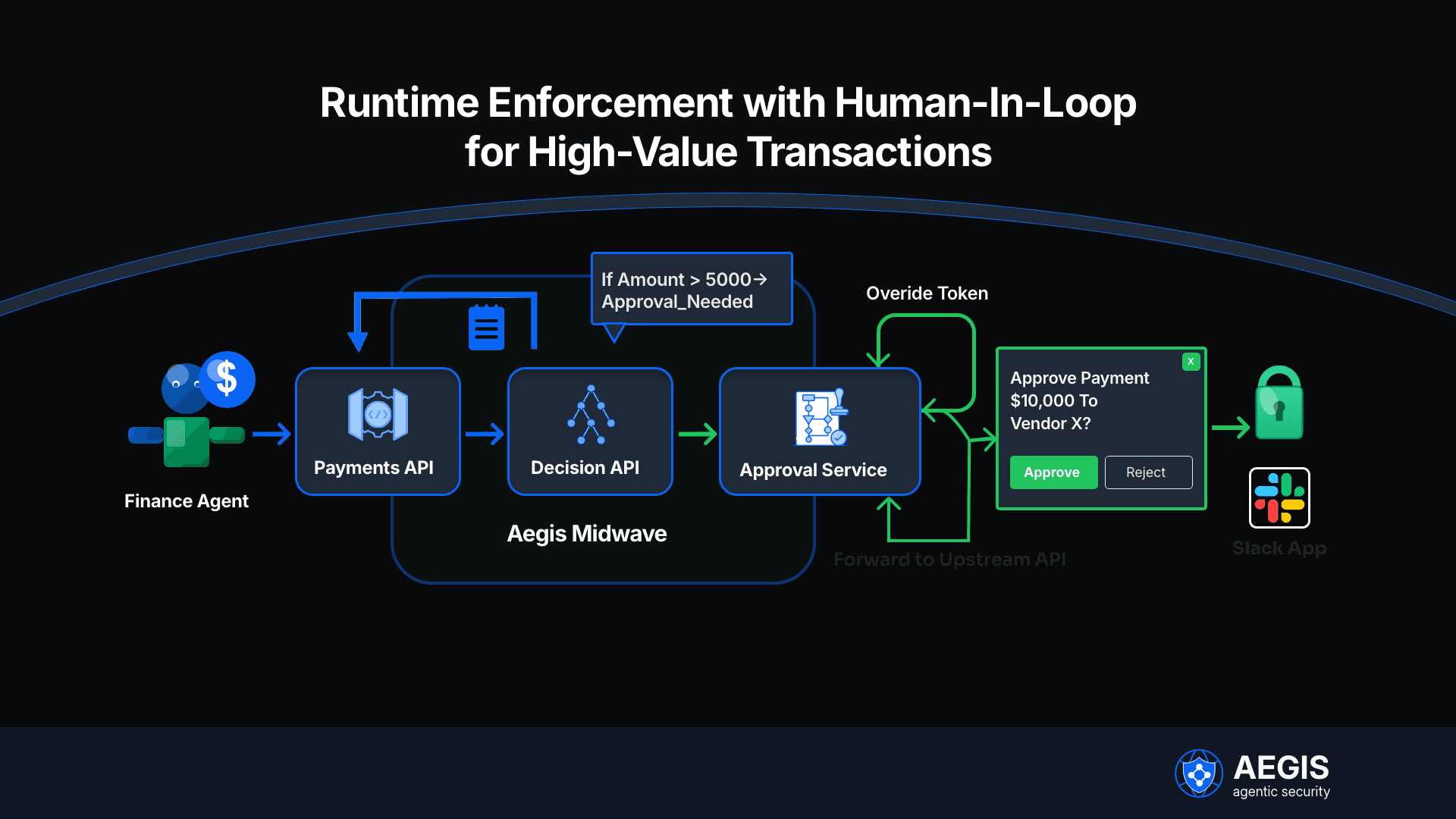
- Healthcare: Redact PHI fields and block cross-domain data exfiltration.
- DevOps: Restrict deployment actions to approved environments.
- MSSPs: Enforce tenant-scoped policies and auditable decisions.
By supporting both MCP and AP2 message envelopes, Aegis becomes the universal policy fabric across multi-agent ecosystems.
Roadmap to Standardization and Industry Adoption
While MCP and AP2 are still maturing, their momentum mirrors early web standardization efforts. The next 12–18 months will likely bring:
- Versioned Schemas for message contracts.
- Canonical Identity Models aligning with short-lived tokens.
- Common Telemetry Fields for cross-framework traceability.
- Reference Implementations embedded in major orchestrators.
Aegis’s protocol-agnostic enforcement layer future-proofs organizations against this evolution. Whether MCP gains dominance or AP2 diverges into A2A subtypes, Aegis normalizes them all at runtime—reducing vendor lock-in.
Comparison: Legacy Security vs Aegis Enforcement
Aspect | Legacy Tools | Aegis Gateway |
Protocol Support | Vendor-specific APIs | MCP, AP2, custom |
Enforcement Layer | Inline or manual | Sidecar proxy with OPA |
Telemetry | Ad hoc logs | Standardized OTel spans |
Approval Workflow | None | Slack/Teams integrated |
Compliance Readiness | Minimal | Full audit trails + signing |
Multi-tenancy | Limited | Tenant-scoped bundles |
Governance and Compliance Implications
Emerging standards simplify not only communication but also compliance mapping. MCP’s structured metadata enables:
- Mapping parent_chain to accountability trails.
- Using capabilities for audit of granted privileges.
- Attaching policy decisions directly to telemetry spans.
Aegis enhances this by generating tamper-proof audit logs with versioned policy history and digital signatures, ensuring end-to-end traceability required by SOC and regulatory reviews.
To explore how Aegis aligns with compliance frameworks across industries like FinTech, Healthcare, and SaaS, Aegissecurity provides tailored blueprints and integration guides.
Conclusion
The rise of agentic AI demands secure interoperability—and that begins with shared semantics. MCP and AP2 are early but promising attempts to unify how agents communicate. Aegis Gateway operationalizes those principles today, delivering runtime enforcement, telemetry normalization, and protocol-agnostic governance.
As standards mature, Aegis ensures enterprises can adopt them without rewriting security controls—bridging innovation with compliance, and autonomy with accountability.
Frequently Asked Questions
1. What are MCP and AP2 standards?
They are emerging interoperability frameworks defining shared schemas and semantics for communication between AI agents and tools.
2. Why are these standards critical for security?
Without consistent message formats and identity semantics, enforcing least privilege or auditing agent actions becomes nearly impossible.
3. How does Aegis handle multiple protocols?
Aegis normalizes message fields from MCP, AP2, and proprietary protocols, evaluating them through unified policy logic.
5. Does Aegis add latency to agent workflows?
No significant impact. Optimized OPA bundles and caching keep policy evaluation under 20ms at P99.
6. How does Aegis prepare for future standards?
It uses adapters and schema validation layers that can absorb new fields (e.g., capability_descriptors) without breaking policies.