
Comparing Commercial Agentic AI Platforms: Features and Limitations
Practical, technical guide to securing agentic AI at runtime with policy-as-code, telemetry, and approval workflows.
Agent Platform Security Checklist — Runtime Controls for Multi-Agent Systems
Introduction
Agentic AI is moving from experiments to production, but many technical buyers still evaluate platforms by UI and pricing instead of runtime security. This post gives security engineers, DevOps leads, and MSSP decision-makers a focused checklist for comparing agent platforms and a concrete reference architecture: Aegis Gateway — a runtime policy + observability fabric for multi-agent systems. We'll cover the threat surface, decision axes you should evaluate during a PoC, what to demand in telemetry, and how Aegis maps gaps to controls.
Key market context (short, cited)
Enterprise interest in agentic AI is real: recent industry surveys report a meaningful share of organizations are scaling or experimenting with agentic systems (23% scaling, many more experimenting). At the same time, industry research warns that many projects will be cancelled if value and controls aren’t proven. Security and integration are among top adoption barriers. (McKinsey & Company)
👉🏻 Evaluate security vendors with confidence to build safer multi-agent ecosystems
Why runtime controls matter
Agent orchestrators are powerful: they chain LLMs, connectors, and tools in multi-step workflows. That power expands the attack surface in four ways:
- Parameter-level risk — prompts or agent outputs can inject malicious values (amounts, file paths, URLs).
- Tool-chaining coercion — a planner agent can coerce another agent to execute actions beyond its intended scope.
- Silent egress & exfiltration — agents can contact arbitrary endpoints unless egress is enforced.
- Cost runaway — uncontrolled agents can trigger expensive model/API calls.
Ask these evaluation questions during vendor/product comparison
- Does the platform expose runtime hooks (ext_authz, sidecar or middleware) where a policy gateway can intercept calls?
- Can policies inspect per-field parameters and make decisions (e.g., amount <= 5,000)?
- Are decisions low-latency at P99 and scalable to thousands of RPS?
- Are audit logs tamper-resistant and SIEM-ready?
Decision axes for technical buyers
Below are the axes you must evaluate and concrete targets to ask for during a PoC.
Security axis
- Identity per agent (short-lived JWTs with org/tenant/agent claims).
- Egress allowlists + deterministic DLP (redaction rules for PII).
- Approval workflows (human-in-the-loop with one-time override tokens).
- Tamper-proof audit trails (signed spans/logs).
Performance & scale axis
- P99 decision latency target: ask vendors to demonstrate ≤ 20 ms for compiled/ cached policy decisions; measure end-to-end proxy overhead too. OPA prepared queries and WASM compilation are common paths to low latency. (Open Policy Agent)
- Scalability: request benchmarks at 1k–10k RPS per region with real policy complexity.
Observability axis
- OpenTelemetry traces for each decision (agent_id, tool, policy_version, decision_reason).
- Structured logs to SIEM with signed attestations.
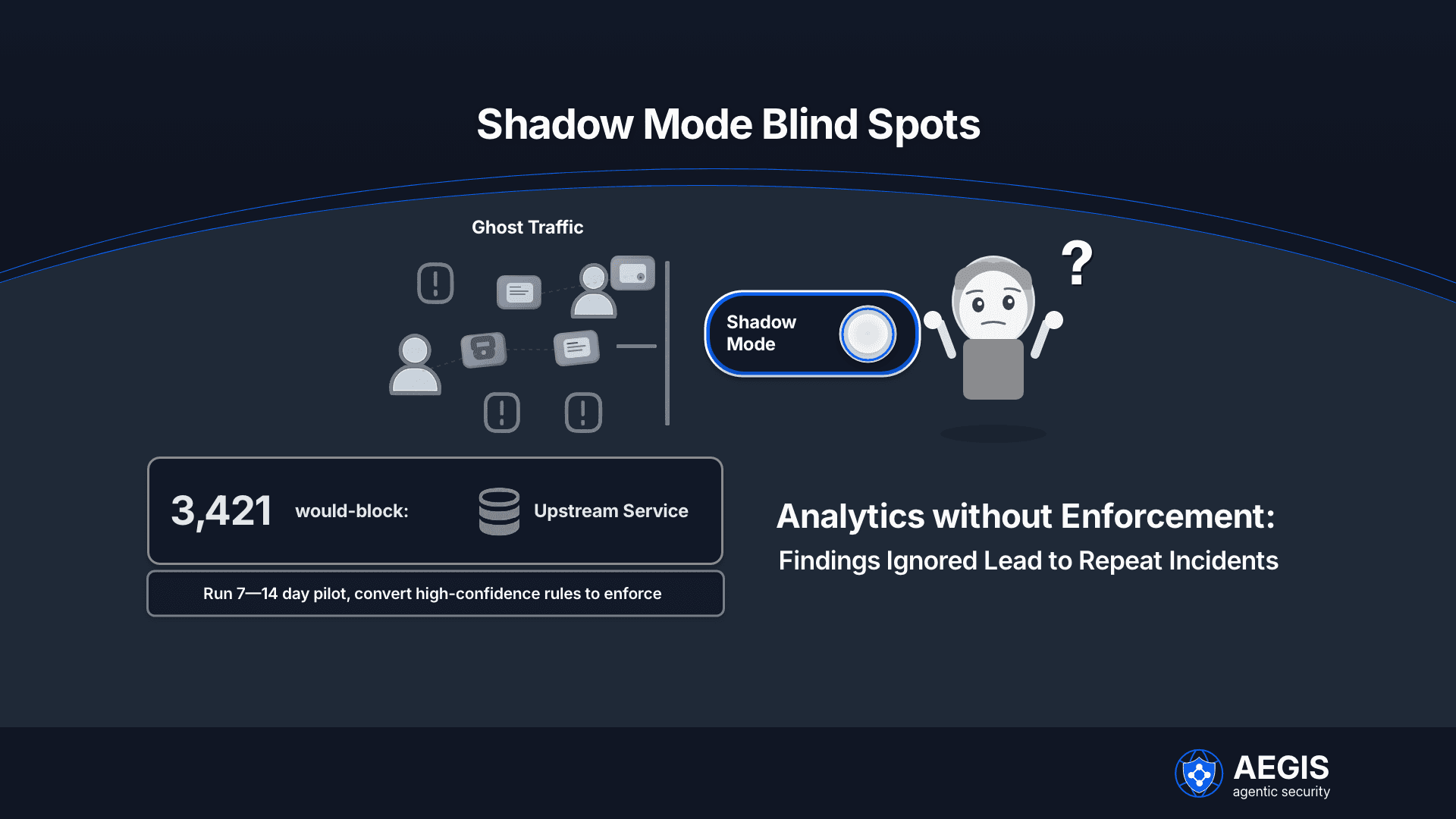
- Shadow mode metrics: would-block counts before enabling enforcement.
Aegis Gateway: reference architecture and how it maps to the axes
This section describes Aegis (reference implementation and product concept) addressing the above axes. About one third of this article focuses on the solution.
Aegis is a lightweight runtime policy & observability fabric that interposes between orchestrator and tools (sidecar / forward proxy + decision service). Its core capabilities:
Identity & per-agent policy
- Agents register with unique IDs. Tokens include organization, tenant and agent claims; short lifetimes and replay protection limit risk.
- Policies written as YAML/JSON compile into OPA bundles; support ranges, regex, budgets, and approval rules.
Runtime enforcement
- Data plane is a proxy (Envoy/sidecar) using ext_authz or middleware calls to Aegis decision API.
- Decisions: allow, deny, sanitize (parameter redaction), approval_needed.
- For approval_needed, Aegis issues an interactive approval request (Slack/Teams) and mints a one-time override token on approval.
Tool-call inspection and DLP
- Aegis inspects request bodies and headers to enforce per-field constraints (e.g., payment amount ≤ threshold), providing deterministic redaction for PII. This mitigates prompt injection/parameter-injection issues seen in real deployments.
Observability & auditability
- All decisions emit OpenTelemetry spans and structured logs containing agent_id, tool, policy_version, decision and cost estimate. Dashboards show P99 latency, would-block rates and budget usage.
- Audit signing and versioned policy bundles enable tamper-evident trails for SOC and compliance reviews.
Developer experience
- SDKs (Python/Node) and decorator patterns make integration with LangChain/LangGraph minimal. Shadow mode allows tuning before enforcement.
Aegis controls mapped to common platform gaps
- Missing inter-agent context → Aegis supports chain headers (parent_agent_id) and validates them at decision time.
- No per-field inspection → Aegis enforces parameter-level conditions and returns standardized PolicyViolation errors.
- No budget controls → Aegis supports per-agent budgets and rate limits with throttling behavior.
Two quick comparison tables
Table 1 — feature matrix (Aegis vs generic alternatives)
Feature / Capability | Aegis Gateway | Orchestrator SafeMode | Legacy Signature Methods |
Runtime policy hooks (ext_authz/sidecar) | ✅ | Limited | ❌ |
Per-field parameter inspection | ✅ | ❌ | ❌ |
Approval workflows (Slack/Teams) | ✅ | Maybe | ❌ |
OpenTelemetry + SIEM export | ✅ | Maybe | ❌ |
Per-agent budgets & rate limits | ✅ | ❌ | ❌ |
Table 2 — example PoC metrics & targets
Metric | Ask the vendor to show | Target / Notes |
P99 decision latency | Measured end-to-end with sample policies | ≤ 20 ms ideal; ≤ 50 ms acceptable |
OPA bundle support | Can vendor provide sample bundle? | Must support hot-reload |
Shadow mode reports | Would-block counts by agent/tool | Collect 7 days before enforcing |
Approval integration | Workflow latency (human response not included) | Approval token issuance < 2 s |
Integration recipe — wiring orchestrator to a policy gateway
Steps to validate during PoC:
- Deploy Aegis sidecar (Envoy) adjacent to agent runtime or add SDK middleware for non-HTTP tools.
- Configure ext_authz to call the Aegis decision API for outbound calls.
- Register agents with minimal metadata and issue short-lived JWTs.
- Publish policies (shadow mode) and collect would-block traces for 7 days.
- Tune regex/conditions and promote to enforce mode; confirm rollback and dry-run works.
Implementation checklist (short)
- Per-agent identities and JWKS verification
- Policy-as-code with versioning & test suites
- Approval flow tests and override token validation
- SIEM export and signed audit logs
- Budget & rate limit smoke tests
Operational & governance considerations
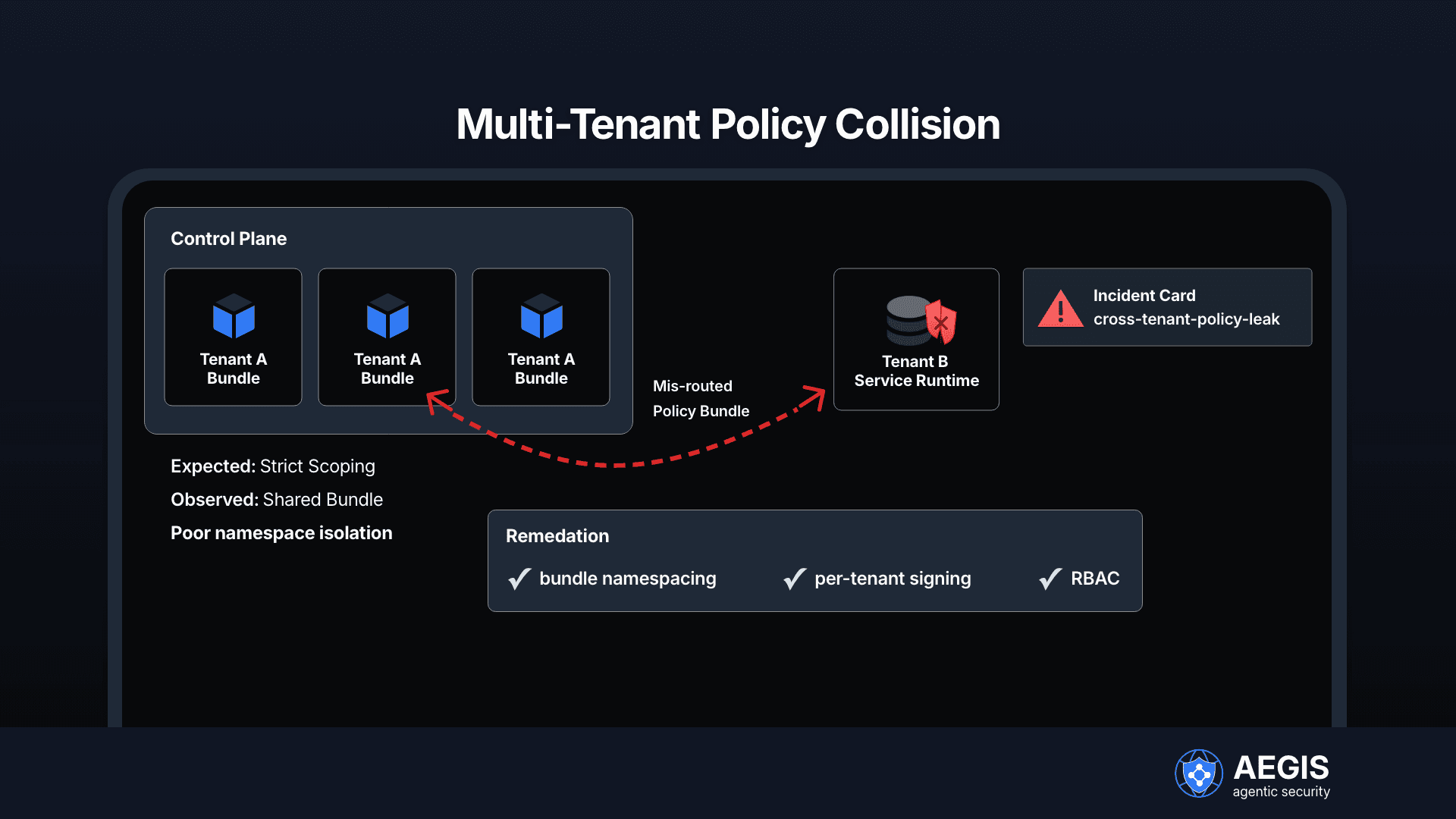
- Multi-tenant scoping: compile tenant-scoped OPA bundles to avoid cross-tenant leakage.
- Fail-closed vs fail-open: use fail-closed for writes and a configurable fail-open for read-only low-risk actions.
- Approval fatigue: design policies with thresholds to avoid human overload; combine budgets and rate limits to reduce noise.
- FinOps: surface per-agent cost estimates in traces to make budget enforcement actionable.
Practical example policy
Policy snippet (YAML — illustrative)
agent: finance-agent
allowed_tools:
- name: stripe-create-payment
actions: [create_payment]
conditions:
amount: { max: 5000 }
currency: [USD, EUR]
on_violation: approval_needed
Aegis would compile this into an OPA bundle and enforce at runtime; a call with amount > 5000 returns PolicyViolation: approval_needed and triggers an approval workflow.
👉🏻 Protect flexibility by choosing interoperable platforms that avoid vendor lock-in
-1.png&w=3840&q=75)
FAQs
Q1: Are platform policies auditable?
Yes — Aegis emits signed audit spans and stores policy version metadata alongside decision logs, enabling a tamper-evident trail for SOC reviews. (OpenTelemetry)
Q2: Can you hot-reload policy bundles?
Yes — policies compile to OPA bundles with hot-reload; ask for demo of bundle update and decision change within seconds. (Open Policy Agent)
Q3: How do we avoid approval overload?
Use thresholds (amount, rate limits), shadow mode tuning, and merge low-risk actions into allowlists; implement per-agent budgets to limit noisy agents.
Q4: What telemetry should I require?
OpenTelemetry spans per decision with fields: agent_id, tenant, tool, policy_version, decision, reason, cost_estimate, latency.
Q5: What PoC artifacts should I request?
Sample OPA bundle, shadow-mode reports for 7 days, scripted malicious prompt test showing would-block, and a signed audit trace for an approval event.
Q6: Does Aegis integrate with existing observability tools?
Yes — export via OpenTelemetry to Grafana/Prometheus, and ship structured logs to SIEM.
👉🏻 Future-proof your systems by aligning with emerging agentic AI standards
Closing / CTA
When comparing agent platforms, prioritize runtime enforcement hooks, policy-as-code compatibility, parameter inspection, and rich telemetry over UI checklists or price alone. Request concrete proof: OPA bundles, shadow-mode reports, sample threat injections and P99 latency measurements.
References & selected reading
- McKinsey — The State of AI: Global Survey 2025 (agentic adoption context). (McKinsey & Company)
- Open Policy Agent — policy performance / Envoy guidance. (Open Policy Agent)
- OpenTelemetry Collector survey and adoption notes. (OpenTelemetry)
- Gartner / Reuters overview on agentic AI project failure risk. (Reuters)
- Industry survey on security concerns for AI agents. (TechRadar)