Collaboration Between Agent Vendors and Enterprises: Best Practices
Practical guide to vendor-enterprise collaboration and runtime enforcement for multi-agent AI using Aegis.
.png&w=3840&q=75)
Why vendor collaboration matters for agent rollout
Enterprises deploying agentic AI face a rare combination of operational complexity and security liability. Recent analyst coverage warns that over 40% of agentic AI projects may be scrapped before proving value if governance and operational expectations aren’t aligned. (Reuters) Large surveys show meaningful pilot activity—roughly a quarter of organizations report scaling agentic systems while many more are experimenting—meaning production use is emerging quickly and at scale. (McKinsey & Company)
Two practical consequences follow:
- Multiple vendors will supply agent connectors and capabilities; each connector introduces identity boundaries, parameter models and failure modes that must be coordinated.
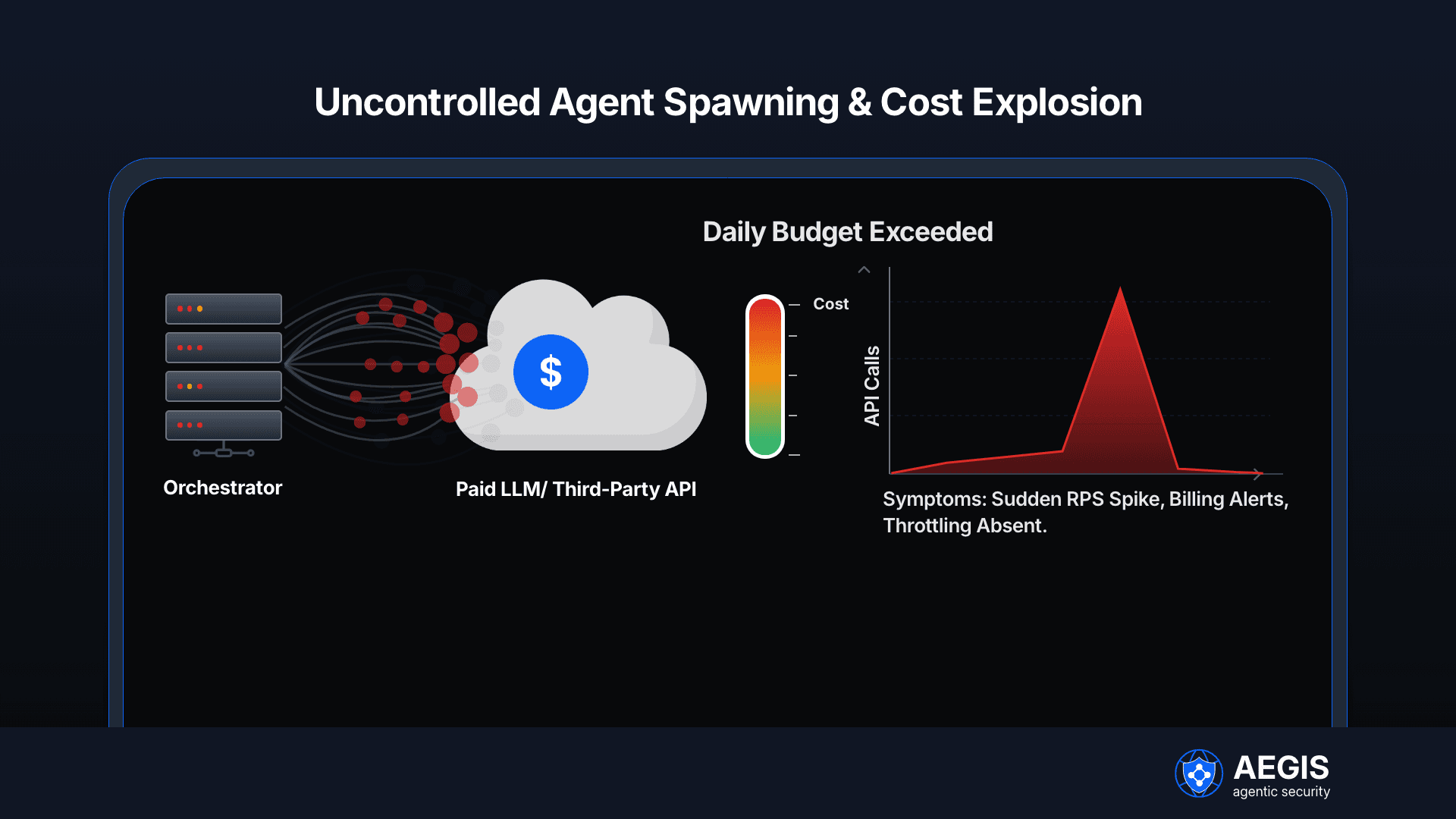
- Without a shared enforcement plane and clear onboarding contracts, enterprises expose themselves to authorization gaps, parameter injection, cost spikes and audit failures.
Those risks are visible in field reports and the Aegis design brief: ad-hoc, point-to-point integrations lead to mismatched identity models, inconsistent test coverage, and operational confusion—exactly the operational failure modes Aegis was designed to prevent.
Practical contract items and onboarding checklist
Standardizing what vendors deliver reduces ambiguity and shortens secure time-to-production.
Must-have contract fields (short checklist)
- Connector manifest (signed): identity model, endpoints, supported actions, version.
- Metadata schema: parameter names, types, constraints (regex, ranges).
- Performance SLA: policy-evaluation latency budget, error-mode behavior.
- Security responsibilities: pen-tests, incident response contacts, data egress rules.
- Compliance package: audit-log schema, retention, and regional residency options.
A tactical onboarding checklist:
- Agent identity model: token formats, expected claims, JWKS endpoint.
- Endpoints & allowed methods with sample request/response bodies.
- Test keys and vendor sandbox preloaded with Aegis policy hooks.
- Shadow-run test harness (see next section).
- Signed manifest + versioning / rollback clauses.
- SLA negotiation with policy-latency caps and service credits.
These items come directly from the vendor-enterprise co-innovation flow Aegis prescribes.
Joint testing and governance playbook
Vendor-enterprise co-testing reduces surprises. The playbook below creates repeatability.
Shadow mode and co-test harness
Run vendor connectors through an Aegis “shadow mode” for a defined window (7–14 days). Shadow mode records would-block events, parameter distributions and would-have-blocked semantics without affecting live traffic. Use a shared test harness to:
- Replay representative production traces.
- Run negative tests for parameter injection (amounts, file paths, shell-like strings).
- Validate identity claims and parent_agent_id chaining for multi-agent calls.
Blocks: Vendor connector → Shadow traffic → Aegis decision log → Report generator → Triage & policy tuning.
Governance cadence & reporting
- Weekly runbook metrics: would-block rate, top offending parameters, approval count and latency.
- Policy change cadence: scheduled policy deployments (weekly for low-risk, emergency for fixes).
- Audit package: signed manifests, OTel spans with policy_version and decision_reason for SOC handover. These telemetry and audit expectations are core to Aegis's approach.
How Aegis operates: solution overview
Aegis is the common enforcement plane that sits between orchestrators (agent frameworks) and tools/APIs. It’s designed as a lightweight policy + telemetry gateway—an “Istio + OPA for agents.” The core components are:
👉🏻 Choose security solutions that strengthen every layer of your multi-agent ecosystem
Runtime enforcement plane
- Sidecar/forward proxy intercepts each agent→tool call, extracts agent identity and parameters, and calls the decision API.
- Decision API evaluates policies (compiled to OPA bundles) and returns allow/deny/sanitize/approval_needed.
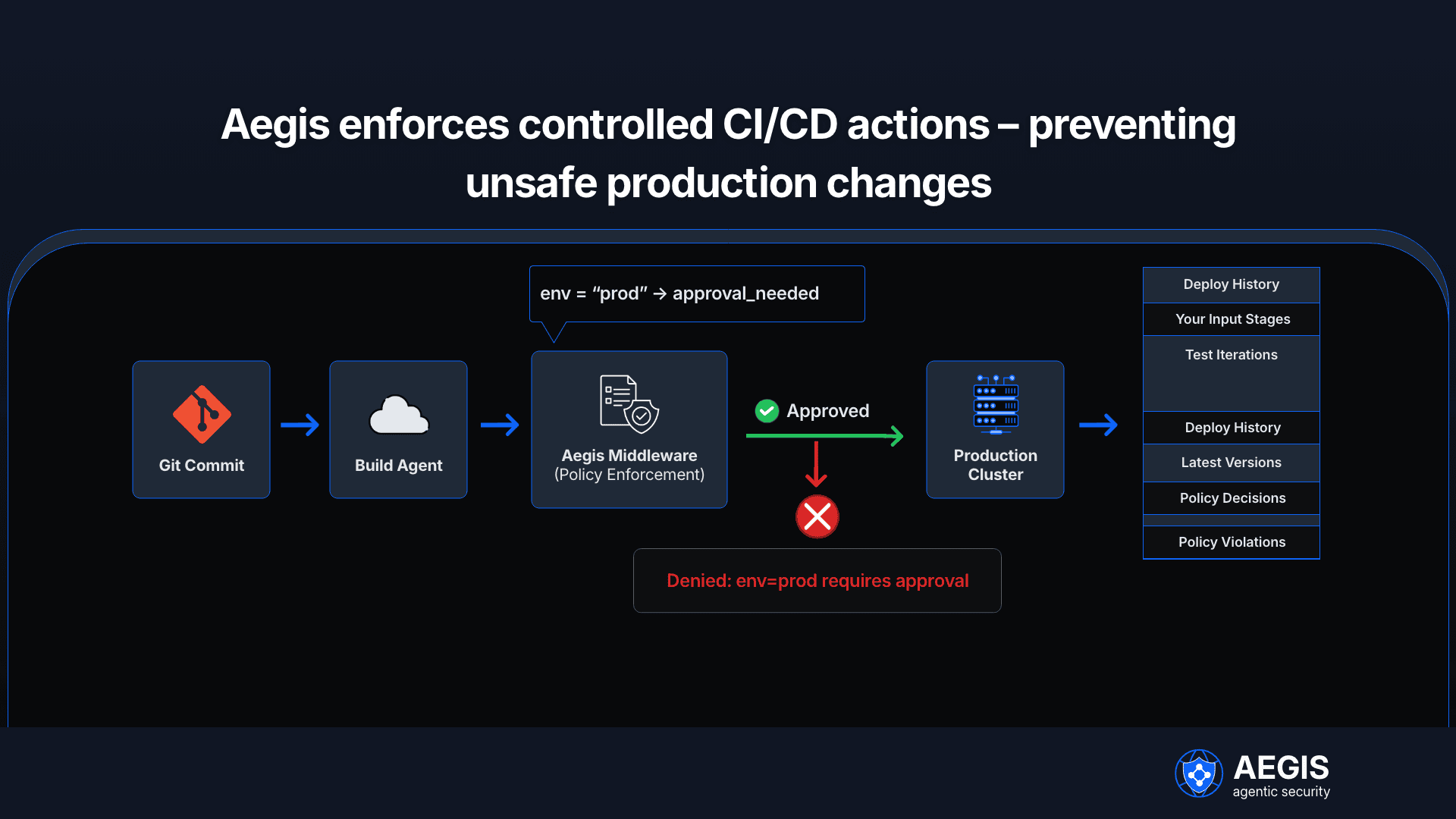
- For high-risk calls (payments, writes to EHR, production deploys), Aegis can pause and trigger an approval workflow that integrates with Slack/Teams and mints a one-time override token on approval.
Policy-as-code and control plane
- Security teams author policies in YAML/JSON; Aegis compiles them into OPA bundles and enforces versioning, schema validation and dry-run simulation.
- Shadow mode allows policy tuning without production impact; hot reload and rollback ensure operational agility.
Observability & audit
- OpenTelemetry spans for every decision: agent_id, tool, decision, policy_version, latency and cost estimate.
- Structured JSON logs for SIEM ingestion and tamper-evident audit trails (optional signed logs).
- Dashboards showing budget consumption, would-block trends, and top offenders—critical telemetry for FinOps and SOC.
Operational primitives (what Aegis enforces)
- Per-agent budgets and rate limits.
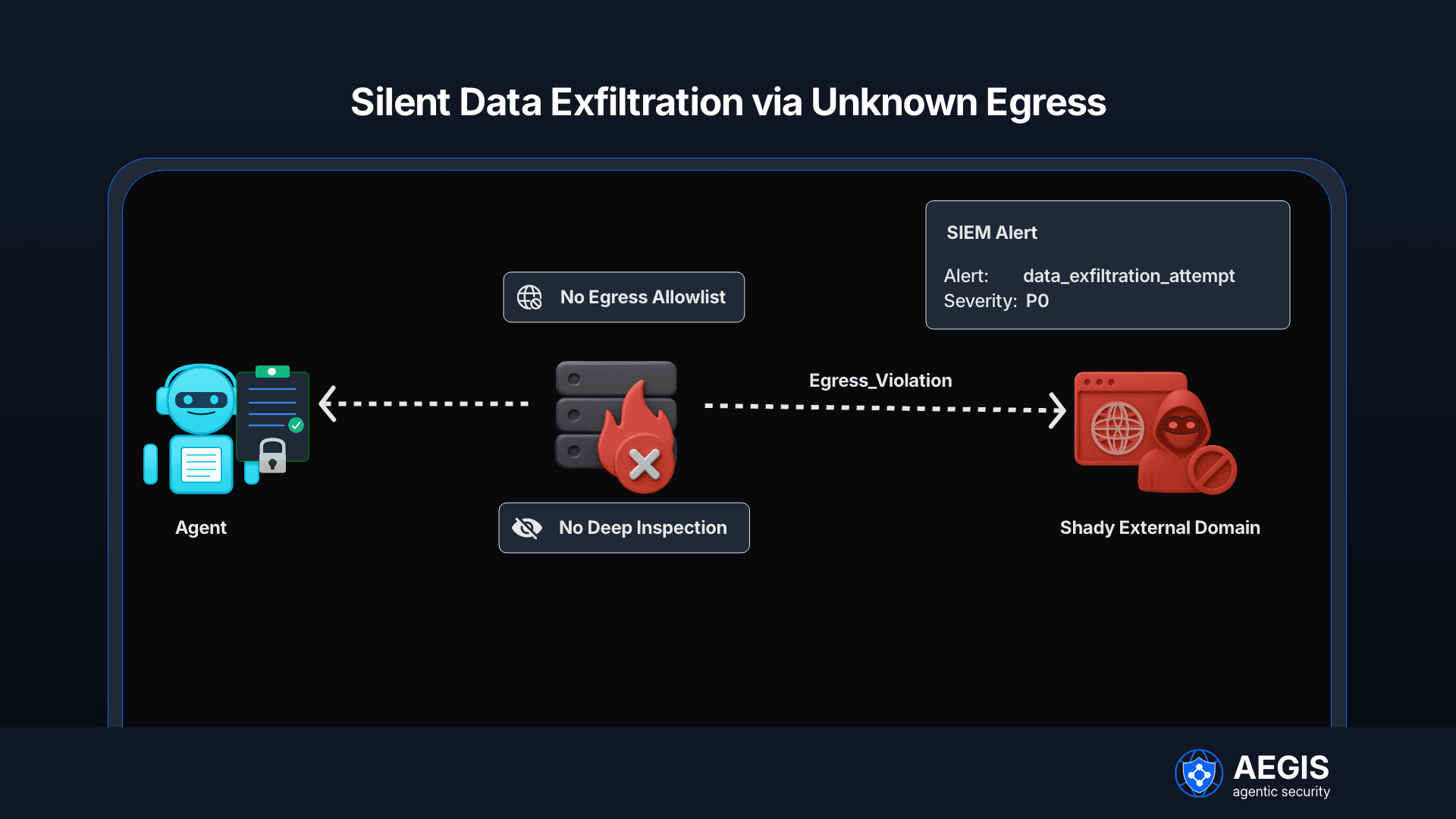
- Per-field parameter validation and deterministic DLP (PII redact).
- Parent-agent chain validation to prevent lateral coercion between agents.
- Tenant-scoped bundles for multi-tenant deployments (MSSP scenarios).
These features directly map to the use cases and problem statements in the product brief.
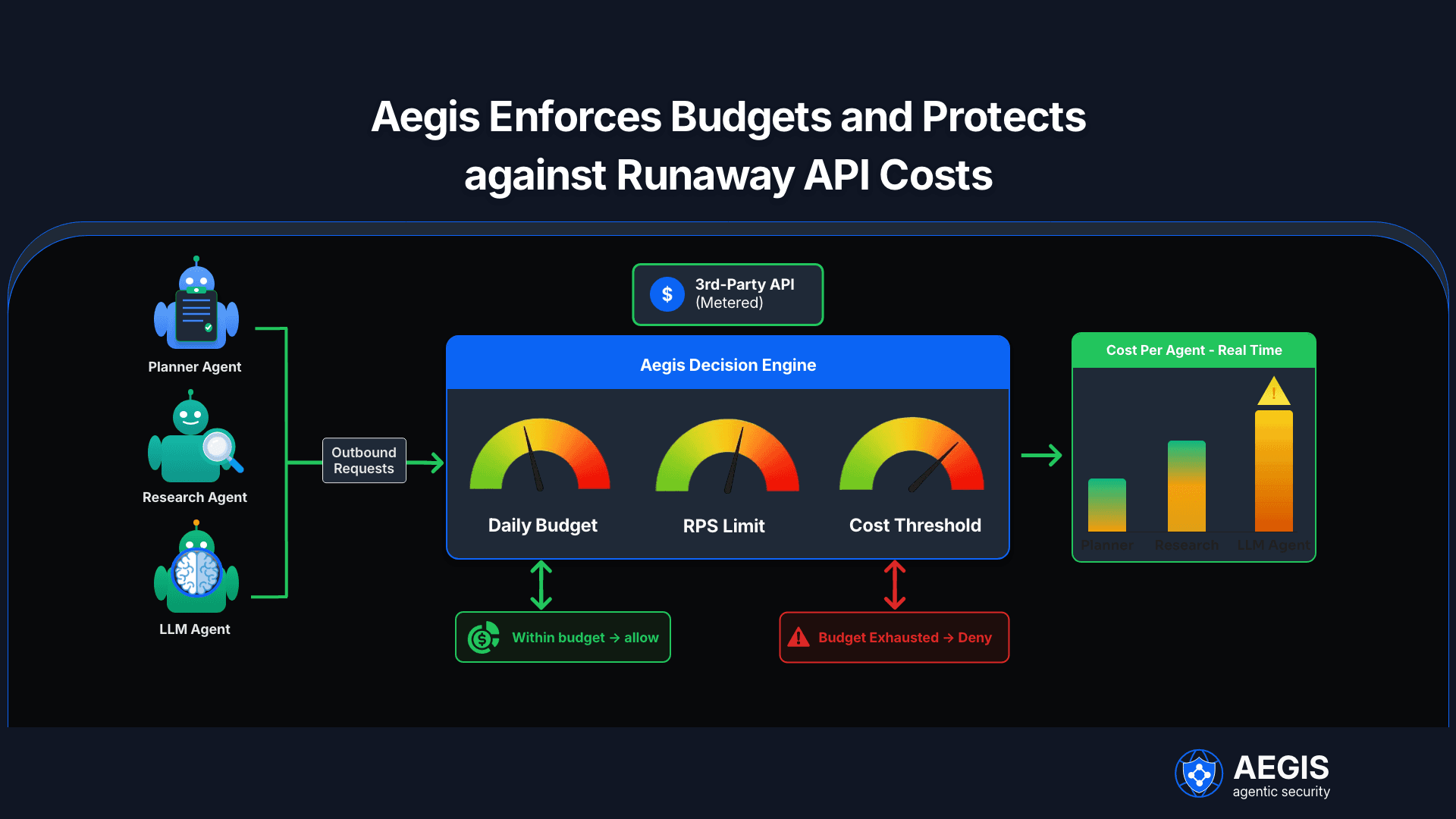
Table 1 — Key Aegis enforcement primitives
Capability | Purpose | Example |
Per-agent budget | Cost control & FinOps | Stop LLM calls when daily budget exhausted |
Field-level conditions | Prevent injection | Amount <= 5000 OR approval_needed |
Approval workflow | Human-in-loop for risk | Slack approval → override token |
Egress allowlist + DLP | Prevent exfiltration | Block unknown domains; redact SSNs |
Case study template (integrating a payments vendor securely)
Use-case: Vendor supplies a payments API connector; enterprise must ensure per-agent ceilings and approvals.
Steps:
- Vendor provides signed connector manifest and sample payloads.
- Enterprise deploys connector in vendor sandbox with Aegis preloaded.
- Shadow-run with representative traces; tune amount regexes and would-block rules.
- Finalize SLA: policy evaluation latency P99 ≤ X ms, and manifest signing for releases.
- Deploy to production with policy enforcement: any payment > $5,000 triggers approval_needed.
Table 2 — Sample contract clauses for payment connector
Clause | Minimum content |
Connector manifest | Versioned, signed manifest; JWKS URL |
Parameter schema | Field types, regex, max_amount, currency list |
Test harness | Shadow runs, replay fixtures, pass/fail criteria |
SLAs | Policy-latency P99, uptime, incident MTTR |
Compliance | Audit log format, retention, data residency |
Governance & operational playbook
- Contract + manifest signing.
- Preload vendor sandbox with Aegis and run 7–14 day shadow tests.
- Weekly report: would-block events, top parameters, approval latency.
- Incident playbook: joint triage responsibilities, escalation roles, and rollback steps.
- Versioning policy: signed, backward-compatible connector updates only.
Why this matters now — market signals
Analysts and industry reports show rapid experimentation with agentic systems but also caution about premature productionization without governance. Gartner projects significant churn in agentic AI projects unless governance improves, underscoring why vendor-enterprise alignment matters. (Reuters) McKinsey and other industry surveys report that many organizations are already scaling or actively piloting agentic workflows—so the window to adopt enforcement patterns is open now. (McKinsey & Company)
👉🏻 Align with emerging standards to future-proof your agentic AI strategy
Frequently Asked Questions
- When should we require signed manifests from vendors?
At vendor onboarding and for every major connector release—use a signed manifest to bind metadata, identity models and versioning to the connector. - How long should a shadow run last?
Typically 7–14 days with production-like traffic; extend if would-block rates remain high and further tuning is required. - What approval latency is acceptable?
Triage policies: immediate allow for low-risk actions; approval workflows should target sub-5 minute human turnaround for business-impacting actions but allow override tokens only once per approval event. - How do we prevent policy misconfiguration from causing outage?
Use schema validation, dry-run mode, rollbacks, and a staged rollout (canary → 25% → 100%) with automated rollback on errors. - Can Aegis handle multi-tenant MSSP scenarios?
Yes—tenant-scoped bundles, per-tenant telemetry and region tag routing are core primitives required for MSSP deployments. - Which metrics should SOC and FinOps watch weekly?
Would-block rate, approval count and latency, top offending parameters, per-agent spend and P99 policy latency.
👉🏻 Move fast with AI innovation while keeping risk under control
Operationalizing vendor co-innovation
Vendor-enterprise collaboration is not a paperwork exercise—it's an operational discipline. Standardized manifests, shadow-mode co-testing, signed policies, and a runtime enforcement plane like Aegis create repeatable guardrails that reduce the attrition risk analysts warn about and make agentic deployments auditable, controllable and production-ready. For enterprises and MSSPs, the combination of policy-as-code, per-agent controls, and OTel-backed telemetry turns a fragile integration surface into a governable, enterprise-grade capability. (Reuters)