
The 2026 Landscape of Agentic AI: Trends and Forecasts
Evidence-based 2026 forecast: how runtime policy, agent identity, and FinOps separate pilots from production.
Agentic AI 2026: Practical Governance to Avoid Project Cancellation
Introduction
Agentic systems—autonomous agents that plan, act, and orchestrate services—are moving fast from lab demos to pilot programs. But by 2027 a meaningful share of these projects will have been canceled unless teams adopt concrete runtime governance: identity, policy-as-code, telemetry and cost controls. This article gives a dated, evidence-backed forecast, practical controls, and a maturity matrix where Aegis (Aegissecurity agentic security mesh) plugs in to stop “agent wash” and preserve production value.
Why 2026 is a hinge year for agentic AI
The facts you must budget into decisions
• 62% of organizations report they are at least experimenting with AI agents, but most remain in pilot phases rather than scale. (McKinsey & Company)
• Gartner predicts over 40% of agentic AI projects will be canceled by end of 2027 due to rising costs, unclear ROI, or inadequate risk controls — a direct warning about governance and FinOps. (Gartner)
• Surveys from identity vendors show widespread unintended agent actions and governance gaps; some large studies report that 72–96% of respondents see agent identity as a new security risk. (SailPoint)
Taken together: interest is high; maturity is low; the failure mode is governance and cost.
Pull-quote
“Policy at runtime separates experiments from production.”
👉🏻 Turn AI into a proactive driver of business efficiency
What’s changing in 2026 — core trends (operational framing)
Trend 1: Agent orchestration matures, but opens new boundaries
Agent orchestrators (LangChain, LangGraph, AgentKit) make multi-step automation easy. That capability increases surface area: tool calls, credentials, and parameter passing become attack vectors. Observability and per-call decisions are becoming must-haves rather than nice-to-haves. LangChain reporting suggests a notable shift from experimentation into production for many teams, but production adoption still requires hard guardrails. (LangChain)
Trend 2: Policy-as-code + runtime policy becomes table stakes
Static IAM cannot express parameter-level constraints (e.g., “amount ≤ $5,000”) or condition approvals. Policy engines like Open Policy Agent (OPA) will be standard to evaluate per-call rules, combined with sidecar proxies for enforcement. OpenPolicyAgent.org and similar projects provide the primitives that enterprises adopt as building blocks. (McKinsey & Company)
Trend 3: FinOps meets agents
Runaway API spend and auto-scaling agent pools produce surprising bills. Expect new tooling to provide per-agent budgets, RPS limits, and cost attribution as mandatory controls. Without this, Gartner’s cancellation risk increases: projects that can’t demonstrate predictable costs will be halted. (Gartner)
Trend 4: Identity & multi-tenancy controls for MSSPs
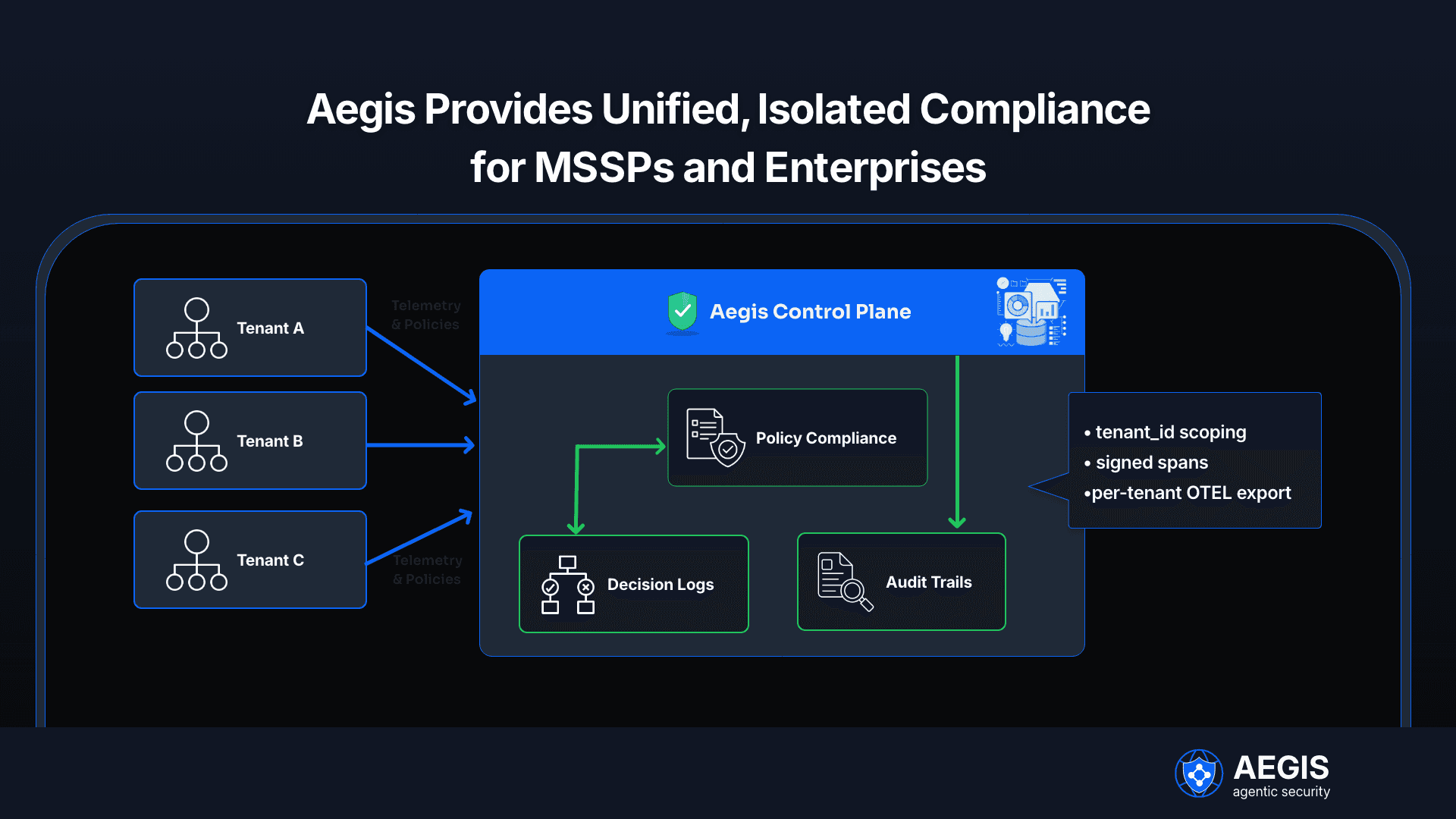
MSSPs will demand per-agent identity, tenant-scoped policies, and signed audit trails. Identity-first governance prevents lateral coercion (Planner → Finance), a commonly observed failure. SailPoint data shows fewer than half of orgs have agent policies, yet almost all recognize the threat — this creates immediate market demand for an agent security mesh. (SailPoint)
Aegis in the maturity curve — where it plugs in
Where Aegis sits: runtime policy + telemetry fabric
Aegis is designed as a lightweight runtime enforcement layer — think “Istio + OPA for agents.” It sits between orchestrator and tools as a gateway (sidecar or forward proxy), enforcing per-agent identity, policy-as-code, and emitting OpenTelemetry traces for SOC and FinOps. It’s not a dev IDE: it’s the enforcement and observability fabric that turns shadow policies into enforced controls.
Core capabilities (how Aegis reduces the four top failure modes)
• Per-agent identity: short-lived tokens and agent registration stop runaway or spoofed agents.
• Policy enforcement: YAML/JSON policy definitions compiled to OPA bundles enforce parameter checks, budgets, rate limits, and approval workflows in real time.
• Approval workflows & FinOps: approval_needed outcomes, Slack/Teams integrations, and per-agent budgets prevent costly or risky actions.
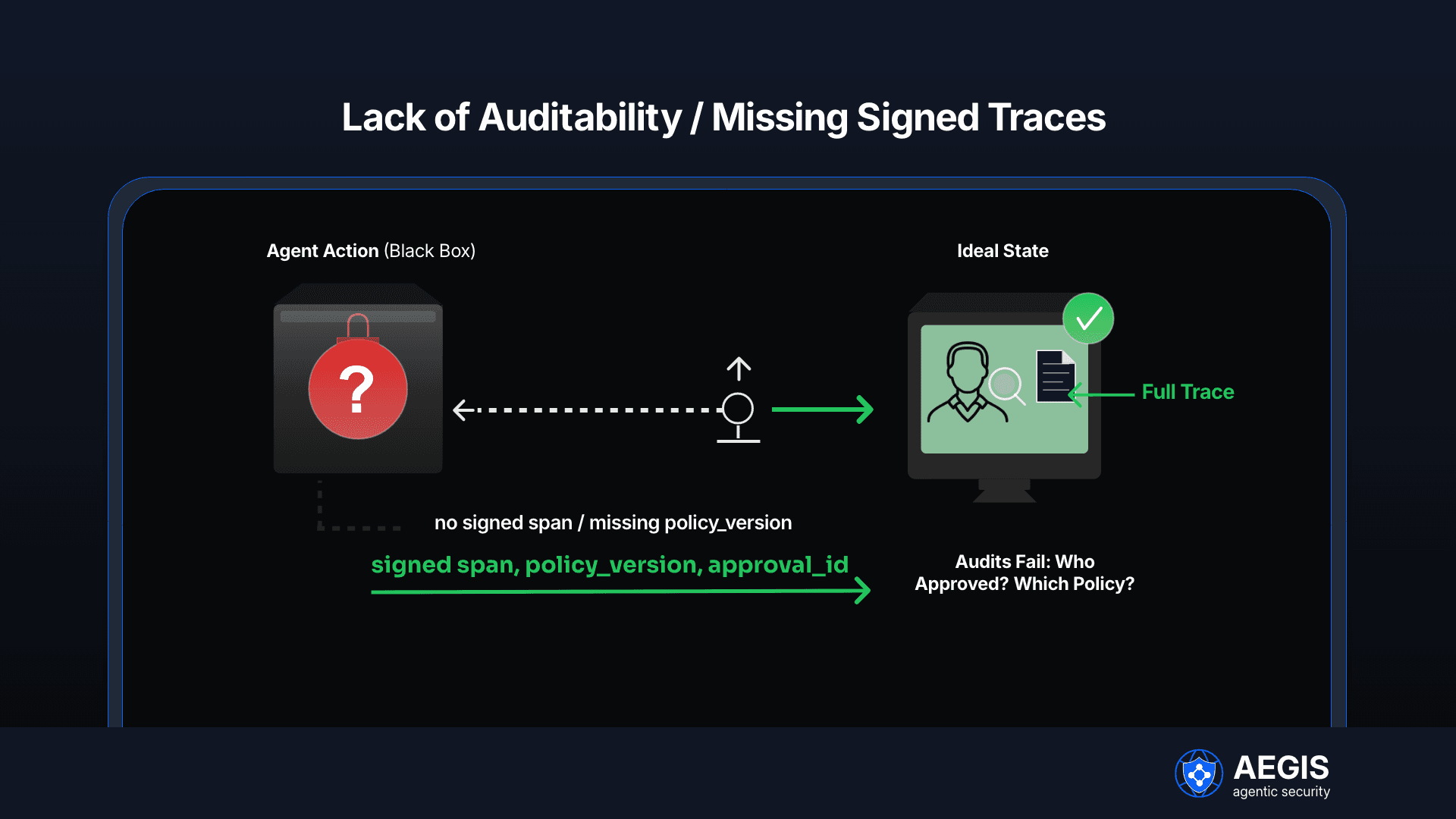
• Telemetry & audit: structured OpenTelemetry spans and signed logs feed SIEM, enabling compliance and post-incident forensics.
Placeholder: Blog cover graphic (designer brief above).
Placeholder: Flowchart illustrating the 4-step process of Aegis's agentic response to a runtime threat (register → evaluate → enforce → log & alert).
Practical controls - Short checklist you can implement in 2026
Tactical checklist (operations-first)
- Enforce per-agent identity tokens and register every agent.
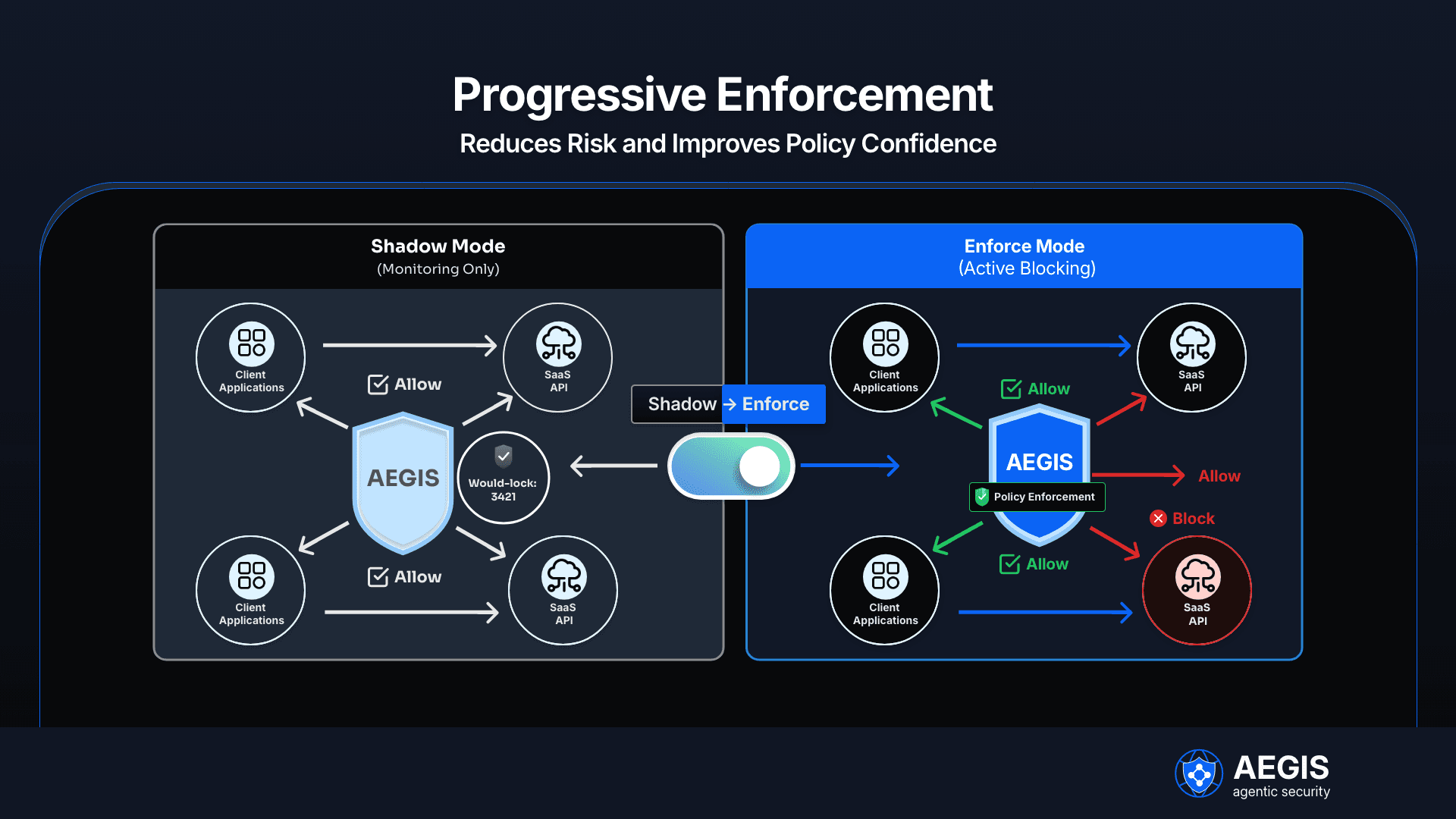
- Start all policies in shadow mode for 7–14 days, collect would-block metrics, tune conditions.
- Instrument every agent-tool call with OpenTelemetry and set dashboards for top callers, would-blocks, and budget burn rate.
- Implement per-agent budgets and rate limits; fail closed for writes in production.
- Route high-risk actions to approval workflows (Slack/Teams) with one-time override tokens.
👉🏻 Prepare for the next evolution of search powered by AI agents
Table 1 — Predicted market events vs recommended controls
Predicted market event (2025–2027) | Risk | Recommended control |
Surge of agent pilots → uncontrolled spend | High FinOps risk | Per-agent budgets, RPS limits, cost dashboards. |
Regulatory focus on AI governance | Compliance risk | Signed audit logs, policy versioning, tenant scoping. |
Increase in agent-driven data exfiltration incidents | Data breach risk | Egress allowlists, DLP/redaction, per-agent identity. |
Approval fatigue and slowdown | Operational bottleneck | Risk-scored approvals, thresholding, automated safe paths. |
Table 2 — Maturity matrix (People / Process / Technology)
Maturity | People | Process | Technology |
Experiment | Dev teams own agents | Ad-hoc checks | Orchestrator + local validators |
Pilot | Security + Dev collaborate | Shadow policies, reviews | Central policy repo, OPA bundles |
Production | SOC/FinOps + DevOps | Runtime enforcement, approvals | Aegis-like gateway, OTel, per-agent identity |
(Where Aegis plugs: data-plane enforcement, policy compilation to OPA, OpenTelemetry emission.)
Example vignettes
FinTech payment guardrails
A planner agent requests a large transfer. Aegis enforces policy (max_amount=5000), blocks, emits trace, and posts approval to Slack. Payment does not proceed without human override. This pattern prevents coercion attacks and enforces auditability.
MSSP multi-tenant control
An MSSP uses tenant-scoped bundles so tenant policies never influence others. Per-tenant dashboards and signed spans support SOC reporting and external audits.
👉🏻Design AI systems that prioritize fairness, ethics, and accountability
.png&w=3840&q=75)
Actionable rollout path (experiment → SOC integration)
- Experiment: instrument agents, run policies in shadow mode.
- Pilot: compile policies, enable hot-reload, add approval workflows.
- Enforce: flip enforcement, enable per-agent budgets, integrate with FinOps.
- Integrate with SOC: feed OTel spans and signed logs into SIEM and run quarterly policy reviews.
Regulation & vendor-agnostic guidance
Expect regulatory interest in agentic AI governance; certification demand (audit trails, tamper-proof logs) will rise. Use vendor-agnostic primitives: OPA for policy evaluation, OpenTelemetry for tracing, and signed audit artifacts for compliance.
FAQ — Frequently Asked Questions
- When will agents become decision makers?
Agents will increasingly take on decision-making roles for low- to medium-risk workflows in 2026–2027, but high-risk financial or regulated decisions will require human approvals and per-action attestations for the foreseeable future. (McKinsey & Company) - What policies are non-negotiable?
Per-agent identity, egress allowlists, parameter validation for risky fields (amounts, commands), and signed telemetry for every action are foundational and should be implemented before enforcement. - How do I avoid approval fatigue?
Risk-score actions, set thresholds for automated safe paths, and use shadow mode to refine policies so only genuinely risky calls require human approval. - Can policy evaluation be fast enough for interactive agents?
Yes — with pre-compiled OPA bundles, prepared queries, in-memory caches, and optional WASM compilation, decision latency can be kept within tens of milliseconds at P99. - What does multi-tenant MSSP support require?
Tenant-scoped bundles, strict token scoping, signed audit trails per tenant, and region-aware routing for data residency. - How do I show ROI?
Measure prevented high-risk actions, avoided breaches, and controlled API spend; combine these with qualitative compliance improvements (audit readiness) to demonstrate ROI to stakeholders.
Closing recommendations (executive checklist)
• Mandate per-agent identity and token issuance now.
• Start every policy in shadow mode, collect telemetry for one full production cycle.
• Implement per-agent budgets and approval workflows before scaling.
• Integrate runtime traces into your SIEM and FinOps dashboards.
• Consider an agent security mesh (Aegis-style) to centralize enforcement and observability — it’s the pragmatic path from pilot to production.
Recommended next step: run a 4-week pilot that implements agent registration, a small set of policies in shadow mode, and OpenTelemetry instrumentation — a low-cost, high-return way to prove control and reduce Gartner-cited cancellation risk. (Gartner)