
SOC2 Considerations for Multi-Agent Architectures
How to achieve SOC 2 audit readiness for multi-agent AI systems with Aegis runtime policy, telemetry, and automated evidence bundles.
SOC 2 Considerations for Multi-Agent Architectures
As agentic AI architectures mature, enterprises face a new audit reality: ephemeral, self-directed software components making interconnected decisions that humans may never explicitly approve. SOC 2, the bedrock compliance framework for trust and accountability, assumes clear control over every system action — but multi-agent systems break that assumption.
According to McKinsey’s 2024 AI infrastructure survey, 23% of enterprises are already scaling agentic AI pilots, and Gartner predicts 40% of such projects will be abandoned by 2027 due to uneven maturity and compliance challenges. The problem isn’t just technological — it’s auditable control.
Traditional SOC 2 evidence relies on IAM logs, static API keys, and manual verification of approvals. In multi-agent architectures, agents spawn dynamically, chain decisions, and execute actions across tools. Aegis Gateway—Aegissecurity agentic runtime policy and observability platform—provides the foundation to restore provable control, traceability, and compliance to these distributed AI systems.
The Compliance Problem: SOC 2 Meets Autonomous Agents
Ephemeral Actors and Unverifiable Chains
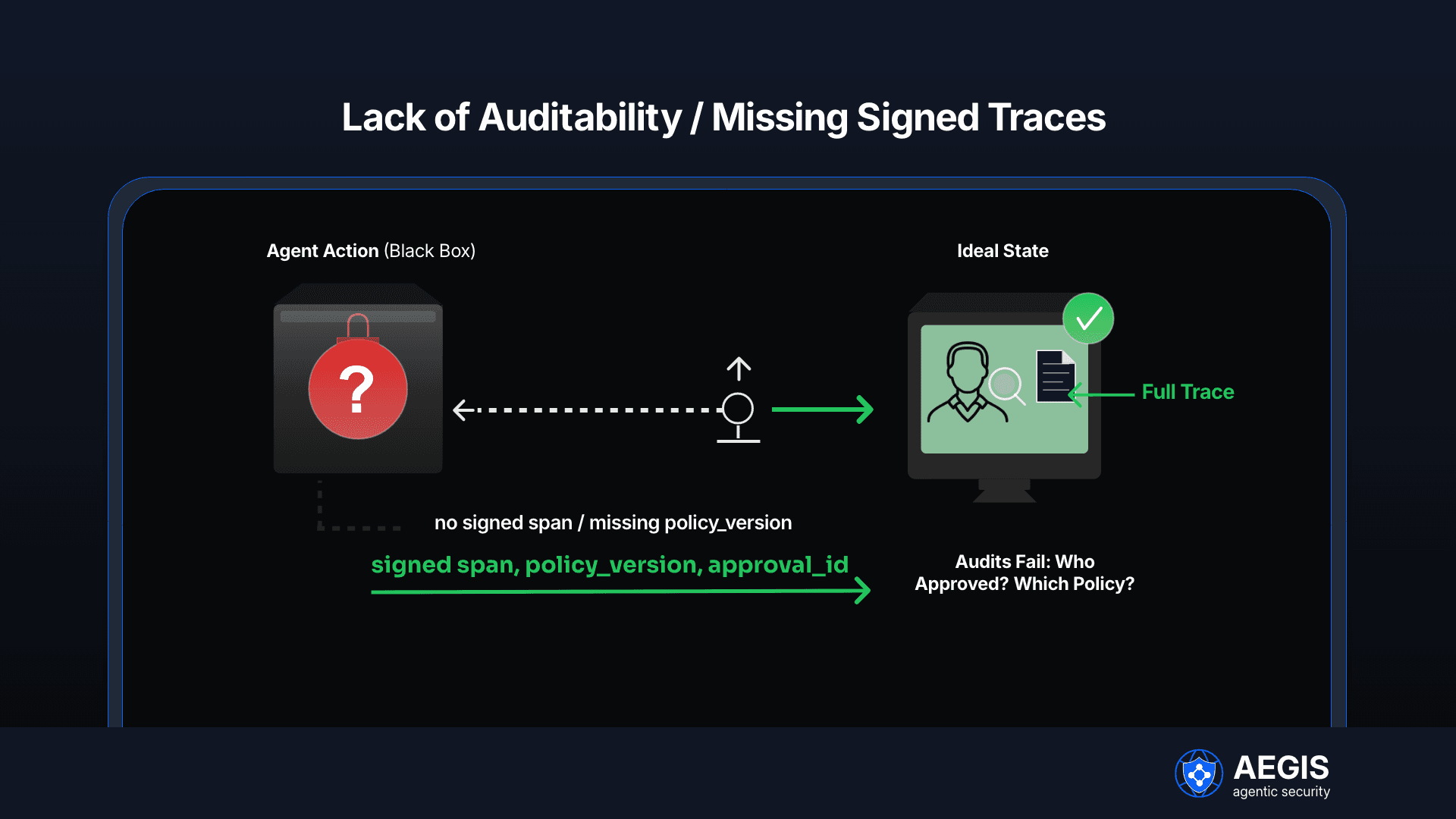
Multi-agent AI systems involve orchestrators, planners, and executors that delegate actions. Each may invoke others via ephemeral tokens or transient process IDs. This design is efficient—but it breaks the audit trail. When one agent calls another, parameter injection or hidden chain calls can occur without any verifiable attribution.
Traditional approach:
- Long-lived IAM keys and coarse service identities
- Logging limited to the orchestrator or app layer
- Manual collection of evidence for approval trails
New challenge:
Who initiated the final action? What was the input context? Which parameters were overridden mid-chain? Without runtime validation, SOC 2 auditors cannot confirm that each action adhered to approved policy.
👉🏻 Meet SOC2 requirements with policy-driven agent governance
The Modern Solution: Runtime Policy and Evidence Fabric
Aegis Gateway provides a runtime enforcement and observability mesh that enforces SOC 2 controls as actions occur, not after the fact.
It acts as a policy-aware gateway between agents and tools, ensuring every tool invocation is evaluated, attributed, and auditable.
.png&w=3840&q=75)
Core Concepts of Aegis Gateway
Function | Description | SOC 2 Mapping |
Agent Identity Registry | Each agent gets a unique, short-lived identity token (JWT) with org, tenant, and scope claims. | Access control (CC6.1–CC6.3) |
Runtime Policy Evaluation | Evaluates each agent→tool call, including parameters, context, and risk thresholds. | Change management (CC8.1) |
Signed Decision Artifacts | Every allow/deny decision is signed and versioned, forming tamper-proof audit trails. | System integrity (CC7.2) |
Automated Evidence Bundles | Compiles structured telemetry, approvals, and policy metadata for SOC 2 auditors. | Audit logging & evidence (CC7.4) |
Aegis transforms the traditional audit cycle from “after-the-fact evidence gathering” to continuous attestation.
👉🏻 Build systems that pass audits with strong SOC2 alignment
Mapping SOC 2 Trust Criteria to Multi-Agent Controls
Security: Verified Agent Actions
Aegis ensures only authorized agents perform specific actions. Each call is checked against real-time policies defined as YAML or JSON. Policies declare:
- Allowed tools and actions
- Conditional logic (amount ≤ $5000, regex match, business hours)
- Required approval thresholds
Each policy compiles into an Open Policy Agent (OPA) bundle and hot-reloads during runtime. This allows SOC 2 reviewers to trace any blocked or approved event directly to the policy version that decided it.
Availability & Processing Integrity: Resilient Control Plane
Aegis decouples the control and data planes. Even during partial network outages, cached policy bundles continue enforcing rules. The system supports fail-closed semantics for critical actions, ensuring that missing policy evaluation does not lead to unauthorized execution—meeting SOC 2’s processing integrity principles.
Confidentiality: Deterministic DLP & Egress Filtering
The gateway integrates deterministic data loss prevention (DLP) filters to redact sensitive PII or PHI from payloads before egress. Outbound requests are validated against tenant-allowed domains (e.g., api.openai.com, internal-api.myorg.com), ensuring regionally compliant data residency.
👉🏻 Streamline SOC2 reporting with automated compliance workflows
Implementing SOC 2 Controls with Aegis
Aegis’s policy-as-code model allows organizations to declare and enforce SOC 2 controls at runtime. The table below maps example Aegis capabilities to SOC 2 control requirements.
SOC 2 Control Area | Traditional Audit Method | Aegis Runtime Approach |
Access Control | Manual IAM reviews | Per-agent scoped JWTs with expiry and signed issuance logs |
Change Management | Static config review | Versioned policy bundles with rollback and attestation |
Logging & Monitoring | Periodic log sampling | Continuous OpenTelemetry streams with decision reasoning |
Data Confidentiality | Manual DLP scans | Real-time PII redaction and egress allowlists |
Incident Response | After-the-fact forensics | Instant alerts and policy-triggered containment |
Audit Evidence | Manual screenshots | Automated evidence bundles (policy + decision logs) |
This approach replaces manual control validation with continuous, cryptographically provable governance.
Practical Scenarios: SOC 2 in Multi-Agent Workflows
1. FinTech — High-Risk Payment Authorization
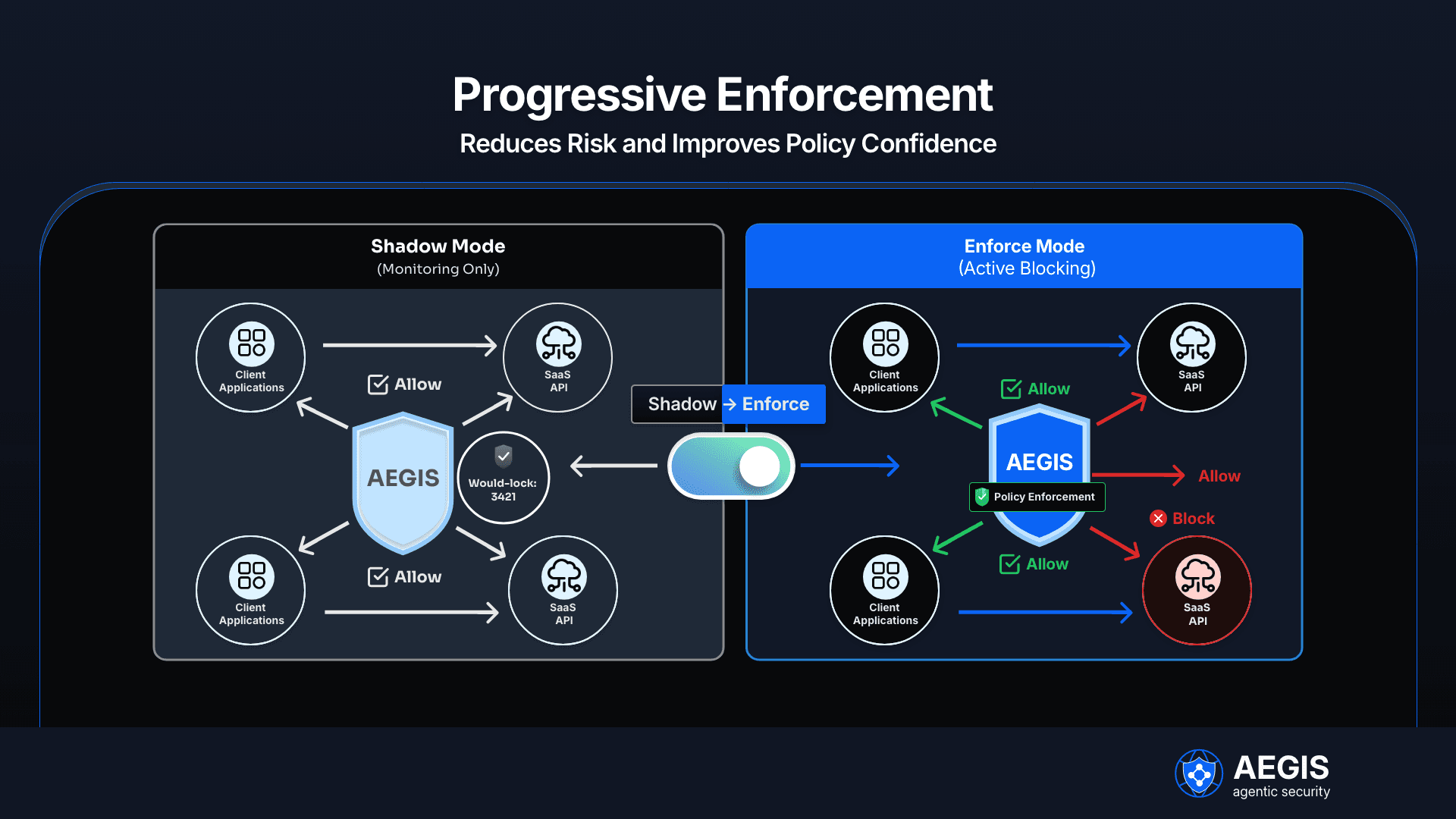
When a planner agent instructs a finance agent to transfer $50,000, Aegis intercepts the request:
- Detects threshold breach ($5000 limit)
- Requires human approval via Slack/Teams
- Mints a one-time override token after approval
- Logs signed decision span with policy version and approval ID
The result is both secure transaction control and SOC 2-ready audit proof.
2. Healthcare — PHI Protection & Auditability
For agents accessing EHR data:
- DLP filters automatically redact SSNs and DOBs
- Only pre-approved internal endpoints are callable
- Off-region requests trigger deny and generate compliance alerts
Each blocked or sanitized call is logged as a signed event, forming immutable evidence.
3. SaaS / FinOps — Budget & Rate Governance
Aegis policies enforce per-agent budgets and API rate limits. Once a threshold is met, subsequent calls are blocked and traced.
SOC 2 reviewers can retrieve full proof of budget enforcement, timestamps, and actor attribution.
Automating SOC 2 Evidence Generation
SOC 2 audits often stall due to evidence sprawl—screenshots, manual exports, and spreadsheets. Aegis eliminates this by automatically packaging:
- Policy definitions and hashes
- Signed decisions (allow/deny/approval)
- Token issuance records
- Metric snapshots (policy coverage %, P99 latency, blocked events)
Each bundle is versioned and stored in an immutable repository, ready for auditor replay.
Auditors can simulate any transaction to verify which policy governed it, satisfying both CC7.4 and CC8.1 requirements.
Architecture for Continuous Audit Readiness
Aegis’s architecture mirrors a service mesh but is purpose-built for AI systems.
Data Plane: Runtime enforcement via proxy/middleware
Control Plane: Policy compiler, token service, and bundle store
It operates across orchestrators (LangGraph, AgentKit, CrewAI) without modifying agent code. Integration is achieved via SDK decorators or a transparent HTTP proxy.
Performance Benchmarks:
- <20ms P99 latency for OPA evaluation
- 99.9% uptime for the decision service
- 100% trace coverage for agent-tool interactions
This ensures continuous compliance without impacting agent responsiveness.
Multi-Tenancy and MSSP Readiness
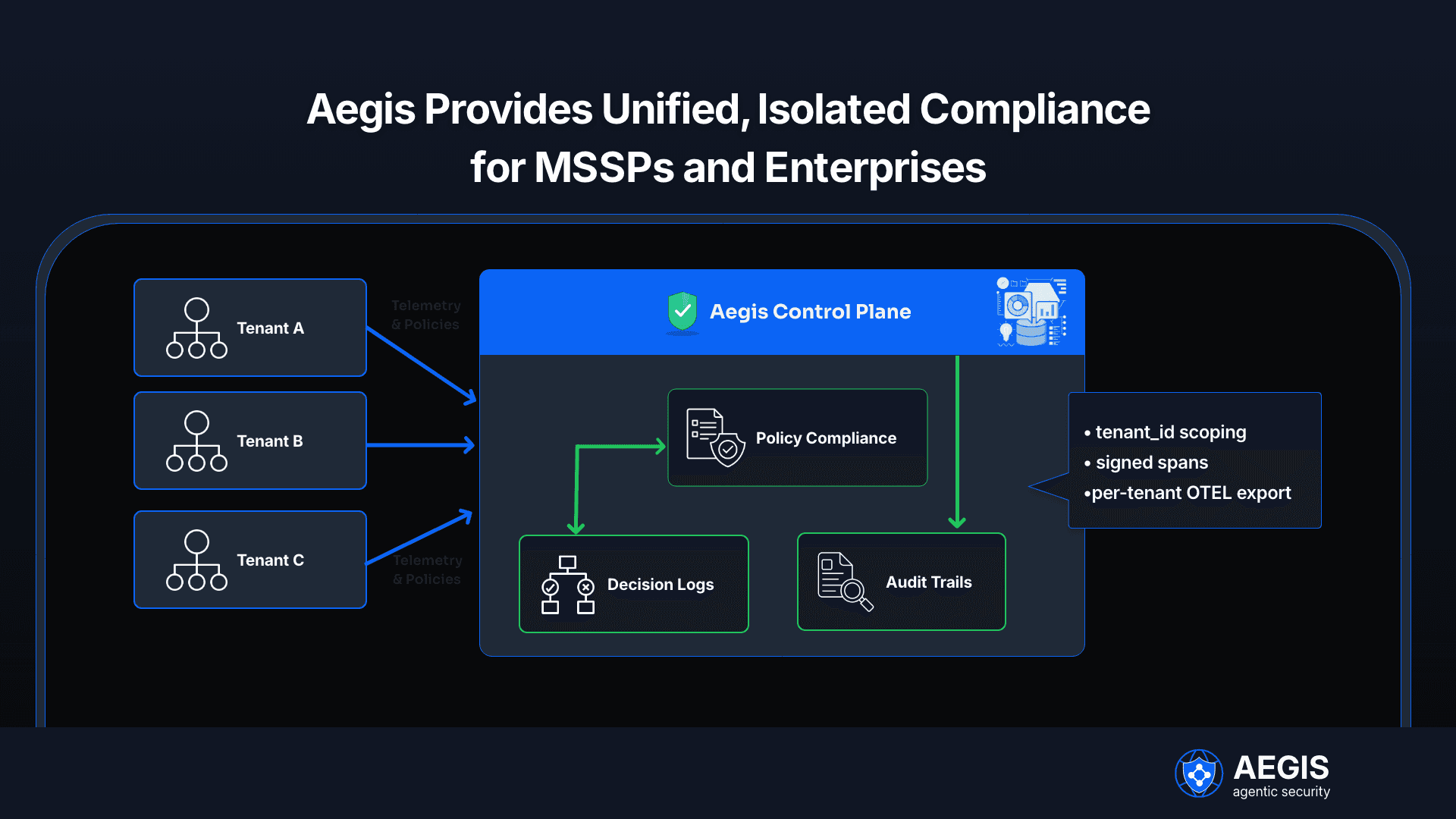
Managed Security Service Providers (MSSPs) require strict tenant isolation. Aegis supports:
- Tenant-scoped policy bundles
- Region-specific routing
- Scoped API keys and signed telemetry
This enables MSSPs to serve multiple regulated customers—finance, healthcare, or manufacturing—while maintaining independent compliance domains.
Operationalizing SOC 2 for Agentic AI
Aegis introduces an operational loop that replaces audit snapshots with living controls.
Four-Step SOC 2 Automation Cycle:
- Define policies as code (YAML/JSON).
- Deploy runtime enforcement via proxy or middleware.
- Observe metrics and blocked events in dashboards.
- Attest compliance via automated evidence exports.
This continuous model aligns perfectly with SOC 2’s trust principles, making compliance real-time and reproducible.
Key Metrics for Compliance Reporting
Metric | Description | Target |
Policy Coverage | % of agent actions governed by policy | ≥80% |
Decision Latency | Time to evaluate and enforce policy | <20ms |
Evidence Completeness | % of actions with attested logs | 100% |
Blocked Events | Number of denied or approved actions | Tracked daily |
Audit Replay Accuracy | Ability to reproduce decision results | 100% fidelity |
These metrics form the baseline for internal SOC 2 dashboards and automated compliance reports.
Why Aegis Enables SOC 2 Readiness
Policy as Code, Proven by Runtime Evidence
Unlike legacy audit tooling, Aegis ties compliance directly to execution:
- OPA-based policy enforcement ensures every decision is policy-driven.
- Short-lived agent tokens remove static key risk.
- Signed telemetry creates tamper-proof audit evidence.
- Automated bundles simplify auditor verification.
Multi-Agent Integrity and Observability
By acting as a universal control point, Aegis prevents lateral coercion between agents and tools. It ensures that every decision is:
- Attributable: verified agent identity
- Authorized: aligned to defined scopes
- Auditable: with signed decision spans
This architecture transforms agentic AI from opaque automation into provably compliant systems.
Frequently Asked Questions
1. How does Aegis help during a SOC 2 audit?
It produces signed decision logs and evidence bundles that auditors can replay to verify each control, replacing screenshots and spreadsheets.
2. Does Aegis integrate with existing orchestrators like LangChain or AgentKit?
Yes. It provides middleware and proxy-based integrations that require no major code rewrites.
3. How are agent identities secured?
Each agent uses a short-lived, signed JWT with org, tenant, and scope claims, ensuring cryptographic identity assurance.
4. Can Aegis handle sensitive data compliance like HIPAA or PCI in addition to SOC 2?
Yes. Its runtime DLP and regional routing features support data privacy and residency requirements beyond SOC 2.
5. What’s the performance overhead of Aegis policy evaluation?
Under 20ms P99 latency, achieved through pre-compiled OPA queries and in-memory caches.
6. How do multi-tenant environments maintain compliance separation?
Aegis isolates policy bundles per tenant and region, ensuring no cross-customer policy bleed.