
Automating Compliance Reporting with AI Agents
Practical guide to using Aegis to secure agentic compliance automation with tamper-evident logs, policy templates, and approval workflows.
Automating Compliance Reporting with AI Agents
Compliance reporting is repetitive, time-bound and high-risk: errors can lead to fines, missed deadlines, or regulatory scrutiny. Modern teams move from spreadsheets and manual certification to agentic automation that extracts, normalizes and prepares filings. That shift offers scale and speed — but also creates provenance, approval and auditability questions. This article explains the problem, architecture patterns, policy templates and a practical implementation checklist that security and compliance teams can use to deploy Aegis — Aegissecurity runtime policy and observability fabric for multi-agent systems — to automate regulatory filings safely.
Problem: Why compliance automation needs stricter runtime controls
Agentic workflows change the failure modes of compliance:
- High volume + periodic cadence (quarterly filings, tax returns, regulator reports) increases blast radius when an agent misconfigures parameters.
- Automation reduces human review latency but removes provenance unless actions are observable and signed.
- Traditional IAM only answers “who” — it does not answer “what parameters are allowed,” “which agent may submit,” or “which filings require human sign-off.”
- Audit trails must be tamper-evident, versioned and tied to policy versions to satisfy auditors.
Market signals show scale matters: 74% of companies still struggle to scale AI to measurable value, so teams need shadow/dry-run approaches before enforcement. (BCG) Agentic AI adoption is accelerating but brittle without governance: analysts warn many early projects will fail without controls. (Reuters)
Practical example (risk scenario)
A planner agent aggregates accounting lines and instructs a finance agent to submit a quarterly filing. Without runtime enforcement the planner can inject an incorrect amount or change submission metadata. Regulators will ask “who changed the submission and under which policy?” If that question is unanswered, remediation and fines follow.
👉🏻 Build transparent systems that are always ready for regulatory audits
Architecture: Where Aegis sits and what it enforces
Aegis is a lightweight policy and telemetry fabric that sits between orchestrators (agent orchestration frameworks) and downstream tools or regulator APIs. It provides policy-as-code, runtime enforcement, approval workflows and tamper-evident traces. Key architecture primitives:
- Agent identity & short-lived tokens — agents register and get scoped tokens.
- Sidecar / forward proxy (data plane) — all agent→tool calls pass through Aegis for inspection.
- Policy evaluator — OPA-style rules compiled from YAML/JSON templates. Decisions: allow, deny, sanitize, approval_needed.
- Approval service — human approvals via Slack/Teams with one-time override tokens.
- Telemetry & audit signing — OpenTelemetry spans and signed, versioned logs for SIEM and auditors.
Diagram placeholder: [Image: Flowchart illustrating 4-step process of Aegis's agentic response to a runtime threat — Agent call → Gateway policy check → Approval_needed flow → Signed submission].
Technical references and design notes are drawn from the Aegis product brief and MVP spec, which define the gateway, policy compiler, OTel emission and sidecar model.
👉🏻 Align your AI systems with NIST standards for stronger risk management
Policy templates (examples you can start with)
- High-risk filing policy (example)
agent: finance-agent
allowed_tools:
- name: regulator-api
actions:
- submit_filing
conditions:
filing_type: quarterly
require_role: auditor_role
approval_threshold: 100000
on_violation: approval_needed
DLP filter for PII — deterministic regex redaction for SSNs, account numbers; sanitize mode removes or masks fields before submission.
Implementation checklist: deployable steps for teams
The following checklist is operational, prioritizing low-risk rollout and measurable controls.
- Inventory & register agents
- Register agents in Aegis agent registry; bind to tenant and role claims. Use short-lived tokens and maintain a changelog for each agent.
- Define policy scope & templates
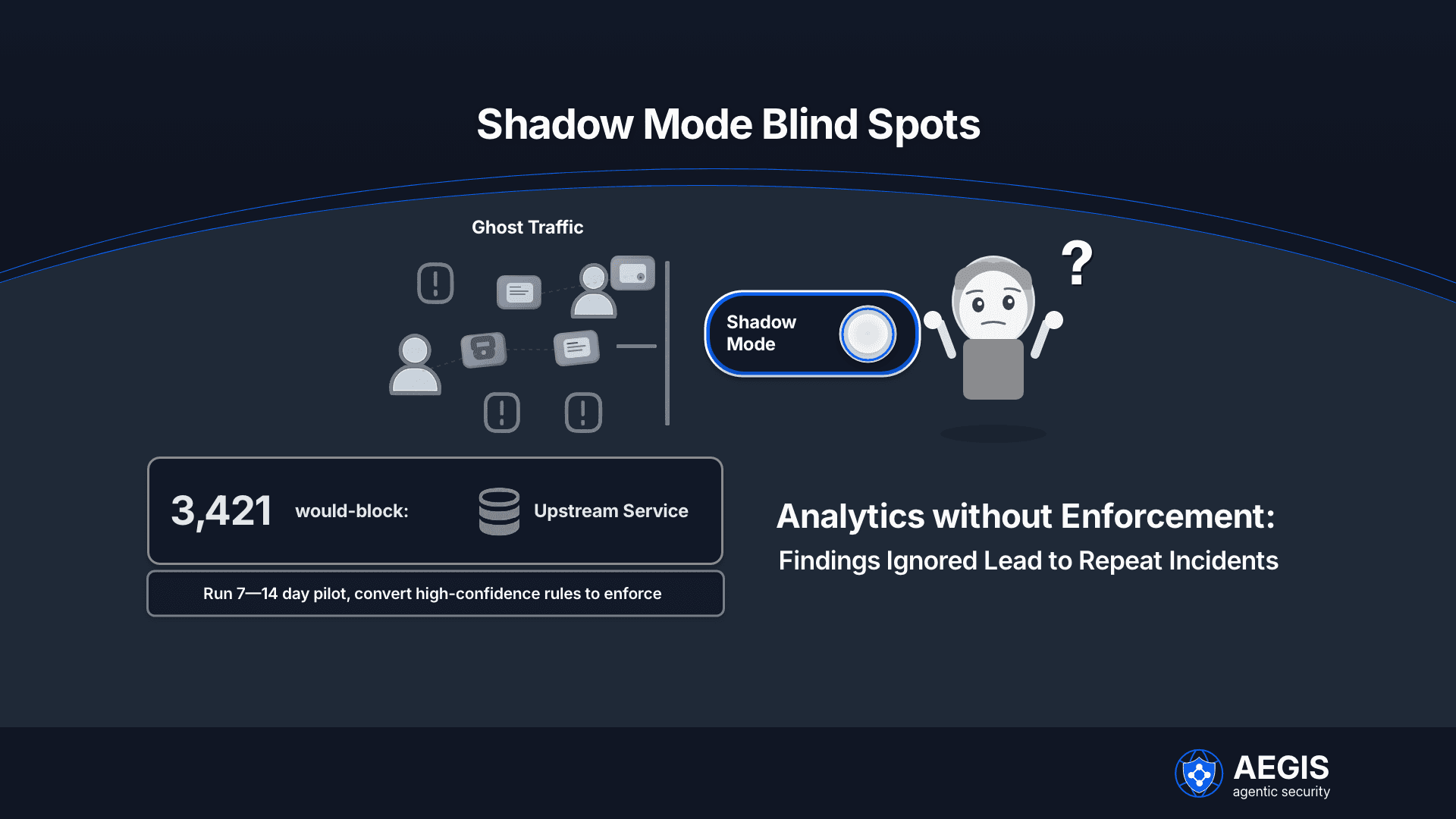
- Create per-filing, per-tool templates (financial filings, FCA/SEC APIs, VAT returns). Start with shadow mode to collect “would-block” data.
- Create per-filing, per-tool templates (financial filings, FCA/SEC APIs, VAT returns). Start with shadow mode to collect “would-block” data.
- Shadow mode rollout (2–4 weeks)
- Run policies in shadow to surface false positives, top violating agents and parameter distributions. Tune regexes and thresholds.
- Run policies in shadow to surface false positives, top violating agents and parameter distributions. Tune regexes and thresholds.
- Approval workflows
- Configure approval_needed flows for thresholds (e.g., amounts > $50k) and integrate Slack/Teams for human verification before allowed retries.
- Configure approval_needed flows for thresholds (e.g., amounts > $50k) and integrate Slack/Teams for human verification before allowed retries.
- Tamper-evident logging & policy versioning
- Store signed audit artifacts (ETag/signed manifest) alongside policy versions so an auditor can map a decision to the exact policy content.
- Store signed audit artifacts (ETag/signed manifest) alongside policy versions so an auditor can map a decision to the exact policy content.
- DLP & residency routing
- Apply deterministic redaction for PII and route submissions to region-tagged endpoints to satisfy data residency.
- Apply deterministic redaction for PII and route submissions to region-tagged endpoints to satisfy data residency.
- SLA & performance testing
- Validate P99 decision latency; target <20 ms per call for interactive agent flows. Use prepared queries + caching when running OPA.
- Validate P99 decision latency; target <20 ms per call for interactive agent flows. Use prepared queries + caching when running OPA.
Typical policy decisions and operational response
Decision | When used | Operational effect |
allow | Low-risk filing, validated params | Proceed to submit API |
sanitize | Contains PII or sensitive fields | Redact fields and continue |
approval_needed | Amounts above threshold / unusual destination | Pause, send approval request |
deny | Out-of-policy tool or agent | Block + log incident |
Shadow → Enforce rollout metrics to track
Metric | Target during shadow | Target after enforce |
Would-block rate | ≤ 5% of calls | 0% false positives |
Policy tuning iterations | 2–4 | maintenance only |
Time to approve (human) | < 30 mins | < 15 mins for critical filings |
Aegis as the practical solution
Aegis provides a narrow, operationally focused control plane for compliance automation agents. It is explicitly designed to handle the unique needs of multi-agent orchestration: parameter inspection, per-agent budgets, approval gating and signed audit trails. The principal value propositions for compliance teams are:
- Provenance & Auditability — Every agent call yields an OpenTelemetry span enriched with agent_id, policy_version, decision_reason and approval_id. Optionally, logs are signed and stored with versioned manifests for auditors. This addresses a common audit question: “Which policy and which human approved this submission?”
- Least-privilege at runtime — Policies are fine-grained: allow specific actions (submit_filing), constrained parameters (filing_type: quarterly), and role requirements (auditor_role). This prevents lateral coercion between agents and stops planner agents from tricking finance agents into high-risk submissions. Example: finance-agent max_amount: 5000 blocks a planner-initiated $50k payment.
- Approval_needed workflows — For filings that require human sign-off, Aegis pauses the request, posts an interactive approval in Slack/Teams and issues one-time override tokens once approved. That flow maintains velocity while preserving human accountability.
- Shadow mode and dry-run — Because many orgs struggle to scale AI safely (74% reported difficulty), shadow mode lets teams observe would-block events, tune policies and build trust before enforcement flips on. (BCG)
- Operational integration — Aegis emits telemetry to SIEM and dashboards for compliance, finance and SOC teams; it enforces egress allowlists to prevent exfiltration and can sanitize PII before leaving the boundary. This makes it deployable in regulated sectors (FinTech, Healthcare, Energy).
Quarterly financial filing
- Planner compiles ledger into a draft and signals finance-agent.
- Finance-agent calls regulator-api:submit_filing via Aegis sidecar.
- Aegis evaluates policy: requires auditor_role or approval_needed if amount > $100k.
- If approval_needed, Aegis posts to Slack; once approved, the override token allows submission and Aegis signs the audit trail.
Implementation patterns and governance
Versioned policies and test harness
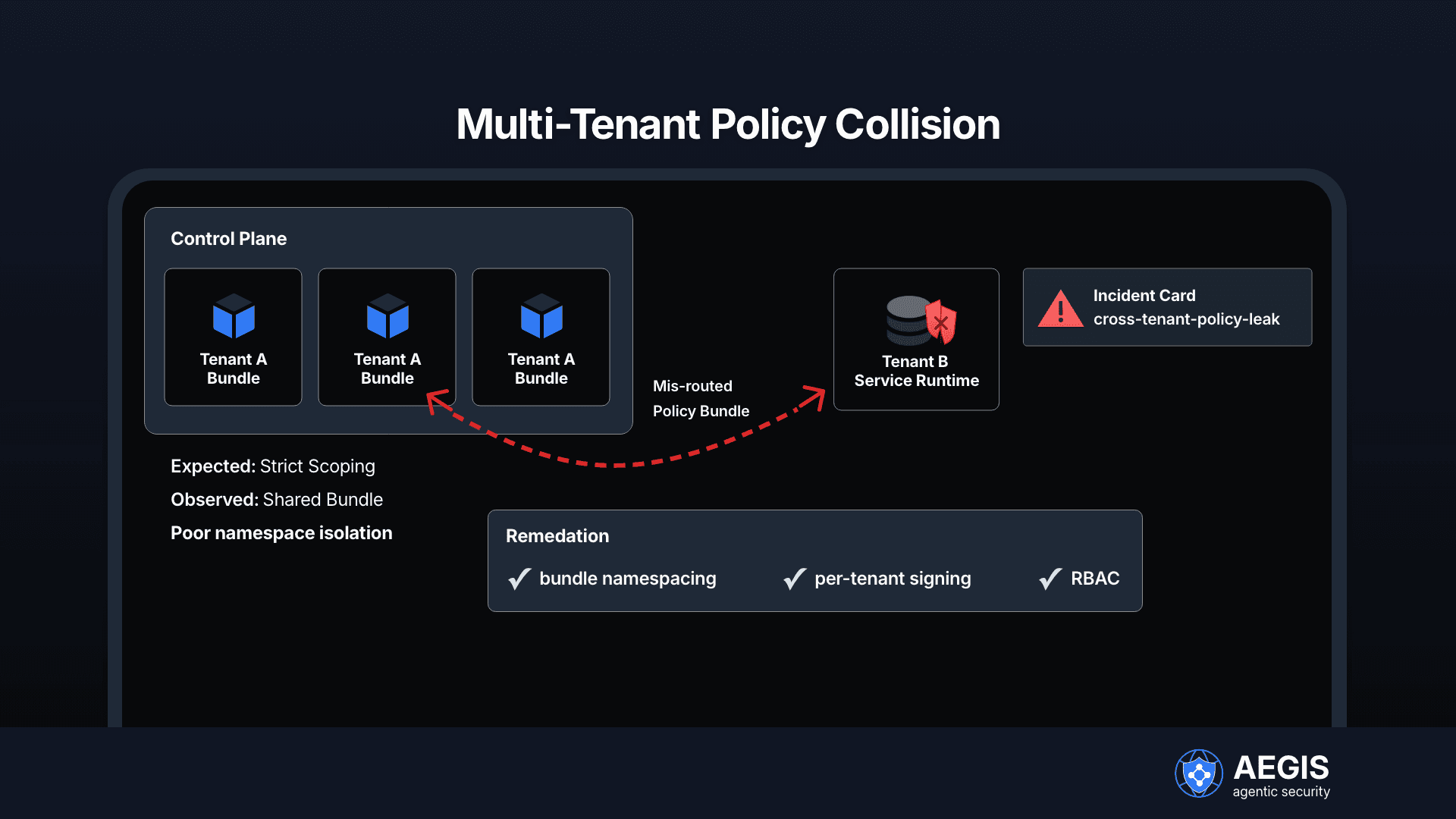
- Keep a policy bundle per tenant and store signed manifests in S3 / object storage. Provide a CLI to run dry-run simulations against historical traces.
Multi-tenant scoping and fail modes
Bundle scoping prevents tenant policy leakage. Configure fail-closed for write actions (submit_filing) and fail-open optionally for low-risk reads to preserve availability.
👉🏻 Achieve SOC2 readiness with secure and compliant agent architectures
.png&w=3840&q=75)
FAQ — Frequently Asked Questions
Q1: Can Aegis integrate with existing orchestrators?
Yes. Aegis supports drop-in middleware and sidecar patterns for LangChain, LangGraph and similar orchestrators; it also offers SDKs for Python/Node.
Q2: How are policy changes audited?
Policy versions are stored with signed manifests and ETags. Every decision is tagged with the policy_version used for that evaluation.
Q3: Will enforcement add unacceptable latency?
Aegis targets P99 decision latency ≤ 20 ms using prepared OPA queries, in-memory caching and optional WASM compilation for Rego.
Q4: How do you avoid approval fatigue?
Use tiered thresholds, aggregate low-risk approvals, enforce budgets/rate limits and run policies in shadow to reduce unnecessary approval events.
Q5: Can Aegis redact PII automatically?
Yes — deterministic DLP rules (regex) can sanitize SSNs, account numbers and other sensitive fields before they leave the boundary.
Closing (operational focus)
Automating compliance reporting with agentic AI delivers efficiency but requires a runtime control plane that preserves provenance, enforces least-privilege and provides human approvals for high-risk actions. Aegis is intentionally focused: policy-as-code, runtime enforcement, tamper-evident logs and approval workflows make it suitable for regulated enterprises that must scale agentic automation without sacrificing auditability or control. For practical next steps, run policies in shadow against a single filing type, verify signed audit trails and iteratively expand scope from there.
External sources cited in this post:
- BCG: “AI Adoption in 2024: 74% of Companies Struggle to Achieve and Scale Value.” https://www.bcg.com/press/24october2024-ai-adoption-in-2024-74-of-companies-struggle-to-achieve-and-scale-value. (BCG)
- Gartner / Reuters coverage on agentic AI project risks. (Reuters)
- Compliance automation market growth and CAGR reports. (Business Wire)