Creating Audit Ready Multi-Agent Systems for Regulators
Learn how Aegis automates audit-ready evidence for regulators through signed telemetry, policy versioning, and structured agent observability.
Creating Audit-Ready Multi-Agent Systems for Regulators
Modern enterprises are increasingly deploying agentic AI architectures—systems composed of autonomous agents that collaborate, make decisions, and execute actions across connected tools. From orchestrating financial transactions to automating patient data workflows, these systems are now mission-critical. However, this innovation introduces a new regulatory challenge: how do you make such autonomous systems audit-ready?
Regulators demand verifiable, tamper-evident records of every decision an AI agent makes. Traditional approaches—manual log exports and post-incident reconciliation—cannot handle the complexity or volume of multi-agent interactions.
This article explores how Aegis, an agentic AI security tool by Aegissecurity delivers structured, compliant, and auditable workflows for these systems through policy versioning, evidence automation, and signed telemetry.
Why Audit-Ready AI Systems Are Now Mandatory
The Regulatory Shift in 2024–2025
The global regulatory landscape has evolved rapidly to address risks posed by AI systems. Updated frameworks from the EU AI Act, US NIST AI Risk Management Framework, and Australia’s IPC New South Wales PIA guidelines now require not only explainability but evidence of control—proof that each AI decision was made under a valid policy and can be reconstructed after the fact.
👉🏻 Maintain complete traceability across all agent activities
The Problem with Traditional Evidence Collection
In most enterprises, compliance officers still rely on ad hoc methods:
- Exporting raw logs manually from distributed systems.
- Manually aligning timestamps across agents and APIs.
- Attempting to link policy versions to observed behaviors.
This process is error-prone, lacks chain-of-custody integrity, and cannot survive regulator scrutiny in multi-agent environments where actions are chained—Agent A triggers Agent B, which interacts with Tool C.
The New Compliance Model: Structured, Signed, and Replayable
To achieve continuous audit readiness, enterprises need structured evidence workflows. Instead of unverified logs, the goal is to create a cryptographically verifiable narrative of every agent decision. Aegis operationalizes this through:
👉🏻 Ensure accountability with structured decision logging
Evidence Component | Description | Regulatory Purpose |
Signed Spans | OpenTelemetry spans containing agent_id, tool, policy_version, and decision_reason, each digitally signed. | Ensures data integrity and traceability. |
Versioned Policies | Every policy bundle is hash-stamped and retained. | Maps decisions to the exact rule in effect. |
Attestation Signatures | Decisions carry attestation signatures confirming who (or which agent) approved an action. | Provides human accountability. |
Evidence Bundles | Automatically packaged datasets combining spans, YAML policies, decision logs, and hashes. | Enables regulator walk-through and replay. |
With Aegis, these artifacts are generated automatically at runtime and stored in an auditable format, eliminating manual reconciliation.
The Role of Aegis: Automating Evidence and Enforcement
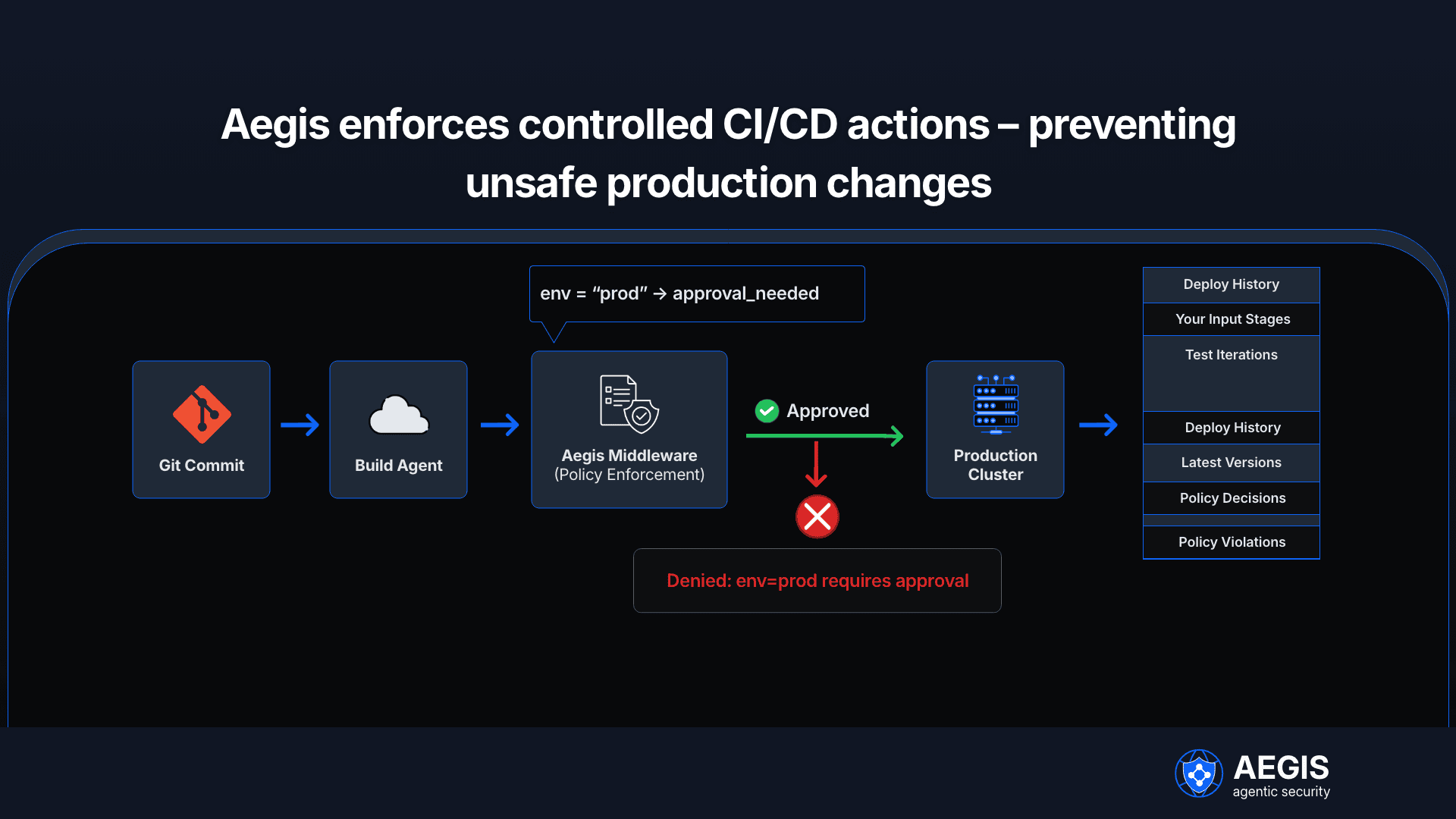
1. Runtime Policy Enforcement
At its core, Aegis Gateway acts as a policy and observability fabric for multi-agent AI systems. Every tool call made by an agent passes through a lightweight runtime enforcement layer that evaluates:
- Agent identity (via signed JWT tokens)
- Policy scope and version
- Decision context (parameters, parent agent, tool, action)
- Approval state (e.g., Slack/Teams confirmation IDs)
If the request violates policy, it is blocked; if it requires human oversight, Aegis automatically issues an approval prompt. All decisions are logged as structured, OpenTelemetry spans.
2. Evidence Automation and Chain-of-Custody
For each decision, Aegis emits digitally signed telemetry that includes:
- agent_id, tool, decision_reason, and policy_version
- Cryptographic hash of the policy bundle used
- Linked approval ID (for traceability)
- Chain signature for chronological integrity
These spans form a tamper-evident ledger, making it impossible for logs to be altered or deleted without detection—essential for SOC2, ISO 27001, and AI-specific audits.
3. Policy Versioning and Replayability
Aegis stores versioned YAML policies that can be replayed during an audit. This lets regulators or internal compliance teams “walk through” an agent’s decision flow using a secure web interface, seeing exactly which rule applied and why it allowed, denied, or escalated a request.
How Aegis Builds Audit-Ready Systems
1. Defining Audit Requirements Per Regulator
Different jurisdictions demand different controls. For instance, financial regulators emphasize chain-of-approval logs, while healthcare regulators prioritize PII redaction and data residency. Aegis allows teams to map regulatory clauses to technical policies.
Regulation | Key Evidence Requirement | Aegis Mapping |
EU AI Act | Traceable decision logs | Policy versioned spans |
HIPAA | Data access tracking | PII redaction telemetry |
PCI-DSS | Transaction authorization evidence | Signed decision bundles |
SOC2 | Integrity of system changes | Policy signature chain |
2. Digitally Signed Evidence Bundles
When auditors request evidence, Aegis produces ready-to-submit packages that include:
- Policy YAML + compiled OPA bundle hash
- Signed decision logs and timestamps
- Proof of data routing decisions
- Slack/Teams approval references
- Retention compliance metadata
Each bundle is verified against stored cryptographic hashes, ensuring non-repudiation and authenticity.
👉🏻 Empower SOC teams with AI-driven incident management
3. Human Approval and Segregation of Duties
Every policy enforcement action requiring human oversight includes a verifiable approval ID linked to organizational directories. This enforces segregation of duties, demonstrating that no single actor (human or agent) can unilaterally execute sensitive operations.
Aegis in Practice: Industry Applications
Aegis’s agentic security mesh is already reshaping compliance and observability across industries.
FinTech: Evidence-Driven Payment Governance
Aegis enforces per-agent payment ceilings, validates parameters (amount, currency, account ID regex), and generates signed spans for every attempted transaction. High-value transfers trigger approval flows, ensuring financial regulators receive full audit trails.
Healthcare: PII and PHI Safeguards
When autonomous agents interact with Electronic Health Record (EHR) systems, Aegis applies deterministic DLP to redact SSNs, DOBs, and healthcare IDs before payload submission. Each redaction event is logged as compliance telemetry, fulfilling HIPAA audit expectations.
MSSP & Multi-Tenant Environments
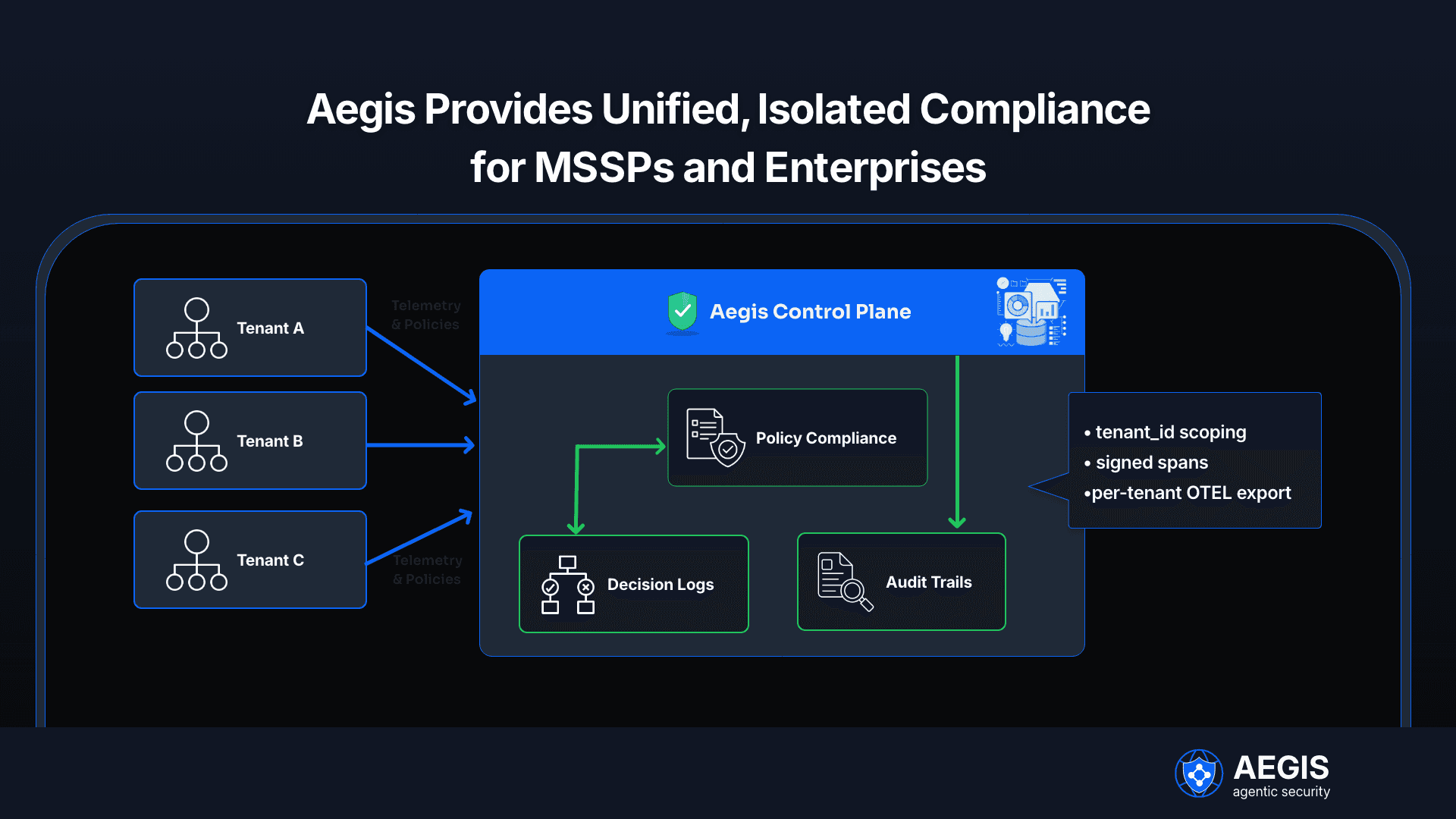
For managed security service providers, Aegis supports tenant-scoped policy bundles and regionally routed data to meet cross-border compliance requirements. Each tenant’s telemetry remains cryptographically isolated, ensuring no policy collisions or data leakage.
Operational Benefits Beyond Compliance
Continuous Readiness
By maintaining an immutable policy history and pre-packaged audit packs, Aegis ensures that every system is always “audit ready.” Enterprises can export auditor-friendly timelines and replay scripts on demand.
Reduced Manual Overhead
Traditional compliance teams spend days preparing logs for each request. Aegis automates the evidence lifecycle—from span capture to notarized export—cutting effort by up to 80%.
Security & Governance Synergy
Auditability reinforces runtime security. Signed spans double as forensic evidence during incident response, providing root-cause correlation to policy versions and agent actions.
Technical Architecture at a Glance
Layer | Function | Key Technologies |
Data Plane | Enforces runtime policy and emits telemetry | Envoy proxy, OPA evaluator, Go decision service |
Control Plane | Manages policies, versions, and tokens | FastAPI API, policy compiler, signed bundle store |
Observability Layer | Collects and visualizes OpenTelemetry traces | Grafana, Prometheus |
Approval Service | Handles Slack/Teams human validation | REST + JWT override tokens |
Evidence Store | Maintains signed bundles and retention metadata | S3/Postgres with versioning |
These components interlock to deliver both runtime protection and regulatory-grade visibility, ensuring every decision made by an AI agent is both secure and explainable.
👉🏻 Gain instant visibility into agent behavior and performance
Building Confidence for Regulators and Security Teams
The purpose of an audit-ready system isn’t just regulatory checkboxing—it’s operational trust. Aegis provides a unified control plane for agents, enabling:
- Automated mapping of technical events to compliance clauses.
- Replayable evidence for each versioned policy.
- Instant verification of data integrity through digital signatures.
This transforms audits from painful, retrospective exercises into continuous compliance operations embedded into the AI workflow.
Frequently Asked Questions
1. What does “audit-ready” mean in AI agent systems?
It means all agent actions, decisions, and policy evaluations are logged, signed, and versioned, enabling regulators to reconstruct event histories at any time.
2. How does Aegis ensure evidence integrity?
Each decision span and policy bundle is digitally signed and chained, ensuring tamper detection and full traceability.
3. Can Aegis integrate with existing orchestrators like LangChain or AgentKit?
Yes. Aegis offers middleware SDKs for LangChain, LangGraph, and AgentKit, requiring minimal changes to existing workflows.
4. How are human approvals linked to audit evidence?
Every approval generates a unique ID tied to Slack/Teams workflows. These IDs are embedded in signed telemetry for chain-of-custody proof.
5. What retention policies does Aegis support?
Aegis supports configurable retention windows mapped to regional regulations (e.g., 7 years for financial records).
6. Does Aegis support multi-tenancy for MSSPs?
Yes. It isolates tenant telemetry, ensures scoped policies, and provides dedicated audit packs per tenant, ideal for MSSPs handling multiple clients.