Creating a Business Case for Investing in Multi-Agent Security Mesh
Learn how to justify investment in agentic AI security meshes and why Aegis is the “Istio + OPA for Agents” for enterprise-grade runtime control.
Creating a Business Case for Investing in a Multi-Agent Security Mesh
Enterprises deploying autonomous agents now face a pivotal question: how do you secure machine-driven workflows with the same rigor as human API access? Traditional IAM or SIEM extensions cannot deliver real-time, per-call governance for autonomous agents. To justify runtime controls for agentic workflows, security leaders must build a solid business case grounded in operational, regulatory, and financial realities.
The following guide explains how to create that case—why multi-agent security meshes are necessary, how Aegis implements this architecture, and what quantifiable returns organizations can expect.
The Case for Securing Agentic AI
The Rise of Multi-Agent Architectures
In 2024–2025, the number of enterprises experimenting with multi-agent orchestration (e.g., LangGraph, CrewAI, AgentKit) has grown by over 800% year-over-year. Agents now perform automated tasks such as financial reconciliation, infrastructure management, and document summarization—each involving sensitive systems and privileged actions.
A recent Architecture & Governance Magazine study found that 54% of enterprises cite security and compliance as the main barriers to adopting multi-agent workflows. While agents can accelerate operational efficiency, they also introduce new risks: privilege escalation, uncontrolled egress, and cost blowouts.
Why Traditional Controls Fall Short
Conventional IAM determines who can access an API—not what an agent is allowed to do once inside. Likewise, SIEM tools observe anomalies post-factum, without enforcing real-time constraints.
👉🏻 Demonstrate measurable business value from every multi-agent AI investment
Limitation | Impact on Agent Workflows |
IAM only enforces identity at login | No control over per-call actions |
Static validations in code | Inconsistent and untraceable enforcement |
SIEM-only monitoring | Reactive detection after damage |
Manual approval processes | Unscalable for high-frequency agent calls |
A multi-agent security mesh addresses these gaps by enforcing runtime policy decisions on every agent call—before any sensitive action executes.
Framing the Business Need
Key Drivers for Investment
- Risk Management: Prevent autonomous agents from unauthorized payments, data leaks, or unapproved actions.
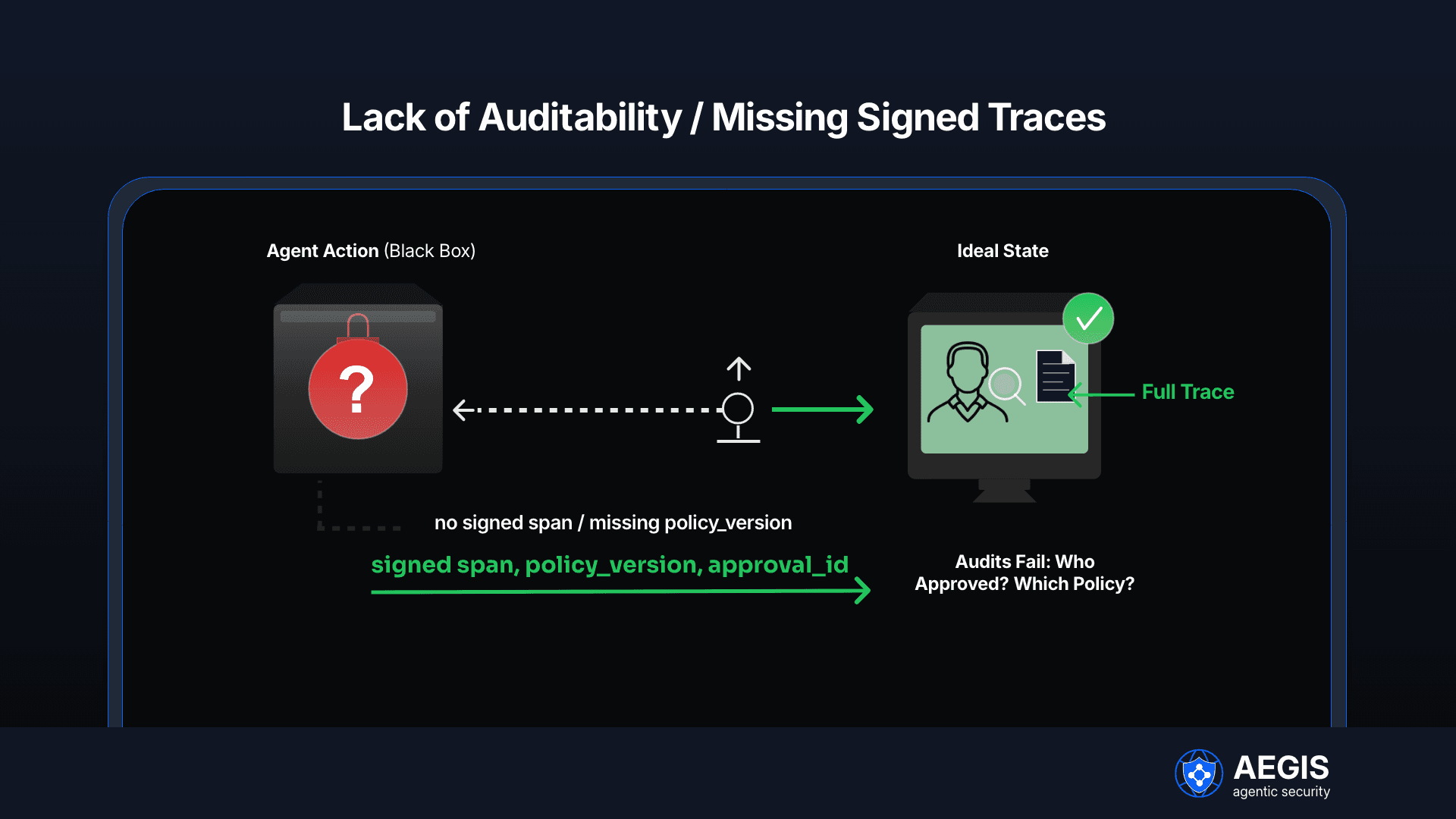
- Compliance Assurance: Provide signed audit logs proving that each agent action was reviewed and authorized.
- Cost Governance: Enforce per-agent budgets, preventing runaway API or LLM spend.
- Operational Speed: Deploy secure agents faster with reusable policy templates and observability out of the box.
Regulatory Alignment
Auditors now expect visibility into automated decision provenance—particularly in finance and healthcare. A security mesh supports these requirements by offering tamper-proof logs and policy versioning.
This aligns with modern compliance mandates (SOX, GDPR, HIPAA), where auditability of autonomous systems is now under scrutiny.
Building the Financial Justification
Security leaders often struggle to quantify ROI for preventive controls. A compelling business case should express both loss avoidance and efficiency gains.
👉🏻 Reduce financial exposure with risk mitigation strategies designed for agentic AI
Cost/Benefit Category | Example Metric | Annual Impact Estimate |
Incident Cost Avoidance | Prevented unauthorized payment ($50K per event) | $200K–$500K saved |
Compliance Efficiency | Audit prep time reduced by 40% | $80K–$120K saved |
FinOps Optimization | Per-agent budgets, throttled API usage | 15–20% reduction in cloud API spend |
Security Operations | Fewer manual reviews and false positives | 25% SOC workload reduction |
When expressed as avoided incidents and reduced compliance burden, runtime policy enforcement quickly pays for itself.
.png&w=3840&q=75)
Introducing Aegis: The Policy and Observability Fabric for Agents
Aegis by Aegisecurity is built as the “Istio + OPA for Agents”—a runtime policy and observability gateway purpose-built for multi-agent AI systems. It enables enterprises to instrument, control, and audit every agent action with near-zero latency.
Core Architecture
Aegis operates as a two-plane mesh:
- Data Plane (Runtime Enforcement):
A sidecar or forward proxy intercepts every outbound agent tool call. The request is evaluated by an OPA-based engine that determines whether to allow, deny, sanitize, or request approval.
Each decision is logged with structured telemetry. - Control Plane (Policy Management):
Security engineers define policies in YAML or JSON, which Aegis compiles into OPA bundles. The system supports versioning, dry runs, and hot reloads.
Admins manage agents, policies, and tokens through an API or CLI.
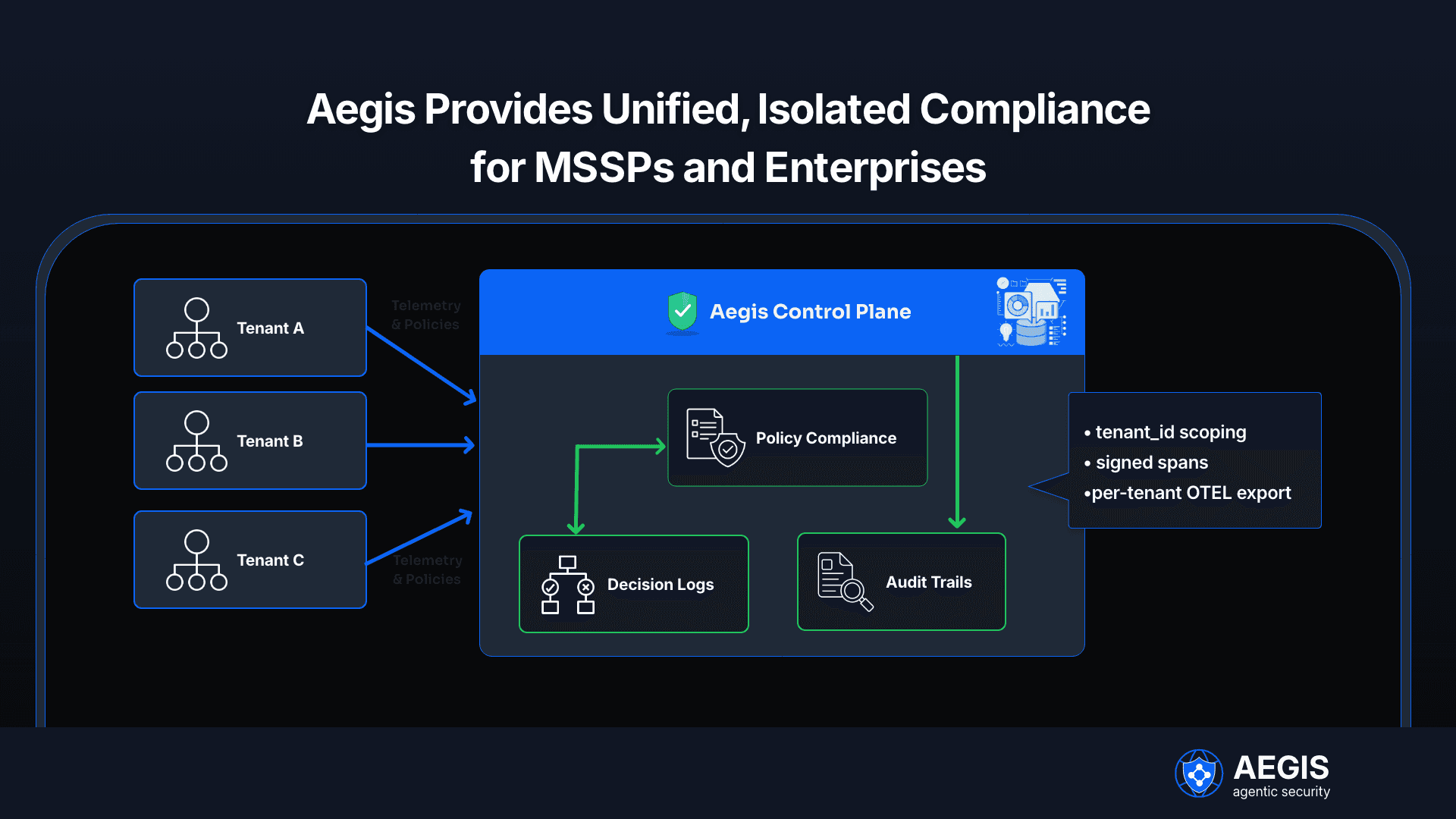
Aegis emits OpenTelemetry traces for every decision, providing visibility into tool usage, blocked actions, and approval workflows—critical for both SOC and FinOps teams.
👉🏻 Optimize AI operations with FinOps practices that improve cost efficiency
How Aegis Addresses Key Enterprise Challenges
1. Privilege Escalation and Tool Chaining
Problem: A planner agent can coerce another (e.g., finance agent) into executing unauthorized payments.
Aegis Solution: Policies enforce which agent can access which tool, with parameter constraints such as max_amount: 5000. Violations trigger automatic blocks or human approval.
2. Data Exfiltration and Egress Control
Problem: Agents can send sensitive data to unknown domains.
Aegis Solution: Outbound allowlists restrict traffic to approved APIs. The gateway enforces regional data routing for compliance.
3. Cost Runaway and FinOps Alignment
Problem: Agents can inadvertently cause API overspend.
Aegis Solution: Per-agent budgets and rate limits automatically throttle requests once usage exceeds thresholds. Dashboards visualize cost per agent/tool.
4. Auditability and Compliance Readiness
Problem: Regulators require traceability of automated actions.
Aegis Solution: Every decision—allow, deny, sanitize—is logged with a signature chain and policy version, producing tamper-proof audit evidence.
Practical Use Cases Across Sectors
Sector | Example Policy Enforcement | Business Outcome |
FinTech | Payment over $5000 requires human approval via Slack/Teams | Prevents fraud, ensures audit |
Healthcare | Block PHI exports, redact SSNs in EHR tool calls | Regulatory compliance |
SaaS/FinOps | Limit agent API budgets to $20/day | Cost governance |
DevOps/CI | Require approval for production deployments | Controlled automation |
MSSP/Multi-Tenant | Tenant-scoped policy bundles and signed telemetry | Cross-tenant isolation |
These examples illustrate how runtime policies bridge the gap between developer autonomy and enterprise control, maintaining velocity without compromising compliance.
Implementation Milestones and KPIs
A well-structured business case should include a 4–5 week pilot plan with measurable KPIs.
Week | Deliverable | Key KPI |
Week 1 | Deploy Aegis Gateway & agent registry | Gateway active, basic telemetry live |
Week 2 | Enable OPA evaluator, logging, dashboards | <20ms P99 latency |
Week 3 | Integrate approval workflows | 100% high-risk approvals gated |
Week 4 | SOC ingestion & FinOps dashboard | 100% traced calls, policy coverage ≥80% |
KPIs include policy coverage, blocked events, latency, and approval turnaround—quantifiable indicators of pilot success.
Making the Executive Case
When presenting to finance or compliance executives, frame Aegis as instrumentation insurance—a small operational investment that mitigates exponentially larger breach or compliance costs.
- For CFOs: Show median API spend reduction via agent-level budgets.
- For CISOs: Emphasize risk mitigation—incident cost avoidance and verified auditability.
- For DevOps leads: Highlight reduced integration complexity—Aegis deploys as a proxy or middleware without app rewrites.
Risk Mitigation Strategy for Rollout
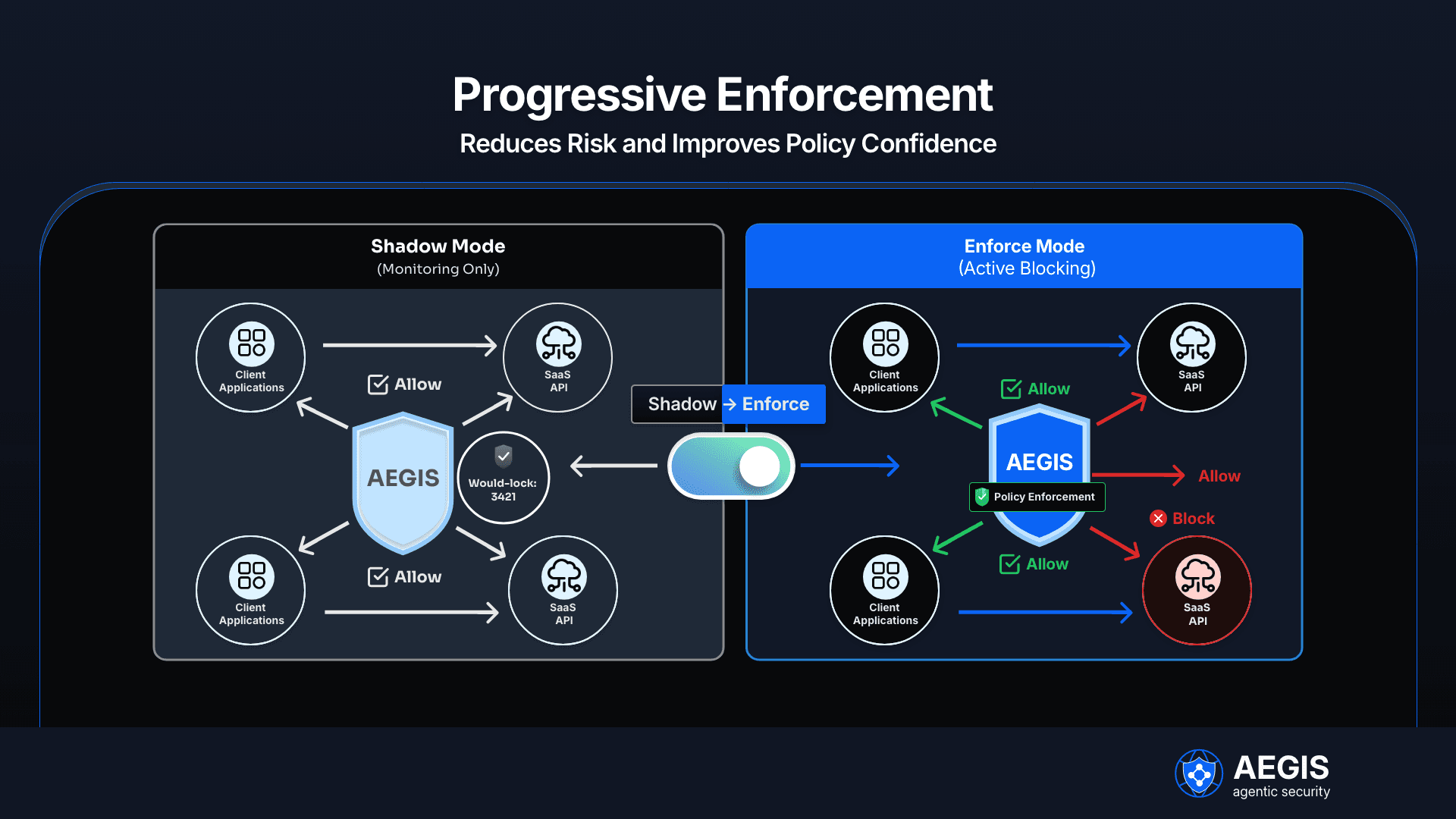
- Shadow Mode Testing: Run policies in “observe only” mode to collect metrics before enforcing.
- Incremental Enforcement: Start with critical tools (e.g., payments, document storage).
- Human-in-the-Loop: Require approvals for only high-risk decisions to avoid fatigue.
- Policy Governance: Maintain versioning, validation, and rollback capabilities to prevent outages.
This approach minimizes disruption while achieving measurable security control improvements.
Frequently Asked Questions
1. How long does an Aegis pilot take to show value?
A typical pilot spans 4–6 weeks, covering integration, policy authoring, and KPI validation (latency, policy coverage, blocked events).
2. What resources are required?
Integration engineering hours (1–2 FTE), SOC ingestion setup, and basic policy authoring. Aegis SDKs minimize orchestration changes.
3. How does Aegis affect latency?
With prepared OPA queries and in-memory caches, decision latency remains under 20ms P99, suitable for high-frequency agent calls.
4. Can Aegis integrate with existing IAM or SIEM?
Yes. IAM handles identity; Aegis enforces runtime policy. Telemetry and audit logs integrate seamlessly with SIEM pipelines.
5. How is ROI measured?
Track avoided incidents, audit readiness, reduced FinOps spend, and SOC time saved—core metrics for security investment justification.
6. What’s the long-term roadmap?
Future updates include Terraform policy providers, advanced anomaly detection, and deeper multi-tenant visualization.