
Retail Inventory Management with Multi-Agent Systems
Practical runtime policies and observability for multi-agent retail forecasting—control spend, prevent exfil, and keep agents auditable.
Aegis: Runtime Security for Agentic Retail AI
Retailers adopting multi-agent systems for forecasting and replenishment gain automation but also inherit new operational risks: parameter injection, runaway spend, data exfiltration and opaque decision trails. AI-driven forecasting can reduce supply-chain errors by 20–50%, improving service levels and reducing stockouts, but only when automation is governed and auditable. (BizTech Magazine)
This article explains the problem, compares legacy techniques with agentic approaches, and then focuses on architecture and policies for protecting agentic retail pipelines using Aegis — a runtime policy and observability gateway that enforces least-privilege between agents and critical tools. Parts of this post (architecture and policy examples) draw on Aegis technical specifications and use cases.
Problem: Why forecasting still fails in retail
Retail forecasting failures are often operational, not algorithmic. Common causes:
- Siloed systems (ERP, POS, WMS) with batch ETL produce stale signals.
- Traditional time-series models and manual overrides don’t adapt to promotional lifts, weather shocks or supply incidents.
- Lack of runtime controls allows agents to propose orders without parameter limits or human approval, causing speculative bulk purchases or inadvertent exfiltration of PII.
Aegis addresses these operational gaps by enforcing per-agent budgets, parameter ranges, allowlists and required approval flows at the boundary between agents and the tools they call.
Old methods vs agentic approaches
Old approach: centralized and manual
- Weekly reports from a forecasting team (ARIMA/ETS/linear models).
- Manual planner overrides and downstream reconciliation.
- Separate tools with batch integration; little runtime validation.
Agentic approach: autonomous collaboration
- Specialized agents for ingestion, feature enrichment (market/weather/social), forecasting (LSTM/ensemble), replenishment and procurement.
- Agents collaborate, simulate scenarios, propose orders and request approvals.
- Faster, but introduces runtime risk: injection, unintended tool chaining, and cost drift.
Comparison table: Old approach vs Agentic + Aegis
Dimension | Legacy forecasting | Agentic systems + Aegis |
Latency to act | Hours–days | Minutes (real-time decisions) |
Auditability | Sparse, manual logs | Full structured traces + policy versioning. |
Cost control | Manual budgets | Per-agent budgets, RPS limits, spend dashboards. |
Risk of exfiltration | Low visibility | Blocked by egress allowlists & DLP policies |
Approval workflows | Manual email/slack | policy-driven approval_needed flows (Slack/Teams integration) |
Architecture: agents + Aegis
Aegis sits as a gateway between the orchestrator and downstream tools (sidecar/proxy pattern). The data plane intercepts every agent→tool call, evaluates policy, and either allows, denies, sanitizes, or issues approval_required. Telemetry is emitted as OpenTelemetry spans so SOC and FinOps teams can audit actions and costs.
Key runtime components
- Agent registry & identity (short-lived JWTs).
- Policy engine (OPA/Rego compiled bundles).
- Ext_authz proxy (Envoy sidecar / forward proxy).
- Decision API (authorisation server) and approvals service (Slack/Teams).
- Observability: traces, structured logs and dashboards.
Policy examples (practical)
Enforcement by parameter
- max_order_amount: limit reorder agent to X units or Y USD per SKU.
- allowed_suppliers: regex allowlist for supplier IDs.
- approval_needed: flag for unusual reorder multipliers (> historical baseline × 3).
Egress and DLP
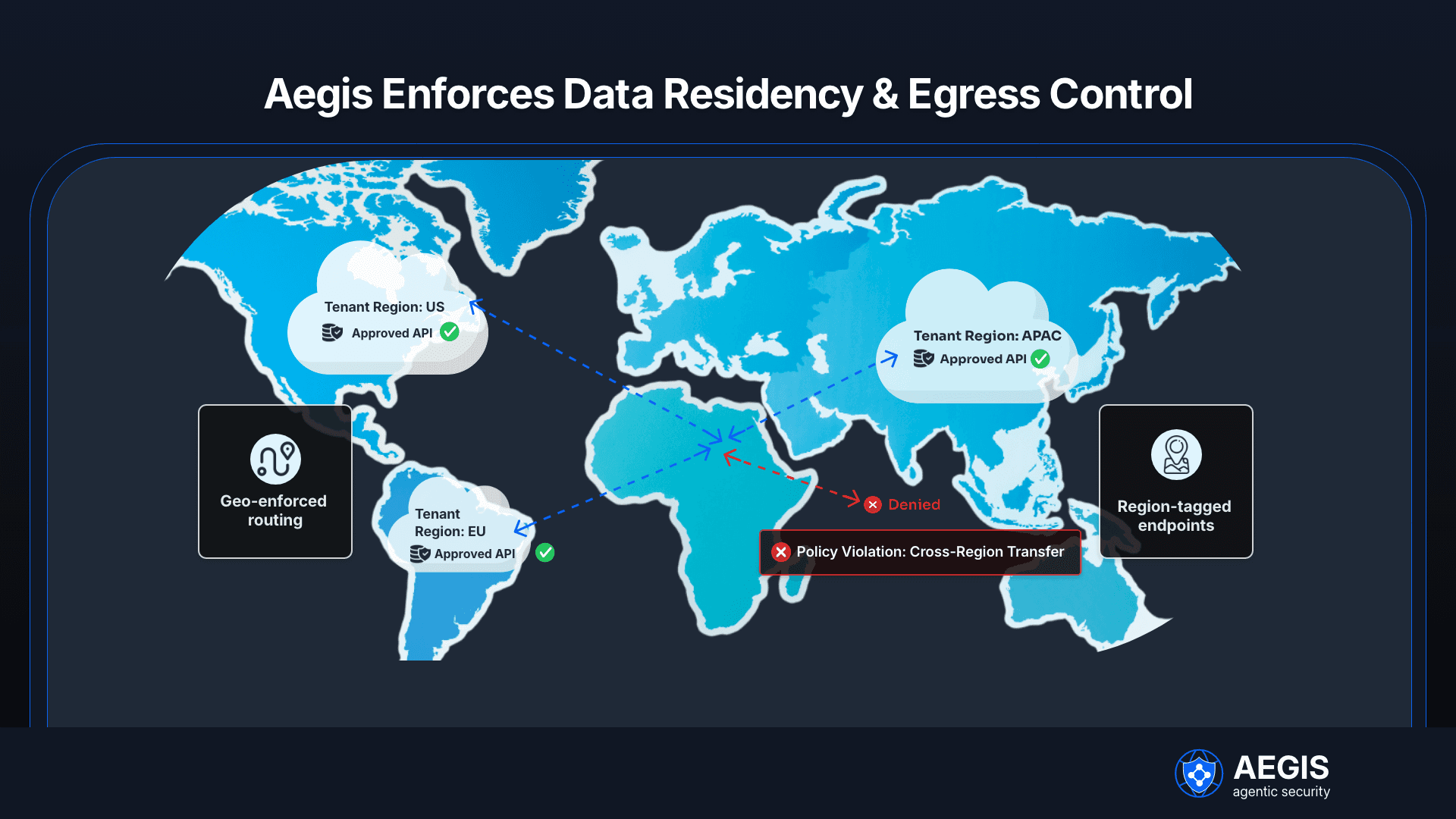
- Allowlist outgoing domains (e.g., internal pricing APIs, analytics) and block external PII exfil unless sanitized.
- Deterministic redaction (regex) for SSNs, payment tokens, email addresses in outbound payloads.
Policy snippet (conceptual YAML)
agent: reorder-agent
allowed_tools:
- name: inventory-api
actions:
- create_order
conditions:
max_order_amount: 10000
allowed_suppliers_regex: "^SUPP-[0-9]{4}$"
approval_needed_if:
- order_multiplier_over_baseline: 3
Aegis as a solution
Aegis is a runtime policy and observability gateway designed to let enterprises adopt agentic retail workflows without accepting unbounded operational risk. Its core value pillars:
- Identity & least privilege
- Agents register with unique IDs; short-lived signed tokens prevent token replay and limit lateral movement across tools.
- Policy-as-code and low latency evaluation
- Security teams write policies in YAML/JSON; Aegis compiles bundles for fast OPA evaluation and hot reloads bundles without restarts. Target P99 decision latency ≤ 20 ms.
- Runtime enforcement & approvals
- For high-risk calls the decision API returns approval_needed; the approvals service posts to Slack/MS Teams and issues a single-use override token upon human approval. This prevents agents from coercing other agents into unauthorized transfers.
- Observability & compliance
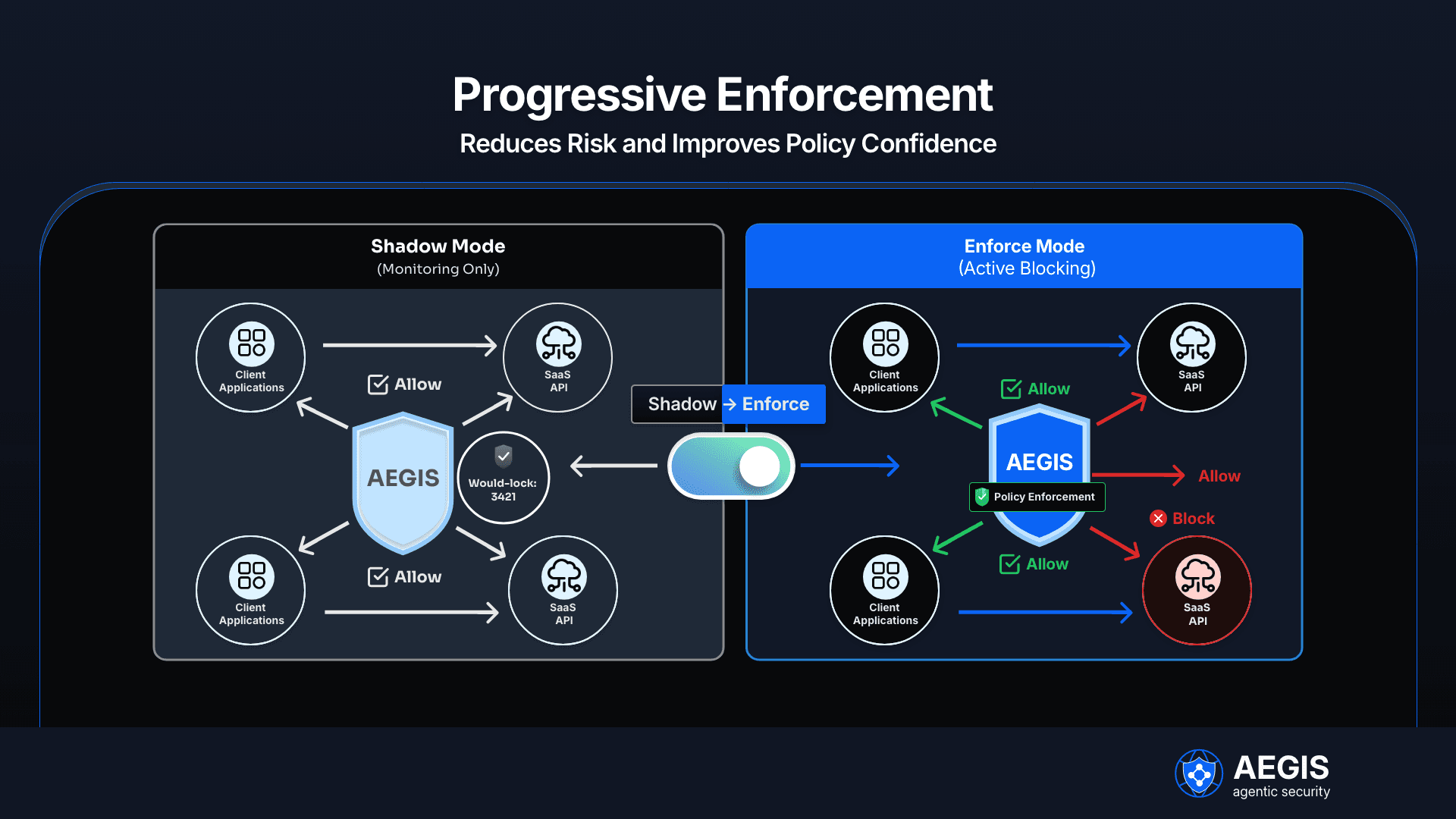
- Every decision emits OpenTelemetry spans containing agent_id, tool, policy_version, decision, and reason. Dashboards show blocked events, would-deny counts (shadow mode) and agent spend for FinOps.
- Developer experience & rollout
- SDKs and middleware for common orchestrators; shadow mode for 7 days to collect would-deny metrics before enforcing live rules.
👉🏻 Improve grid reliability with autonomous agents optimizing utility operations
- SDKs and middleware for common orchestrators; shadow mode for 7 days to collect would-deny metrics before enforcing live rules.
Use-case snapshots
- Promotion lift forecasting: forecasting agent proposes high uplift; reorder agent is constrained by Aegis max_order_per_sku policy to prevent speculative bulk purchasing.
- Flash sale price signals: allowlist external pricing endpoints; block unexplained price-change requests without approval_needed.
- Multi-store rebalancing: file writes restricted to /agents/{id}/tmp and transfer requests enforced via approval workflow.
For product background and industry pages, see Aegissecurity resources on industry applicability, solution overview and company information.
.png&w=3840&q=75)
Metrics & ROI
Quantitative impact (select references)
- AI forecasting can reduce supply-chain errors by 20–50% and materially improve efficiency. (BizTech Magazine)
- McKinsey and industry reports estimate inventory reductions of 20–30% where AI optimizes segmentation and replenishment. (McKinsey & Company)
Practical metrics to track after Aegis deployment
Metric | Baseline to measure | Target after 90 days |
Would-deny ratio (shadow → enforced) | 0 → collect | <5% false positives |
Policy decision latency P99 | n/a | ≤20 ms. |
Blocked exfil attempts | 0 | All unauthorized egress blocked |
Cost overruns by agent | $ per day | ≤ policy budget limits |
Implementation checklist
- Register agents with identity and daily budgets (per-agent JWT + budget config).
- Author policies: max_order_amount, allowed_suppliers regex, egress allowlists, approval_needed rules.
- Deploy Aegis sidecars or forward proxy and point orchestrator outbound through it.
- Run 7-day shadow mode; collect would-deny metrics and tune thresholds.
- Enable approvals integration (Slack/Teams) and sign audit logs for compliance.
👉🏻 Streamline property operations with intelligent multi-agent automation
Implementation table: Phases
Phase | Activities | Acceptance |
Phase 1 (Pilot) | Envoy sidecar, token service, 2 policies, shadow mode | Collect would-deny metrics |
Phase 2 (Enforce) | Enable enforcement, approvals, dashboards | Zero business disruptions for critical flows |
Phase 3 (Scale) | Multi-tenant bundles, budget enforcement | P99 latency targets and audited traces. |
Frequently Asked Questions
- How does Aegis integrate with existing orchestrators?
Aegis provides SDKs and middleware for common orchestrators and supports a sidecar/proxy pattern so minimal changes are required. - What happens when a policy blocks a legitimate action?
Deploy policies in shadow mode for at least 7 days to tune would-deny triggers, and use a rollback/versioning process if necessary. - Can Aegis prevent data exfiltration?
Yes — per-tenant egress allowlists and deterministic DLP redact or block PII before it leaves the environment. - How are approvals handled at scale?
Approvals integrate with Slack/Teams and issue a single-use override token. Policies can be tuned to reduce overload by specifying thresholds. - Does Aegis add noticeable latency?
Designed for low overhead; target P99 decision latency under 20 ms using prepared OPA queries and caching.
👉🏻 Drive smarter trading decisions with real-time autonomous market analysis
Conclusion
Agentic systems unlock real operational improvements for retail forecasting and inventory optimization, but they must be governed at runtime. Aegis provides the bridge — policy-as-code, low-latency enforcement, approvals and rich telemetry — enabling teams to retain the speed and automation of agents while controlling cost, access and compliance.