
Autonomous Agents in Energy Trading and Market Analysis
How Aegis enforces runtime risk, auditability and per-agent controls for autonomous energy-trading agents. Practical patterns, metrics, and implementation tips.
Agentic AI in Energy Trading: Runtime Risk Controls and How Aegis Fits
Introduction
Energy trading has moved from scheduled desk-driven workflows to agentic automation: signal-generation agents, market-scan agents, execution agents and risk-control agents operating at intraday timescales. That shift delivers speed and scale but raises immediate operational and compliance risks — from excessive exposure to subtle market-manipulation vectors. This post lays out practical design patterns for deploying autonomous agents in energy trading, the pre-trade and runtime checks required, and how Aegis — a runtime policy and observability gateway — enforces those controls in production. (Research context and product details are drawn from our Aegis design brief and technical spec.)
Why agentic AI is now core to energy trading
Market drivers and adoption signals
Renewable penetration and finer nodal pricing have increased intraday volatility; recent industry analysis shows the rise in renewable capacity and congestion-driven price swings that force trading decisions to millisecond-to-minute horizons. Algorithmic trading and automated strategies are growing rapidly: the automated/algorithmic trading market shows double-digit CAGR projections in recent 2024–2025 reports. (Energize Capital)
Adoption numbers for agentic AI are meaningful: several 2025 surveys indicate that a meaningful portion of large organizations are piloting or scaling agentic systems, even as analysts caution about project attrition without governance. Gartner and other analysts note more than 40% of agentic projects risk being scrapped unless governance, identity and ROI are addressed. (Reuters)
👉🏻 Improve utility efficiency with intelligent agents that optimize grid performance
.png&w=3840&q=75)
Operational challenge summary
- Latency and time-to-execution targets (intraday rebalances require sub-second to low-second response).
- Market sensitivity and exchange rules (certain order types and routing are restricted).
- Audit & compliance: verifiable, tamper-resistant trail for each automated trade.
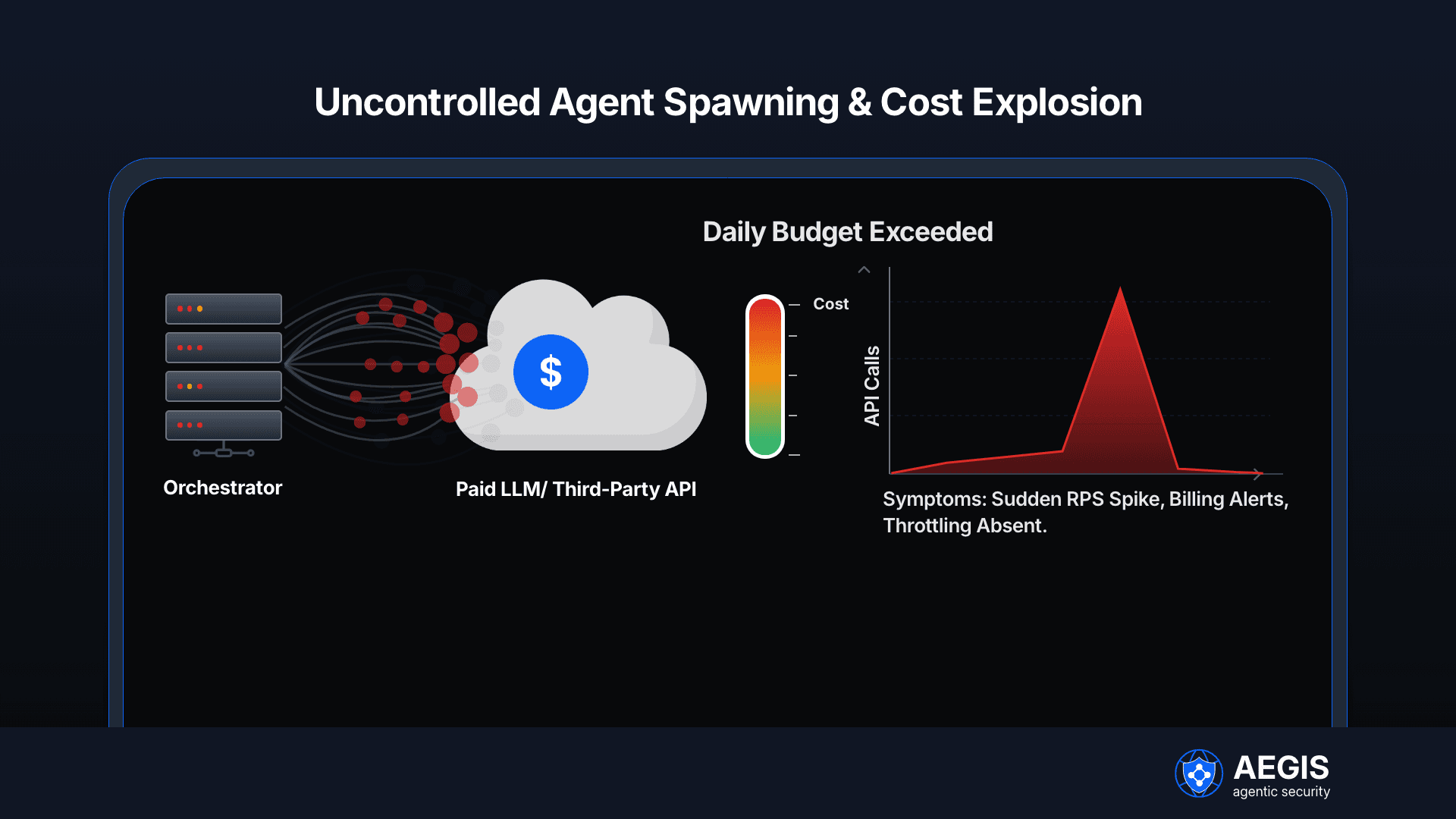
- Cost and safety: prevent runaway agent spawn leading to unexpected exposures or API spend. These problems map directly to runtime enforcement needs.
Core runtime controls required for energy-trading agents
Minimal pre-trade policy checklist (what every execution should verify)
- Agent identity and role (which agent requested the trade).
- Per-agent position/exposure limits (absolute and per-instrument).
- x order size and order-type allowlist (market/limit/iceberg etc.).
- Latency ceilings (reject if delayed beyond allowed decision TTL).
- Throttling & rate limits (prevent burst ordering).
- Pre-trade simulation (shadow fill or expected slippage estimate).
- Human-approval hooks for outliers (override tokens and signed approvals).
Automated strategy types and required pre-trade checks
Strategy type | Typical cadence | Key pre-trade checks |
Market-scan / signal generation | seconds–minutes | Parameter validation, parent-agent provenance, simulated P&L, exposure delta |
Execution (smart order routing) | sub-second–seconds | Order-type allowlist, max order size, exchange-compliance checks |
Risk-control / hedging | seconds–minutes | Cross-position aggregation, net exposure limits, margin checks |
Scenario synthesis / reporting | minutes–hours | Data lineage preservation, sensitive-data redaction, human review flag |
Aegis: runtime policy & observability fabric for Agentic AI Systems
What Aegis enforces at runtime
Aegis is designed to operate as a lightweight policy and telemetry gateway sitting between the orchestrator (agent framework) and downstream tools (exchanges, broker APIs, internal systems). It enforces least-privilege agent identity, inspects parameters (amounts, destinations, order types), evaluates policies in real time and returns structured allow/deny/sanitize/approval_needed decisions. Its data-plane is optimized for low-latency decisions and full traceability.
👉🏻 Transform inventory management with agents that improve stock accuracy and speed
Key capabilities relevant to energy trading agents:
- Per-agent exposure & parameter limits: policies can specify absolute/max position per agent or per strategy. Attempts to exceed those limits are blocked with a structured policy violation.
- Pre-trade simulation gating: Aegis can require that signals include simulated P&L / slippage estimates and verify those fields against tolerances before allowing execution.
- Human-approval workflow: For high-risk orders (e.g., size > threshold), the system returns approval_needed, posts an interactive approval request to Slack/Teams and issues a one-time override token on approval.
- Egress & data residency controls: restrict which domains or broker endpoints agents may call, preventing data exfiltration or accidental cross-border routing.
- Telemetry for audits: every decision emits OpenTelemetry spans and signed logs (policy version, decision reason, agent id), enabling SIEM ingestion and tamper-resistant audit trails for compliance reviews.
Implementation pattern: where Aegis sits in the trading loop
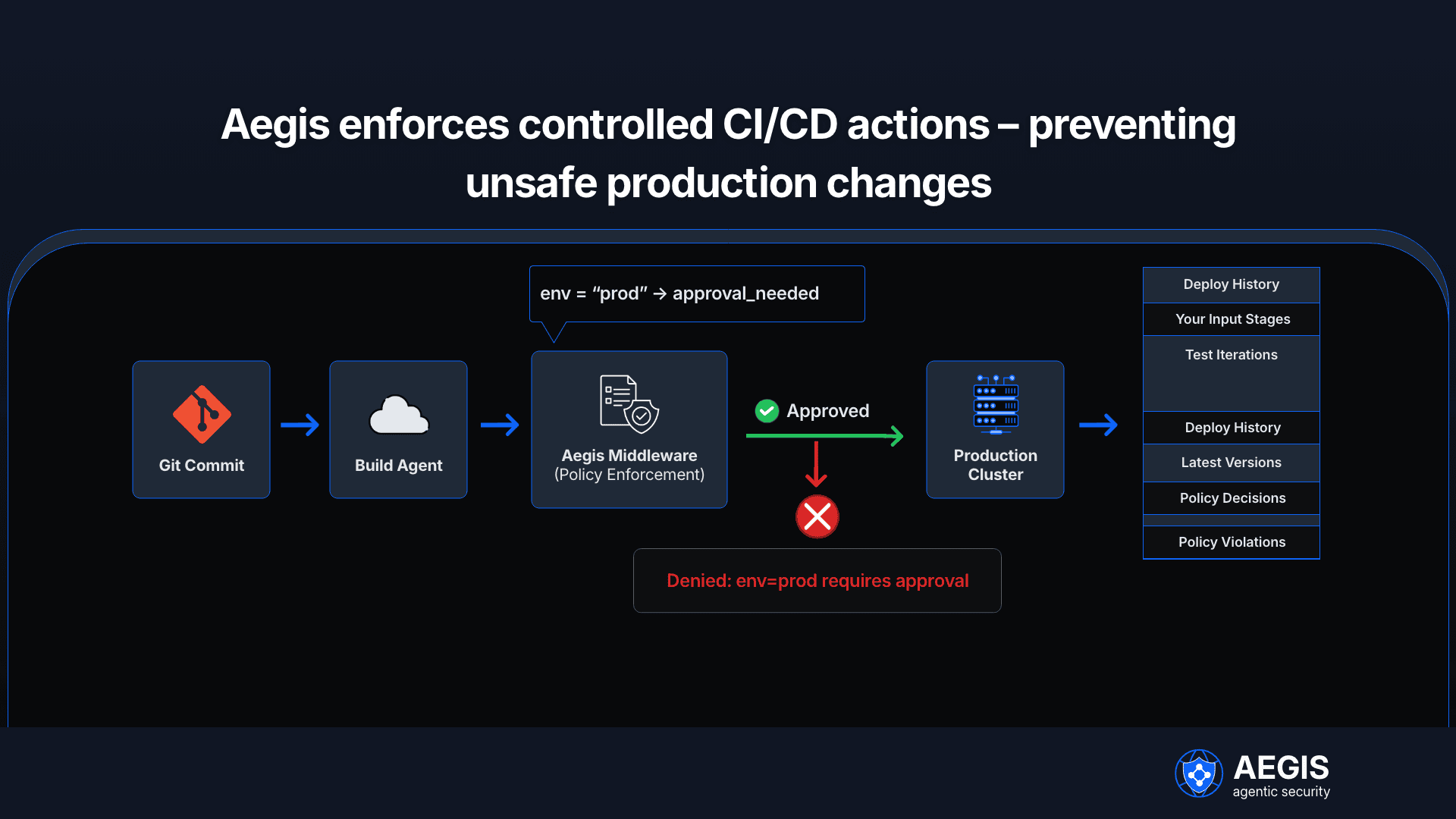
Aegis supports both sidecar/proxy deployment and SDK middleware for orchestrators so integrations with LangChain/LangGraph/AgentKit remain minimal. Shadow mode enables observing would-block events without disrupting live flows, which is key for tuning policies before enforcement.
Operational metrics and monitoring
Metrics you must collect
- P&L attribution vs simulated P&L (to measure model drift).
- Slippage and mean time-to-execution.
- Trade rejection rate and reasons (policy violations broken down).
- Per-agent API spend and budget burn-down.
- Approval queue length and approval latency.
Recommended runtime metrics and alert thresholds
Metric | Why it matters | Example alert threshold |
Trade rejection rate (%) | Indicates misconfigured policies or agent errors | > 5% sustained over 10 minutes |
Avg slippage (bps) | Execution quality check | > historical mean + 25% |
Approval queue latency (s) | Human bottlenecks create execution risk | > 60s median for intraday alerts |
Per-agent budget usage | Prevent runaway spend | > 80% daily budget |
Telemetry from Aegis integrates into existing Prometheus/Grafana stacks and emits structured logs for SIEMs, enabling compliance exports and forensic analysis later.
👉🏻 Simplify property management with AI agents that automate daily operations
Practical deployment checklist & governance
Stepwise rollout (practical tip)
- Start in shadow: deploy Aegis in shadow mode to collect would-block events for 7–14 days.
- Map agent privileges: define agent identities and map to trader desk approvals. Use short-lived tokens per agent.
- Implement per-agent exposure policies: set conservative defaults and test using simulated fills.
- Enable approvals for high-risk paths: wire Slack/Teams approval channels and train desk managers on override tokens.
- Gradually tighten enforcement: flip from shadow to enforce as false positives drop.
- Maintain policy versioning: keep policy history and sign manifests for audit.
Example policy fragment (conceptual YAML fields)
Field | Purpose | Example |
agent | Agent identity | intraday-exec-agent |
allowed_tools | Which broker APIs | - broker-api: /orders |
conditions.max_amount | Max order size | 100000 |
conditions.latency_ttl_s | Freshness of decision | 2 |
action_on_violation | Behavior | deny or approval_needed |
(Policies in Aegis are compiled into fast OPA bundles and hot-reloaded for minimal downtime.)
Security considerations specific to trading
- Prevent tool-chaining abuse: enforce parent-agent provenance headers to stop a Planner agent coercing a Finance/Execution agent into unauthorized actions.
- DLP for sensitive fields: redact or sanitize PII or proprietary desk strategies from downstream logs when required.
- Adversarial testing: run spoofing and prompt-injection scenarios in the sandbox; validate that policies block parameter injection leading to manipulative order patterns.
Edge cases & cross-border rules
Settlement and cross-border regulatory routing require special policy rules: per-tenant region tags, routing to approved settlement endpoints, and special approval flows for cross-border orders. Aegis supports region-tagged policies and allowlists to enforce residency.
FAQ — Frequently Asked Questions
Q1: Where does Aegis sit in an agentic trading stack?
A1: Aegis sits between the orchestrator (agent framework) and tools (brokers, exchanges, internal systems) as a sidecar/proxy or SDK middleware, evaluating each call against policy and emitting traces and signed logs.
Q2: Can Aegis enforce per-agent budgets and throttle expensive LLM calls?
A2: Yes — policies can include daily budgets, request quotas, and rate limits; Aegis will block or return BudgetExceeded errors when thresholds are breached.
Q3: How does human approval work for intraday trades?
A3: For approval_needed results, Aegis posts interactive approval requests to Slack/Teams and issues a one-time override token on explicit approval; the original call can then be retried securely.
Q4: What telemetry and audit artifacts are produced?
A4: OpenTelemetry spans per decision, structured JSON logs (agent_id, decision, policy_version, reason) and optional signed manifests for tamper-resistant audit exports.
Q5: How do I start safely with agentic trading?
A5: Begin with signal agents in shadow mode, simulate fills, apply conservative per-agent limits, and iterate policies before enabling full enforcement. Use Aegis’s dry-run features and dashboards to validate.
Q6: What are recommended alert thresholds for approval queues?
A6: For intraday-critical flows, aim for median approval latency <60s and set automated fallback limits if human approvals are unavailable; tune thresholds in shadow mode.
Conclusion
Agentic AI brings both opportunity and operational risk to energy trading. The pragmatic path is iterative: shadow-mode observability, conservative per-agent policies, enforced pre-trade checks and human approvals for outliers. Aegis provides the runtime policy fabric, low-latency enforcement and auditable telemetry necessary to run autonomous trading agents safely at scale while keeping compliance, multi-tenancy, and FinOps concerns under control. For industry mappings and solution specifics, see Aegissecurity industry and solution pages and the company overview linked above.