Protecting Sensitive Data in Agentic Workflows: Best Practices
Learn best practices for securing PII and sensitive data in agentic AI workflows using runtime policy, DLP, and Aegis’s agent-level enforcement.
Protecting Sensitive Data in Agentic Workflows: Best Practices
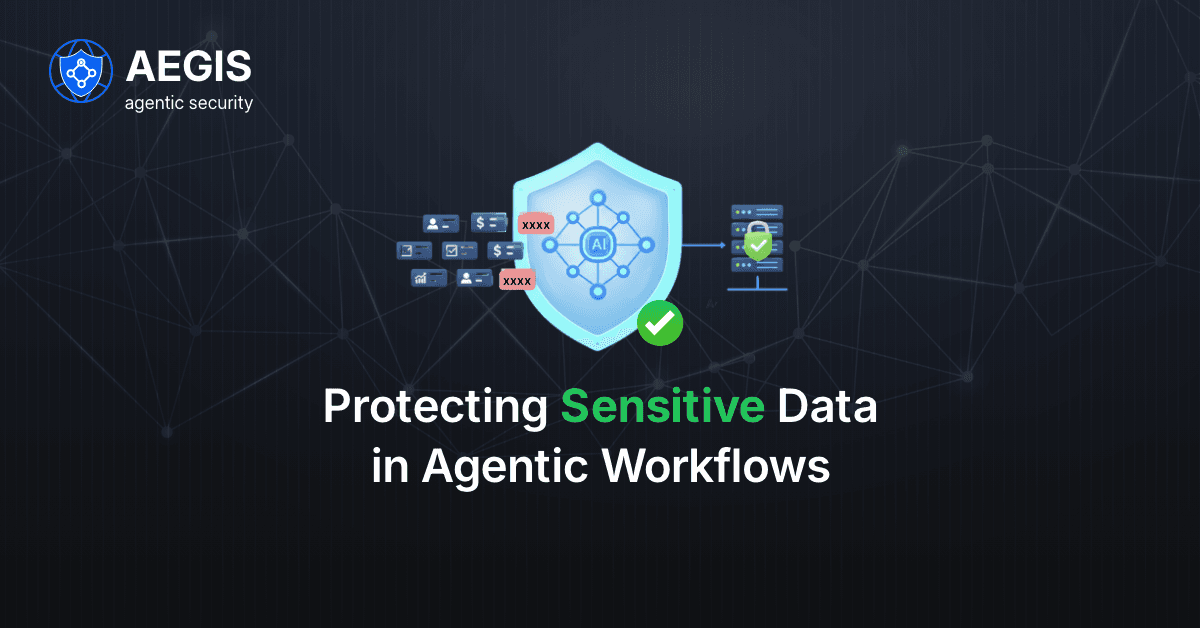
As enterprises operationalize multi-agent AI systems, a pressing question emerges: how can we protect sensitive data when autonomous agents act on behalf of humans, passing parameters, credentials, and personal information through unpredictable chains of reasoning and tool calls? Traditional data controls—built around static APIs and perimeter IAM—are no longer sufficient.
This article examines the problem of sensitive data exposure in agentic workflows, the shortcomings of legacy controls, and how Aegis, Aegissecurity Agentic AI Security Gateway, offers a runtime, policy-driven solution to enforce privacy and compliance across distributed AI systems.
The Problem: Sensitive Data in Motion Across Agentic Systems
Agentic workflows—chains of autonomous agents reasoning and delegating tasks—are increasingly common in enterprise AI architectures. Research from Architecture & Governance Magazine shows that over 50% of enterprises cite security and compliance as the top barriers to AI agent adoption.
Yet, these same systems often touch highly sensitive data types:
- PII/PHI during data enrichment or record updates
- Financial credentials when interacting with APIs like Stripe or ERP systems
- Internal secrets embedded in environment variables or tool configurations
Without runtime inspection, any agent prompt or parameter can become an exfiltration vector—a hidden path for sensitive data to leak into logs, APIs, or untrusted third-party systems.
👉🏻 Strengthen data protection by combining classification with end-to-end security practices
.png&w=3840&q=75)
Failure Modes in Legacy Models
Legacy models rely heavily on:
- Static IAM rules and API keys
- Perimeter-based firewalls
- Agent-level validations inside code
However, in dynamic AI environments, this approach collapses:
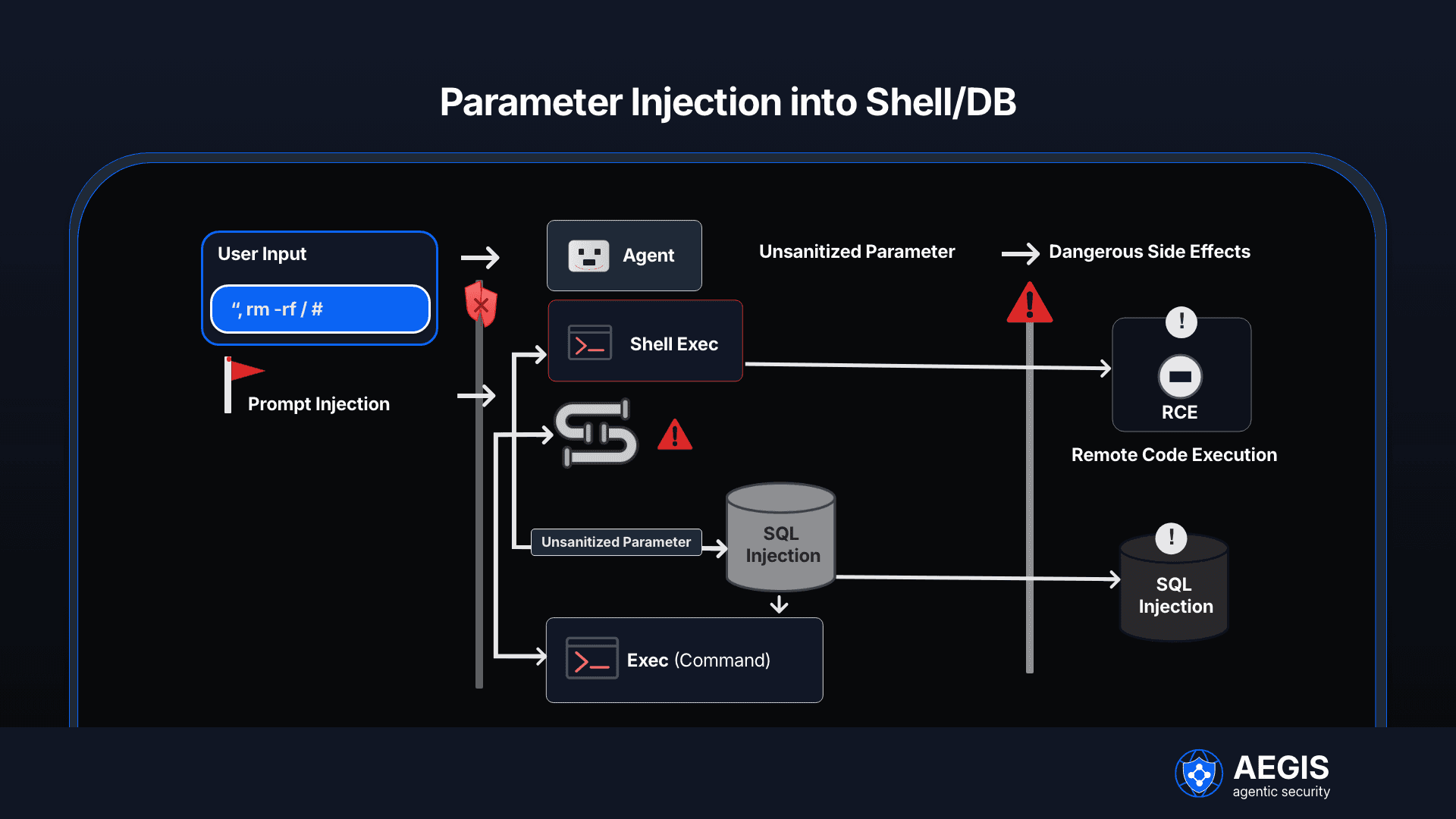
- Prompt injection can expose hidden data or override safety rules
- Agent chaining can bypass scoped credentials
- Tool calls can exfiltrate secrets to unmonitored destinations
According to IBM’s 2024 Cost of a Data Breach Report, the average cost of a data breach reached $4.88 million, and AI automation errors are among the fastest-growing contributors to insider risk.
(Source: IBM Cost of a Data Breach Report 2025)
Why Static Controls Fail Agentic AI
Traditional IAM decides who can call an API—not what the autonomous agent is allowed to do within each call. As enterprises adopt orchestrators such as LangChain, LangGraph, or CrewAI, multiple agents execute concurrently, often spawning sub-agents or delegating tasks. These interactions happen in milliseconds, far beyond the scope of manual governance or post-factum auditing.
👉🏻 Prevent data leaks by integrating DLP into every agent workflow
Common Weak Points
Vulnerability | Description | Real Impact |
Parameter Injection | User text flows unvalidated into a tool parameter (SQL, payment, command) | Unauthorized or malicious actions executed |
Cross-Agent Privilege Escalation | One agent coerces another to use higher privileges | Fraudulent transfers or data access |
Uncontrolled Egress | Agents call unapproved APIs or domains | Silent data exfiltration |
Lack of Auditability | No traceability of agent decisions or identities | Compliance failures (e.g., SOC2, HIPAA) |
The New Paradigm: Runtime, Per-Call Enforcement
To secure agentic systems, enterprises need runtime, per-call policies that inspect every agent-tool interaction. Instead of trusting code or developer discipline, this model enforces deterministic, inspectable decisions.
The Runtime Policy Model
A runtime policy layer like Aegis introduces the following capabilities:
- Agent identity enforcement: Each agent carries a short-lived, signed token.
- Parameter inspection: Every call’s payload is parsed and validated before execution.
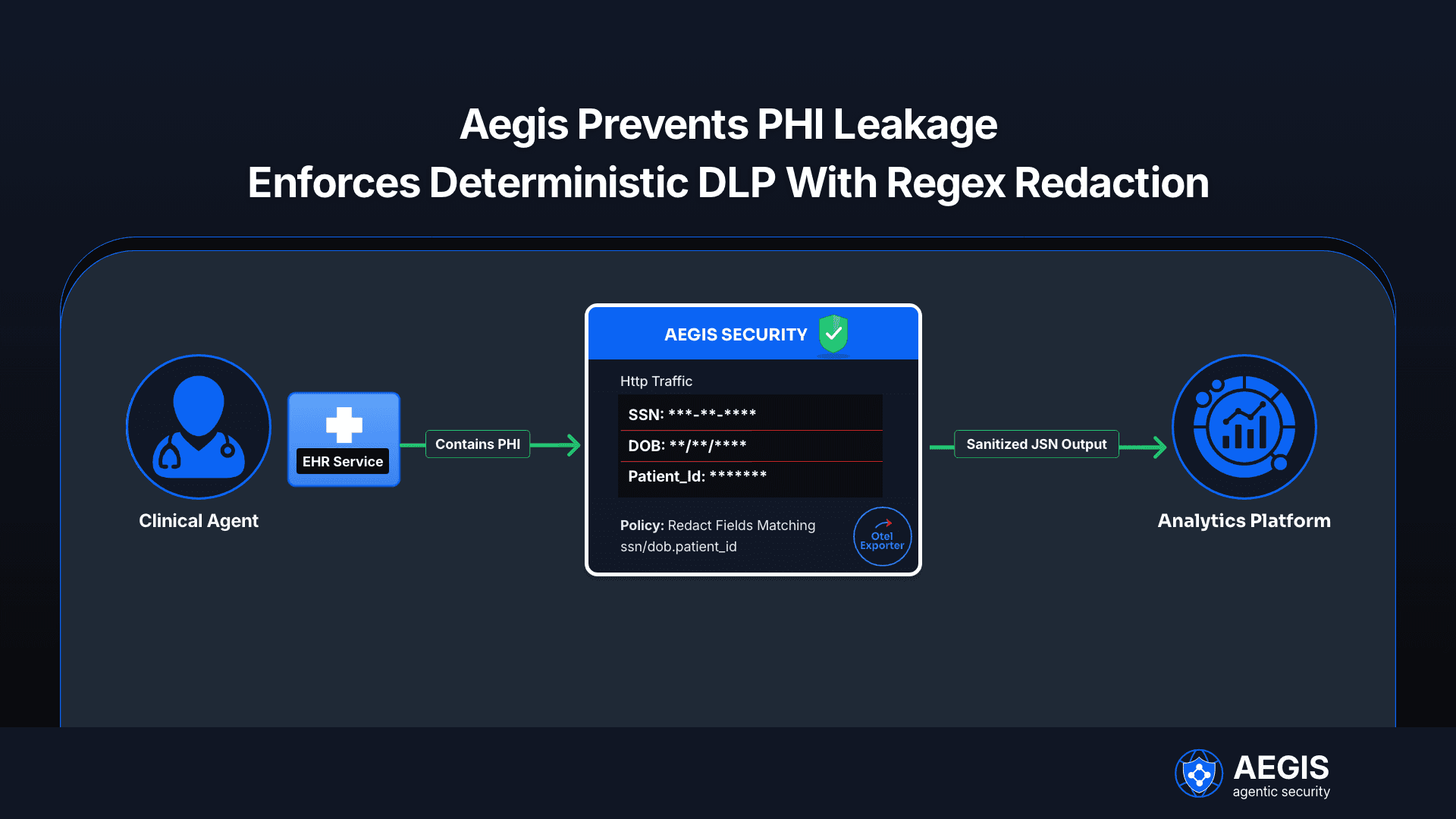
- Deterministic DLP: Patterns such as SSNs, emails, or patient IDs are redacted.
- Egress allowlisting: Calls are only permitted to pre-approved endpoints.
- Tamper-proof audit: Every policy evaluation emits a signed decision trace.
Example Policy Snippet (YAML)
agent: finance-agent
allowed_tools:
- name: stripe-payments
actions:
- create_payment
conditions:
max_amount: 5000
approval_needed: true
redact: regex(ssn)
Aegis in Action for Runtime Enforcement for Sensitive Data Protection
Architecture Overview
Aegis Gateway operates as a policy and observability fabric for agentic AI environments.
It inserts a lightweight sidecar or forward proxy between agents and external tools. Each call is evaluated by an OPA-based policy engine, which determines whether to allow, deny, sanitize, or pause for approval.
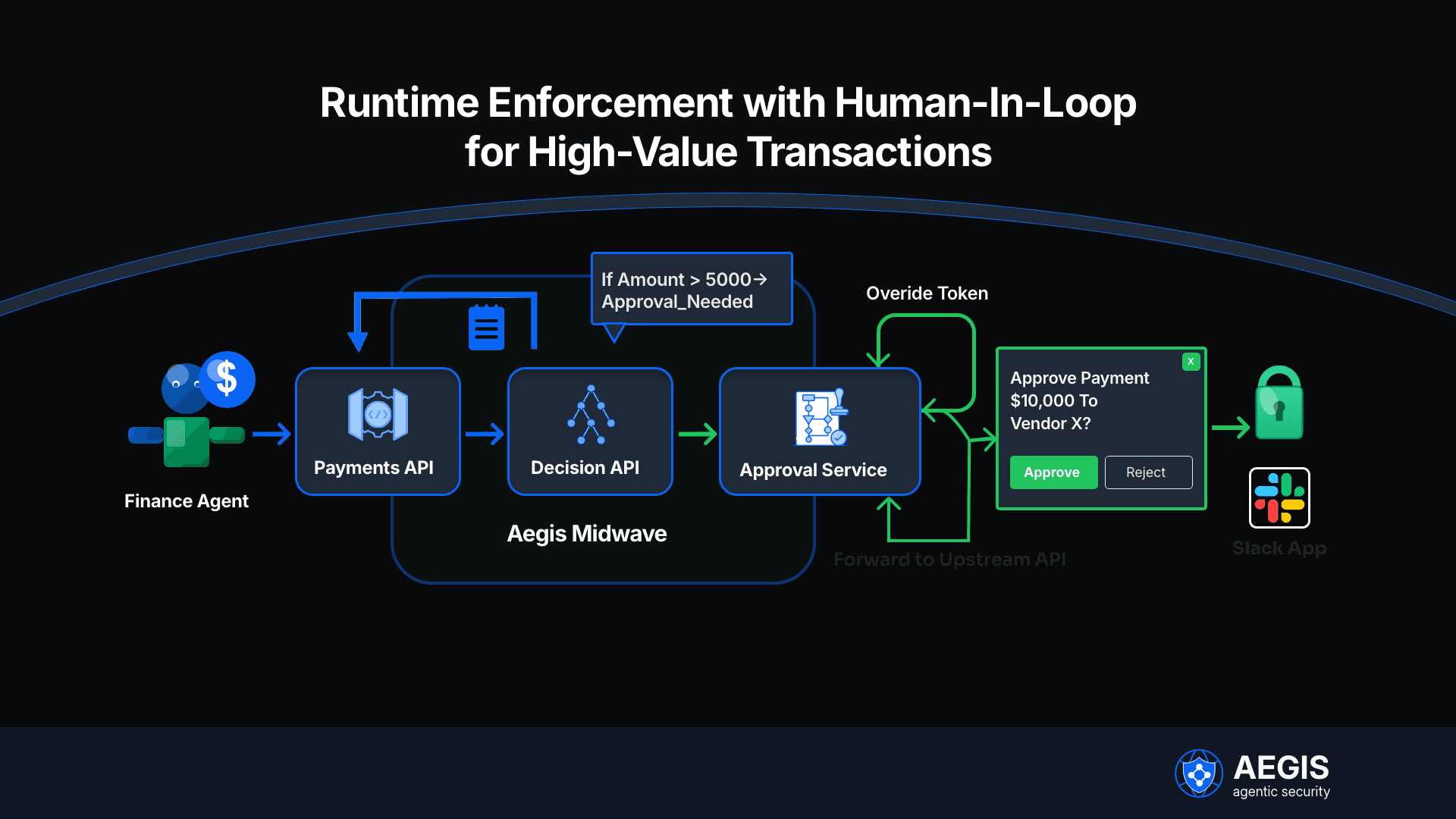
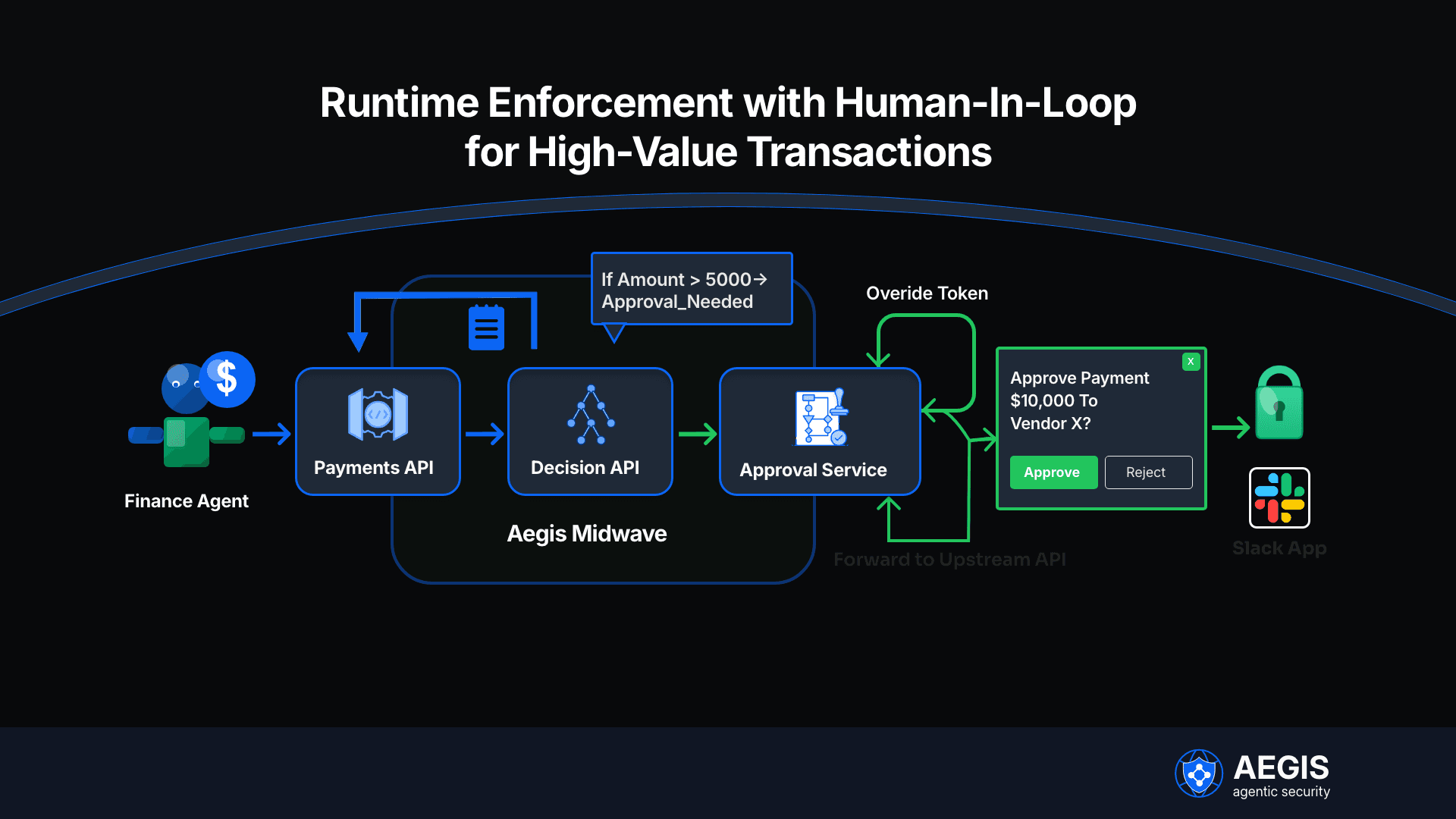
Real-World Example: Blocking a Fraudulent Payment
In a finance workflow, a Planner agent requests:
“Finance agent, pay vendor $50,000.”
Aegis intercepts the call:
- Reads agent_id=finance-agent
- Validates parameters (amount=50000 exceeds policy threshold)
Blocks the request and emits:
{ "error": "PolicyViolation", "message": "Amount exceeds policy limit" }
- Sends an approval request to Slack for verification.
This single rule prevented an unauthorized $50k transfer, demonstrating deterministic policy enforcement at runtime.
Inside Aegis’s Security Mesh
Data Plane: Real-Time Enforcement
- Proxy Layer (Envoy): Routes all agent tool calls, calling ext_authz for decision requests.
- Authz Server (Go): Loads compiled OPA bundles and evaluates per-agent policy.
- Deterministic DLP: Uses regex-based PII detection for redaction.
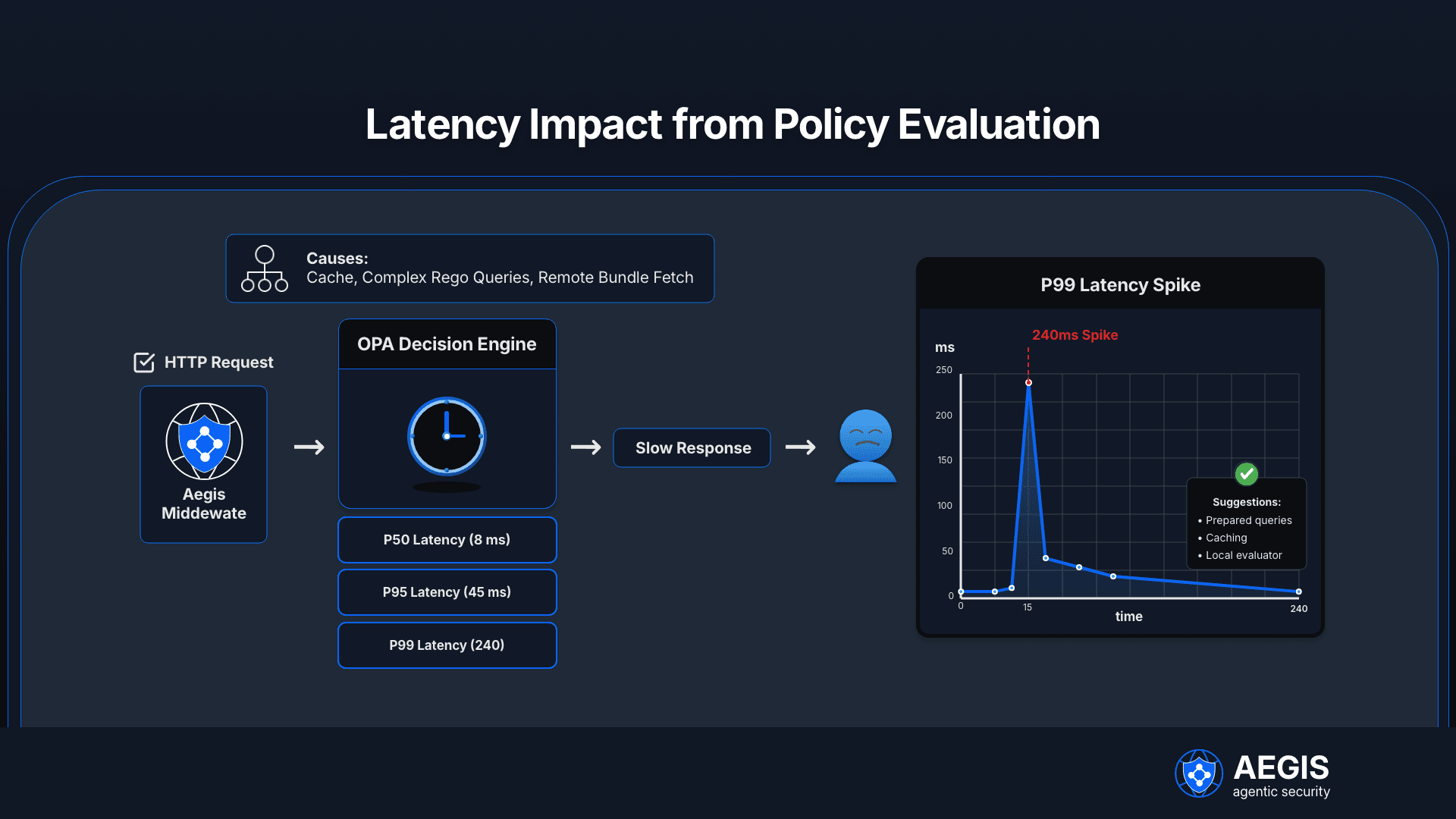
- Latency Target: ≤ 20 ms at P99 through caching and WASM-compiled Rego.
Control Plane: Governance and Audit
- Policy-as-Code Compiler: Transforms YAML/JSON into OPA bundles.
- Versioned Bundles: Signed, stored, and retrievable for audit.
- Token Service: Issues short-lived JWTs with agent_id, tenant, and scopes.
- Approvals Service: Integrates with Slack/MS Teams for high-risk operations.
.png&w=3840&q=75)
Observability and Metrics
Aegis emits OpenTelemetry metrics on every decision:
Metric | Description | Example Value |
blocked_violations_total | Policy-violating calls blocked | 23/day |
pii_redaction_count | Fields sanitized via regex | 127/day |
p99_latency_ms | Decision evaluation latency | 18 ms |
approval_requests_sent | Human approvals triggered | 14/week |
Dashboards in Grafana or Datadog visualize agent activity, blocked policies, and PII exposure rates.
👉🏻 Safeguard sensitive data with confidentiality-first pipeline design
Implementation Checklist: Securing Your Agentic Workflow
Step 1: Define Policy Scopes
Assign each agent a unique ID and least-privilege permissions:
- Finance agent: Stripe payments ≤ $5 000
- Clinical agent: Read-only access to internal EHR endpoints
Step 2: Implement Deterministic DLP
Use regex and schema-based filters to redact common identifiers:
- regex(ssn)
- regex(email)
- regex(account_id)
Step 3: Use Short-Lived JWTs and Mutual TLS
Aegis issues scoped JWTs valid for minutes, reducing replay and exfiltration risks.
Step 4: Enable Shadow Mode
Run policies in shadow mode before enforcement to identify false positives. Once validated, switch to enforce mode.
Step 5: Monitor KPIs
Track:
KPI | Description |
Policy Violations Blocked | Count of denied or sanitized calls |
PII Redactions | Number of fields redacted |
Time-to-Detect Anomaly | Detection latency from event to alert |
Audit Log Coverage | % of calls traced and signed |
Aegis is Built for Regulated, Multi-Agent Enterprises
Where legacy systems stop at IAM, Aegis extends security to every AI decision boundary. Its agent-aware enforcement and policy-as-code approach make it suitable for:
- FinTech: Preventing fraudulent transfers
- Healthcare: Enforcing PHI redaction in automated EHR interactions
- MSSPs: Providing tenant-scoped observability and signed compliance logs
- SaaS: Controlling API budgets and outbound domains
Aegis’s deterministic enforcement ensures:
- Predictable outcomes: Each call yields a verifiable allow/deny result
- Low latency: < 20 ms P99 decision latency
- Audit readiness: Signed, immutable traces meet compliance evidence standards
Common Objections and Responses
Concern | Response |
“Won’t this add latency?” | Evaluations use cached queries and in-memory OPA—target P99 ≤ 20 ms. |
“Integration seems complex.” | Middleware SDKs for LangChain/LangGraph require minimal code change; policies can run in shadow mode. |
“What about attachments or binary data?” | Aegis can sanitize base64 payloads and strip binary attachments before routing. |
“How are logs secured?” | All decisions are signed and chained, providing tamper-evident audit trails. |
Frequently Asked Questions
1. How does Aegis detect and redact PII?
It uses deterministic DLP with regex-based redaction for identifiers (SSN, email, patient ID) and supports schema-driven masking rules per agent.
2. What happens when a policy blocks an action?
The gateway returns a PolicyViolation error, logs the event, and optionally routes it for human approval through Slack or Teams.
3. Can Aegis integrate with existing orchestrators like LangChain?
Yes. SDK middleware for LangChain and LangGraph wraps agent calls automatically, with optional decorators for non-HTTP tools.
4. How does shadow mode help during rollout?
Shadow mode simulates policy enforcement, logging “would-block” events without interruption—ideal for tuning before production enforcement.
5. Is Aegis multi-tenant ready?
Yes. Tenant-scoped bundles, region-based routing, and isolated allowlists ensure strict data segregation.
6. What’s the impact on developer workflows?
Aegis provides CLI and SDK tools to test, validate, and deploy policies within minutes, supporting dry-run and rollback features.
Conclusion
Securing sensitive data in agentic AI workflows requires more than code reviews and static IAM rules—it demands runtime governance and transparent enforcement. Aegis delivers this capability with per-agent policies, deterministic DLP, and audit-grade telemetry.
For enterprises scaling autonomous agents across critical domains, Aegis transforms security from reactive to preventive, ensuring that every agent action is safe, compliant, and accountable.