Ensuring Confidentiality in Multi-Agent Data Pipelines
Runtime policy and data controls for multi-agent pipelines — enforcing purpose, redaction, regional routing and provable erasure.
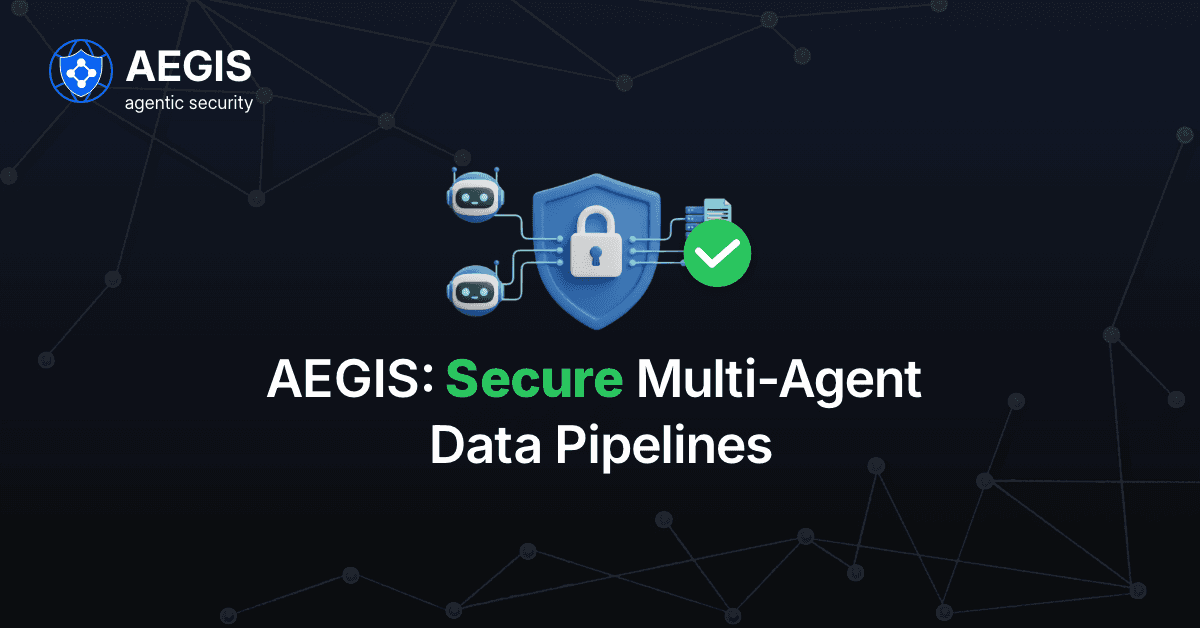
Aegis — Securing Multi-Agent Data Pipelines
Multi-agent architectures are moving from experiments to production: ingestion agents, transformation agents, analytics agents and export agents form pipelines that carry sensitive data across hops. Each hop is a leakage opportunity. This article describes common pipeline risks, operational controls required to preserve confidentiality in multi-agent flows, and how Aegis — Aegissecurity runtime policy and observability fabric — enforces purpose-bound access, inline sanitization, regional routing, and provable erasure for enterprise deployments.
Key takeaways: tag sensitivity at ingestion, bind policy checks to purpose claims, perform inline redaction before egress, isolate tokens per tenant, and link retention/erasure to policy decisions.
Why multi-agent pipelines amplify risk
Traditional protections—encryption at rest and in transit plus static ACLs—assume a single, trusted service perimeter. Multi-agent pipelines break that assumption:
• Agents may be chained by orchestrators, creating lateral privilege paths.
• Parameters (body/query) can carry sensitive fields (PHI, PII) that are accidentally forwarded.
• Agents may call external endpoints, creating exfiltration risk if egress is uncontrolled.
• Auditability breaks down when per-call decisions and purpose claims aren’t recorded.
Enterprise surveys in 2024–2025 show security and governance topping concerns as organizations scale AI: a majority of enterprises report worry about data protection and governance with generative and agentic AI adoption. (Deloitte)
Cost of a data breach remains material: recent IBM analyses underline rising average breach costs and the growth of large “mega-breaches”, reinforcing the need for runtime controls that prevent accidental exports. https://www.ibm.com/reports/data-breach. (IBM)
👉🏻 Ensure confidentiality across pipelines handling sensitive workloads
Core controls needed for confidential agent pipelines
1) Data lineage & sensitivity tagging (ingestion)
Tag every data object at ingestion with sensitivity (e.g., PHI, PII, public), purpose (e.g., care, analytics, billing), tenant and region. Downstream policy decisions reference these tags when authorizing access or export.
2) Purpose binding and policy checks
Policies must require a purpose claim (and validate it) before allowing export. Purpose binding prevents an analytics agent from repurposing PHI for non-approved exports.
3) Inline transform and deterministic DLP
Before an agent forwards data to another agent or an external tool, sanitize or redact sensitive fields inline (e.g., regex deterministic redaction, tokenization). This ensures downstream agents only see what they need.
4) Region routing & data residency
Route data to approved regional endpoints based on tenant/contract. Block any attempt to send restricted data off-region.
5) Tenant isolation & tokenization
Issue per-tenant, per-agent short-lived tokens and isolated policy bundles to prevent cross-tenant policy bleed or token reuse.
6) Retention, erasure & provable deletion
Link retention policy and erasure requests to the pipeline: record which agent stored which tokens, support automated deletion, and emit signed attestations for auditors.
How Aegis enforces confidentiality
Aegis is designed as a runtime policy and observability fabric that sits between orchestrators and tools. It functions as a lightweight gateway (sidecar/forward proxy) plus a decision service that evaluates policy-as-code on every agent→tool call. The design goals: minimal latency, developer ergonomics, and auditable decisions.
Identity, policy and token model
Agents register and receive short-lived JWTs containing organisation, tenant, agent id and scopes. Aegis compiles YAML/JSON policies into fast OPA bundles and hot-reloads them into the decision service. Policies express allowed tools, parameter conditions (regex, numeric ranges), budgets and approval thresholds. Policies are scoped per tenant to avoid cross-tenant collisions.
Runtime enforcement with inline sanitization
The proxy inspects each request: it extracts the agent id from the token, the target tool, the call parameters and any chain headers (parent_agent_id). It evaluates the OPA bundle and returns allow, deny, sanitize (redact fields) or approval_needed. When sanitize is returned, Aegis rewrites the request body to remove or tokenise sensitive fields before forwarding. All decisions emit OpenTelemetry spans and structured logs suitable for SIEM ingestion.
👉🏻 Combine encryption and DLP to secure every data flow
Purpose binding and routing
Policies require a purpose claim for read/export calls. For export actions Aegis validates the declared purpose, checks consent and routes to approved regional endpoints. Attempts to bypass routing or export outside an approved region are denied and logged.
Approval workflows and override tokens
High-risk calls (e.g., export PHI, payments above thresholds) yield approval_needed decisions. Aegis integrates with messaging systems for human approvals and then mints single-use override tokens to allow the action once approved, maintaining auditability.
Observability and provable trails
Every decision logs the agent id, tool, policy version, decision_reason, latency and estimated cost as an OpenTelemetry span. Policies and policy change history are versioned and can be signed to prove non-repudiation for audits. These features are crucial for regulators reviewing retention and deletion attestations.
Operational examples
Example pipeline: ingest PHI → de-identify agent → analytics agent → report exporter.
- Ingest: Agent A tags record as PHI, purpose=care.
- Transform: De-identify agent B runs deterministic DLP → replaces SSN, tokenizes patient_id. Aegis enforces sanitize decision.
- Analytics: Agent C receives tokenized IDs (no PHI). Policy prohibits C from export unless purpose=analytics and tenant allows.
- Export: An exporter agent requests export; Aegis requires purpose=reporting and region routing; if off-region, request denied. Audit trail records each decision.
Table 1 — Control comparison (legacy vs Aegis)
Control area | Legacy approach | Aegis approach |
Access model | Static ACLs, coarse | Per-agent, short-lived tokens, purpose checks |
Parameter inspection | None | Field-level DLP & sanitize |
Egress control | Network allowlists | Policy-driven region routing & destination checks |
Auditability | App logs / partial | Signed policy versions, OTel spans, SIEM JSON logs |
Retention/erasure | Manual | Policy-linked provable deletion |
Table 2 — Runtime decisions & outcomes
Decision | Typical trigger | Result |
allow | Low-risk, purpose valid, within budget | Forwarded |
sanitize | Sensitive fields present | Request rewritten & forwarded |
approval_needed | Amount > threshold / PHI export | Pause & send approval workflow |
deny | Purpose missing / off-region export | Block & log |
Deployment & developer experience
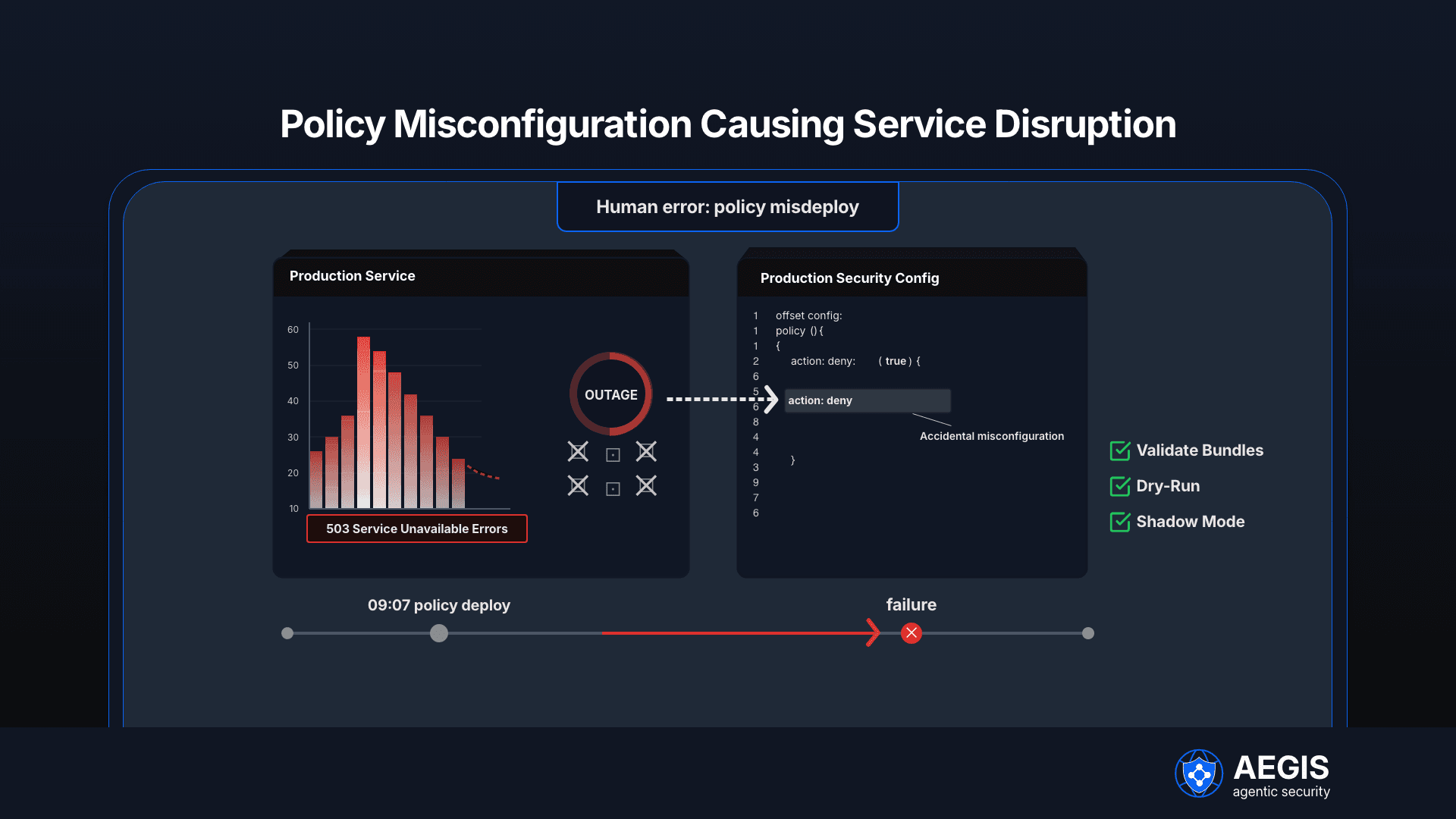
Aegis uses a sidecar/forward proxy model that requires minimal orchestrator changes: a small SDK or middleware integrates with common orchestrators and can run in shadow mode to collect would-deny events. Policy authors write YAML/JSON policies that the control plane validates and compiles into OPA bundles. Hot-reload ensures rollbacks or fixes don’t require service restarts. Shadow mode plus dry-run tools allow safe tuning before enforcement.
👉🏻 Protect data across borders with compliant and secure transfer mechanisms
.png&w=3840&q=75)
Operational metrics to monitor:
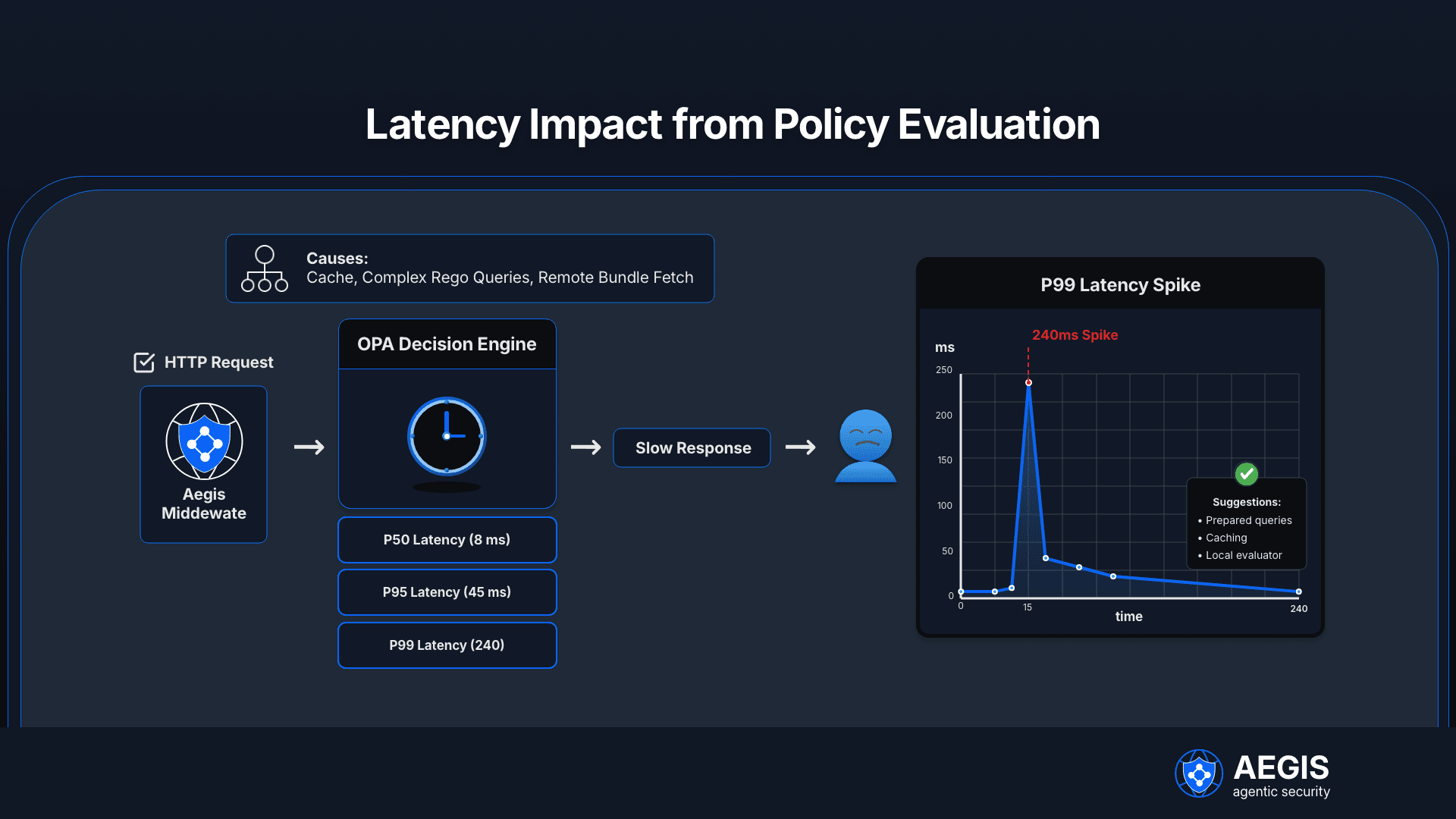
• blocked calls per hour, • policy violations by agent, • approval queue depth, • P99 latency for decision calls.
Aegis emits OpenTelemetry spans compatible with Grafana/Prometheus and SIEM systems so SOC and compliance teams can consume the same telemetry they already use.
Implementation checklist for security teams
- Tag data at ingestion with sensitivity & purpose.
- Define per-agent policies (tools, parameters, budgets).
- Deploy Aegis in shadow mode for 7–14 days; collect would-deny metrics.
- Implement inline sanitizers for deterministic DLP patterns.
- Add approval thresholds for high-risk actions and integrate human workflow channels.
- Configure region routing rules and enforce egress domain allowlists.
- Configure audit export to SIEM and store signed policy versions.
FAQs
Q: How does Aegis preserve latency for interactive agents?
A: Aegis compiles OPA policies into prepared queries, uses in-memory caches and targets sub-20ms decision P99 for common paths.
Q: Can Aegis redact fields automatically?
A: Yes. Aegis can return a sanitize decision which rewrites requests to redact/tokenize fields deterministically before forwarding.
Q: How are approvals handled at scale?
A: Policies set thresholds to limit noisy approvals; Aegis posts approval requests to messaging platforms and issues single-use override tokens after human sign-off.
Q: Does Aegis work in multi-tenant MSSP models?
A: Yes. Policy bundles and tokens are tenant-scoped; telemetry tags tenant and agent ids so SOC can partition views per customer.
Q: Can policies be tested before enforcement?
A: Policies support shadow/dry-run simulation and versioned rollbacks so teams can validate would-deny events without impacting production.
Q: What evidence is available for auditors?
A: Aegis produces signed policy history, OpenTelemetry spans with decision reasons, and SIEM-ready logs to demonstrate provenance and deletion attestations.
Closing
Securing confidentiality in multi-agent pipelines requires moving enforcement from static perimeters into runtime decision points that understand agent semantics, purpose, and field-level sensitivity. Aegis provides that runtime fabric: per-agent identity, policy-as-code, inline sanitization, regional routing and signed audit trails — all designed for minimal developer friction and enterprise observability