
Data Classification and Handling for Agentic AI
Practical guide to runtime data classification, field-level DLP, and how Aegis enforces per-call controls for agentic AI.
Aegis: Runtime Data Classification & Control for Agentic AI
Agentic AI agents routinely access, transform and transmit data across tools, tenants and regions. Traditional static classification—files in a DMS, labels in an IAM catalog, or human gatekeeping at export time—doesn't map to agentic workflows where data flows in real time and fields travel through several tool connectors. This article explains a practical runtime model for data classification and handling, why it's necessary now, and how Aegis implements deterministic, auditable control—without compromising developer velocity.
Key takeaways: adopt field-level tagging, per-call redaction, routing by tenant/region, and a policy fabric that enforces decisions at the agent↔tool boundary while producing SIEM-ready telemetry.
👉🏻 Protect sensitive data across every agent workflow with proven best practices
Why static classification fails for agentic AI
Agentic AI multiplies data flow surfaces. Agents call connectors (EHR, payments, storage, LLMs), transform payloads, and can inadvertently exfiltrate sensitive fields. Recent industry reporting highlights both rapid agent experimentation and rising security concerns: surveys show a spike in interest for agentic AI, but analysts warn many projects will be scrapped without governance; Gartner projects over 40% of agentic AI projects may be terminated by 2027 due to unclear value and rising risk. (Reuters)
A SailPoint–style survey of practitioners shows near-universal support for governance: 92% call it essential, while only ~44% have formal policies—illustrating the gap between deployment and control. Security teams report unintended agent actions (unauthorised access, sharing sensitive data), reinforcing the need for runtime controls that are applied per-call, not post-factum. (TechRadar)
Policy and privacy frameworks are also evolving to account for AI data flows; large consultancies and analyst reports document rising enterprise adoption and the need for new operational controls. (Capgemini)
👉🏻 Identify and mitigate privacy risks before they impact your systems
Core principles for runtime data classification and handling
Design policy mechanics for real-time, deterministic decisions:
- Field-level classification: tag sensitive fields (PII, PHI, CUI) at the schema or middleware layer before the agent call.
- Deterministic DLP & regex redaction: apply per-field regex rules for known patterns (SSN, PAN, DOB) to redact or tokenise values.
- Per-call routing: route calls by tenant and region to satisfy data residency.
- Connector zoning: treat third-party connectors as separate data zones and define explicit policies per connector.
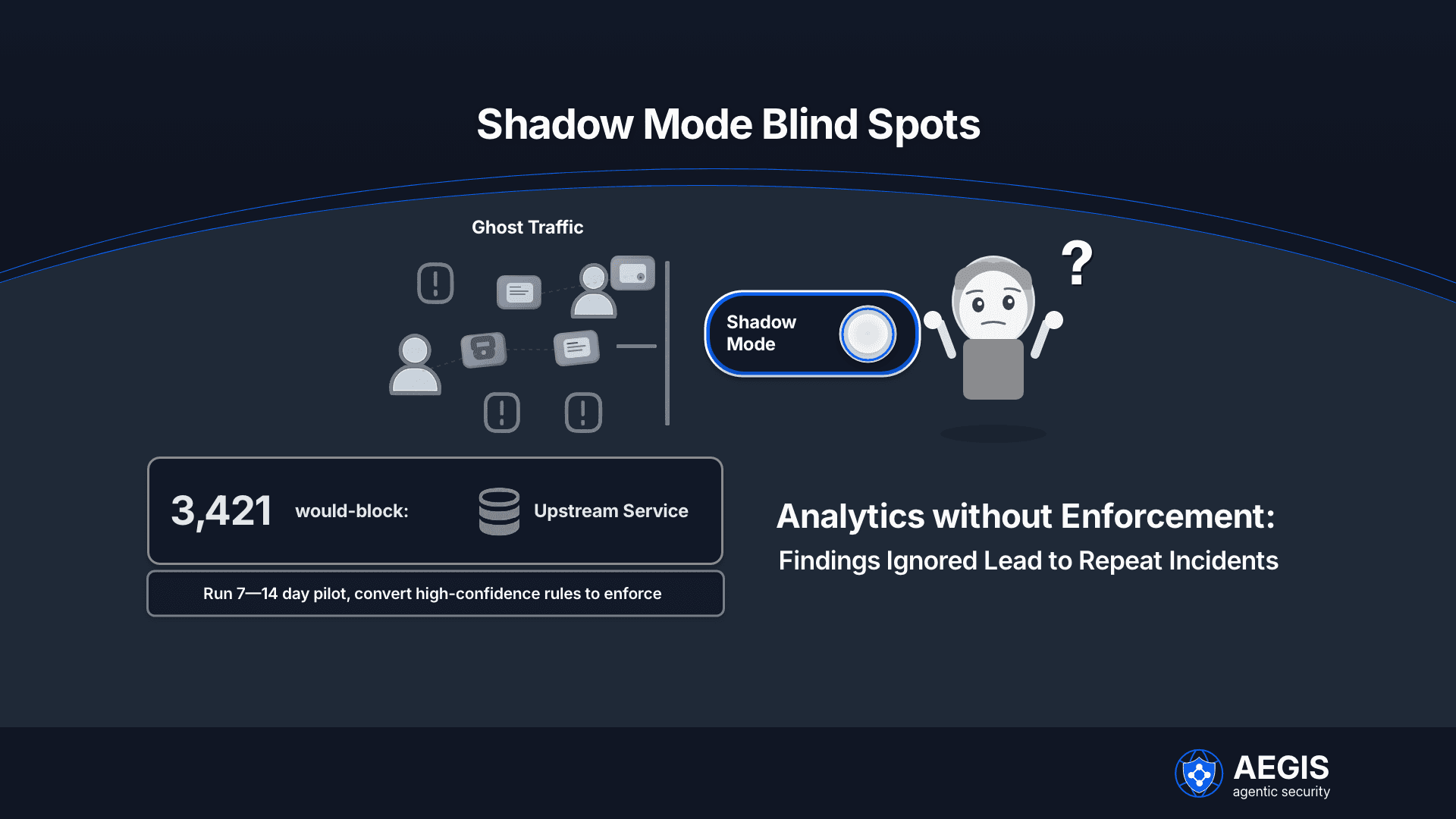
- Shadow mode & measurement: run policies in observation first to measure would-block events and fine-tune regexes and scopes.
- Auditability: maintain tamper-evident trails of decisions, reasons, policy version and attestation signatures.
These principles reflect established recommendations and the Aegissecurity product direction for Aegis.
The operational taxonomy: mapping business needs to rules
Start with a simple classification aligned to business and regulatory categories:
Class | Typical contents | Example handling |
PII | Name, email, SSN | Field-level redaction or tokenisation; block external export |
PHI | Medical records, diagnosis | Deterministic tokenisation; route to regional EHR only |
CUI | Contract terms, IP | Allow internal-sink writes only; block external cloud export |
Non-sensitive | Logs, config | Allow with standard encryption-in-transit controls |
Use this matrix as a living policy cookbook. As connectors onboard, map connector→allowed classes (e.g., analytics connector: non-sensitive + tokenised PHI only).
Aegis in practice — runtime enforcement patterns
Aegis is designed as a runtime policy and observability gateway that intercepts agent calls, evaluates policies, and enforces outcomes: allow, deny, sanitize (redact), or approval_needed. The core design follows a lightweight data plane + control plane split with OpenTelemetry telemetry and policy-as-code workflows.
How Aegis enforces data classification
- Agent registration & identity — each agent receives a short-lived JWT with claims (org, tenant, agent_id, scopes). Tokens are used to attribute actions and apply scoped policies.
- Field tagging at call time — developer SDKs or schema validators mark fields (e.g., patient.ssn: PHI) before the outbound request. This metadata travels with the call as structured attributes for the Aegis decision service.
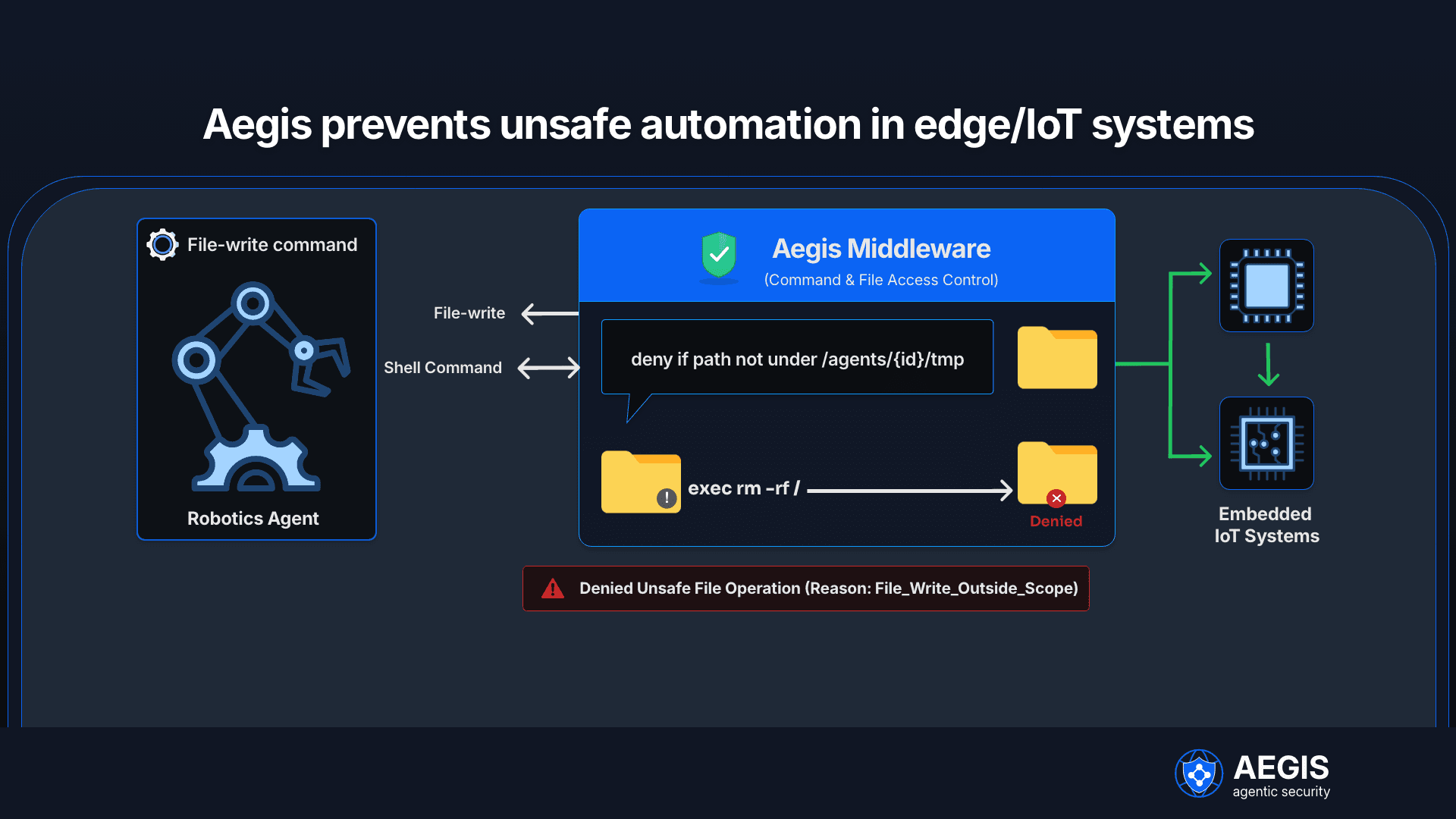
- Deterministic DLP evaluation — the Aegis enforcer runs prepared checks: regex redaction, allowed-sink validation, and per-field routing. If a PHI field is present and the destination is not an approved EHR URL, the call is either redacted or blocked.
- Per-tenant/residency routing — decisions include routing instructions so traffic can be sent to regional endpoints only (EU tenant → EU-hosted tool). This satisfies data-residency compliance.
- Shadow mode & telemetry — teams run the same rules in shadow mode to collect “would-block” metrics and tune regexes before enforcing. Aegis emits OTel spans containing decision reason, policy_version and approval_id when relevant.
Example: Preventing PHI export from an EHR to public cloud
- Clinical agent requests export = true on an EHR read. The control plane policy requires purpose=care and destination internal-ehr.myorg for PHI reads.
- Aegis inspects the payload, detects PHI fields (SSN, DOB), and determines destination is an external analytics bucket → block or redact the PHI fields and emit an audit event with PolicyViolation: DataResidencyMismatch.
Implementation patterns and developer tips
- Use schema validation to fail early: enforce field-level annotations at the connector or SDK layer to provide immediate feedback to developers.
- Deterministic tokenisation: when analytics require identifiers, tokenise PHI deterministically so analytics can run without exposing raw values.
- Parameter whitelists: define explicit whitelists for sensitive API parameters to prevent parameter injection.
- Shadow-run first: use a 7–14 day shadow window to gather would-block counts and tune policies before flipping to enforcement.
Operational metric | Recommended threshold |
Shadow-mode would-block ratio before flip | < 3% of critical workflows |
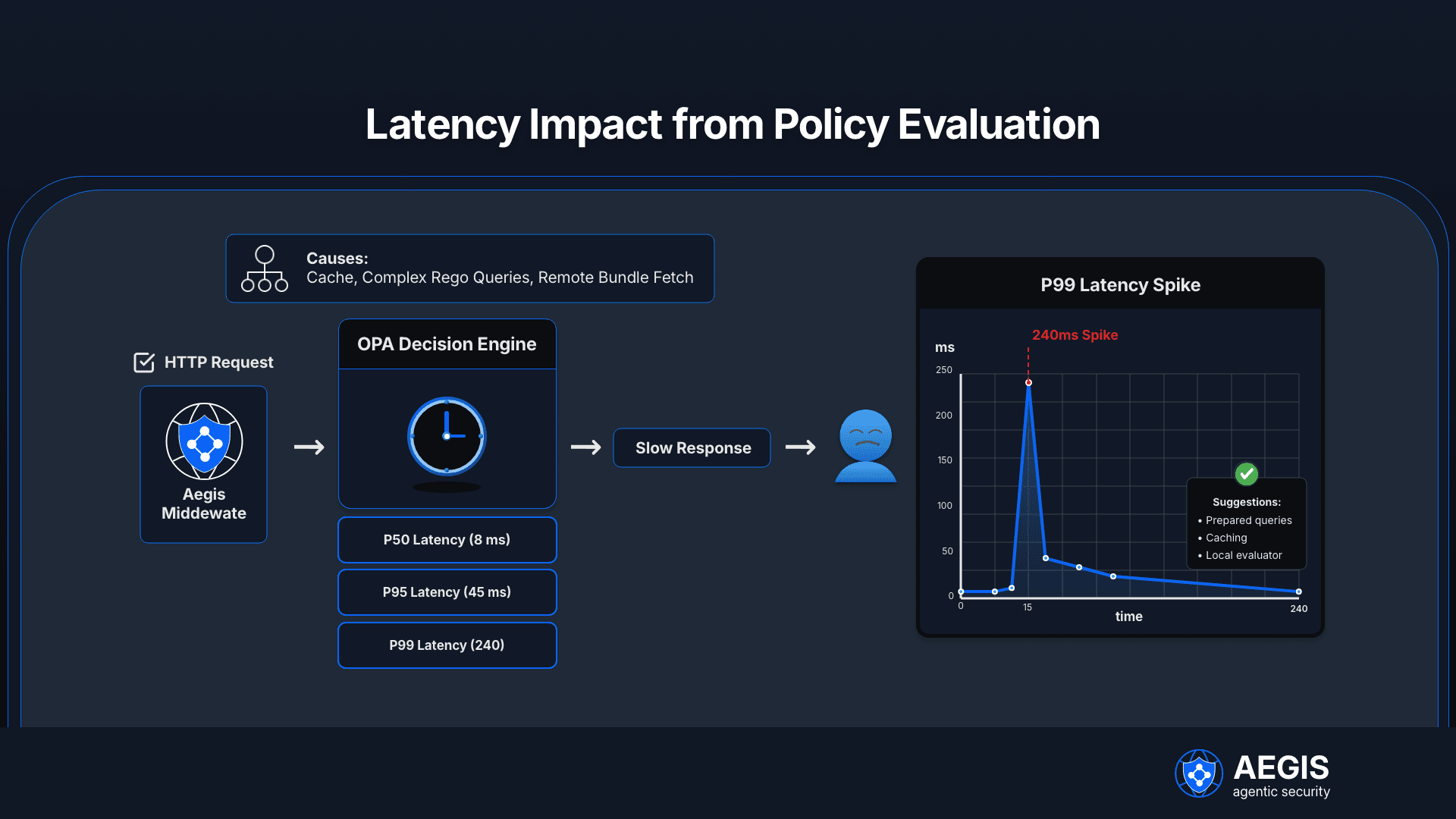
Policy evaluation P99 latency | ≤ 20 ms |
Audit trace coverage | 100% of agent-tool calls |
These thresholds reflect MVP goals and non-functional targets used in Aegis design.
Integrations, compliance & scale
Aegis integrates with existing observability and identity tooling: OpenTelemetry for traces and dashboards (Grafana/Prometheus), SIEM exports for compliance, and SSO/JWKS for token verification. For multi-tenant deployments, bundles are scoped and hot-reloaded; policy failures are auditable with version history and tamper-evident manifests. These design choices align with enterprise governance and SOC needs.
👉🏻 Ensure compliant and secure data transfers across global boundaries
-1.png&w=3840&q=75)
Table 1 — Runtime enforcement capabilities
Capability | Legacy controls | Aegis runtime |
Field-level redaction | No (post-process) | Yes (per-call, deterministic) |
Per-call approval | Manual ticketing | approval_needed + override token |
Data residency routing | Manual network controls | policy-driven routing by tenant |
Audit trace fidelity | Partial | 100% agent-tool spans (OTel) |
Table 2 — Policy outcomes & typical action
Decision | Typical enforcement action |
allow | Forward request, emit span |
sanitize | Redact fields, forward, emit span |
deny | Block and return PolicyViolation |
approval_needed | Pause, notify approvers, mint override token |
Getting started & next steps
- Build a classification onboarding checklist per connector: schema, regex cookbook, allowed sinks.
- Run policies in shadow mode for 7–14 days and collect would-block metrics.
- Enforce per-field redaction for known patterns (SSN, PAN, DOB) and require purpose claims for sensitive reads (e.g., EHR).
- Produce a compliance-ready export mapping datasets to applied policies.
Frequently Asked Questions
Q: Can runtime classification be deterministic at scale?
A: Yes — by using prepared policy queries (OPA), in-memory caches, and deterministic regex/tokenisation you can achieve P99 evaluation latency targets (design target ≤ 20 ms). Shadow-mode helps tune performance before enforcement.
Q: How do you avoid too many human approvals?
A: Use thresholds, budgets and contextual conditions in policies. Route only high-risk actions to approval; allow low-risk flows automatically. Shadow mode helps calibrate what truly needs approval.
Q: What about multi-tenant policy collisions?
A: Scope policy bundles by tenant and use versioned manifests. Aegis-style designs keep tenant data separate and enforce strong scoping for bundles and claims.
Q: How do I validate regexes and DLP rules?
A: Build a policy cookbook, run unit tests against representative payloads and use shadow-mode metrics to validate coverage and false-positive rates.
Q: How does Aegis integrate with observability and SIEM?
A: Aegis emits OpenTelemetry spans and structured JSON logs with policy_version and decision_reason, which can be ingested by Grafana/Prometheus and exported to SIEMs (Splunk/ELK/Datadog).
Operational mindset, not a single product trick
Runtime data classification for agentic AI is an operational discipline: it combines schema hygiene, deterministic DLP, per-call policy enforcement and strong telemetry. Aegis implements this discipline as a runtime enforcement fabric—policy-as-code, agent identity, deterministic redaction, routing by tenant/region, and auditable telemetry—allowing security, compliance and DevOps teams to scale agentic workflows safely.
Further reading and sources: Gartner analysis on agentic AI project outcomes (report summarised by Reuters), SailPoint survey coverage and industry reports on agent adoption and governance. (Reuters)