Integrating DLP Solutions with Multi-Agent Frameworks
Learn how Aegis Gateway enforces runtime security, policy control, and observability across multi-agent AI systems, ensuring compliance and safe automation.
Securing Multi-Agent AI with Aegis Gateway
As enterprises adopt agentic AI to automate workflows and decision-making, they face a growing security challenge: autonomous agents can act independently, chain calls across tools, and potentially execute harmful or unauthorized operations. According to recent research, searches for “agentic AI” have increased over 800% year over year while over 50% of enterprise leaders cite security and compliance as their top barrier to adoption.
Aegis Gateway, developed by Aegissecurity, provides the missing layer—an AI Agent Security Mesh that enforces runtime policy decisions, identity boundaries, and observability across multi-agent ecosystems. Acting as a “policy and observability fabric” between agents and tools, Aegis ensures that no AI agent exceeds its privileges or escapes its intended operational scope.
Understanding the Multi-Agent Security Challenge
The Rise of Agentic Systems
.png&w=3840&q=75)
Modern enterprises now deploy multi-agent architectures using orchestrators like LangGraph, CrewAI, and AgentKit. These systems delegate specific tasks—payments, data retrieval, deployments—to autonomous agents that coordinate dynamically. However, this autonomy introduces novel security and compliance risks:
- Privilege Escalation – A planner agent can coerce a finance agent into initiating unauthorized payments.
- Data Exfiltration – A rogue or compromised agent might send data to unapproved domains.
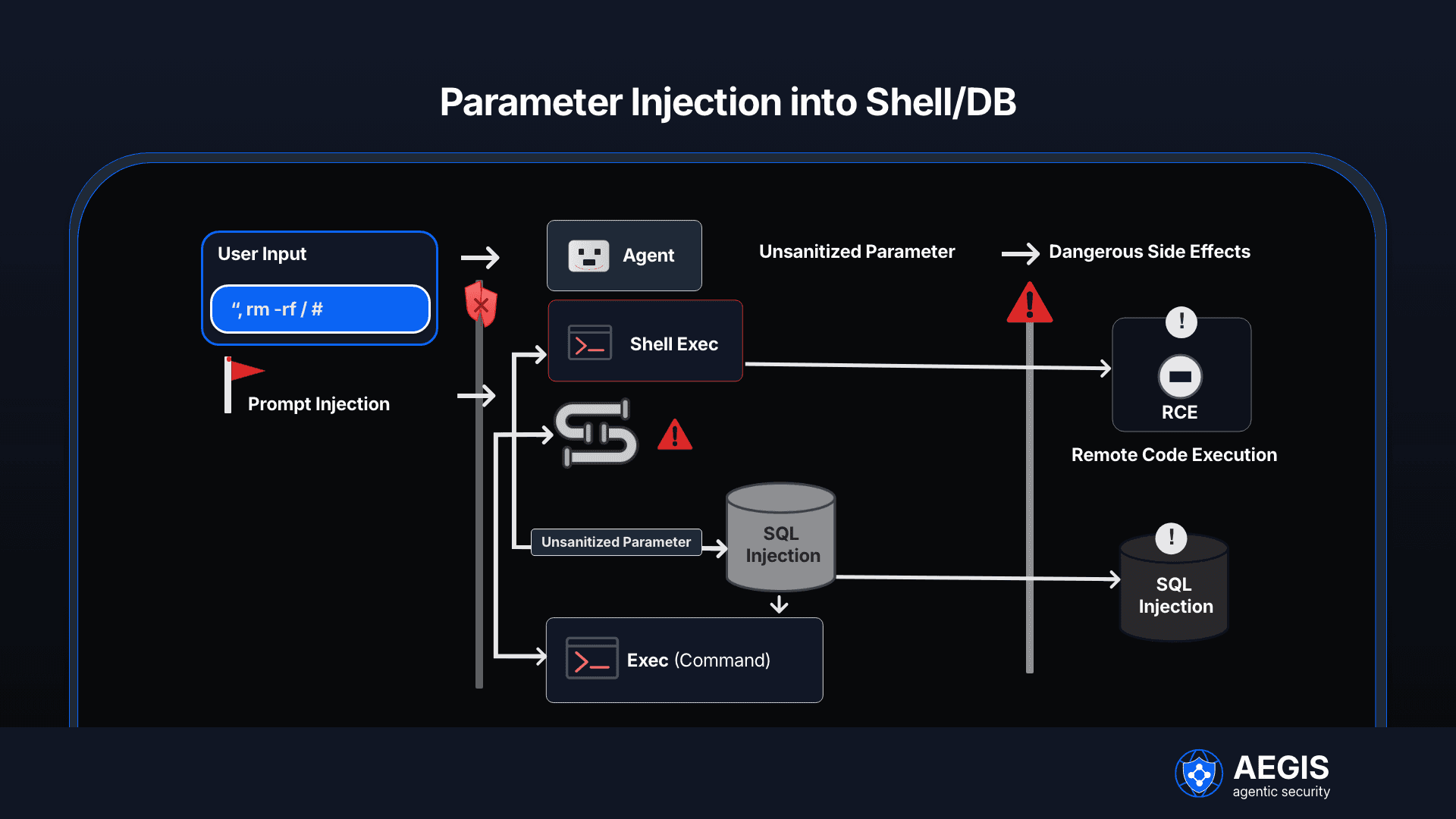
- Parameter Injection – Agents passing unvalidated parameters could trigger unsafe shell commands or SQL queries.
- Shadow Agents & Cost Explosions – Uncontrolled agents may spawn excessive API calls, inflating operational costs.
Without centralized governance, enterprises rely on ad hoc code-level checks that lack auditability, scalability, and consistency.
Why Traditional IAM Fails for AI Agents
Traditional Identity and Access Management (IAM) defines who can call an API, not what the AI is allowed to do within that call. For agentic systems, this is insufficient. Security must operate at the runtime boundary, inspecting every action, parameter, and context chain between agents and tools.
That’s the gap Aegis Gateway fills.
👉🏻 Reinforce data security with layered DLP and protection strategies
Inside Aegis Gateway - Policy and Observability Fabric for AI Agents
Core Concept
Aegis functions as a runtime policy enforcement gateway between orchestrators and tools. It evaluates every agent request—who is making the call, to which tool, with what parameters, and under what conditions—and decides whether to allow, deny, sanitize, or require human approval.
Policy-as-Code Model
Security teams write policies in YAML or JSON and store them centrally. These policies are compiled into Open Policy Agent (OPA) bundles, supporting complex logic like ranges, regex validation, rate limits, and budget caps. Each decision is traceable, signed, and exportable for compliance reviews.
Example policy:
agent: finance-agent
allowed_tools:
- name: stripe-payments
actions:
- create_payment
conditions:
max_amount: 5000
approval_needed: true
Policies can also specify data redaction, such as removing PII before posting to Slack or storing logs.
Runtime Enforcement Layer
At runtime, Aegis acts as a sidecar or proxy that intercepts agent requests:
- Inspects headers: agent identity, tool ID, and call context
- Validates parameters: using schema or regex rules
- Executes policy: allow, deny, sanitize, or request human approval
- Emits telemetry: every decision generates OpenTelemetry spans for dashboards and SIEM integration
The enforcement decision typically adds less than 20 ms latency at P99, making it suitable even for interactive agent workflows.
Control and Observability at Enterprise Scale
Control Plane
The control plane manages policies, agents, and versions. It validates YAML definitions, compiles OPA bundles, and pushes updates across tenants using secure manifests. Key capabilities include:
- Policy versioning and rollback
- CLI and API interfaces for automation
- Dry-run and shadow mode testing before enforcement
- Integration with S3/GCS for versioned bundle storage
Data Plane
The data plane handles runtime enforcement and telemetry:
- Proxy (Envoy): Routes outbound agent calls through the Aegis decision layer.
- Authorization Server (Go): Evaluates calls using prepared OPA queries.
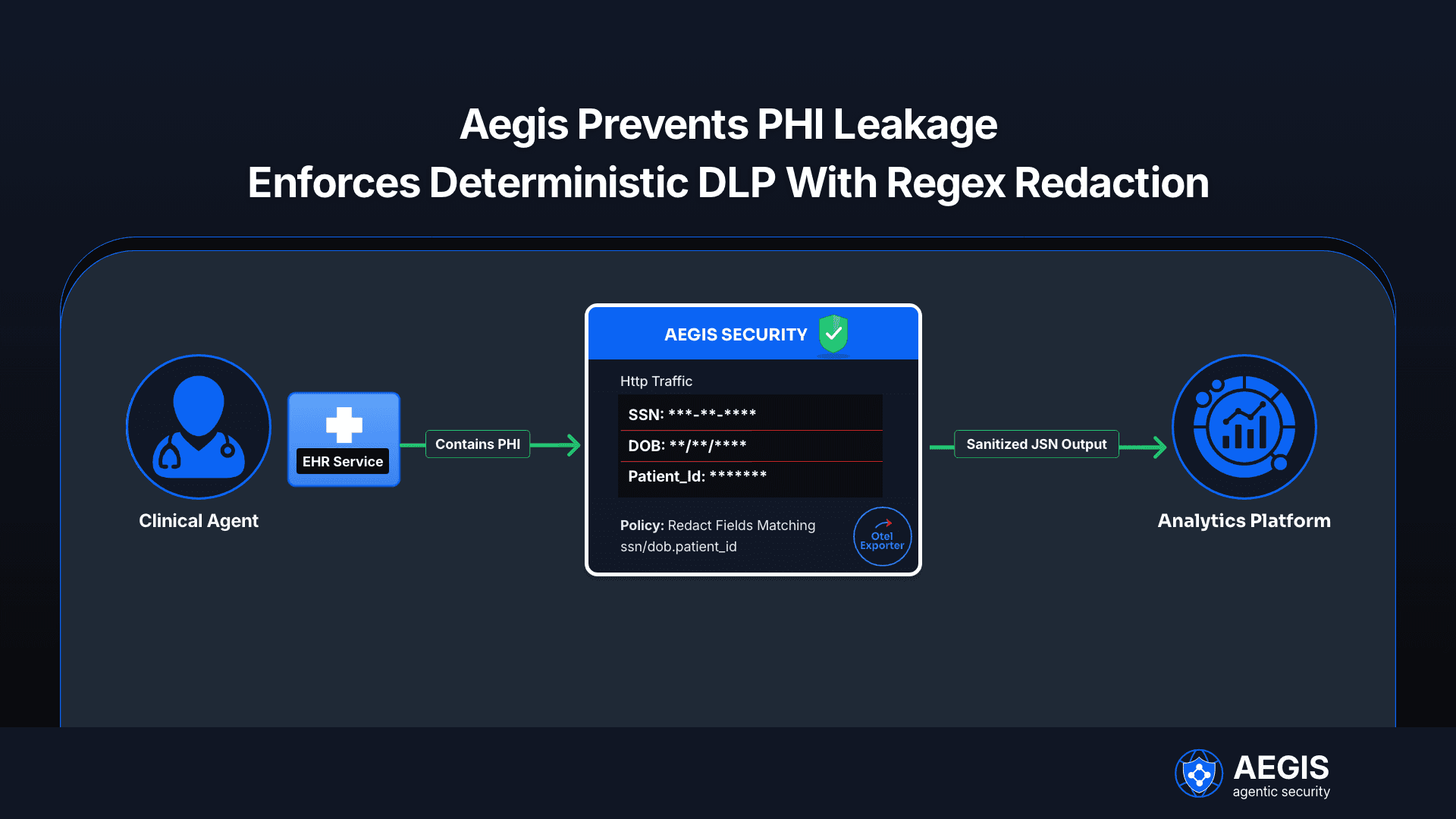
- DLP & Sanitization: Redacts PII (e.g., SSNs, API keys) deterministically.
- Telemetry Engine: Emits OpenTelemetry metrics and structured logs to Grafana or Prometheus.
Practical Use Cases Across Industries
Aegis Gateway’s architecture is built to solve real-world challenges in regulated and multi-tenant environments. Below are representative examples:
Industry | Scenario | Aegis Enforcement |
FinTech | High-risk payments over $5,000 | Require human approval via Slack before execution |
Healthcare | Access to patient EHR data | Enforce purpose=care and redact PII fields |
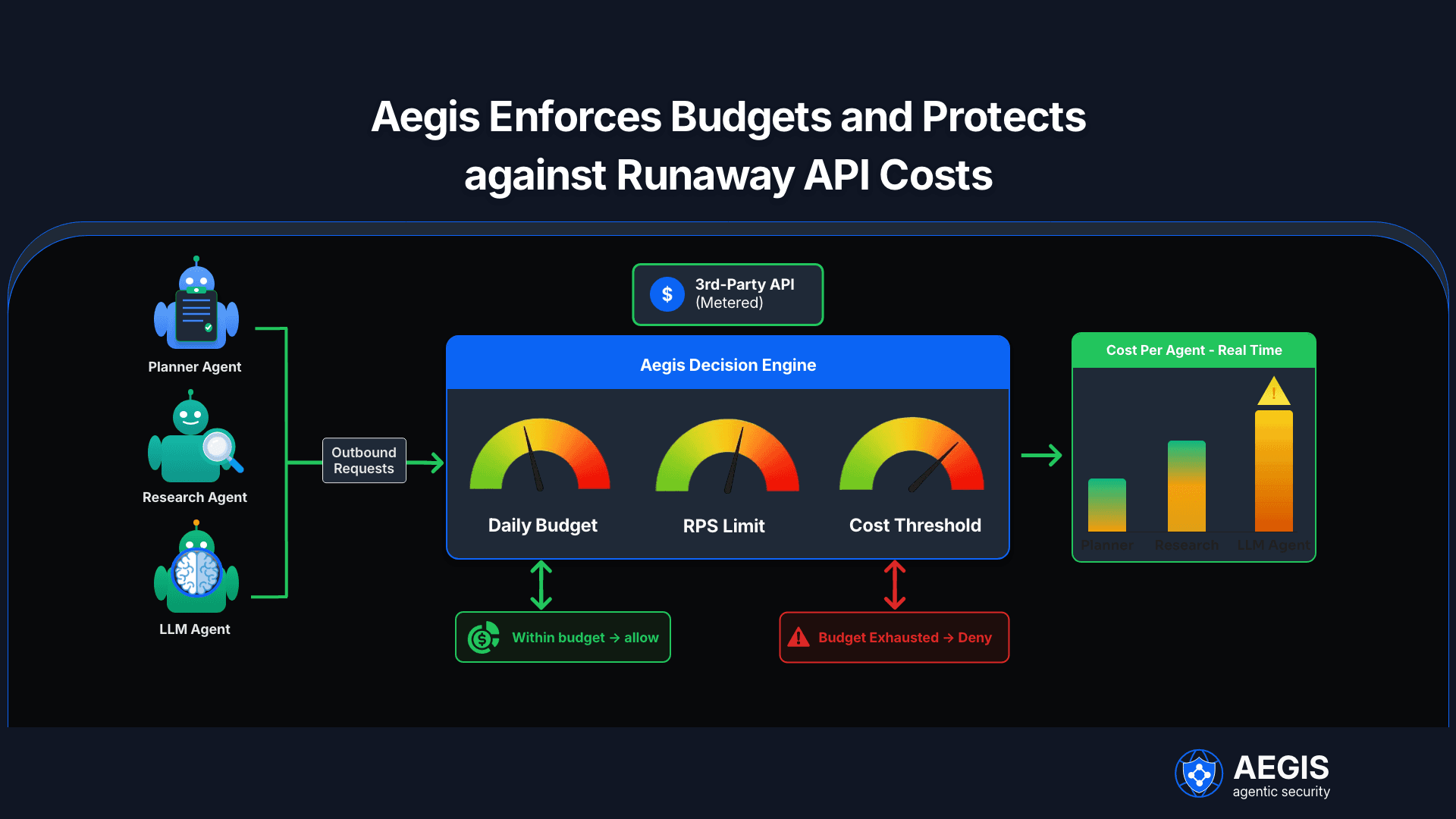
SaaS/FinOps | API spend governance | Per-agent budgets and RPS rate limits |
DevOps | Agent-triggered deployments | Only allow deploys to staging; require approval for production |
MSSP | Multi-tenant auditing | Signed spans with tenant ID and policy version for SIEM logs |
Each enforcement action generates tamper-proof audit trails, helping organizations demonstrate compliance under frameworks like SOC 2, ISO 27001, and HIPAA.
👉🏻 Secure both data and secrets with unified protection controls
Agent Security in Action
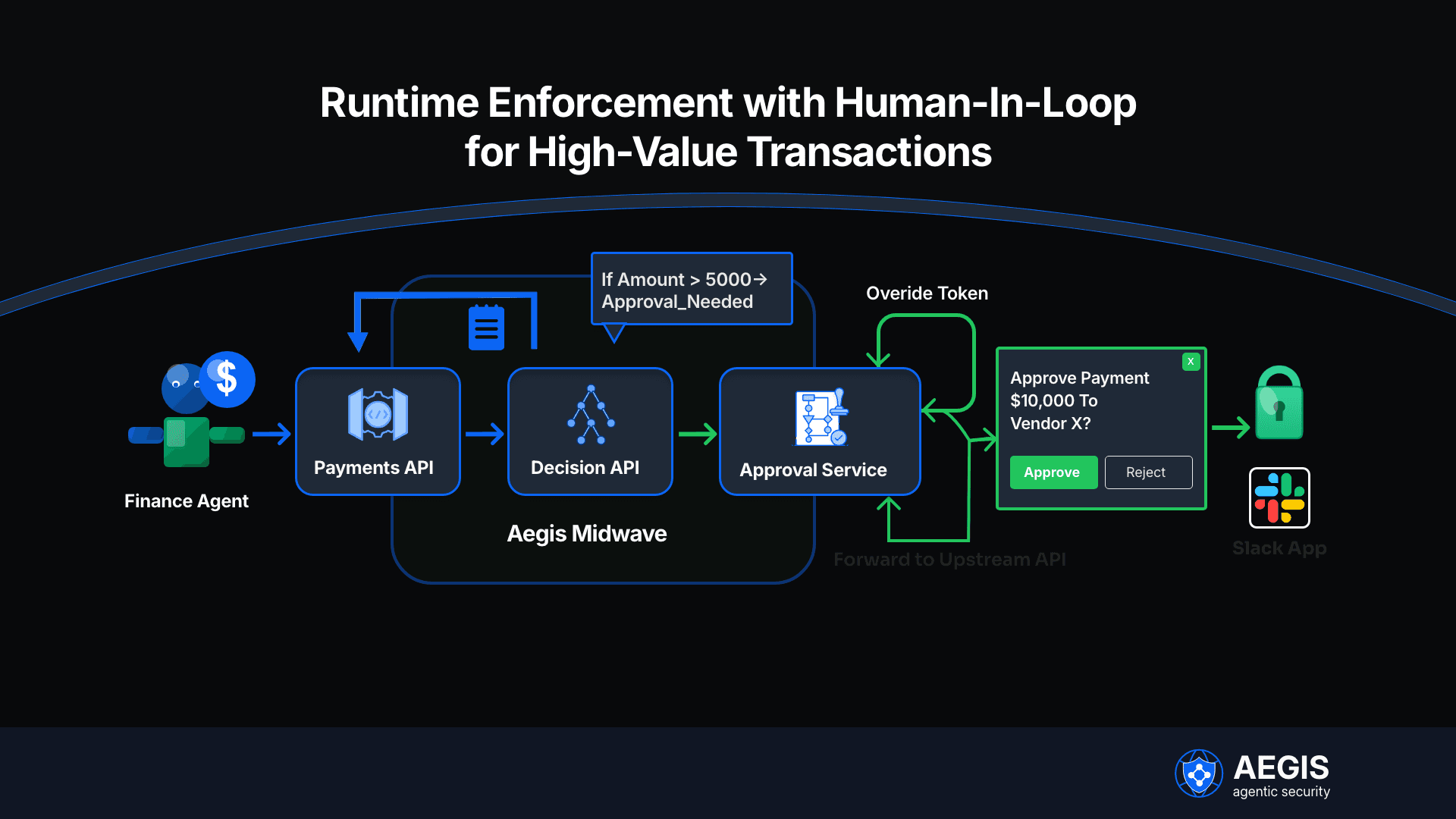
1. Secure Payment Workflows
A finance agent is allowed to initiate payments up to $5,000. Any higher triggers a human approval:
- Planner agent requests: “Pay $50,000 to vendor.”
- Finance agent calls Aegis.
- Policy engine detects threshold breach → approval_needed.
- Slack workflow requests manual authorization.
- Once approved, an override token allows one-time retry.
2. Healthcare DLP Enforcement
A clinical agent attempts to export patient data to an external domain.
Aegis intercepts the request, detects export=true flag, and blocks it. The payload is sanitized to remove SSN and DOB fields before forwarding internally.
3. Cost and Rate Governance
For LLM-heavy SaaS platforms, Aegis enforces per-agent budgets:
daily_budget: 20
rps_limit: 5
When the limit is exceeded, the gateway returns PolicyViolation: BudgetExceeded and logs telemetry for FinOps visibility.
Key Technical Advantages
Deterministic Latency and High Availability
Using prepared OPA queries and in-memory caching, Aegis maintains ≤ 20 ms decision time at P99. The data plane supports 10,000+ requests per second per region, scaling horizontally with stateless services.
Secure Identity and Egress Control
Agents authenticate with short-lived JWTs signed using Ed25519. Each token encodes organization, tenant, agent ID, and scope. The proxy enforces outbound domain allowlists, mitigating exfiltration risks.
👉🏻 Enhance DLP effectiveness with strong data classification foundations
Shadow Mode and Dry-Run Safety
Security teams can deploy policies in shadow mode, observing “would-block” events before enforcement. This feature reduces false positives and allows smooth rollout without operational disruption.
Comprehensive Observability
Aegis integrates seamlessly with OpenTelemetry, Grafana, and SIEM tools. Dashboards visualize:
- Decision outcomes (allow/deny/approval)
- Policy versions and reasons
- Cost per agent/tool
- Compliance alerts and egress violations
Comparison: Aegis Gateway vs. Legacy Approaches
Capability | Legacy IAM | Service Mesh | Aegis Gateway |
Identity management | ✅ | ✅ | ✅ |
Runtime policy enforcement | ❌ | ❌ | ✅ |
Parameter-level control | ❌ | ❌ | ✅ |
Human-in-the-loop approvals | ❌ | ❌ | ✅ |
Observability & telemetry | ⚠️ Partial | ✅ | ✅ |
Multi-tenant isolation | ⚠️ | ⚠️ | ✅ |
Shadow/dry-run mode | ❌ | ❌ | ✅ |
Aegis merges the policy control of IAM, the observability of service meshes, and the context awareness of agentic AI frameworks—without requiring major code rewrites.
Operational and Compliance Impact
Aegis directly addresses the core drivers identified by enterprise security teams:
- Risk Management – Prevent unauthorized actions, data leaks, or overreach by autonomous agents.
- Compliance – Produce auditable logs showing every decision, policy, and approval chain
- FinOps Control – Track and throttle tool usage at the agent level.
- Operational Velocity – Deploy policies quickly without interrupting existing orchestrations.
This unified approach transforms AI security from reactive containment to proactive governance.
The Road Ahead for Agentic Security
As multi-agent ecosystems expand, runtime governance will become as fundamental as IAM or network firewalls. Aegis Gateway’s “mesh” approach—combining OPA-based policy evaluation, runtime inspection, and telemetry-first design—positions it as the core security fabric for next-generation AI workloads.
Future iterations aim to add policy visualization UIs, relationship-based authorization (OpenFGA), and graph-level anomaly detection to further secure agent collaboration.
Frequently Asked Questions
1. How does Aegis Gateway differ from traditional IAM?
IAM authenticates who is calling; Aegis decides what the agent can do at runtime, inspecting every call, parameter, and outcome.
2. What latency does Aegis introduce?
Under 20 ms per decision at P99, thanks to OPA prepared queries and in-memory caching.
3. Can I test policies without enforcing them?
Yes. Shadow mode records potential violations without blocking, ideal for policy tuning.
4. How does Aegis integrate with existing orchestrators?
Aegis provides Python/Node middleware for frameworks like LangGraph, LangChain, and AgentKit—requiring minimal app changes.
5. What compliance benefits does Aegis provide?
Aegis offers tamper-proof logs, signed spans, and full decision traceability, simplifying audits for SOC 2, HIPAA, or ISO 27001.
6. How does it handle human approvals?
For sensitive actions, Aegis pauses execution and routes approval requests to Slack or Microsoft Teams. Once approved, a one-time override token permits the call.
Aegis Gateway provides a foundational layer for secure, compliant, and observable multi-agent AI—turning autonomous orchestration into a controlled, auditable, and trustworthy enterprise capability.