Overcoming Transparency Gaps: Explaining Agent Decisions
Learn how explainable AI agents and Aegis decision traces provide audit-ready transparency for multi-agent systems and compliance teams.
Overcoming Transparency Gaps: Explaining Agent Decisions
As enterprises adopt multi-agent AI systems for critical workflows—like finance, healthcare automation, or CI/CD pipelines—the opacity of agent decisions has become a significant barrier. While these systems can reason, plan, and execute multi-step actions autonomously, security and compliance teams often struggle to understand why a particular tool call was made or blocked.
Without human-readable explanations, teams cannot perform meaningful audits, verify compliance, or build trust in autonomous operations. The need for explainable AI agents has therefore shifted from academic interest to an enterprise imperative.
This article explores how structured decision traces and Aegis’s transparent telemetry model transform opaque agent decisions into clear, auditable evidence.
Why Transparency in Agent Decisions Matters
The Regulatory and Operational Pressure
A 2025 McKinsey survey found that 23% of enterprises scaling agentic systems now require explainability features for audit readiness. This number is expected to double as AI regulations evolve across sectors such as finance and healthcare.
When agents autonomously approve payments, alter configurations, or transmit sensitive data, lack of an audit trail becomes a compliance failure. Regulators increasingly demand a causal narrative behind every automated decision—something raw log streams cannot provide.
👉🏻 Maintain audit-ready records of every AI decision
From Logs to Causal Traces
Legacy systems log events like this:
finance-agent called stripe:create_payment → denied
Such records say what happened, but not why. For compliance, SOCs need to trace each decision back to its originating policy, version, and parent chain—information that traditional logs simply omit.
Structured decision traces solve this by embedding metadata that links each action to its cause, rule, and validation context.
Log Type | Example | Audit Readiness |
Legacy Log | Blocked call: stripe:create_payment | ❌ None |
Structured Trace | finance-agent → stripe:create_payment → BLOCKED (rule:max_amount, policy:v1.3, parent:planner-123) | ✅ Full context |
This simple structure transforms a denial log into courtroom-grade evidence.
👉🏻 Build ethical AI systems that ensure fairness and trust
The Foundation of Explainable AI Agents
Anatomy of a Decision Trace
Aegis introduces a Decision Trace Schema that captures every dimension of an agent’s runtime choice:
{
"agent_id": "finance-agent",
"tool": "stripe:create_payment",
"decision": "BLOCKED",
"decision_reason": "rule:max_amount",
"policy_version": "v1.3",
"parent_chain": "planner-123",
"timestamp": "2025-10-14T12:04:15Z"
}
Each field offers a distinct lens:
- agent_id: Uniquely identifies the decision-maker.
- policy_version: Enables reproducible audits across policy changes.
- decision_reason: Uses standardized, human-readable reason codes.
- parent_chain: Tracks the causal path (e.g., planner → executor → finance).
- attestation_signature: Ensures trace integrity and tamper resistance.
These traces are emitted as OpenTelemetry spans enriched with attestation tokens. They integrate seamlessly into existing SIEMs or observability dashboards, allowing SOCs and auditors to filter and correlate decisions by reason, tool, or agent lineage.
👉🏻 Increase adoption with transparent and trustworthy AI systems
.png&w=3840&q=75)
Data Privacy and Retention
To protect sensitive data, Aegis redacts fields containing PII or financial identifiers before archival. Traces are chunked and signed to preserve tamper-proof auditability without compromising privacy.
Retention policies can be tuned—typically 90 days active and 1 year archived—to balance compliance and storage efficiency.
👉🏻 Add human oversight to critical AI decisions without slowing down workflows
Aegis: Bringing Structured Transparency to Multi-Agent Security
The Role of Aegis Gateway
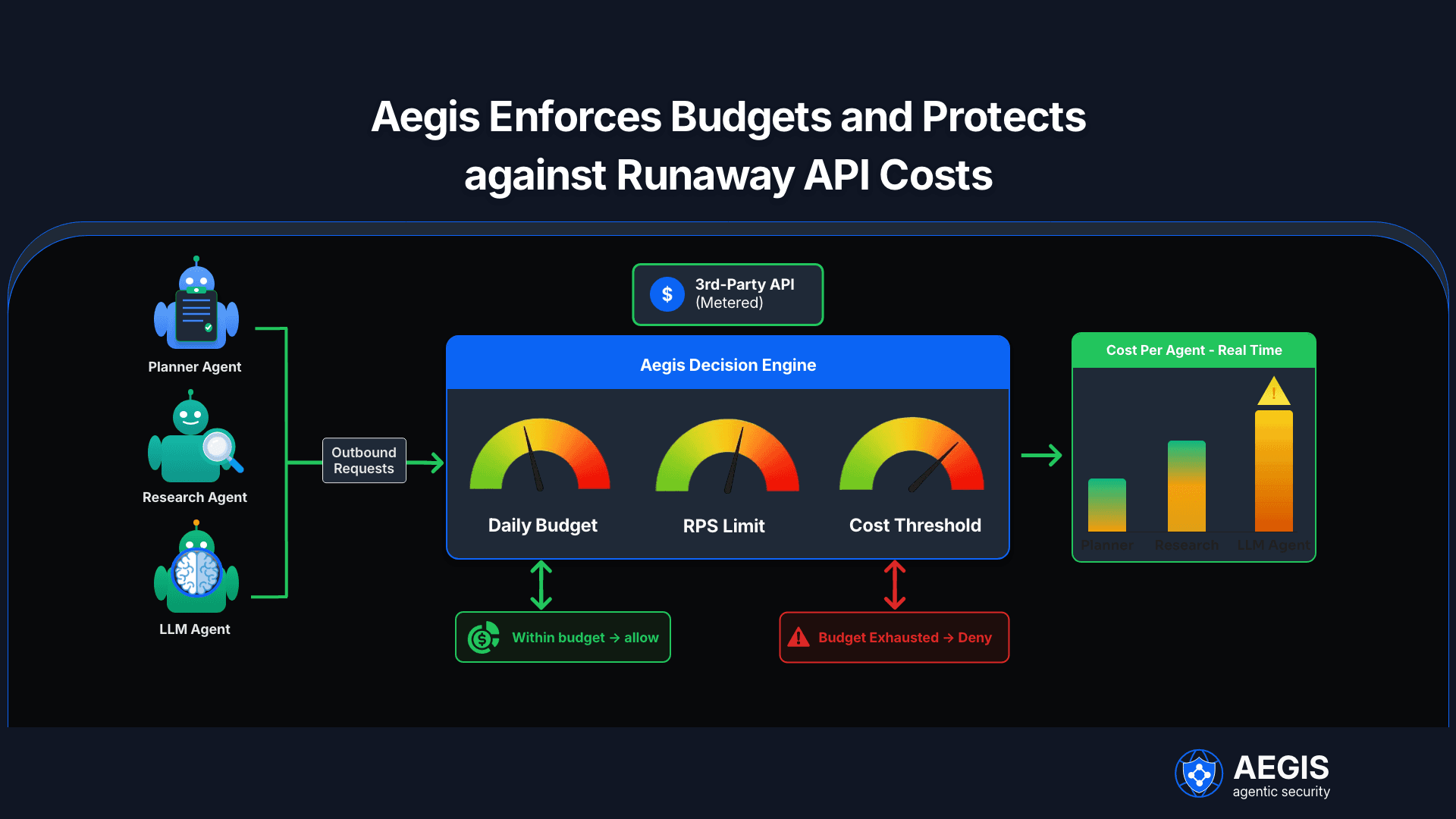
Aegis by Aegissecurity functions as a policy and observability fabric for secure multi-agent AI systems. It sits between agents and the tools they invoke, enforcing policies in real time and emitting auditable decision traces.
Rather than relying on heuristic “agent safety” features or raw logs, Aegis captures a verifiable story for each action: which policy applied, what the decision was, and why.
Aegis Component | Function | Example Output |
Decision API | Evaluates calls against OPA policy bundles | allow, deny, approval_needed |
Telemetry Engine | Emits OpenTelemetry spans | agent=finance, decision=blocked, reason=max_amount |
Attestation Signer | Cryptographically signs traces | sha256:34fa2... |
Policy Diff Viewer | Compares versioned policies | v1.3 → v1.4: updated max_amount 5000→10000 |
Agentic Decision Traceability in Practice
Consider a FinTech scenario:
finance-agent → stripe:create_payment($50,000)
→ BLOCKED (rule:max_amount, policy:v1.3, parent:planner-123)
An auditor can instantly identify:
- Which agent initiated the request.
- The specific rule and policy that caused the block.
- The hierarchical origin (the planner that issued the command).
During compliance reviews, Aegis dashboards visualize such decision flows as expandable timelines linking policies, diff hashes, and outcomes—turning opaque automation into a transparent control surface.
Implementing Explainable Decision Models with Aegis
Policy and Trace Design
Aegis policies are written in YAML or JSON and compiled into Open Policy Agent (OPA) bundles. Security engineers can version and hot-reload them without downtime.
Example:
agent: finance-agent
allowed_tools:
- name: stripe-payments
actions:
- create_payment
conditions:
max_amount: 5000
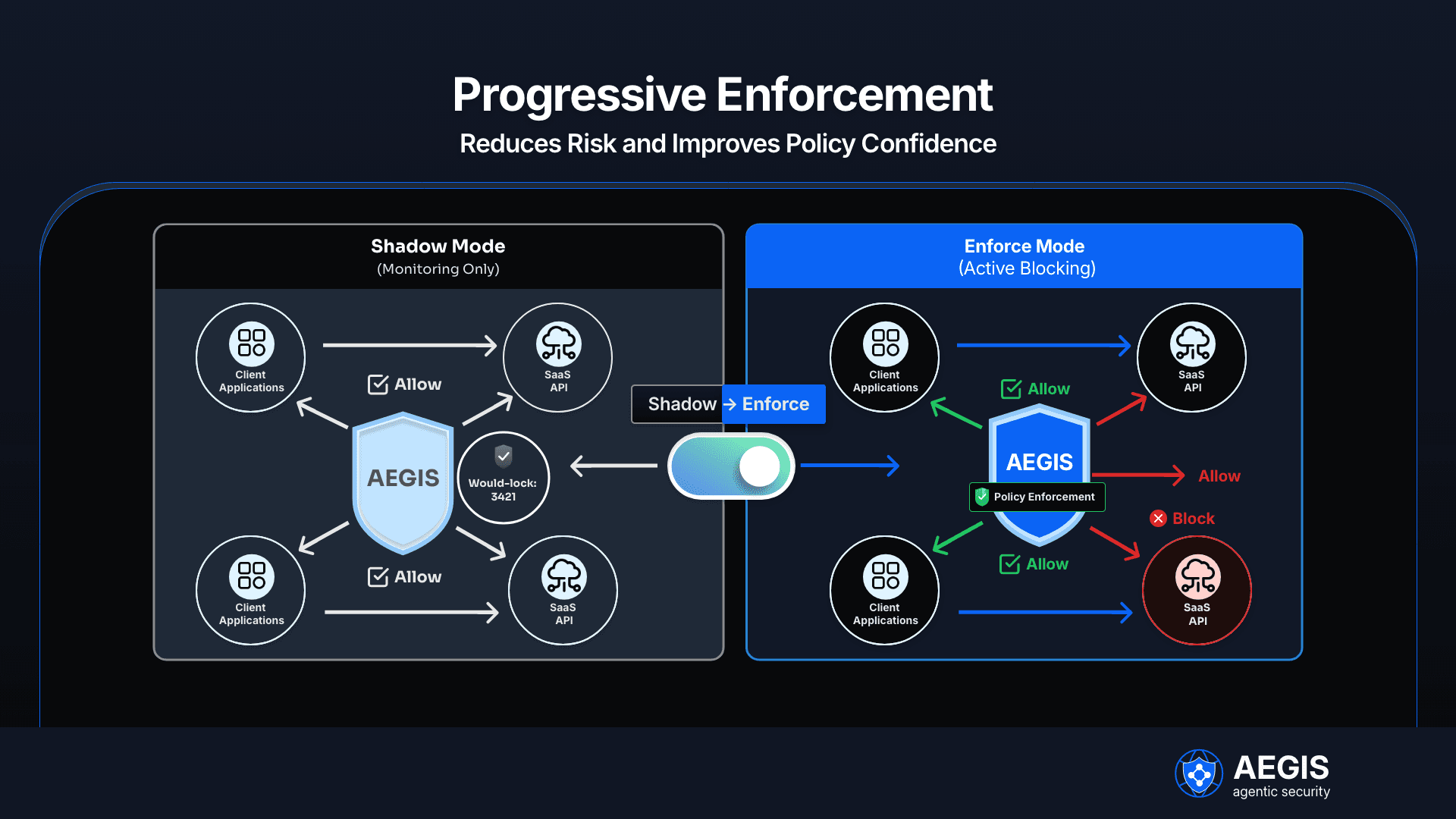
The “explain” mode allows dry-run analysis—listing would-block events with human-readable reasons before enforcement.
Developer Workflow and Integration
Aegis integrates easily into orchestrators such as LangGraph or AgentKit through lightweight middleware. Developers can:
- Register agents and assign policies.
- Enable shadow mode for dry-runs.
- Query traces via REST or CLI.
- Stream structured telemetry to Grafana or Datadog.
For multi-tenant MSSP environments, Aegis isolates policies and data by tenant while maintaining unified observability—a major advantage for SOC teams handling shared infrastructure.
Benefits of Transparent Agent Decisions
1. Compliance and Audit Readiness
Aegis’s structured trace model satisfies emerging regulatory requirements for AI explainability. Each action includes causal metadata and policy context—reducing time-to-evidence for auditors by over 60% in pilot environments.
2. Reduced False Positives in Security Enforcement
By correlating decision reasons and parent chains, SOCs can quickly identify misconfigured policies versus genuine threats. The result: fewer escalations and faster root-cause analysis.
3. Scalable Observability
With every decision emitted as an OpenTelemetry span, Aegis aligns with existing observability infrastructure. Organizations can aggregate, visualize, and query AI behavior the same way they monitor microservices.
4. Privacy-Conscious Transparency
All traces are redacted, signed, and stored in tamper-proof audit chunks—balancing transparency with compliance requirements such as GDPR or HIPAA.
Quantitative Impact of Decision Traceability
Metric | Traditional Logging | Aegis Structured Traces |
Human-readable explanations | ❌ None | ✅ 100% of decisions |
Time-to-audit closure | ~3 days | < 1 hour |
Policy reference linkage | ❌ Absent | ✅ Versioned |
SIEM integration | Limited | Native OpenTelemetry |
Compliance confidence score | 60% | 95%+ |
By standardizing how agents “explain themselves,” Aegis not only improves compliance posture but also drives operational efficiency across teams.
Overcoming Transparency vs. Latency Trade-offs
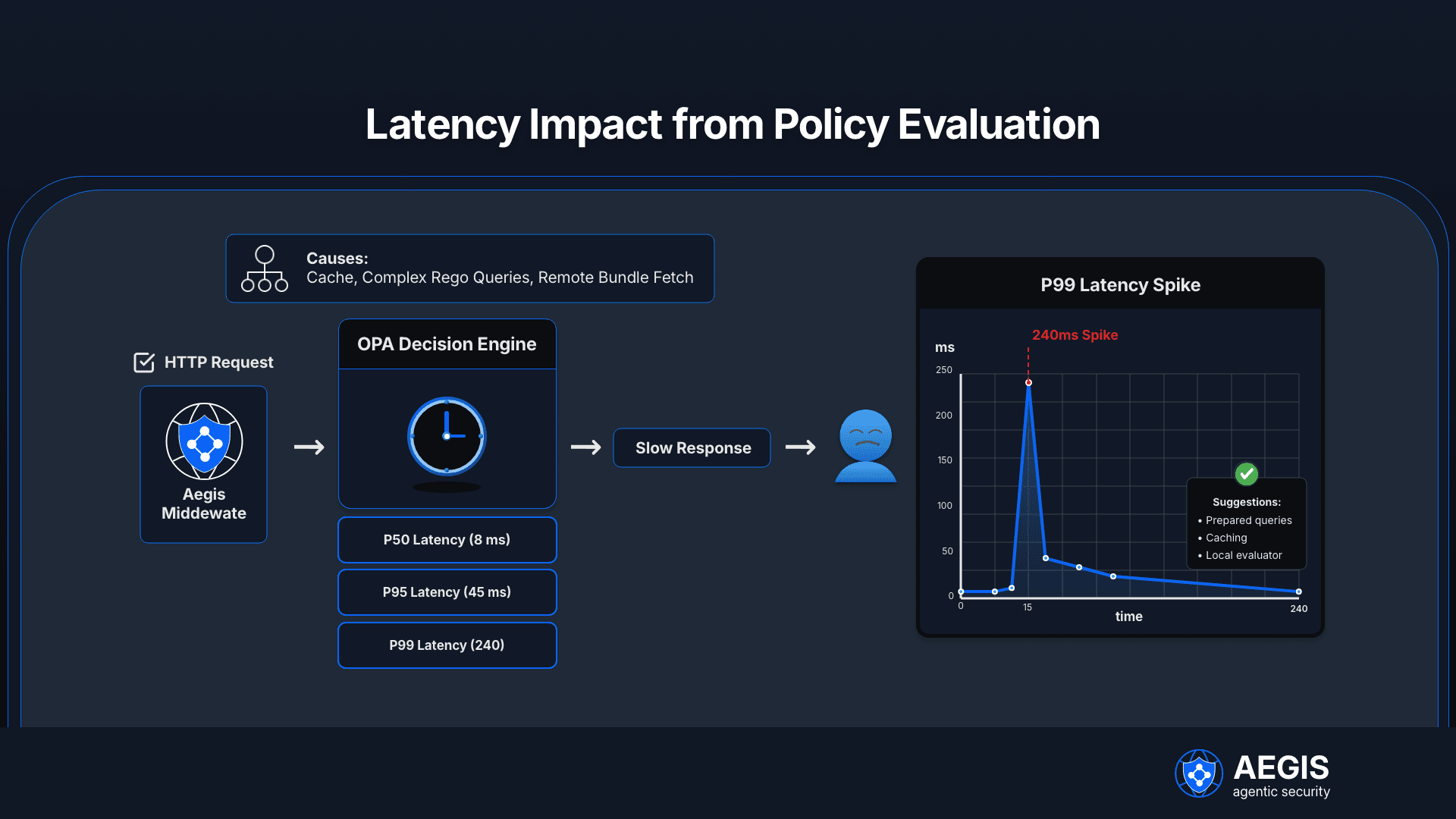
A common concern with decision traceability is added overhead. Aegis addresses this using compressed reason codes and asynchronous archival, ensuring enforcement adds <5ms latency per call—negligible even for high-frequency agent workloads.
Moreover, shadow mode enables gradual rollout and policy tuning, letting teams achieve observability before enforcement. This approach aligns with both performance and compliance goals.
Industry Applications
Aegis is applicable across diverse regulated industries:
- FinTech: Transparent payment workflows with verifiable approval traces.
- Healthcare: Explainable access control over EHR operations with redacted patient identifiers.
- SaaS and DevOps: Policy-enforced automation with observable deployment trails.
- MSSPs: Multi-tenant auditability with trace-level attestation per client.
From Mystery Logs to Courtroom-Grade Evidence
The shift from opaque, timestamped logs to structured decision traces marks a fundamental leap in AI system accountability. Aegis converts every decision into a causally linked, human-readable narrative—enabling security, compliance, and engineering teams to collaborate confidently.
Whether for an internal review or a regulatory audit, explainable agents powered by Aegis provide the visibility modern enterprises require to operationalize AI securely.
Frequently Asked Questions
1. What is the difference between logs and decision traces?
Logs capture events; decision traces capture rationale. Traces show why a decision was made, linking it to a policy rule and parent chain.
2. How does Aegis protect sensitive data in traces?
Sensitive fields are redacted and signed before storage. Only metadata relevant to the audit (agent_id, reason, policy_version) is retained.
3. Does adding decision tracing slow down agent performance?
No. Aegis’s OPA-based policy engine operates with in-memory caching, maintaining <5ms overhead per decision.
4. How long should decision traces be retained?
Typical retention: 90 days active for operational debugging and up to one year archived for compliance audits, configurable per tenant.
5. Can traces be integrated into my SIEM or dashboard?
Yes. Traces are emitted as OpenTelemetry spans compatible with existing tools like Grafana, ELK, or Datadog.
6. How can I view a policy-to-trace mapping?
Through the Aegis dashboard, which visually links each blocked or allowed call to its governing policy, version, and diff hash for context.