Overcoming Integration Debt in Agentic Implementations
Practical playbook to remove integration debt in agentic systems: policy-as-code, gateway patterns, telemetry, and an Aegis migration roadmap.
Overcoming Integration Debt in Agentic Implementations
Integration debt—the brittle mass of duplicated connectors, hidden assumptions, and unversioned glue code—becomes an operational showstopper as agentic systems move from prototypes to production. This article gives security and engineering teams a practical playbook for inventorying, consolidating, and preventing integration debt in multi-agent deployments, and explains how a centralized enforcement fabric like Aegis reduces repetition, enforces least privilege, and produces auditable telemetry.
Why integration debt matters for agentic systems
Agentic architectures accelerate experiments: teams spin up orchestrators and agents that call external services (payments, file stores, HR APIs). Rapid iteration produces many small, fragile connectors and ad-hoc auth hacks. That “glue” is cheap short-term but creates:
- Duplication: multiple connectors to the same upstream with different auth/assumptions.
- Hidden assumptions: schema expectations baked into agent prompts or handlers.
- Lack of tests & versioning: no contract CI, so breaking changes surface in prod.
- Observability blind spots: no single trace of which agent initiated which call.
Academic research and field reports show AI systems bring new forms of technical debt—design, data, and integration debt—that standard SDLC practices often miss. Recent arXiv work categorizes emerging AI technical-debt classes and highlights the need for new governance patterns. (arXiv)
Gartner and industry reporting also warn that many agentic projects will fail or be scrapped unless governance, cost control, and integration disciplines are applied. (Reuters)
👉🏻 Design systems that grow with your agent workloads
A practical lifecycle going from inventory to enforced gateway
Follow a phased, low-risk migration path—pilot → expand → enforce. The high level steps:
- Define integration debt signals (duplication count, undocumented connectors, missing tests).
- Inventory connectors and rank by risk/usage.
- Create a shared connector library + SDK wrappers.
- Introduce a gateway / policy fabric to absorb auth and policy logic.
- Migrate glue logic into sidecars or filters and adopt policy-as-code.
- Roll out in shadow mode, add telemetry, then flip enforcement.
Inventory & prioritization (quick wins)
- Run a lightweight scan: list all agents, endpoints called, and maintainers.
- Rank by risk: payment connectors, data exports (PII/PHI), and third-party writes first.
- Target connectors with multiple homegrown variants—consolidation yields fast ROI.
.png&w=3840&q=75)
Table 1 — Example connector risk inventory (sample)
Connector | # of unique connectors | Risk category | Priority |
Stripe / Payments | 3 | High (finance) | P0 |
SharePoint / Document store | 2 | Medium (PII leakage) | P1 |
HR API export | 1 | High (policy mismatch) | P0 |
Internal feature flagger | 4 | Low | P2 |
Gateway & policy fabric: core concepts
The gateway pattern centralizes identity, policy, and telemetry at the agent↔tool boundary. It offers:
- Single-point policy evaluation (allow/deny/sanitize/approval_needed).
- Token minting and short-lived agent identities.
- Contract validation and schema guards.
- Unified telemetry (OpenTelemetry spans, structured logs) for SIEM and FinOps.
Open Policy Agent (OPA) and similar engines are proven to handle policy-as-code workloads when prepared queries, caching and bundle hot-reload are used to meet low-latency targets. OPA docs and Envoy integration guides offer performance best practices that are directly applicable for runtime policy evaluation. (Open Policy Agent)
👉🏻 Choose the right architecture for flexibility and performance
OpenTelemetry is the de facto integration path for trace + metric shipping; adoption data shows broad momentum in observability platform integration—use it to tie policy decisions back into dashboards and cost reports. (coresite.com)
Introducing Aegis: the runtime policy & observability fabric
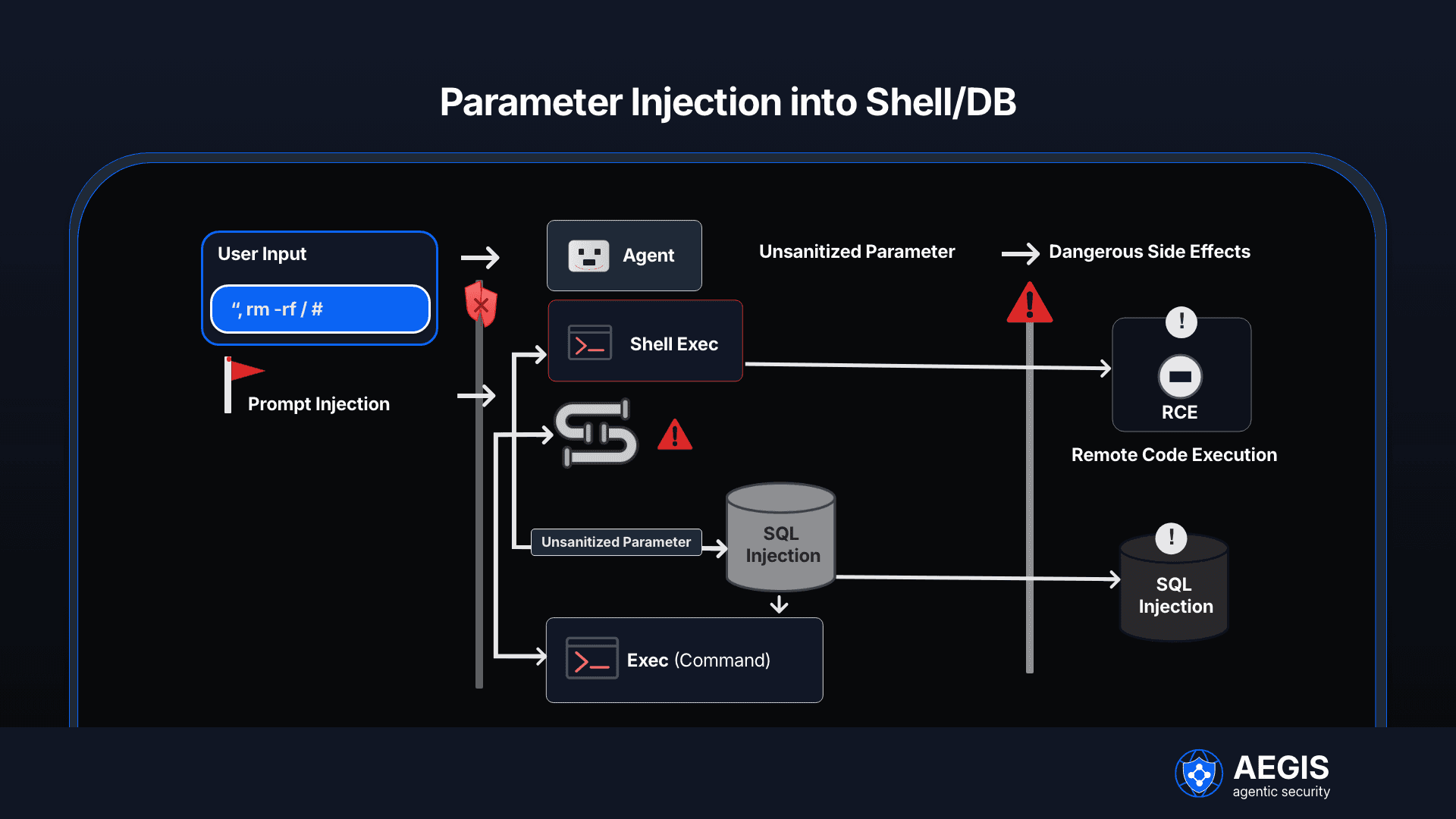
Aegis functions as a runtime policy and enforcement fabric for multi-agent systems, acting as “Istio + OPA for agents”: a lightweight gateway that enforces per-agent permissions, inspects parameters, and emits auditable traces. The Aegis Gateway sits between orchestrators (AgentKit / LangGraph / custom orchestrators) and external tools, operating as a sidecar or forward proxy to intercept all tool calls.
👉🏻 Leverage cloud ecosystems to scale and manage agent workloads
Key Aegis capabilities
- Identity & tokens: short-lived JWTs that carry tenant, agent and scope claims. Tokens are minted per agent and rotated; Aegis treats agents as first-class service accounts.
- Policy-as-code: engineers write YAML/JSON policies that Aegis compiles into OPA bundles. Policies express allowed tools, permitted actions, parameter conditions (ranges, regex), thresholds and approval rules. Changes are versioned and hot-reloadable.
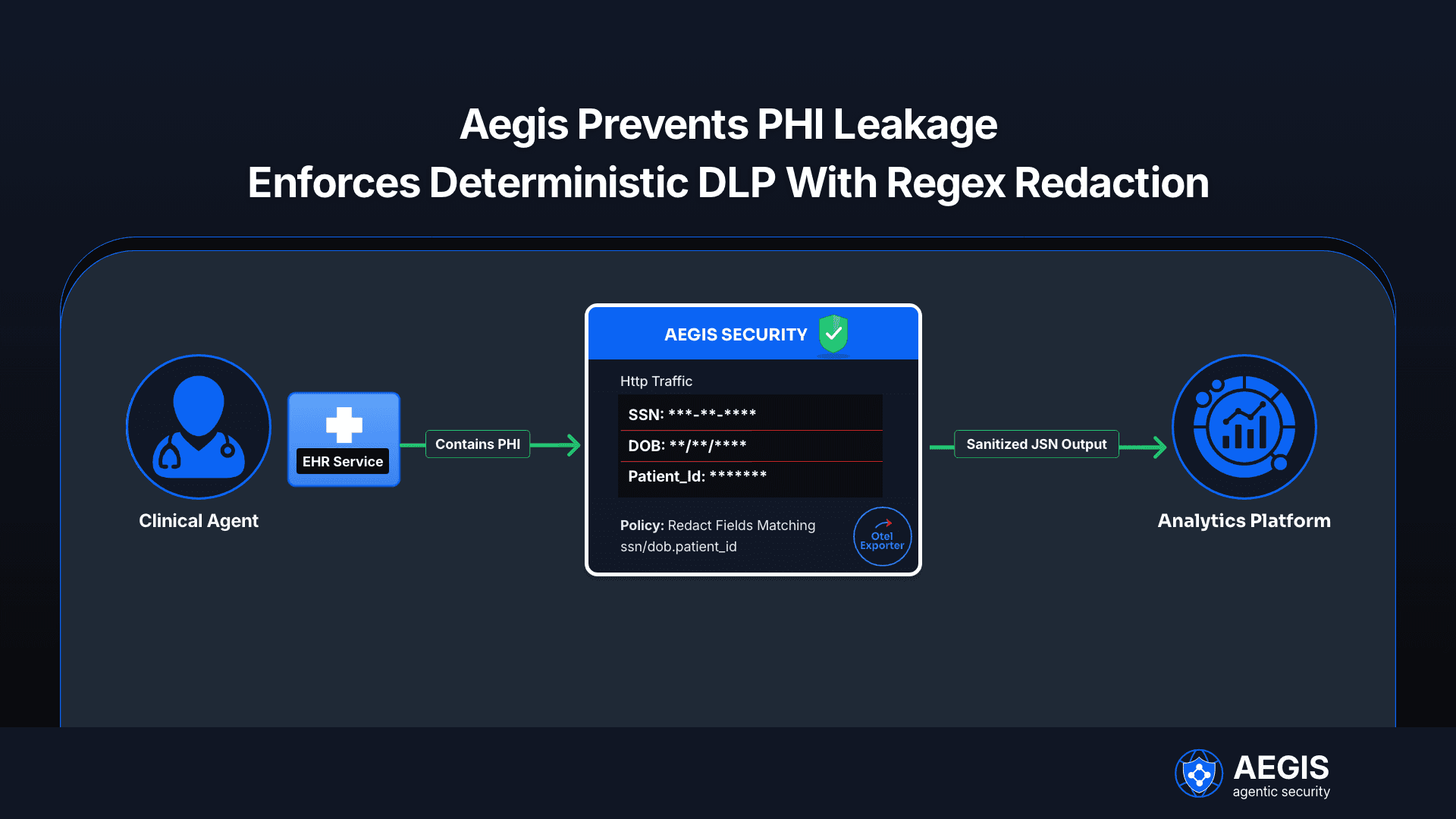
- Runtime enforcement & DLP: each request is evaluated with agent_id, tool_id, parameters and chain context. Decisions are allow/deny/sanitize/approval_needed; deterministic regex redaction is applied where configured.
- Shadow mode: Aegis can run in observation-only mode to collect would-block metrics before enforcement. This enables safe policy tuning and reduces surprise outages.
- Telemetry & audit: OpenTelemetry spans and structured logs include policy_version, decision_reason, and estimated cost to support compliance and FinOps. Dashboards show blocked rates, top agents, and budget burn.
Operational patterns with Aegis
- Gateway absorbs auth & schema checks so devs no longer duplicate connector auth in agent code.
- Policy dry-run → shadow → enforce lets teams iterate with confidence.
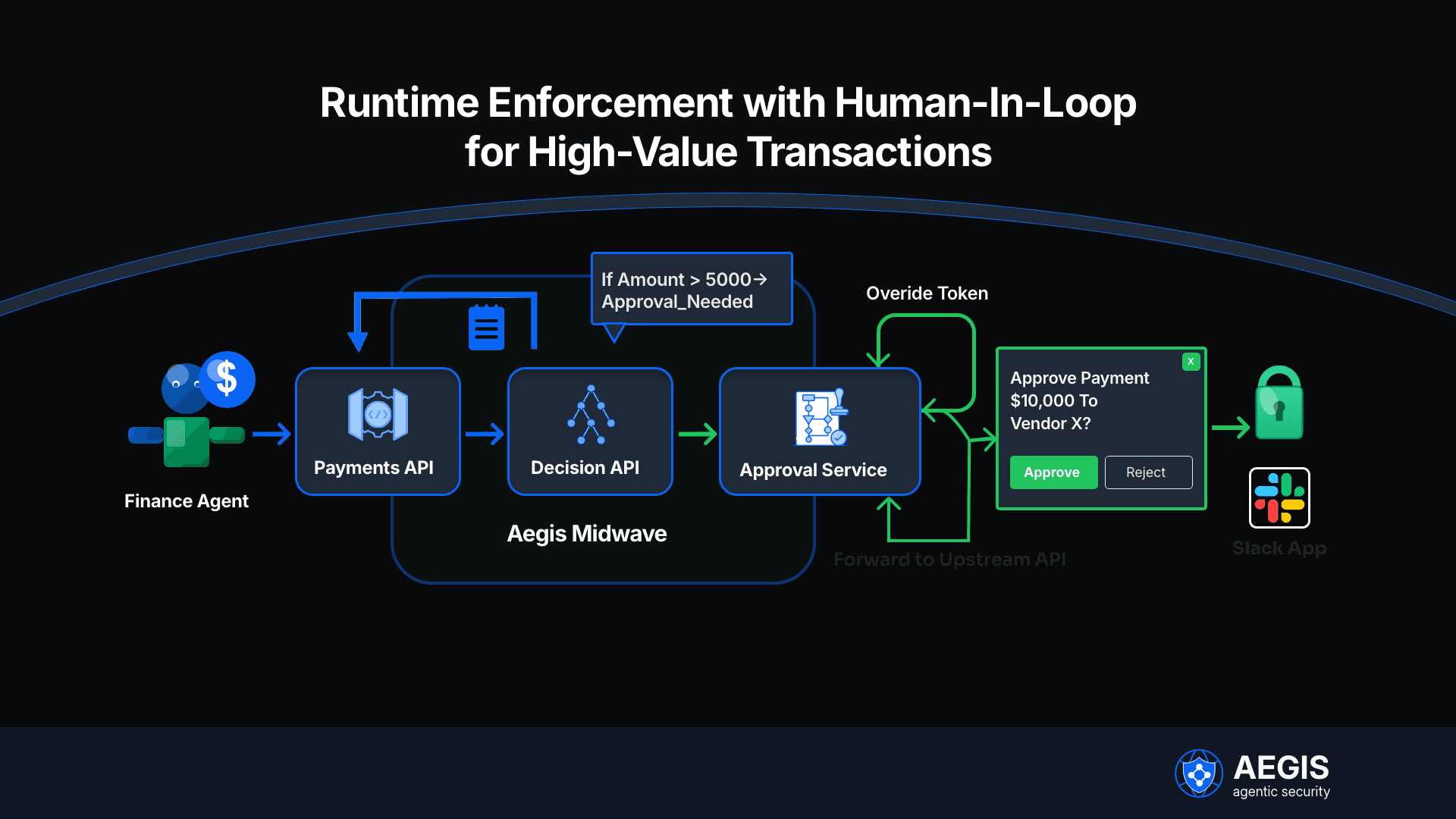
- Approval workflows integrate with Slack/MS Teams for human-in-loop authorization on high-risk actions.
- Per-agent budgets and rate limits prevent runaway spend and generate FinOps signals.
Example: preventing duplicate DLP logic
Two teams built SharePoint connectors; one allowed exports. Aegis centralizes policy that restricts export actions for non-compliant agents, sanitizes payloads when needed, and records a single, auditable decision trail—removing the need for two separate DLP implementations and eliminating conflicting behavior.
Table 2 — Aegis vs legacy glue approaches
Dimension | Legacy glue | Aegis Gateway |
Connector duplication | Multiple variants, inconsistent auth | Single gateway, SDK wrappers |
Policy location | In agent code (ad-hoc) | Policy-as-code, versioned bundles |
Observability | Sparse, per-agent | OpenTelemetry spans, SIEM-ready |
Approvals | Manual, ad-hoc | Integrated approval workflow |
Cost control | None | Per-agent budgets & quotas |
Implementation checklist (engineering playbook)
- Create an inventory and assign connector owners.
- Build a shared connector library + SDK (Python/Node).
- Deploy Aegis in sidecar mode for a pilot tenant (target 60–80% of critical connectors behind gateway).
- Author policies: start conservative; run shadow mode for 7–14 days.
- Add contract CI: contract tests between agent and connector with schema validation.
- Migrate glue into filters/sidecars; deprecate legacy connectors after a shadow rollout.
- Add telemetry: OpenTelemetry spans, dashboards, and alerts for policy drift.
Practical metrics to track
- Duplicate connector count (goal: reduce by 80% in pilot).
- Time-to-fix for connector breakage.
- Policy violation rate (would-block vs actual blocks).
- % of agent→tool calls traced.
Risk controls & operational safeguards
- Shadow mode and policy dry-run prevent accidental production outages.
- Versioned policy bundles + rollback for emergency remediation.
- Fail-closed for writes by default; configurable fail-open for read-only flows.
- Approvals service with rate limiting and override tokens to avoid approval fatigue.
Roadmap & timeline (6–10 weeks pilot)
Week 0: Inventory & pilot definition.
Weeks 1–2: Deploy gateway sidecar, register first agents, author initial policies.
Weeks 3–4: Shadow rollout, collect would-deny metrics, refine policies.
Weeks 5–6: Enforce critical paths, add budget controls and contract CI.
Weeks 7–10: Expand to more connectors, enforce, and retire legacy code.
Links & further reading
- Technical references: OPA policy performance and Envoy integration guidance. (Open Policy Agent)
- Academic background on technical debt in AI systems (arXiv). (arXiv)
Frequently Asked Questions
Q: How do I measure integration debt?
A: Track duplicate connector counts, undocumented connectors, missing contract tests, and number of connectors bypassing centralized gateway. Use a short audit script to enumerate agents and endpoints.
Q: Is running Aegis going to add latency?
A: Properly tuned OPA prepared queries, caches and in-process evaluation keep P99 decision latency low; aim for <20 ms decision path and measure end-to-end proxy overhead. (Open Policy Agent)
Q: How do I avoid approval overload?
A: Use policy thresholds, per-agent budgets and rate limits; route low-risk approvals to automated queues and throttle notifications.
Q: Can Aegis help with FinOps?
A: Yes—per-agent budgets, request quotas and telemetry permit cost attribution and automated throttling when budgets are exhausted.
Q: What’s a safe rollout strategy?
A: Shadow mode for 7–14 days, tune regex/parameter conditions, then promote to enforcement. Keep rollback and emergency policy versions ready.
Q: Which connectors should be consolidated first?
A: Prioritize payment processors, HR/export paths and any connector with multiple homegrown variants.