
Navigating Cross-Border Data Transfers in Agentic Workflows
How to enforce data-residency, egress and approvals for multi-agent AI at runtime using policy, tokens and observability.
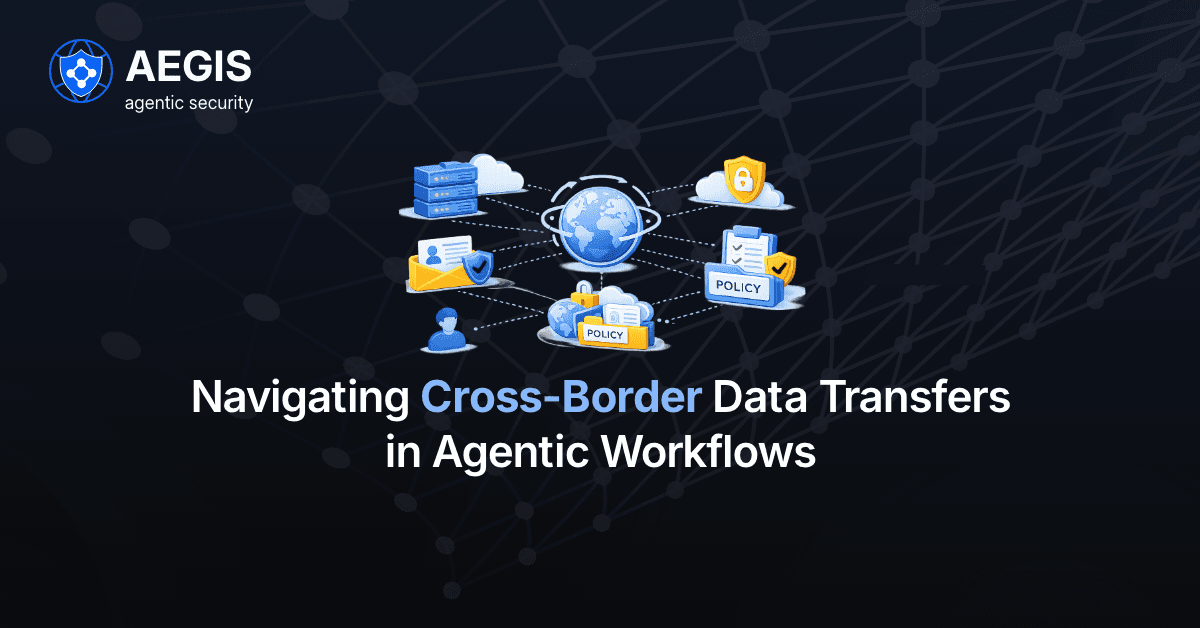
Navigating Cross-Border Data Transfers in Agentic Workflows
Agentic AI workflows — orchestrations of autonomous agents calling services, tools and third-party APIs — expose a new surface for cross-border data movement. Regulations (Schrems II and successor guidance), enterprise risk controls and operational needs force security teams to answer a simple question: how do we stop sensitive data from flowing to the wrong country at runtime? This article maps the regulatory landscape, describes concrete technical controls and gives a compliance playbook — showing how Aegis (Aegissecurity) enables policy-driven, auditable residency enforcement for multi-tenant agent ecosystems.
The regulatory landscape for cross-border data and agents
Since the CJEU’s Schrems II judgment organisations must assess adequacy or implement additional safeguards for transfers outside the EEA. Supervisory guidance emphasizes case-by-case assessments and technical/contractual supplementary measures to preserve GDPR protections when data flows cross borders. Practical guidance from regulators now places technical enforcement (routing, encryption, DLP) alongside contractual mechanisms. (IAPP)
At the same time, enterprise adoption of agentic AI accelerated in 2024–25: recent surveys report broad enterprise interest and explicit concerns about privacy and security in agentic deployments — for example, over 65% of respondents request stronger data privacy/security features for agents. Simultaneously, analyst coverage warns that many agentic projects will fail without robust governance. These trends make residency controls a compliance and business-continuity priority. (Cloudera)
Technical controls for runtime residency enforcement
Runtime residency enforcement must be automated, low-latency and auditable. The technical pattern combines identity, tokens, an egress proxy, data labeling/DLP, and policy logic.
Token claims, proxies, DLP
Token service: issue short-lived, signed tokens that embed organisation, tenant, agent id and a region claim (for example region=eu-west-1) so downstream policy decision points know residency intent.
Egress proxy / routing: the proxy enforces an allowlist of endpoints per-tenant and per-region. Requests intended for EU tenants are routed to EU-hosted endpoints or blocked. Proxies can re-originate requests (mutual TLS, rotated certs) to guarantee location of egress. Aegis implements this as an Envoy forward proxy with ext_authz hooks and a token service that mints region-scoped JWTs.
DLP and data labeling: classify payloads at the source (agent middleware) and tag PII/PHI before any outbound call. Deterministic redaction (regex for SSNs, hashes for identifiers) or parameter-level sanitization prevents sensitive fields from leaving locale. Policies reference these labels to make allow/deny decisions.
Policy engine: policy-as-code (YAML → OPA bundles) expresses residency rules, egress allowlists, and approval requirements. Policies run in the authorisation server (prepared queries, cache) to meet P99 latency targets under 20 ms. Shadow mode enables tuning without disruption.
👉🏻 Bring structure and control to how your agents handle data
Example control matrix
Control layer | What it enforces | Typical implementation |
Identity & Tokens | Region claim + tenant binding | Short-lived signed JWTs (region, tenant, agent) |
Proxy & Routing | Outbound endpoint location | Envoy forward proxy with egress allowlist |
DLP / Labeling | Field-level protection | Deterministic regex redaction, schema labeling |
Policy engine | Residency + approvals | OPA bundles, policy-as-code, shadow mode |
Observability | Audit proof & traces | OpenTelemetry spans, structured logs |
Case studies and compliance playbook
This section walks through three operational examples and a rollout checklist for SOC, legal and engineering teams.
Use cases
- Healthcare: a clinical agent attempts to export patient records. Policy: deny any export call where tenant.region != request.destination.region and payload label includes PHI. Outcome: block and emit signed trace for auditor. Aegis supports deterministic redaction and approval interrupts for exceptional transfers.
- Retail payments: a payments agent must call country-specific PSP endpoints. Policy: route payment calls to psp.{country}.payments.example only; block cross-country PSP calls to reduce fraud and meet local rules.
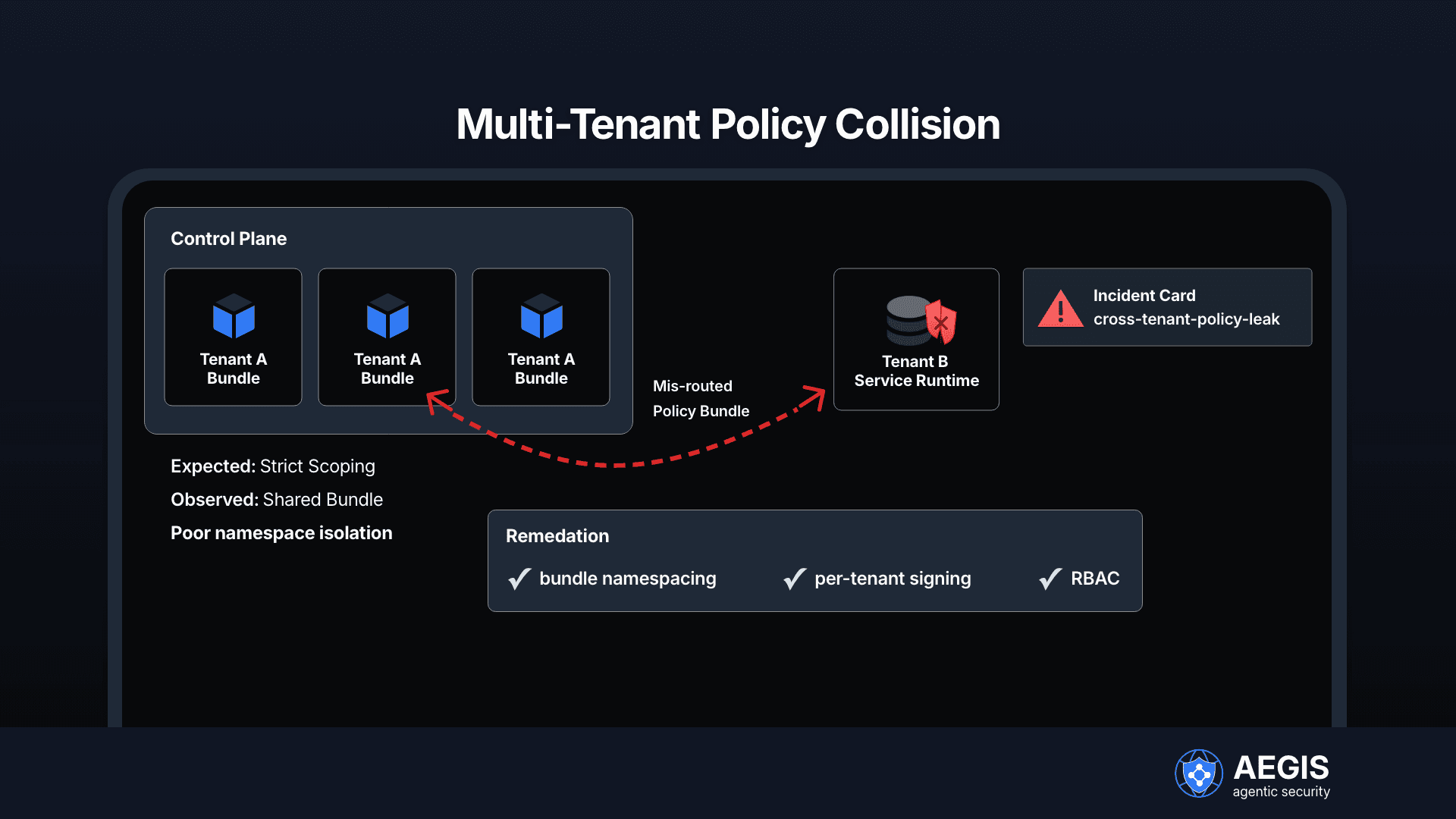
- MSSP multi-tenant enforcement: tenant-scoped bundles ensure each tenant’s residency policy is evaluated independently on the shared control plane; audit logs include tenant id, policy version and decision reason for regulatory review.
-1.png&w=3840&q=75)
Measurement and KPIs (table)
KPI | Why it matters | Target |
% cross-border attempts blocked | Measures enforcement effectiveness | > 95% for high-risk labels |
Time-to-remediate policy misconfigs | Ops responsiveness | < 2 hours SLA for critical blockers |
Override tokens issued | Shows residual human interventions | Low, with trend toward 0 after tuning |
Audit completeness (fields logged) | Evidence for regulators | 100%: agent_id, resource, policy_version, reason |
Implementing with Aegis
At least one-third of operational design must describe the solution. Aegis is a runtime policy and observability gateway that implements the patterns above as an integrated product: policy-as-code, token issuance with region claims, an egress proxy, deterministic DLP, approvals workflows and fully structured telemetry.
👉🏻 Reduce compliance risk with proactive privacy evaluations
How Aegis enforces residency at runtime
- Agent registration: agents are registered per tenant and assigned region tags (e.g., eu, us). Aegis tokens encode those tags and short lifetimes to limit replay risk.
- Policy bundling & decision flow: policies authored in YAML compile into OPA bundles. At each outbound call the Envoy sidecar or middleware invokes the Aegis decision API. The authoriser evaluates agent id, destination, payload labels and policy version, then returns allow/deny/sanitize/approval_needed. Decisions are signed and returned with an attestation if needed.
- Egress enforcement & routing: if the decision is allow, the proxy either re-originate the call via a region-bound connector or forward with a re-written endpoint to guarantee residency. If the decision is deny, the call is blocked and a standardized PolicyViolation response is returned to the orchestrator.
- Approvals and override tokens: for legitimate cross-border exceptions, Aegis posts an approval request to Slack/Teams; on human approval it issues a one-time override token that includes the approval id and policy version. This creates a tamper-evident trail for auditors.
Integrations and operational patterns
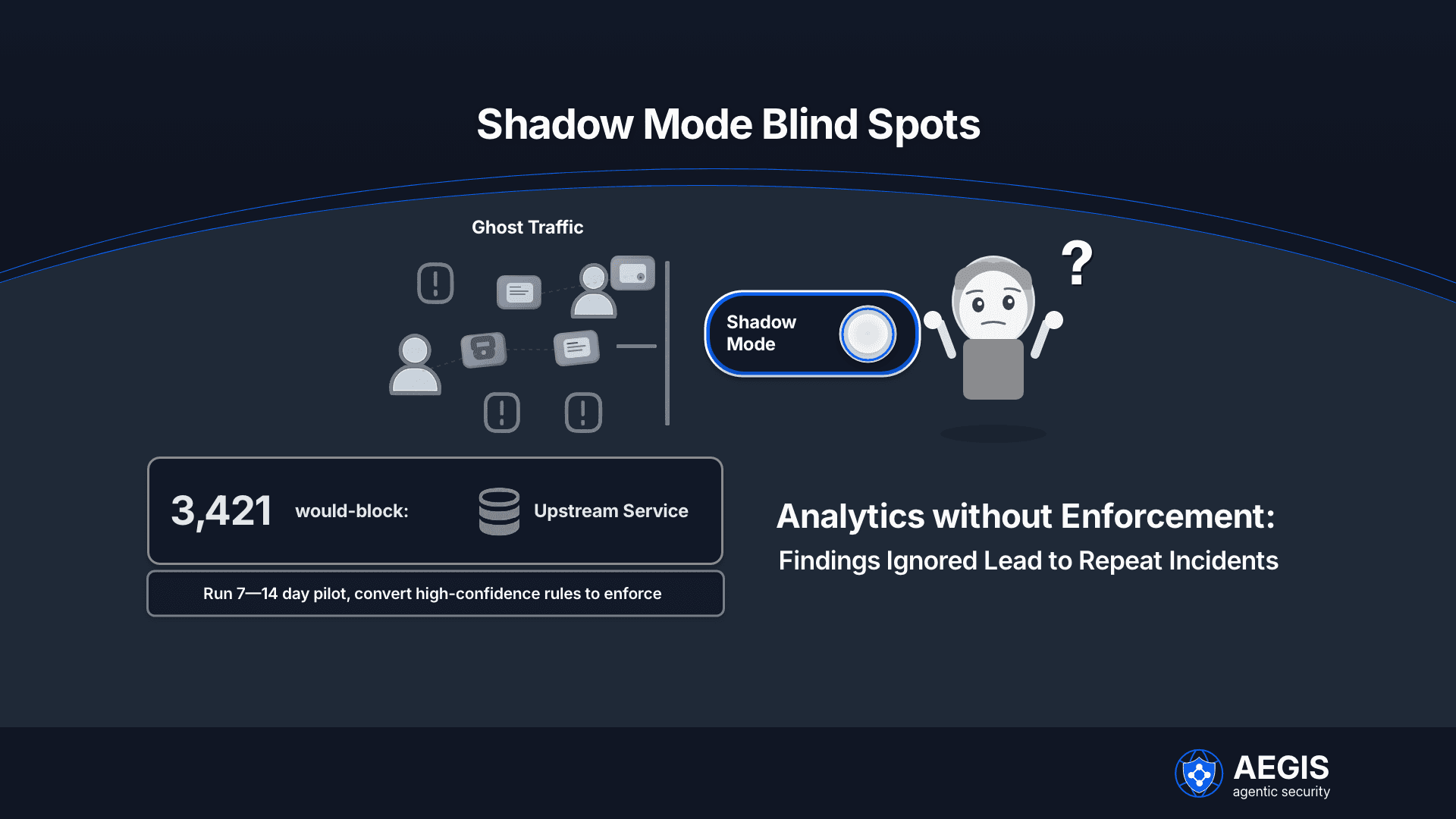
- Dry-run / shadow mode: run policies in shadow to collect “would-block” metrics, then iterate. This reduces accidental outages from misconfiguration.
- Fail-closed for writes: default writes fail closed; reads may be configurable fail-open with warnings.
- Cached allowlists: for low-risk reads, maintain cached allowlists to reduce latency for remote enforcement.
Deployment checklist
- Inventory critical connectors (start with Stripe / SharePoint).
- Define tenant region tags and mapping to legal agreements.
- Implement data classification at source and tag sensitive fields.
- Deploy Aegis sidecars with shadow mode for 7–14 days.
- Tune policies, measure KPIs, flip enforcement on for critical flows.
- Integrate approvals and legal sign-offs; maintain policy versioning and signed audits.
Design trade-offs and risks
Network latency and cloud provider limits can impede routing to remote regions — mitigate with cached allowlists and selective fail-open policies for non-sensitive reads. Misconfigured policies can block business flows; shadow mode and schema validation reduce that risk. Aegis provides dry-run simulations and sample policies (Stripe, SharePoint) to accelerate safe rollout.
👉🏻 Accelerate compliant submissions with intelligent automation
Frequently Asked Questions
Q: How does Aegis prove where data actually egressed?
A: Aegis re-originates or proxies outbound calls through region-bound connectors and emits signed OpenTelemetry spans that include the egress host, timestamp, policy_version and decision_reason — forming tamper-evident proof for auditors.
Q: What if a policy is too strict and blocks production flows?
A: Use shadow/dry-run mode, validate policies against schema, and apply gradual rollout (pilot connectors first). Aegis supports version rollback and simulation to avoid outages.
Q: Can Aegis handle multi-tenant MSSP deployments?
A: Yes — Aegis scopes bundles per tenant, enforces tenant-level residency rules on a shared control plane and emits tenant-scoped, SIEM-ready logs for SOC reviews.
Q: How do approvals integrate with legal workflows?
A: Approval templates map to internal data transfer agreements; approval requests include policy references and create auditable override tokens for traceability. Legal can run dry-run simulations via the governance UI.
Q: Are there sample policies to speed adoption?
A: Aegis ships sample policies and cookbooks for common connectors (Stripe, SharePoint) and recommends piloting those before broad rollout.
Closing notes and further reading
Cross-border residency enforcement is now a runtime engineering problem as much as a legal one: success requires identity binding, field-level classification, policy-as-code and signed telemetry. Aegis implements these patterns in a deployable gateway that fits modern agentic architectures and addresses auditability, approvals and multi-tenant governance.
Selected sources and regulator guidance consulted: EDPB transfer guidance and Schrems II analysis, Cloudera AI agents survey, and industry analysis on agentic AI adoption and risks. (European Data Protection Board)