Agents for Regulatory Submissions in Pharma and Healthcare
Explore how agentic AI automates pharma regulatory submissions and how Aegis enforces compliance, provenance, and secure agent workflows.
Agents for Regulatory Submissions in Pharma and Healthcare
Pharmaceutical regulatory submissions are among the most documentation-intensive processes in any industry. Every submission to the FDA, EMA, or MHRA—whether an Investigational New Drug (IND) or New Drug Application (NDA)—requires meticulous evidence collation, traceability, and version control. Traditionally, this process consumes thousands of human hours: scientists and regulatory specialists manually collect lab data, verify spreadsheet results, format eCTD sections, and route drafts for review.
Agentic AI is now transforming this process. Intelligent agents can extract data from lab information systems, assemble submission components, validate content, and prepare final packages—reducing cycle time from months to weeks. Yet the automation brings its own risks. Each autonomous action must be verifiable, authorized, and compliant. Unauthorized submissions, missing attestations, or unredacted patient data can lead to regulatory delays and penalties.
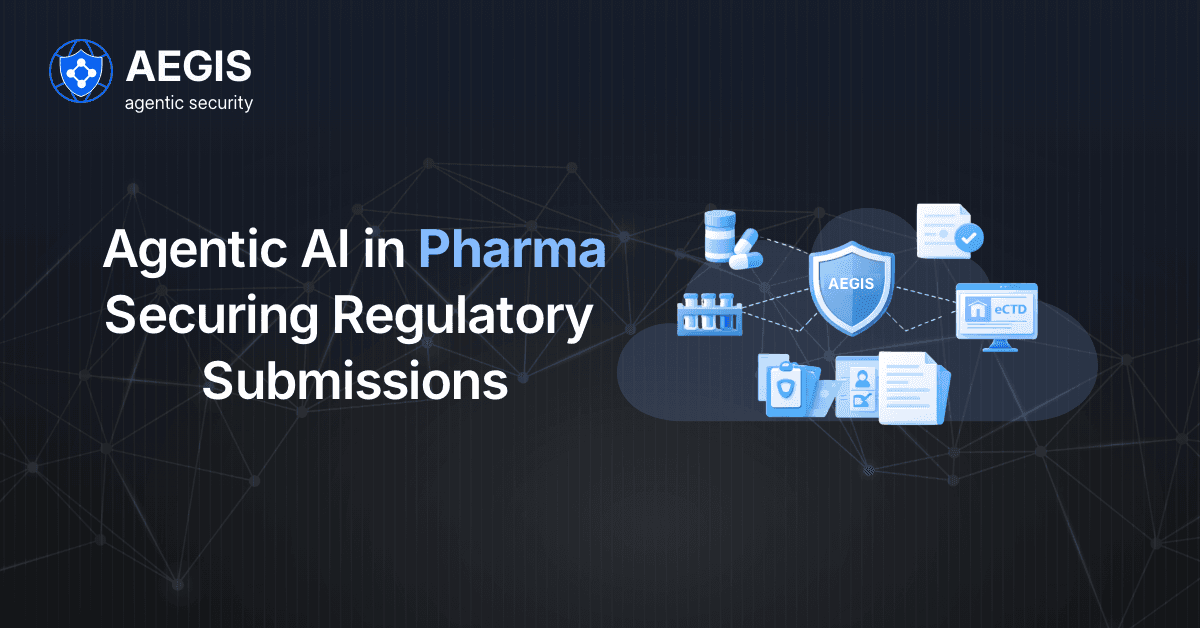
This article examines how pharma regulatory agents automate submission assembly and how Aegis, Aegissecurity agentic security mesh, ensures provenance, policy enforcement, and auditability across every automated step.
-1.png&w=3840&q=75)
The Challenge: Automating Regulatory Submissions Without Losing Control
1. Complexity and Risk in Regulatory Submissions
A single NDA may contain over 100,000 pages of evidence and data. Each dataset—from pharmacokinetics to clinical trial outcomes—must pass version checks and validation gates. Manual workflows are error-prone, and even a single misfiled dataset can derail approval.
Traditional tools such as document management systems and manual checklists cannot keep pace with AI-driven automation. Agentic AI orchestrators like LangGraph and AgentKit can now manage the entire submission lifecycle—but without centralized security and compliance oversight, the risks multiply:
- Data provenance gaps: Automated agents may assemble outdated or unverified data.
- Unauthorized egress: Agents could attempt to email draft submissions outside approved networks.
- Inconsistent approvals: Missing sign-offs or misattributed attestations violate SOPs.
- Regulatory non-compliance: Incomplete audit trails or missing redactions breach FDA 21 CFR Part 11 and EMA Annex 11.
2. The New Workflow: Agentic Submission Assembly
A modern submission pipeline can be visualized as follows:
Each agent specializes in a discrete role:
Stage | Agent Role | Key Responsibilities | Aegis Enforcement |
Data extraction | Data-extractor agent | Pulls study results, formats tables | Verify schema and lineage |
Document assembly | Document-assembler | Generates CTD modules | Require verified data sources |
Compliance validation | Compliance-checker | Runs completeness and redaction checks | Validate against policy templates |
Submission orchestration | Submission-orchestrator | Packages and uploads eCTD | Enforce digital signatures and sign-off chains |
Enter Aegis: Security Mesh for Agentic Compliance
Aegis Gateway from Aegissecurity is a runtime policy and observability layer purpose-built for multi-agent AI systems. In the pharma and healthcare context, Aegis acts as a compliance firewall—governing what each agent may access, transform, or submit.
Aegis operates as a sidecar or proxy between AI agents and their tools (databases, submission APIs, file systems). Every call is evaluated in real time by a policy engine based on Open Policy Agent (OPA). The system enforces outcomes such as allow, deny, sanitize, or approval_needed, ensuring that autonomous workflows never bypass regulatory controls.
👉🏻 Ensure compliant and secure data transfers across global boundaries
1. Policy-as-Code for Regulatory Governance
Security teams write declarative YAML policies defining agent privileges and compliance gates. For example:
agent: submission-orchestrator
allowed_tools:
- name: regulator-portal
actions:
- upload_submission
conditions:
signed_by: ["PrincipalScientist", "QAOfficer"]
pii_redacted: true
Aegis compiles and enforces these rules in real time. This ensures that no automated submission can proceed without the required digital signatures and validations.
2. Tamper-Evident Audit Trails
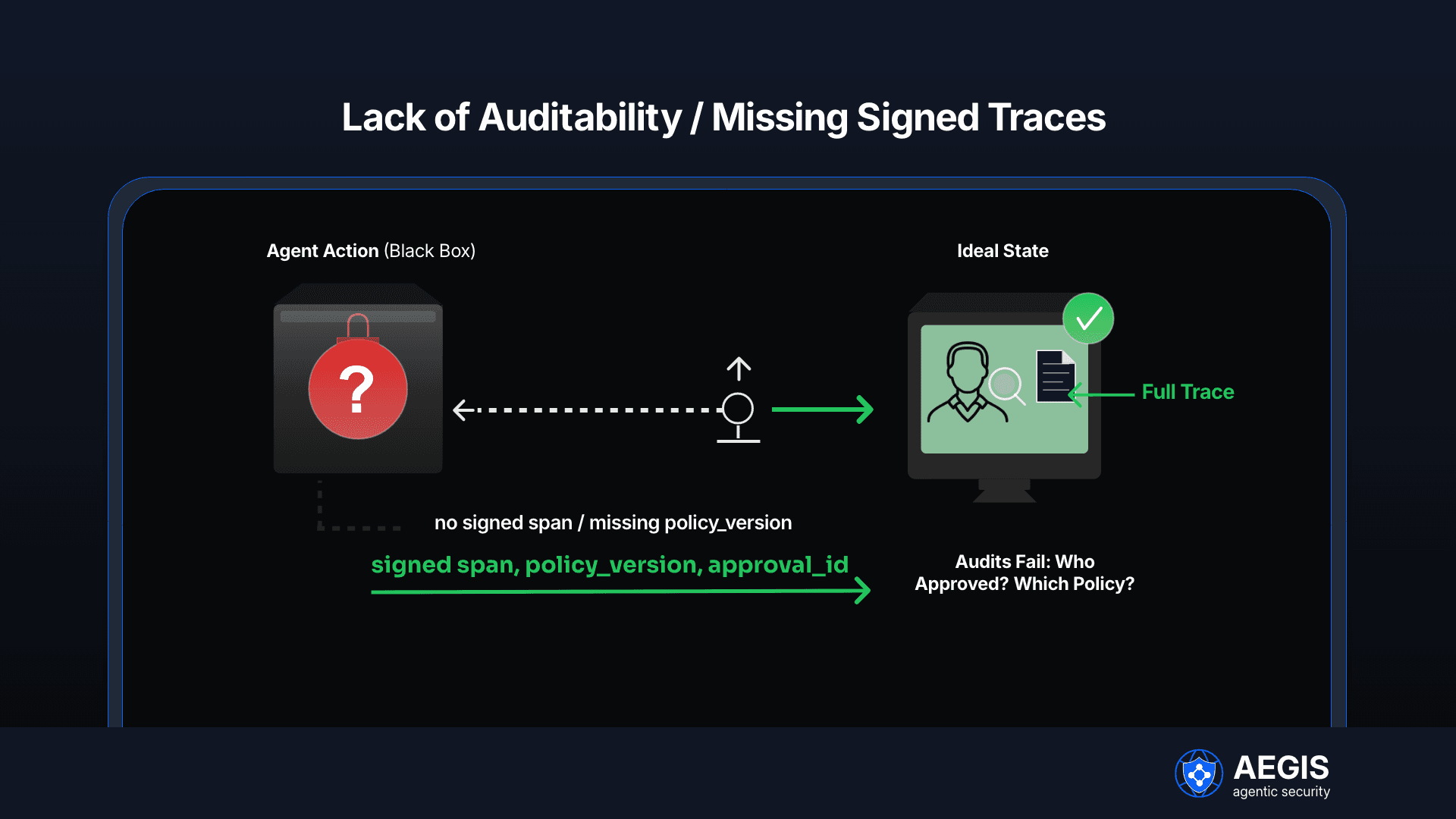
All Aegis decisions—approvals, rejections, sanitizations—are logged with cryptographic hashes and time stamps. The result: a provable chain of custody for every submission artifact. Regulatory auditors can verify not just what was submitted, but which agent prepared it, which policies were applied, and who approved each step.
3. Egress and Redaction Controls
Aegis enforces network allowlists so agents cannot email draft submissions or upload artifacts outside the approved regulator portal. Integrated deterministic DLP ensures all personally identifiable information (PII) is redacted before transmission—critical for GDPR and HIPAA compliance.
Regulatory Submission Automation in Practice
Use Case 1: IND/NDA Assembly
In a typical workflow:
- Data-extractor agent retrieves clinical trial outcomes and lab measurements.
- Assembler agent formats the data into CTD modules.
- Compliance agent validates content using Aegis policy templates.
- Aegis Gateway enforces signature checks before the submission-orchestrator uploads the package.
If any signature or validation is missing, Aegis automatically blocks the call and records the violation for review.
Metrics to Track:
Metric | Description | Improvement Target |
Submission prep time | Time from draft to submission | ↓ 60 % with automation |
Compliance issues caught pre-submit | Violations detected before upload | ≥ 95 % detection |
Audit trail completeness | % of artifacts with signed lineage | 100 % required |
This combination of agentic automation and runtime enforcement enables pharmaceutical teams to accelerate IND/NDA cycles while maintaining the rigorous traceability demanded by regulators.
👉🏻 Build privacy-first systems with structured impact assessments
Use Case 2: Pharmacovigilance Reporting
Pharmacovigilance agents can automatically collect adverse event data and prepare periodic safety reports (PSURs). Aegis enforces the following:
- Redact PHI before upload.
- Verify that each report includes required attestations.
- Block unauthorized destinations (e.g., personal email, public cloud storage).
- Such guardrails allow continuous safety monitoring without compromising patient privacy.
Inside Aegis: How the Enforcement Fabric Works
1. Data Plane – Runtime Enforcement
Aegis deploys as a forward proxy (Envoy) intercepting agent tool calls. For every request, it checks:
- Agent identity (JWT with tenant + role claims)
- Target endpoint (e.g., regulator-portal)
- Request parameters (metadata, attachments)
- Policy version in force
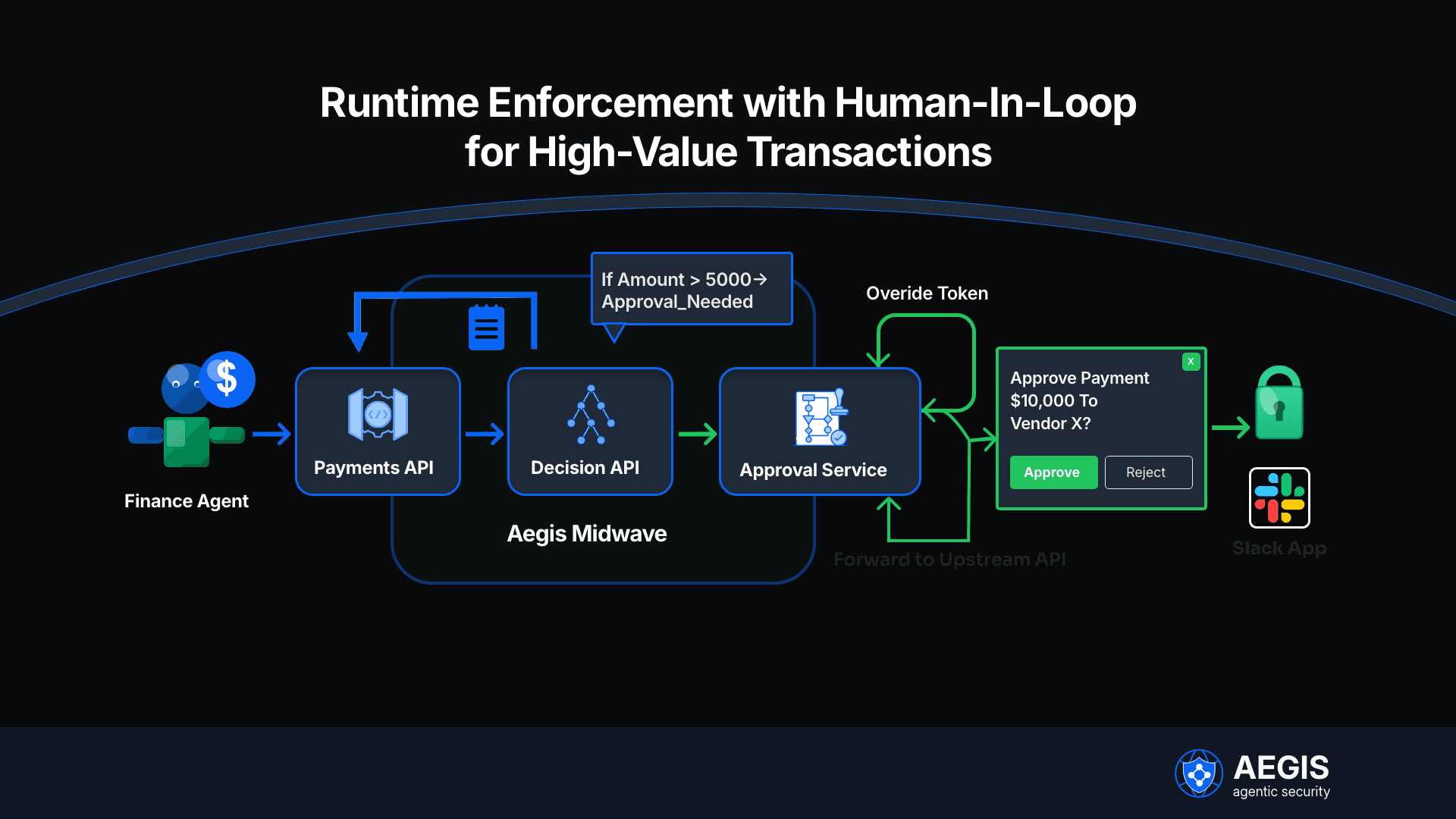
If a policy returns approval_needed, the call pauses and Aegis triggers an approval workflow in Slack or Microsoft Teams. Once approved, the client retries using a one-time override token.
2. Control Plane – Policy Management and Observability
Security and compliance teams use the Aegis Console API to:
- Register agents and assign roles
- Validate and publish policy versions
- View OpenTelemetry dashboards (latency, deny ratio, policy coverage)
- Export signed logs for SOC and QA review
This enables full visibility, governance, and non-repudiation across automated submission systems.
👉🏻 Keep sensitive data secure across every stage of your pipelines
Quantifying the Impact: Compliance and Efficiency Gains
The following table summarizes expected benefits based on pilot implementations:
Dimension | Traditional Process | With Aegis-Enabled Agents | Improvement |
Manual document collation | Weeks of spreadsheet merging | Automated extraction & assembly | 10× faster |
Compliance validation | Manual checklist review | Automated OPA-based policy enforcement | 95 % error reduction |
Audit readiness | Ad-hoc evidence gathering | Tamper-proof, time-stamped logs | Immediate |
PHI protection | Manual redaction | Deterministic DLP enforcement | Zero leaks detected |
Approval workflows | Email chains | Slack/Teams interactive approvals | 70 % faster turnaround |
These results align with broader AI adoption trends: over 50 % of enterprises cite security and compliance as top barriers to agentic AI deployment, emphasizing the need for built-in enforcement layers rather than ad-hoc safeguards.
Implementation Roadmap for Pharma Teams
- Pilot in a controlled sandbox: Start with non-production CTD sections or internal validation packets.
- Define policy templates: Encode sign-off, redaction, and egress rules for each submission type.
- Integrate Aegis SDKs: Use Python or Node middleware with your orchestration framework (LangGraph, AgentKit).
- Run in shadow mode: Observe would-deny events before enforcing.
- Gradually enforce policies: Begin with validation agents, then extend to submission-orchestrators.
- Enable audit exports: Store signed artifacts and telemetry for inspectors.
This staged approach minimizes disruption while quickly surfacing misconfigurations or latent compliance issues.
Broader Implications: Agentic AI Governance in Regulated Industries
While this article focuses on pharma, similar patterns apply to healthcare, insurance, and financial sectors. Anywhere autonomous agents handle regulated data, Aegis provides the necessary control plane for:
- Data lineage enforcement
- Runtime access control
- Egress monitoring
- Cost and budget governance
- Multi-tenant isolation
Such capabilities make Aegis not just a security tool but a governance backbone for safe and compliant agentic automation across industries.
.png&w=3840&q=75)
Frequently Asked Questions
1. How does Aegis differ from traditional IAM or API gateways?
IAM manages who can call an API, while Aegis governs what an AI agent can do within that call—enforcing contextual, parameter-level policies and approvals in real time.
2. Can Aegis integrate with existing regulatory submission systems?
Yes. It functions as a proxy or middleware layer compatible with existing eCTD builders and orchestrators, requiring minimal code changes.
3. What compliance standards does Aegis support?
Aegis facilitates conformance with FDA 21 CFR Part 11, EMA Annex 11, and data privacy laws like HIPAA and GDPR through audit logging, redaction, and egress controls.
4. Does Aegis introduce latency to the submission pipeline?
Optimized OPA caching and prepared queries keep runtime decision latency below 20 ms, maintaining seamless agent operations.
5. How are audit logs secured against tampering?
Aegis cryptographically signs all logs and supports chain-of-hash verification, ensuring integrity for regulator audits.
6. What’s the best way to start implementing Aegis?
Begin with a pilot around a single submission workflow, validate policies in shadow mode, then scale enforcement across other agents and departments.