
Monitoring Multi-Agent Systems: Observability Metrics to Track
Learn essential observability metrics and monitoring strategies for multi-agent AI systems, and how Aegis delivers policy-driven visibility and security.
Monitoring Multi-Agent Systems: Observability Metrics to Track
The rise of agentic AI—autonomous systems capable of planning, reasoning, and coordinating with other agents—has transformed enterprise automation. Yet, these distributed multi-agent systems introduce a new class of observability challenges: emergent behaviors, hidden causal loops, and cost explosions that traditional logs can’t explain.
This post explores the key observability metrics for multi-agent systems, common pitfalls in monitoring, and how AegiSecurity Aegis provides a secure, policy-aware observability fabric that aligns runtime intelligence with compliance and FinOps priorities.
The Complexity of Observing Multi-Agent Systems
Why Conventional Logs Fail
Traditional monitoring tools assume a static call graph—service A calls service B. But multi-agent systems form dynamic, evolving topologies: agents spawn other agents, call external tools, and adapt based on LLM-driven reasoning. Naive logs conceal causality because each agent runs its own logic and emits uncorrelated telemetry.
A recent survey of over 1,000 technology leaders found that security and observability are the top two barriers to adopting agentic AI at scale (Architecture & Governance, 2024). As multi-agent architectures like LangGraph, AgentKit, and CrewAI gain traction, enterprises require distributed tracing with decision metadata to make sense of these interactions.
👉🏻 Monitor agent workflows in real time with end-to-end telemetry insights
Hidden Costs of Poor Observability
Without structured telemetry, teams face:
- Undetected feedback loops (agents repeatedly triggering the same tools).
- Runaway LLM costs due to duplicated calls or hallucinated requests.
- Policy violations that go unnoticed until audits or incident reviews.
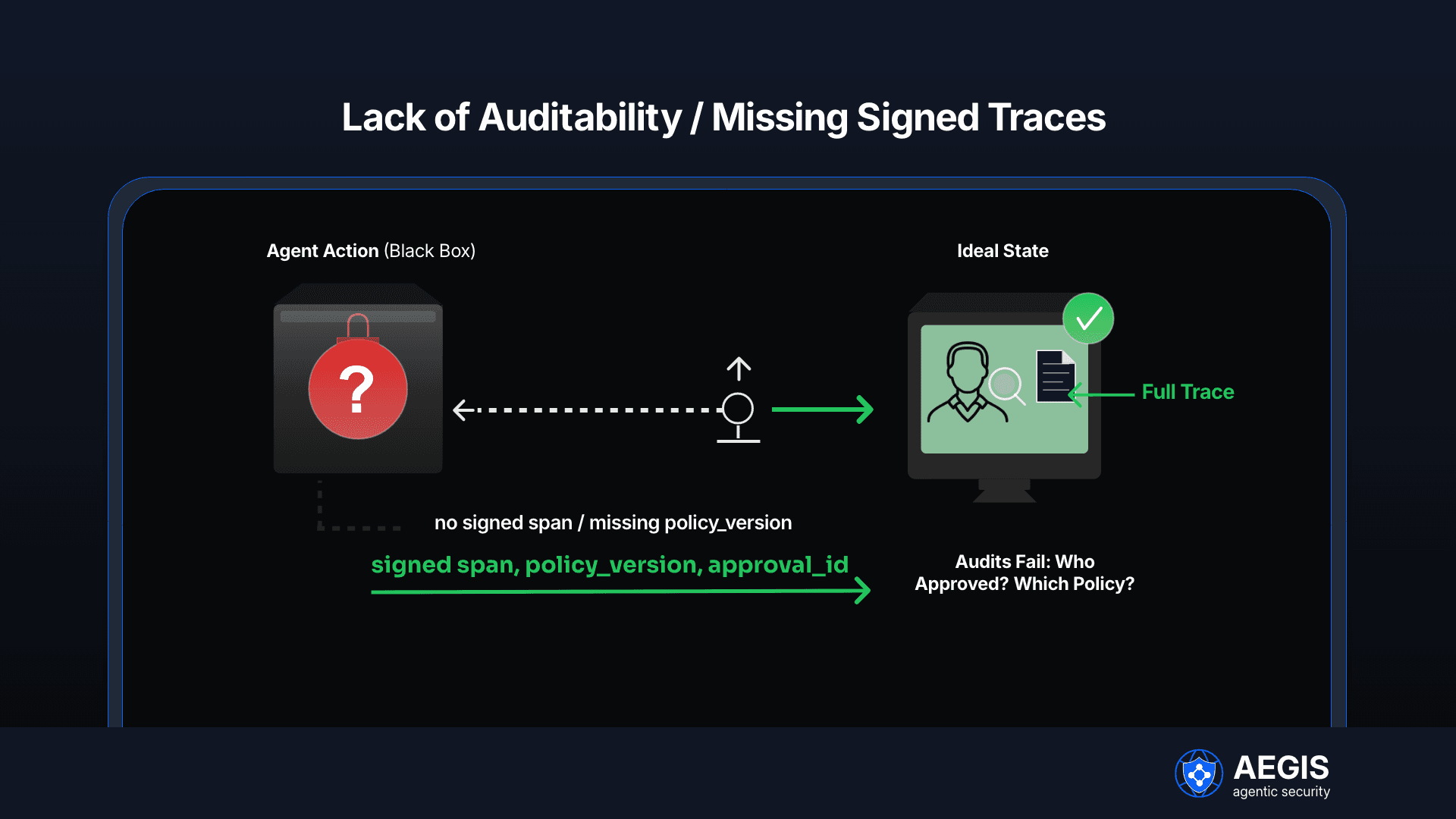
- Compliance gaps, where no trace exists linking a decision to a human approver.
Aegis was designed to close these gaps by merging policy enforcement with OpenTelemetry-based observability, ensuring that every agent action is visible, attributable, and explainable.
👉🏻 Validate system reliability with robust performance testing frameworks
Essential Observability Metrics for Multi-Agent Systems
Monitoring agentic workflows requires more than CPU or request metrics. Observability must capture decision context. Aegis, functioning as a runtime policy and telemetry gateway, emits structured spans for each decision, enabling the following key metrics.
1. Core Interaction Metrics
Metric | Description | Value for Operators |
Calls per Agent | Total number of outbound tool calls made by each agent. | Highlights high-traffic agents and potential anomalies. |
Allow/Deny Ratio | Percentage of allowed vs. blocked actions. | Detects abnormal behavioral shifts. |
Approval Latency | Time from approval_needed to human approval. | Indicates operational friction and policy bottlenecks. |
Parent Chain Length | Depth of nested agent calls. | Helps detect recursion or coercion attempts. |
Budget Usage | Cumulative spend per agent/tool. | Enables FinOps tracking and throttling. |
Aegis attaches each span with policy_version, decision_reason, and agent_id, offering 99%+ tracing coverage across multi-tenant deployments.
2. Compliance & Security Indicators
Metric | Observed Pattern | Alert Trigger |
Blocked Critical Actions | Count of blocked payments, deletions, or data exports. | >3 blocks per hour. |
Abnormal Allow/Deny Shift | Deviation from baseline allow ratio. | ±20% in 24 hours. |
Approval Queue Length | Number of pending human approvals. | >50 pending. |
Budget Burn Rate | Daily cost growth vs. limit. | >80% usage by mid-day. |
These KPIs feed compliance dashboards and SIEM connectors, offering auditable proof of runtime governance—essential for regulated sectors such as finance, healthcare, and government.
Designing Observability Dashboards That Matter
Aegis integrates seamlessly with Prometheus and Grafana, exporting OpenTelemetry spans for aggregation. Well-structured dashboards should map agent behavior to policy effectiveness rather than infrastructure health alone.
1. Operational Dashboards
Operational dashboards focus on runtime efficiency and latency. Typical panels include:
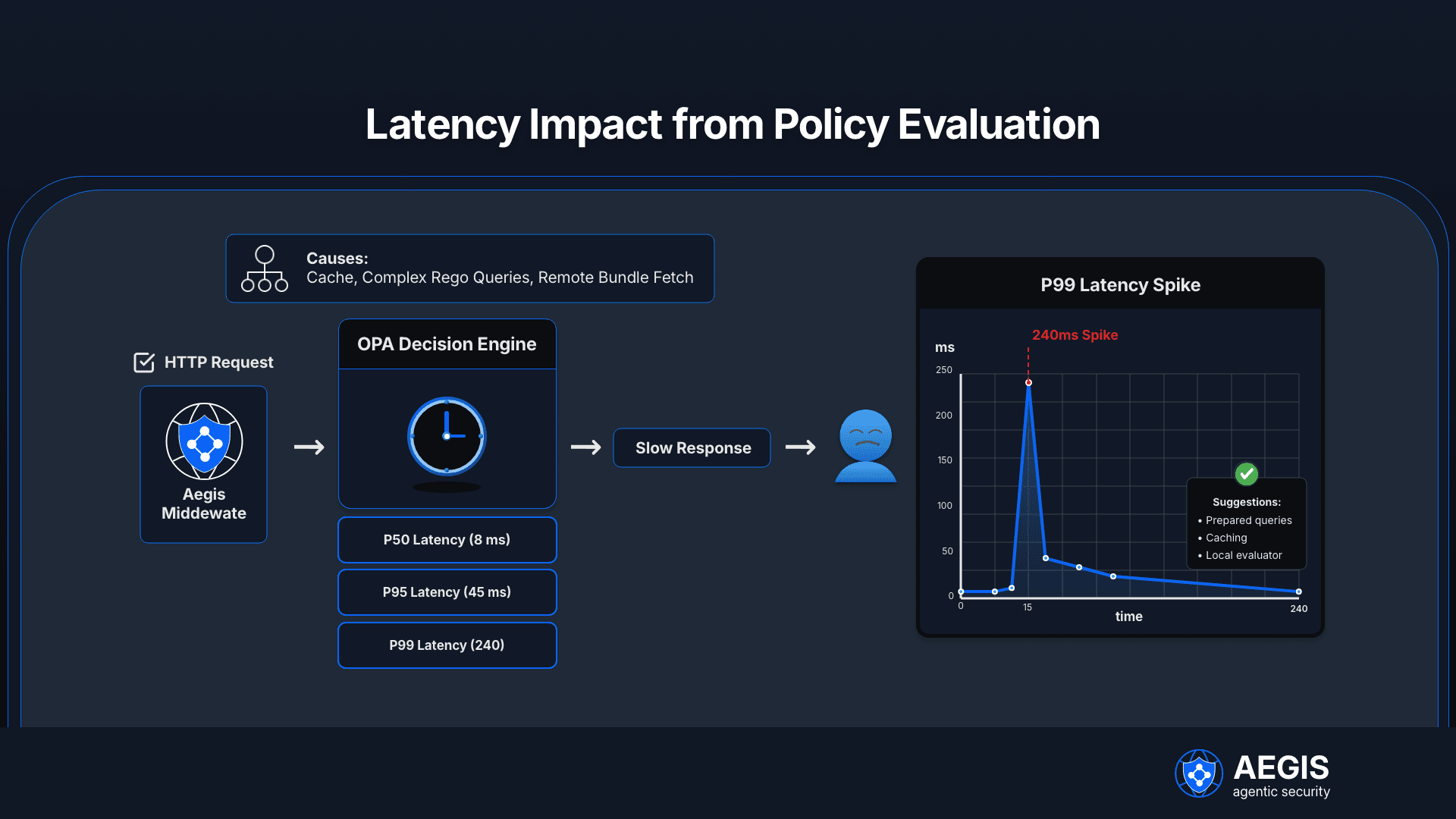
- P99 Latency per Tool: Measures decision and enforcement overhead (Aegis targets <20 ms).
- Top Offending Agents: Agents triggering repeated denials.
- Cost per Agent/Tool: Useful for FinOps reviews.
2. Compliance & Audit Dashboards
Compliance views prioritize trace completeness and policy coverage:
- Policy Evaluation Heatmap (agent × tool matrix).
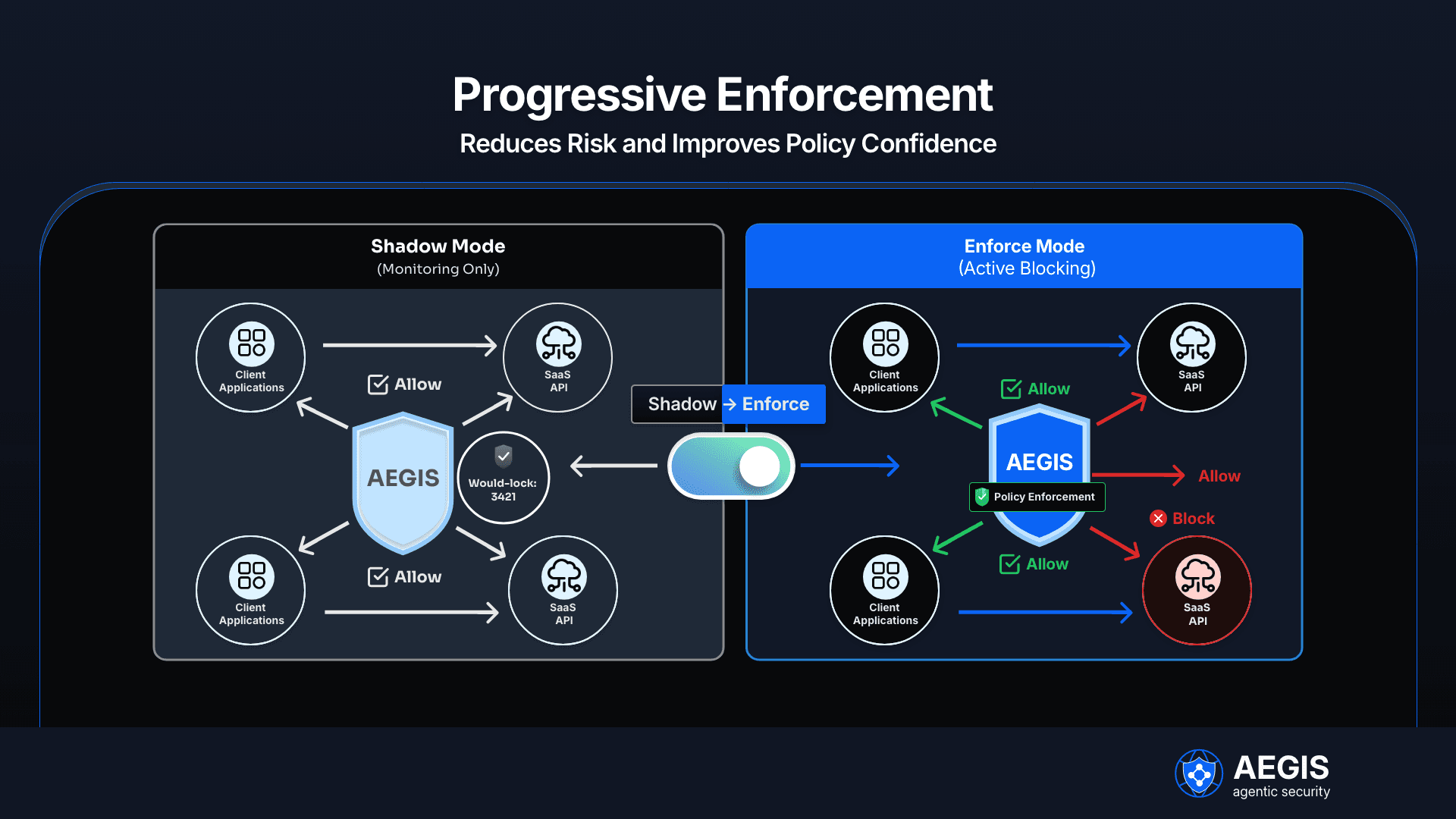
- Shadow Mode Findings: Events that would have been blocked if enforcement were active.
- Audit Log Traceability: Mapping approvals to human approvers and timestamps.
Aegis allows exporting weekly observability reports to demonstrate compliance posture and cost optimization impact—critical for SOC teams and auditors.
👉🏻 Trace every agent interaction with distributed observability tools
Alert Math: Turning Metrics into Action
Aegis supports declarative alerting policies derived from observability data. These rules use thresholds and statistical baselines to prevent alert fatigue.
Metric | Alert Rule | Recommended Remediation |
Approval Queue Length | >50 pending approvals for >10 min | Add tiered approval or adjust thresholds. |
Allow/Deny Ratio | Allow rate <70% for 30 min | Inspect policy misconfigurations. |
Budget Burn Rate | >80% before 12 PM | Throttle agent spend or increase budget. |
Latency P99 | >50 ms | Enable caching or switch to WASM evaluator. |
Such alert math transforms observability into proactive governance.
Common Pitfalls in Multi-Agent Observability
1. Metric Explosion Due to High Cardinality
Agents generate spans with high-dimensional labels (tool, tenant, policy, version). Without sampling or tag normalization, metric backends can choke.
Mitigation: Aegis applies controlled cardinality through span_sampling_strategy and tenant-aware indexing, balancing precision and cost.
2. Shadow Mode Blind Spots
Shadow enforcement provides visibility but no control. Many teams forget to convert “would-block” insights into enforceable policies, leaving gaps in runtime protection.
Solution: Aegis’s observability UI automatically surfaces persistent shadow-mode events and recommends promotion to enforcement.
3. Overloaded Approval Workflows
When every medium-risk action triggers human approval, queues grow, latency increases, and productivity drops.
Remedy: Use Aegis’s policy thresholds to define context-sensitive approvals (e.g., only block when amount > $5,000).
Aegis as Policy-Aware Observability for Agentic AI
.png&w=3840&q=75)
1. Runtime Enforcement with Full Telemetry
At its core, Aegis Gateway acts as a policy and observability fabric for secure multi-agent AI systems. Deployed as a proxy or sidecar, it evaluates every agent-to-tool call, applies policy decisions (allow, deny, sanitize, or approval_needed), and emits structured OpenTelemetry spans.
Each span includes:
- agent_id, tool_name, and decision_reason
- policy_version for auditability
- latency_ms and estimated_cost_usd
- Cryptographically signed trace ID for compliance chains
This approach provides both control and observability—not postmortem logging but real-time, policy-aware telemetry.
2. Multi-Tenant Dashboards and FinOps Visibility
Aegis dashboards (accessible via Grafana or SIEM) give operators a unified view across tenants:
Dashboard View | Key Metric | Benefit |
Per-Tenant Summary | Total calls, blocked actions, spend | Enables MSSP visibility. |
Agent Cost Heatmap | Cost per agent/tool | FinOps optimization. |
Latency Distribution | P50–P99 enforcement time | Detects performance regressions. |
Policy Effectiveness | % of compliant calls | Tracks governance maturity. |
These dashboards enable CISOs and FinOps teams to quantify impact—blocked critical actions, costs saved from throttling, and average policy latency—providing tangible business KPIs.
3. Secure Observability Pipeline
Aegis sanitizes all telemetry before export, ensuring no PII or secrets leak into traces. Payloads are truncated, and DLP filters redact sensitive content. Signed span hashes ensure tamper-resistance for audit compliance.
Aegis’s OpenTelemetry integration also makes it interoperable with existing enterprise observability stacks, meaning teams can use familiar dashboards and alerting engines while gaining AI-specific insight.
Implementation Checklist
Security and DevOps teams can apply the following checklist to establish observability maturity in multi-agent environments:
- Instrument the Orchestrator Gateway with OpenTelemetry middleware.
- Tag Every Span with agent_id, tenant_id, and policy_version.
- Validate P99 Latency Targets using synthetic workloads.
- Store Sanitized Payload Snapshots for compliance.
- Configure Sampling and Retention based on FinOps guidance.
- Link Traces to Ticketing Systems for automated triage.
- Enable Shadow Mode during rollout, then switch to enforce after validation.
Aegis simplifies this with its CLI toolkit for tailing spans, replaying traces locally, and exporting weekly observability reports for executive reviews.
How Aegis Addresses Real-World Use Cases
From the Aegis Use Case Library:
- FinTech: Enforce per-agent payment limits, prevent coercion between planner and finance agents.
- Healthcare: Apply deterministic DLP to redact PHI before data leaves the system.
- SaaS/FinOps: Limit per-agent budgets, visualize spend per trace, and throttle costly APIs.
- MSSPs: Generate tenant-isolated observability and signed telemetry for SOC reviews.
Each scenario ties observability to operational assurance—Aegis not only monitors but enforces accountability.
Frequently Asked Questions
1. How does Aegis differ from standard observability tools?
Traditional observability platforms show what happened; Aegis shows why. It links telemetry to policy decisions, identities, and approvals—turning observability into governance.
2. Can Aegis integrate with existing OpenTelemetry setups?
Yes. Aegis emits standard OTel spans and metrics, which can be ingested by existing backends like Grafana, Datadog, or SIEMs.
3. How does Aegis avoid metric overload?
It employs span sampling and normalized tags to manage cardinality. Administrators can configure retention and aggregation levels.
4. Is sensitive data protected in Aegis traces?
Absolutely. Aegis sanitizes payloads before export, applying deterministic DLP rules to redact PII or financial data.
5. What are the key KPIs to present to executives?
Executives track blocked critical actions, cost savings from throttling, and audit coverage—metrics Aegis dashboards provide out of the box.
6. How can I validate observability coverage?
Run synthetic workloads and verify ≥99% trace coverage via Aegis’s validation tools.
Final Thought:
As enterprises move toward complex multi-agent ecosystems, observability must evolve from passive monitoring to policy-driven visibility. Aegis Gateway delivers this convergence—combining enforcement, cost awareness, and traceability to make agentic AI both secure and accountable.