Balancing Performance and Policy Strictness in Agents
How Aegis enables agentic AI systems to maintain strict security policies without sacrificing performance or user experience.
Balancing Performance and Policy Strictness in Agentic AI
Autonomous agents are no longer prototypes—they’re becoming production workloads in finance, healthcare, and SaaS environments. As their responsibilities grow, so does the demand for precise control. The tension between security policy strictness and runtime performance is now one of the defining challenges in agentic AI design.
If policies are too relaxed, agents can exfiltrate data or trigger unauthorized actions. If they’re too strict or slow, workflows stall and developers abandon enforcement altogether. The balance between these extremes defines whether agentic AI succeeds in enterprise environments.
This article explores the performance-policy tradeoff, the limitations of legacy enforcement models, and how Aegis Gateway—a policy and observability fabric from Aegissecuirty —delivers real-time governance without breaking latency budgets.
👉🏻 Reduce risk exposure by tightly scoping agent permissions
The Problem: Latency vs Control in Agentic Workflows
As enterprises embed AI agents into operational systems, they encounter the same dilemma that early microservice architectures faced: governance overhead versus performance.
Real-world Risks of Relaxed Policies
When AI agents have minimal guardrails, the results can be catastrophic:
- Privilege escalation: A planner agent persuades a finance agent to trigger payments beyond its authority.
- Prompt or parameter injection: User-supplied text influences an agent’s tool parameters, executing unintended shell or SQL commands.
- Silent data exfiltration: Agents send internal data to unapproved endpoints, bypassing audit logs.
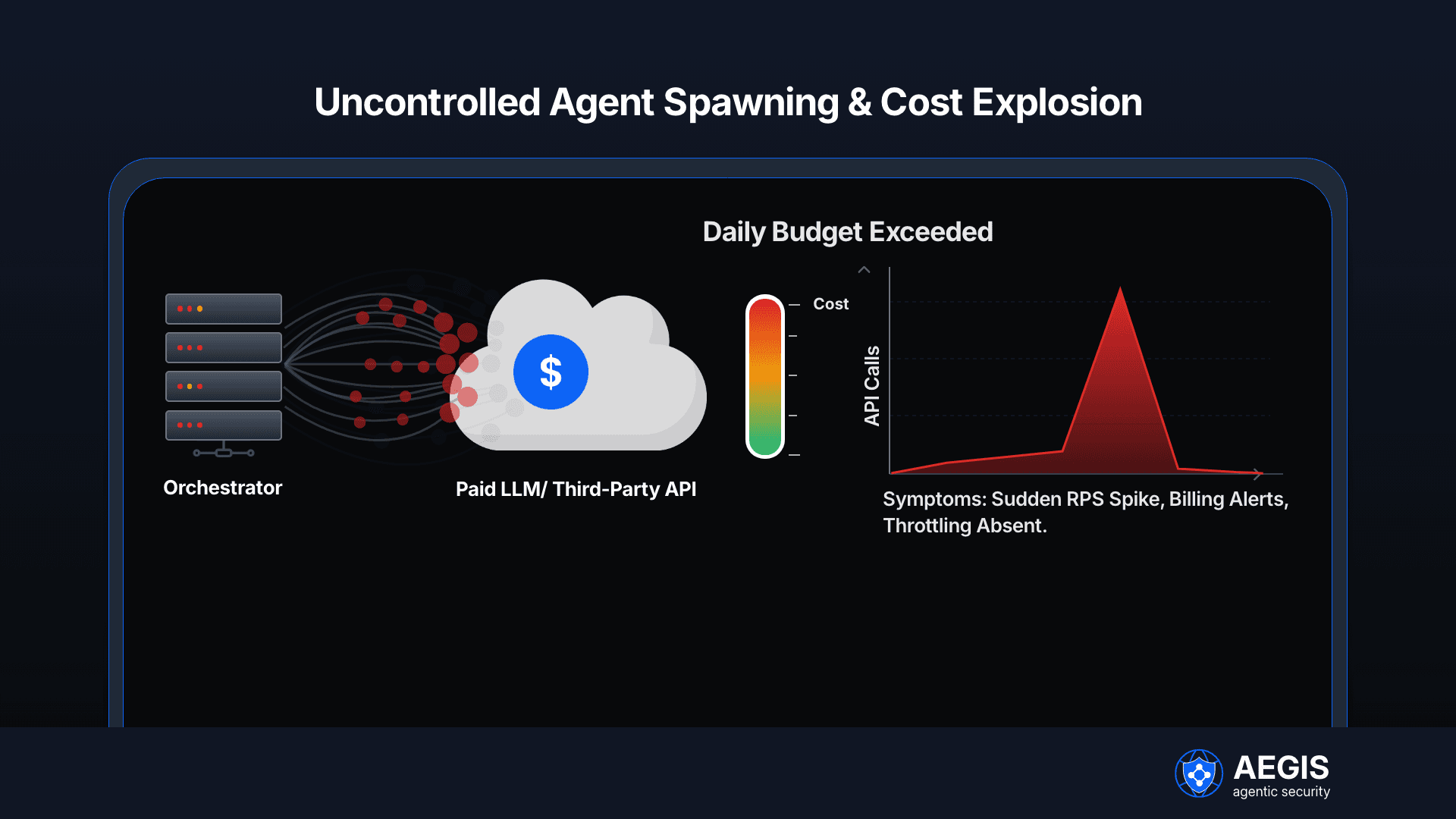
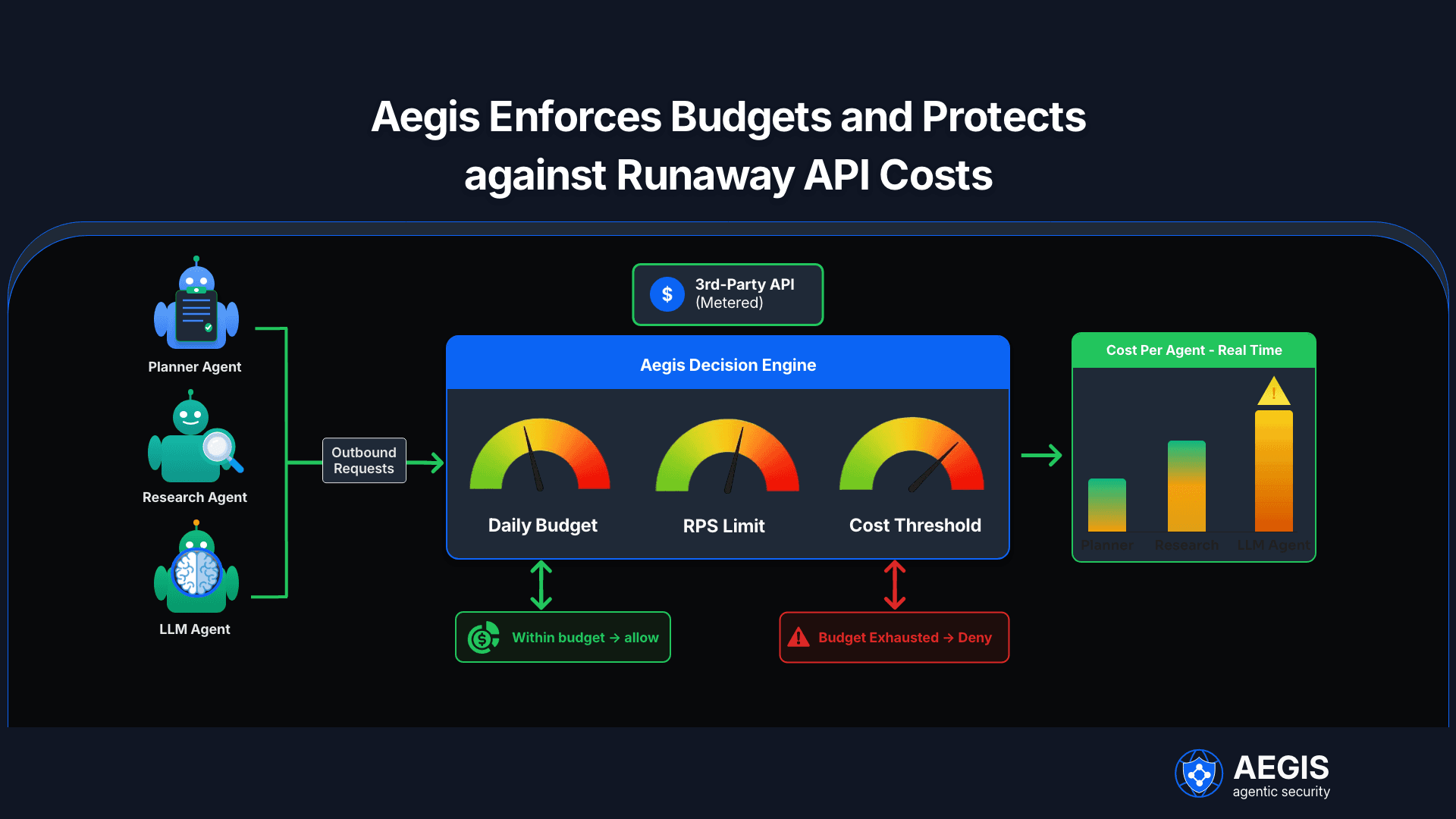
- Budget overruns: Autonomous agents generate runaway API costs by invoking high-cost endpoints repeatedly.
These incidents aren’t theoretical. In a 2024 McKinsey survey, 23% of enterprises are scaling agentic AI while 39% are still experimenting, citing governance and performance as key blockers. Poor runtime controls increase the likelihood of costly misbehavior.
Performance Targets Security Teams Must Set
Runtime security can’t afford to introduce noticeable delays. Agentic systems must:
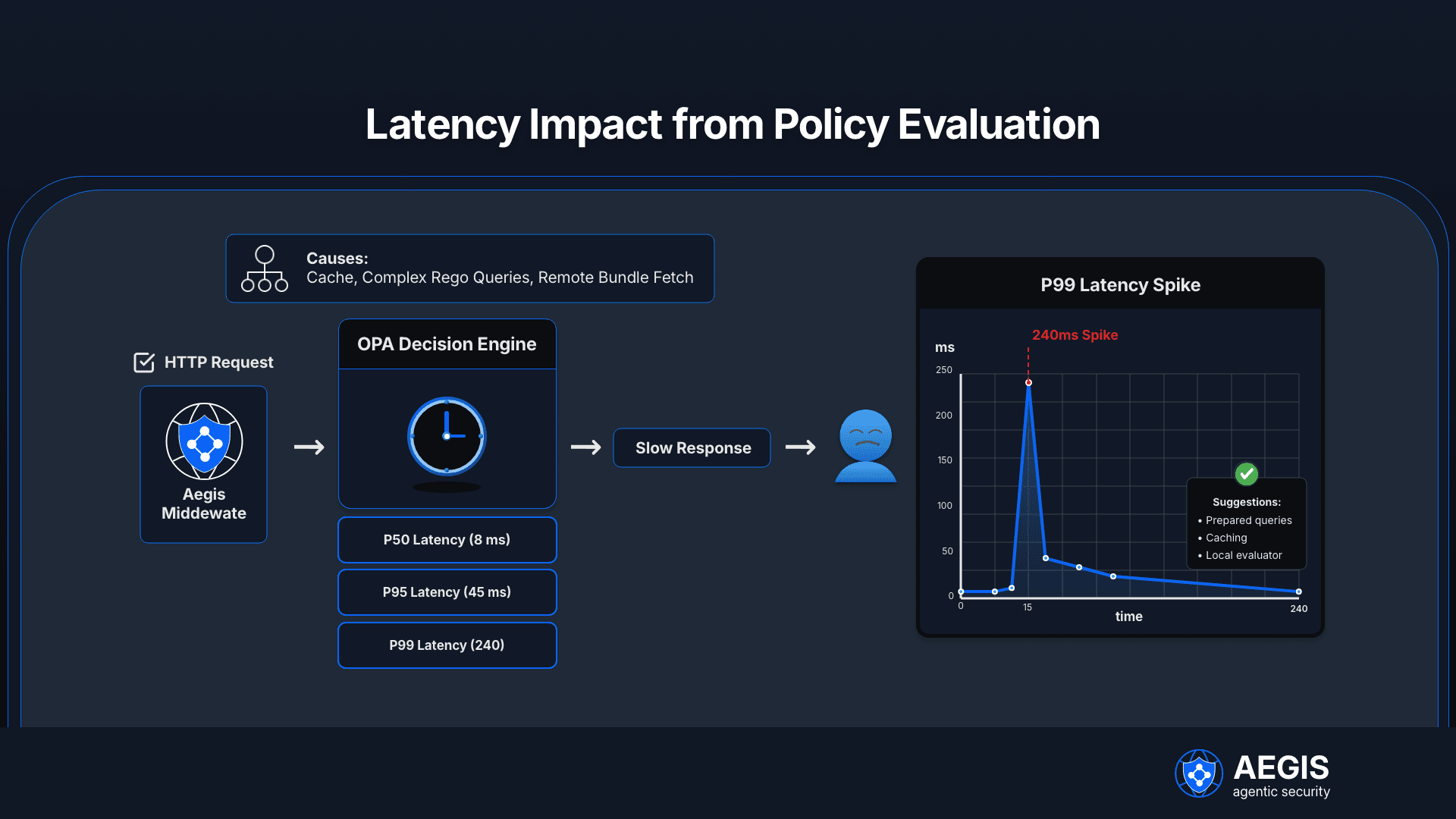
- Maintain <20 ms P99 policy evaluation latency
- Scale to 10,000+ requests per second per region
- Operate deterministically across tenants
- Remain observable with per-decision telemetry
Failing to meet these targets often leads to policy bypassing, as developers disable checks for smoother performance. Gartner warns that up to 40% of agentic projects may be scrapped by 2027 if governance and latency aren’t balanced effectively.
👉🏻 Control usage and costs with intelligent rate limiting strategies
Legacy Approaches and Their Failure Modes
Traditional governance tools were never designed for autonomous agents. Most rely on coarse IAM controls, static network ACLs, and manual policy audits. These models fail at agent scale for several reasons:
Legacy Method | Limitation | Impact |
Embed policy checks inside agent code | Tight coupling; requires redeploys for updates | High maintenance, inconsistent enforcement |
IAM-only gating | Focuses on “who,” not “what” or “how much” | Fails to catch risky parameters or contexts |
Offline policy reviews | Reactive, not real-time | Violations discovered post-incident |
Manual approvals | Adds human latency | Breaks automation loops |
A modern agentic environment—with 50+ micro-agents calling APIs across services—cannot depend on static IAM logic or embedded validation code. It needs runtime decisioning that’s both fast and adaptive.
👉🏻 Continuously verify trust across all agent interactions
The Modern Pattern: Runtime Policy Fabric
This is where Aegis Gateway enters. Acting as a runtime policy and observability layer, it provides enterprises with sub-20 ms enforcement for agent workflows without altering the agent codebase.
Architecture and OPA Integration
Aegis operates as a reverse proxy or sidecar between the orchestrator (e.g., LangGraph, AgentKit) and the tools agents call.
Each request undergoes:
- Identity extraction: Agent ID and token verification via short-lived JWTs.
- Policy evaluation: Using compiled Open Policy Agent (OPA) bundles with prepared queries and in-memory caches.
- Decision response: One of allow, deny, sanitize, or approval_needed.
- Telemetry emission: OpenTelemetry spans log latency, policy version, and decision context.
OPA’s prepared-query architecture lets Aegis hit sub-10 ms decision times in common cases, even under high concurrency. For stricter latency budgets, policies can compile to WASM, ensuring deterministic performance on constrained edge deployments.
Shadow Mode and Tuning Workflow
Before full enforcement, Aegis runs in shadow mode, where policies execute without blocking. Security teams can observe “would-block” events and tune rules before flipping the switch.
A typical tuning workflow:
- Deploy policy in shadow mode for 7 days.
- Collect metrics on would-deny events.
- Adjust thresholds, regexes, or budget caps.
- Transition to enforce mode with confidence.
This hot-reload approach eliminates redeploy cycles—a common pain point in legacy governance.
Metrics and Testing Methodology
Balancing security and speed requires disciplined measurement. Aegis implements fine-grained observability for latency, decision outcomes, and shadow-mode false positives.
Metric | Target | Measurement Method |
Policy evaluation latency (P99) | ≤ 20 ms | OpenTelemetry spans |
Enforcement overhead per call | ≤ 5 ms | End-to-end proxy tracing |
Decision coverage | ≥ 95% of agent→tool calls | Gateway logs |
False-positive (shadow mode) rate | < 2% | Shadow-to-enforced comparison |
Policy hot reload | < 1 second | CI/CD dry-run tests |
This transparency is vital for DevSecOps and compliance teams, especially those managing multi-tenant environments where enforcement errors could cascade across customers.
Aegis Gateway: Balancing Policy Strictness and Performance
Runtime Enforcement at Scale
Aegis evaluates policies per request rather than per deployment. For each call:
- The agent identity is validated.
- The target tool and parameters are inspected.
- Policy bundles are queried in-memory.
- The decision outcome is returned—often in under 15 ms.
This allows enforcement without breaking interactive agent workflows such as conversational reasoning or sequential planning chains.
Aegis also supports conditional allow (sanitize) actions, replacing risky data with redacted versions instead of full denials. This improves usability while maintaining guardrails.
Policy-as-Code and Hot Reload
Security engineers define policies in YAML or JSON:
agent: finance-agent
allowed_tools:
- name: stripe-payments
actions:
- create_payment
conditions:
max_amount: 5000
These definitions compile into OPA bundles that Aegis caches and evaluates instantly. With hot reload, policy updates apply without downtime—critical for enterprises operating continuous agent flows.
Observability and Auditability
Every decision emits OpenTelemetry spans, which can be streamed to Grafana or SIEM platforms for:
- Real-time decision audits
- Latency distributions
- Top policy violators
- Spend-by-agent tracking
This telemetry ensures compliance visibility for regulated industries such as FinTech, Healthcare, and MSSPs—where agent actions must be provably authorized.
Implementation Checklist and Patterns
Security and DevOps leaders can follow this structured rollout to achieve low-latency policy control.
Step | Description | Benefit |
1 | Measure baseline latency pre-policy | Establish P99 reference |
2 | Define strict vs permissive policy tiers | Classify low/medium/high risk tools |
3 | Enable shadow mode | Observe would-block metrics |
4 | Compile policies to OPA bundles | Reduce cold-start delays |
5 | Cache frequent allow decisions | Improve hot-path throughput |
6 | Implement approval_needed for high risk | Avoid unnecessary full blocks |
7 | Add deterministic DLP | Prevent PII leakage |
8 | Instrument all decisions with OTel | Enable compliance reporting |
9 | Define per-agent budgets and rate limits | Enforce FinOps controls |
10 | Fail-closed for writes, optionally fail-open for reads | Guarantee safety during outages |
By following this pattern, enterprises can continuously tighten policy strictness while monitoring latency regressions in real time.
.png&w=3840&q=75)
Aegis in Action: Enterprise Use Cases
Aegis’s architecture supports concrete, high-impact scenarios across sectors:
- FinTech Payment Enforcement – Automatically blocks unauthorized transactions and requires human approval for payments exceeding thresholds.
- Healthcare Data Control – Redacts PHI fields (SSN, DOB) before agents can export EHR data outside approved endpoints.
- SaaS Cost Governance – Applies per-agent rate limits and budget ceilings, halting runaway LLM costs.
- DevOps CI/CD Safety – Enforces deployment environment whitelists and image-digest validation for safe production releases.
- MSSP Multi-Tenancy Compliance – Provides signed audit spans and tenant-isolated policies for clean SOC reviews.
These scenarios demonstrate how Aegis maintains both tight control and operational fluidity—two traits rarely coexisting in legacy systems.
Performance, Policy, and the Path Forward
Agentic AI’s future hinges on trust and speed. The ability to enforce strict policies while maintaining near-real-time performance defines whether these systems can safely scale across industries.
Aegis Gateway offers that equilibrium:
- Runtime decisions in under 20 ms
- Policy-as-code with instant updates
- Full observability for compliance and FinOps
- Human-in-the-loop approvals for high-risk actions
Rather than choosing between control and performance, Aegis delivers both—operational safety at production velocity.
Frequently Asked Questions
1. How does Aegis ensure low latency for policy decisions?
Aegis uses Open Policy Agent (OPA) prepared queries, in-memory caches, and optional WASM compilation to deliver decisions under 20 ms (P99).
2. Can policies be tested before enforcement?
Yes. Shadow mode lets teams simulate enforcement, collect would-block metrics, and adjust policies before flipping to active enforcement.
3. Does Aegis require rewriting agent code?
No. It functions as a proxy or middleware layer between agents and tools, preserving existing orchestrator workflows (e.g., LangGraph, AgentKit).
4. What happens if the policy engine becomes unavailable?
Aegis supports configurable fail-open or fail-closed behavior, ensuring safety for writes and resilience for reads.
5. How is observability achieved?
All policy evaluations emit OpenTelemetry traces containing agent ID, policy version, decision reason, and latency data for full auditability.
6. Is Aegis suitable for multi-tenant environments?
Yes. Aegis isolates policy bundles and telemetry per tenant, ensuring strong data segregation—a critical requirement for MSSPs and enterprise SaaS.