
Implementing Segregation of Duties in Agent Workflows
How Aegis enforces segregation of duties across agent chains with policy-as-code, attested chains, approval flows and auditable traces.
Aegis - Enforcing Segregation of Duties in Agent Workflows
Enterprises adopting agentic AI rapidly face a practical governance problem: agents can chain actions and effectively self-authorize high-risk workflows. This post explains why Segregation of Duties (SoD) must move from manual human gates into runtime policy enforcement, how to model SoD for multi-agent systems, and how Aegis — Aegissecurity agent security mesh — enforces SoD with chain attestation, approval tokens, and auditable traces.
Key takeaways up front:
- SoD for agentic systems requires validating parent/child agent identity and enforcing different identities for initiation, approval, and execution.
- Runtime enforcement reduces fraud vectors (e.g., planner → finance payment coercion) while producing traceable telemetry for compliance.
- Real-world adoption is accelerating but immature; 23–29% of organizations are experimenting or scaling agentic AI, while security remains a top barrier. (McKinsey & Company)
Why SoD matters for agentic AI
Agent chains create new privilege-escalation surfaces. A planner agent can craft prompts that cause downstream agents to perform high-confidence actions (payments, deployments, PII exports) without an independent approval step. Payment fraud and BEC remain large risks — surveys show ~79% of orgs faced payment fraud attempts in 2024 and card/credit transfer fraud is measured in the hundreds of millions EUR in recent reports — making runtime controls essential. (AFP)
Traditional controls (manual approvals, IAM ACLs) are insufficient:
- Manual approvals are slow, error-prone, and not enforceable across automated agent chains.
- IAM controls "who" can call an API but not "what" parameters are allowed, nor whether the call originates from an authorised agent chain context.
👉🏻 Contain potential damage with strict least privilege enforcement
Principles for SoD in agent workflows
- Split duties by identity — require different agent identities (agent_id) for initiation, approval, and execution. The policy primitive require_different_agent_id is fundamental.
- Chain attestation — enforce parent_agent_id header and cryptographic attestation of the chain so decisions can validate ancestry.
- Approval tokens with single retry validity — when human approval is granted, mint a one-time override token tied to the approval id and policy version.
- Policy-as-code, testable — declare SoD matrices and conditions in YAML/JSON, compile to OPA bundles and run CI tests (dry-run mode first).
- Observability & auditing — emit OpenTelemetry spans that include agent_id, parent_agent_id, policy_version, decision, and approval_id. These traces are the audit fabric.
How Aegis implements SoD
Aegis is built as a runtime policy and observability gateway that enforces SoD across orchestrator → tool calls. Key components and behaviors:
Runtime gate (data plane)
- An Envoy sidecar or forward proxy intercepts outbound tool calls and calls the Aegis decision service. The request includes short-lived JWT with agent_id and (when present) parent_agent_id.
- The decision service evaluates compiled OPA bundles and returns allow/deny/sanitize/approval_needed. For approval_needed it responds with a structured reason and an approval_id.
Chain validation and attestation
- Aegis requires clients/orchestrators to propagate parent_agent_id in a signed header. The decision engine verifies the chain signature (or checks a replay-protected jti in the token service) to ensure the parent is authentic. This prevents planner impersonation or token recycling.
Approval workflow
- When a policy returns approval_needed, Aegis posts an interactive message to Slack/Teams with the payload, policy snippet, and one-click approve/deny. On approval, Aegis mints a one-time override token (single retry) and logs the approval event with a tamper-evident audit record.
Developer & operator UX
- Policies are authored in YAML, compiled to OPA bundles, and validated in CI via the CLI aegis policy validate and aegis policy dry-run commands. Bundles are versioned and can be rolled back if misconfiguration causes disruption.
Practical enforcement example (payment flow)
Policy: finance-agent allowed stripe:create_payment if amount ≤ 5000 OR approval_needed if > 5000. If a planner tries to coerce a single planner-agent to do both draft and final payment without finance-approver identity, Aegis denies the call and emits an audit span.
👉🏻 Control agent permissions with scalable role-based frameworks
-1.png&w=3840&q=75)
Policy primitives & a compact Rego pattern
Table: Core SoD policy primitives
Primitive | Purpose | Example |
require_parent_agent_id | Ensure call has upstream context | deny if missing for multi-step workflows |
require_different_agent_id | Prevent same agent from approving its own actions | allow only if parent_agent_id != agent_id |
approval_needed | Pause and route approval | override_token valid for 1 retry |
max_amount, regex(param) | Parameter validation | deny if amount > 5000 or dest_account !~ regex |
Compact Rego sketch (pseudo)
package aegis.sod
allow {
input.agent_id == "finance-agent"
input.tool == "stripe.create_payment"
input.amount <= 5000
}
approval_needed {
input.tool == "stripe.create_payment"
input.amount > 5000
}
deny {
input.parent_agent_id == input.agent_id
}
Operational tradeoffs: approval batching vs one-off approvals
Table: Approval tradeoffs
Tradeoff | Batching | One-off |
Human latency | Lower (batch) | Higher (per-call) |
Authorization risk | Higher (bulk approve) | Lower (granular) |
Audit clarity | Moderate | High (per approval id) |
Approval fatigue | Lower | Higher |
Guidance: use one-off approvals for high-risk financial, production-deploy, or PHI actions; use batching for low-risk bulk operations with tighter parameter constraints and shorter validity windows.
Testing, CI, and onboarding
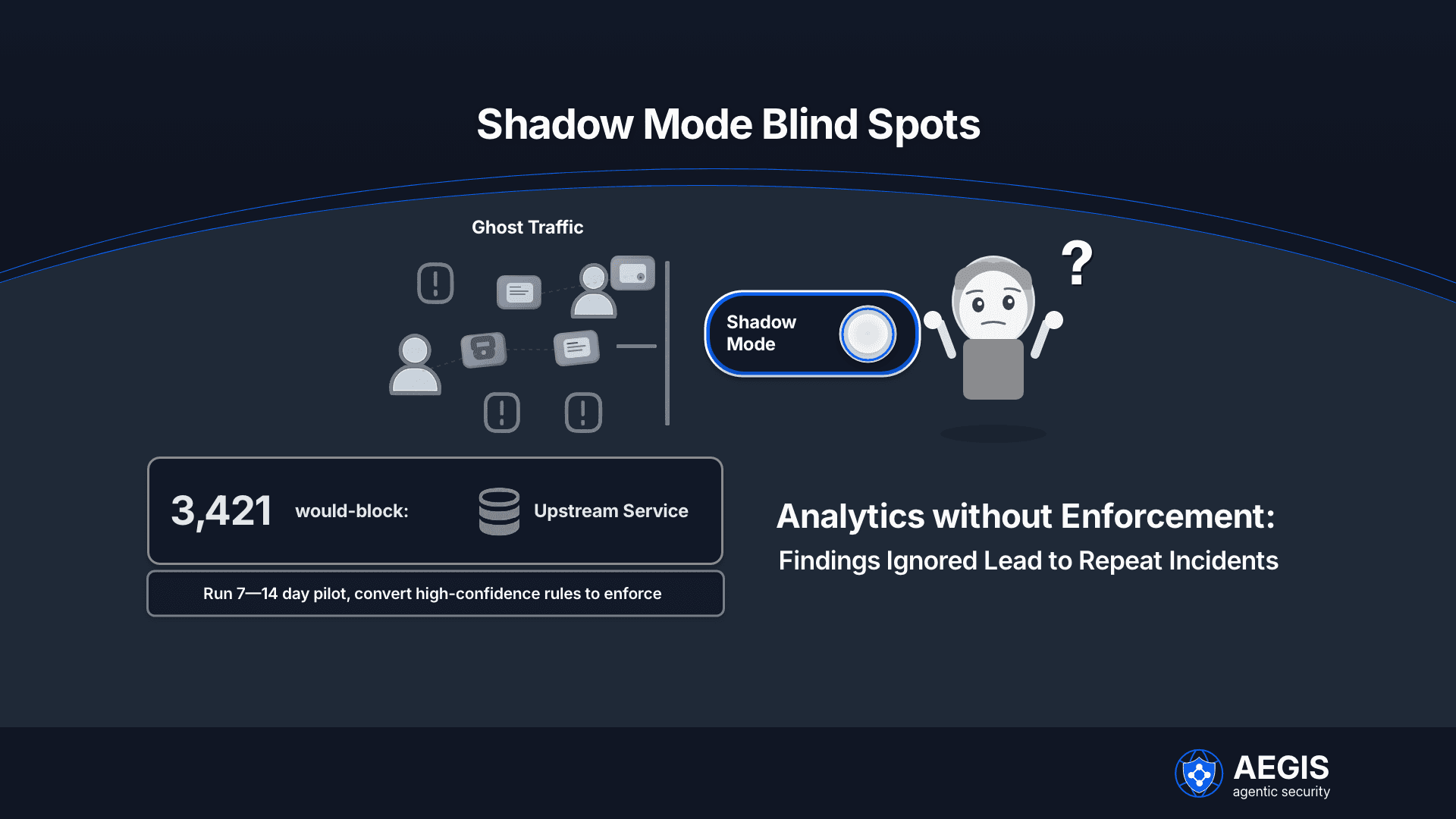
- Run policies in shadow mode for a defined window (7–14 days) to collect would_block metrics and tune regexes and thresholds.
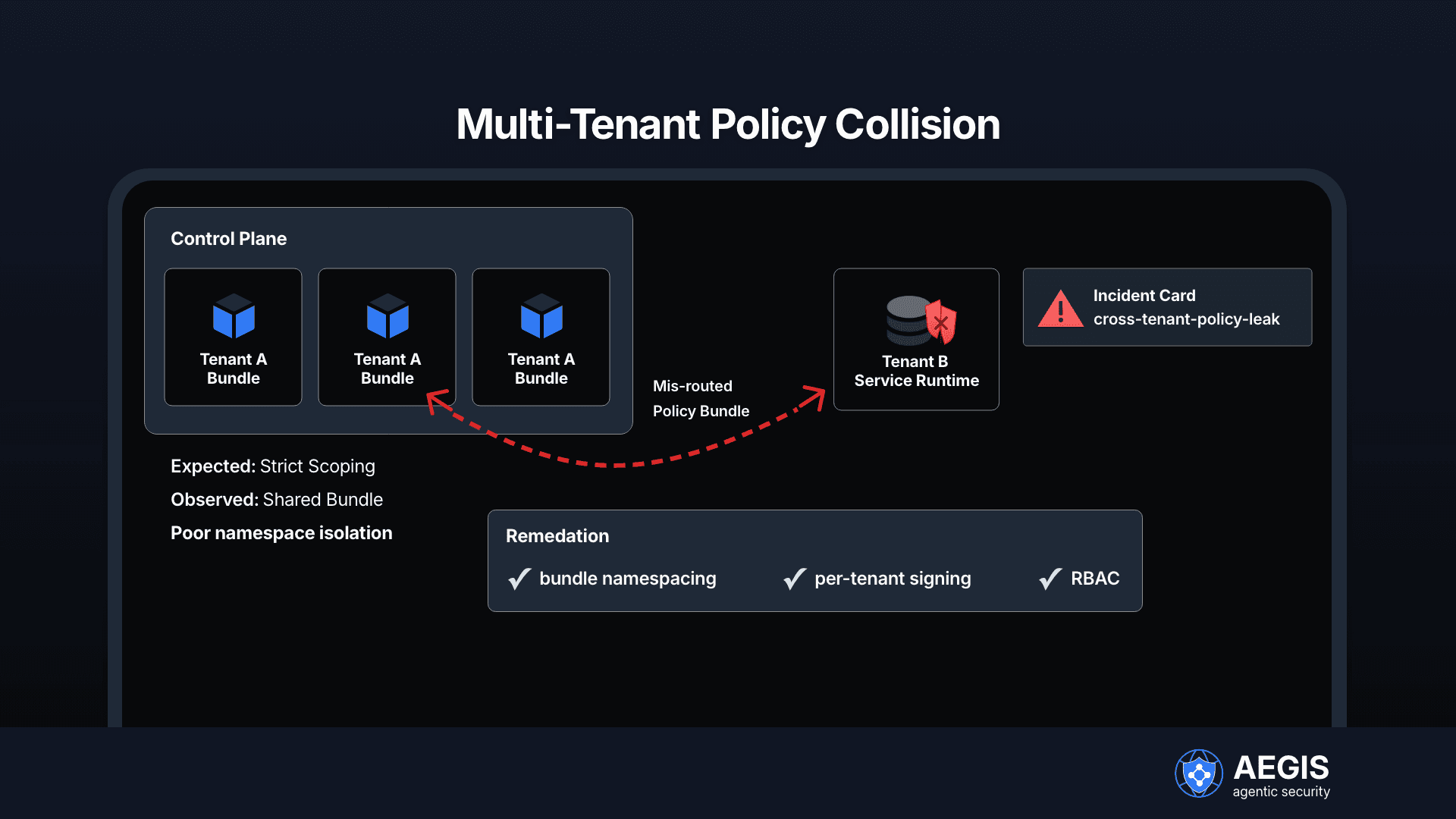
- Integrate aegis policy validate into your pipeline to fail PRs with misconfigurations. Ship small incremental policy changes and use canary tenants for multi-tenant stacks.
Observability & metrics
Instrument these SLOs and dashboards:
- Prevented SoD violations per week (count).
- Average approval latency (ms / minutes).
- Policy coverage (% of critical tools under Aegis).
- Top agents by would-block volume.
Industry context: adoption is accelerating but risks remain — analysts show enterprise experimentation rates between low tens of percent and early scaling in 2024–25; security concerns and integration complexity are frequently cited as blockers, confirming the need for a runtime mesh like Aegis. (Capgemini)
👉🏻 Fine-tune policies to achieve both speed and strong governance
Best practices & remediation
- Minimize approvals that materially hurt throughput: calibrate thresholds using shadow mode metrics.
- Map roles explicitly: create SoD matrices (who may create, approve, execute) and tie them to agent identity claims.
- Emergency exceptions: allow a time-boxed break_glass flow which requires post-mortem and extra logging.
Frequently Asked Questions
Q: How does Aegis prevent agent impersonation?
A: Aegis enforces signed, short-lived JWTs (Ed25519), validates parent_agent_id headers and uses jti replay protection to prevent recycled tokens.
Q: When should I require SoD for a workflow?
A: High financial value, PHI/PII exports, production infra changes, and multi-tenant cross-tenant actions should require SoD. Use risk scoring and shadow mode data to decide.
Q: Do approval tokens increase attack surface?
A: Only if poorly scoped. Aegis mints short-lived, single-use override tokens tied to approval_id and policy_version to limit replay and misuse.
Q: Can SoD policies be tested in CI?
A: Yes — compile YAML to OPA bundles in CI, run aegis policy dry-run against representative traces, and fail builds on regressions.
Q: What metrics should SOC/FinOps track?
A: Prevented SoD violations, approval latency, would-block rates, top offending agents/tools, and per-agent budget consumption.
This post synthesizes Aegis’s architecture and practical SoD patterns to give security engineers and operators a concrete path to enforce least privilege in agentic systems. For implementation playbooks, CI examples and policy templates, consult Aegis technical documentation and industry pages at Aegissecurity.
Further reading and source material: McKinsey and Capgemini agentic adoption reports, EBA and AFP payment fraud reports, and Aegissecurity Aegis technical briefs. (McKinsey & Company)