Managing Third-Party Risk in Agent Toolchains
Practical guidance to secure agent toolchains: connector attestation, runtime policies, DLP and Aegis Gateway enforcement.
Managing Third-Party AI Risk in Agent Toolchains
Agentic systems accelerate automation but introduce new supply-chain and runtime risks when they call third-party connectors (APIs, plugins, parsers). This article lays out the attacker models you should worry about, practical runtime and vendor controls, and how a runtime policy mesh like Aegis enforces least-privilege, DLP and auditable enforcement for production agent deployments. Throughout, I cite contemporary findings and concrete mitigations security teams can operationalize today.
👉🏻 Identify and eliminate hidden risks across multi-agent ecosystems before they scale
Third-party threats in toolchains
Supply-chain scenarios
Agent toolchains commonly stitch together orchestrators, agents and connectors (e.g., PDF parsers, payment APIs, storage plugins). These connectors expand an attack surface in predictable ways:
- Compromised connector: a plugin with a backdoor that exfiltrates retrieved documents.
- Malicious plugin: intentionally malicious third-party shipped through a marketplace.
- Dependency backdoors: transitive NPM/PyPI packages that enable remote code or memory poisoning.
- Stale token/secret exposure: long-lived API keys embedded in connector configs.
Recent work demonstrates the severity: RAG/memory poisoning attacks can embed triggers in knowledge stores with very high success rates (>80% attack success in demo red-teaming). This shows that attacker control over a connector or content store is a real, measurable vector for agent compromise. (arXiv)
👉🏻 Turn real-world breach lessons into proactive defense strategies
Data-centric risk: what’s actually at stake
Third-party connectors touch sensitive context: PII/PHI, payment instructions, code-deploy commands. Unchecked, they enable:
- Silent exfiltration (egress to attacker domains).
- Parameter injection leading to privileged actions (e.g., unexpected payment amounts).
- RAG backdoors that alter agent behavior on demand.
The OWASP GenAI guidance catalogs prompt injection and data-flow risks that are now part of standard LLM risk taxonomies; treat connectors as high-risk I/O surfaces. (OWASP Gen AI Security Project)
Runtime & vendor controls
Vetting and attestation for connectors
A production program for third-party connectors should include:
- Signed manifests: every connector bundle (binary or archive) shipped with a signed manifest and hashchain provenance.
- Vendor attestation questionnaire: SLA for incident response, supply-chain disclosure, source provenance.
- Continuous SCA: schedule software composition analysis and dependency scanning for transitive packages.
Operationally, include a connector rotation schedule (short-lived credentials) and contractual minimums for disclosure and patch timelines.
👉🏻 Mitigate financial and operational risks with AI-focused insurance strategies
Runtime allowlists, sandboxing and least-privilege
At runtime, static vetting is necessary but insufficient. Agents need an enforcement plane that does per-call checks:
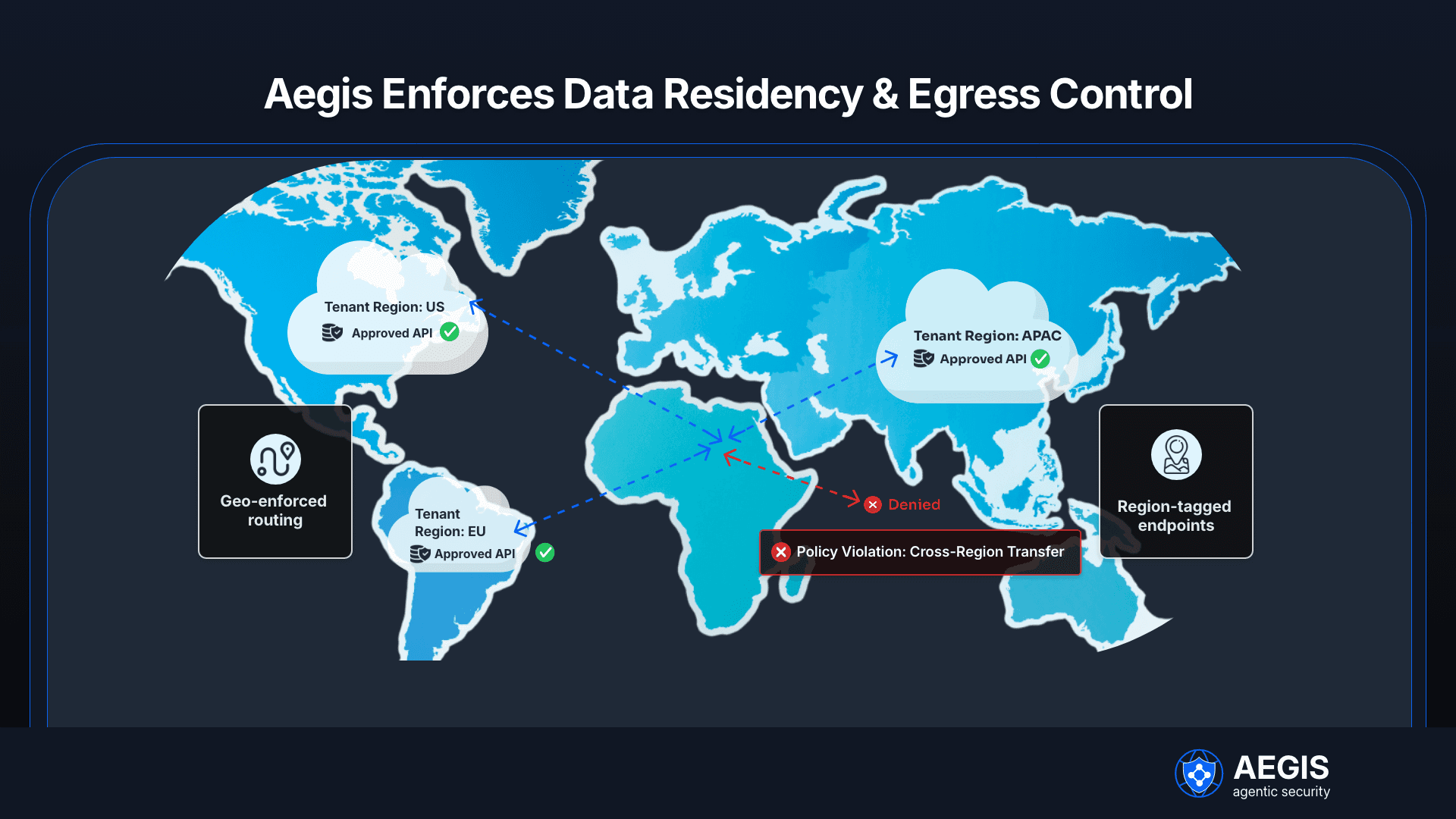
- Runtime allowlists (egress): only permitted domains and IP ranges for the connector; reject any unexpected remote fetch.
- Sandboxing: isolate connector execution (e.g., container level or sidecar) with strict filesystem and network rules.
- Connector least-privilege: tokens scoped to minimal API capabilities (narrow scopes, time-bounded).
Aegis uses egress policies to block unexpected remote fetches (example: a third-party PDF parser attempting remote retrieval would be blocked by egress policy and the payload sandboxed before any external call).
Aegis enforcement — design and operational detail
Policy-as-code and attestation
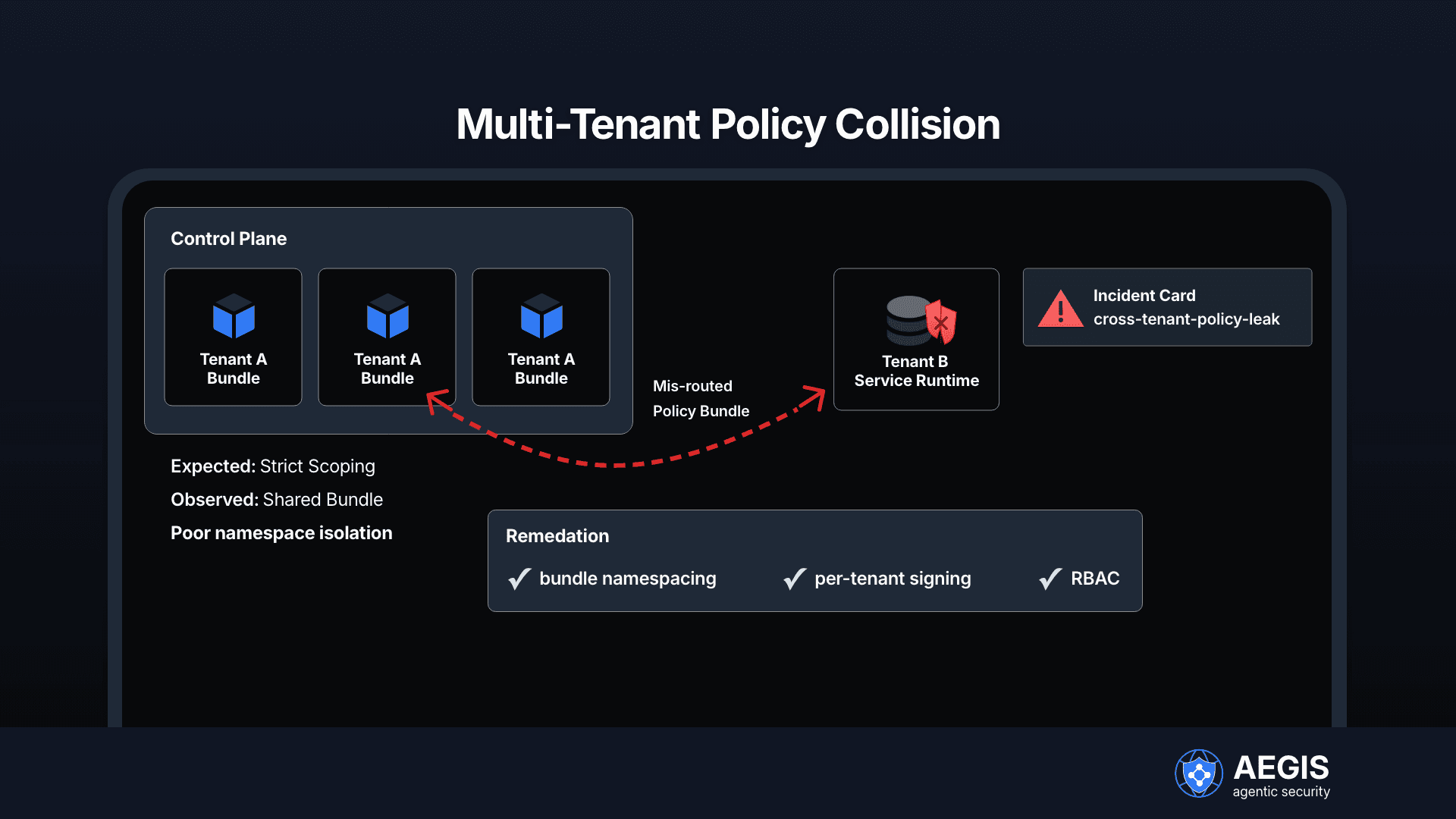
Aegis treats every agent and connector as first-class identities. Policies are written as YAML/JSON, compiled into optimized policy bundles and hot-reloaded into the runtime evaluator. Key capabilities:
- Agent identity and scope: agent_id ↔ allowed_tools mapping with parameter-level conditions (e.g., max_amount: 5000).
- Signed policy bundles: manifests with integrity hashes and version history to prevent silent policy tampering.
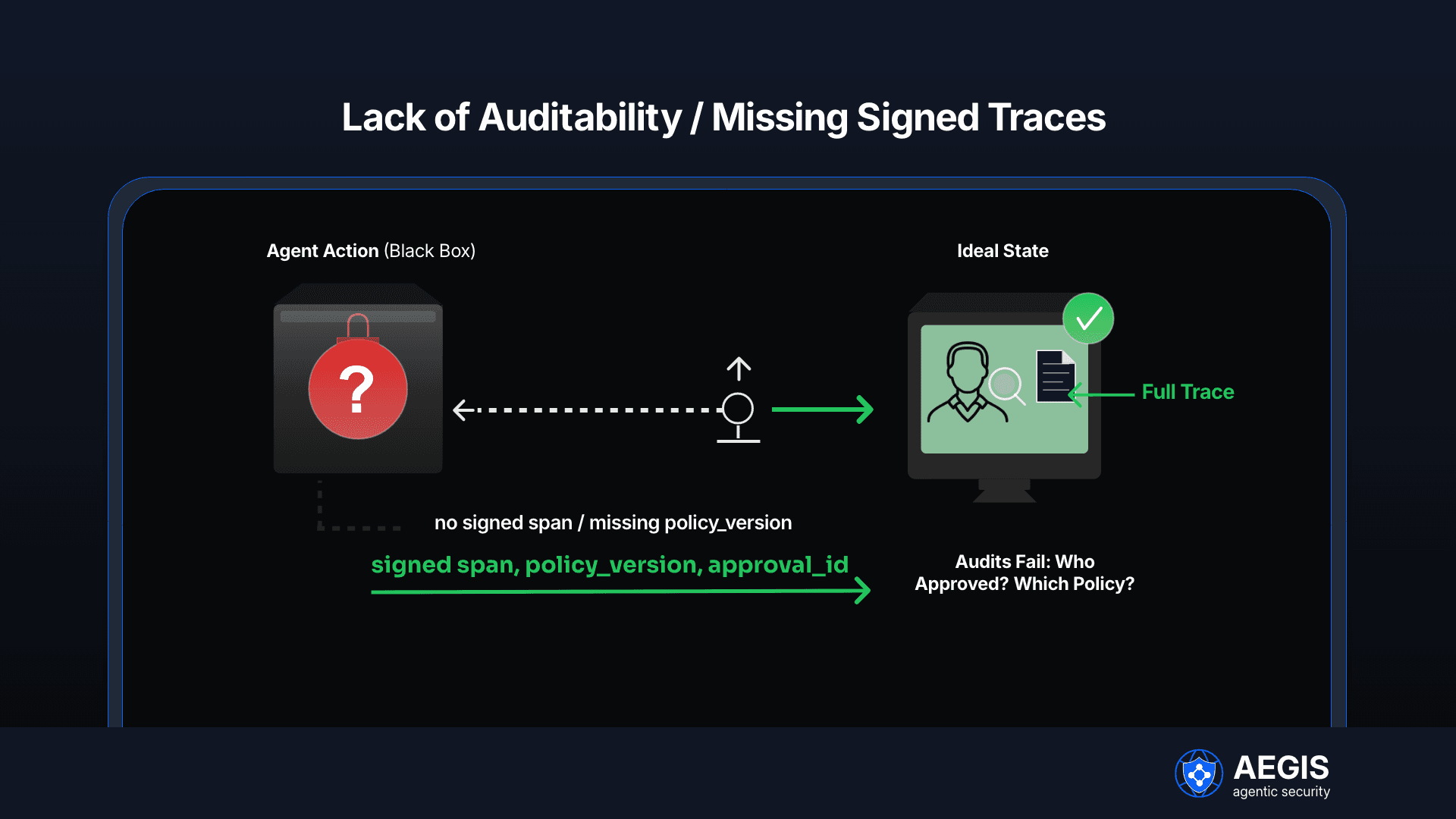
- Attestation metadata: decisions include signed attestation tokens for downstream audit.
By compiling policies to a fast evaluator (e.g., OPA prepared queries or WASM) Aegis keeps decision latencies low while ensuring auditability.
Runtime enforcement, DLP and approvals
Aegis enforces at the agent→tool boundary (sidecar or forward proxy). Core enforcement logic:
- Inspect call: agent identity, tool name, parameters, chain of calls (parent_agent headers).
- Outcome: allow / deny / sanitize / approval_needed.
- Deterministic DLP: regex-based PII redaction (SSN, emails) and optional in-memory masking before outbound calls.
- Approval workflow: for high-risk actions (payments over threshold), the gateway pauses and issues an approval request to Slack/Teams, and returns a standardized PolicyViolation if blocked.
This runtime model prevents a Planner agent from coercing a Finance agent into an unauthorized payment and provides a signed audit trail for compliance teams.
Observability, telemetry and incident integration
Aegis emits structured OpenTelemetry spans for every decision: agent_id, tool, decision, policy_version and reason. These integrate into SIEMs for SOC review and enable post-incident forensics with tamper-evident logs.
Table: Sample enforcement outcomes and operational action
Outcome | Description | Operational action |
allow | Call within policy | Forward request; emit allow span |
deny | Violation (unauthorized tool/params) | Block; emit deny span + alert |
sanitize | Sensitive fields redacted | Forward sanitized payload; log redacted fields |
approval_needed | High-risk action | Pause; notify approvers; mint override on approval |
Practical defenses mapping to threat model
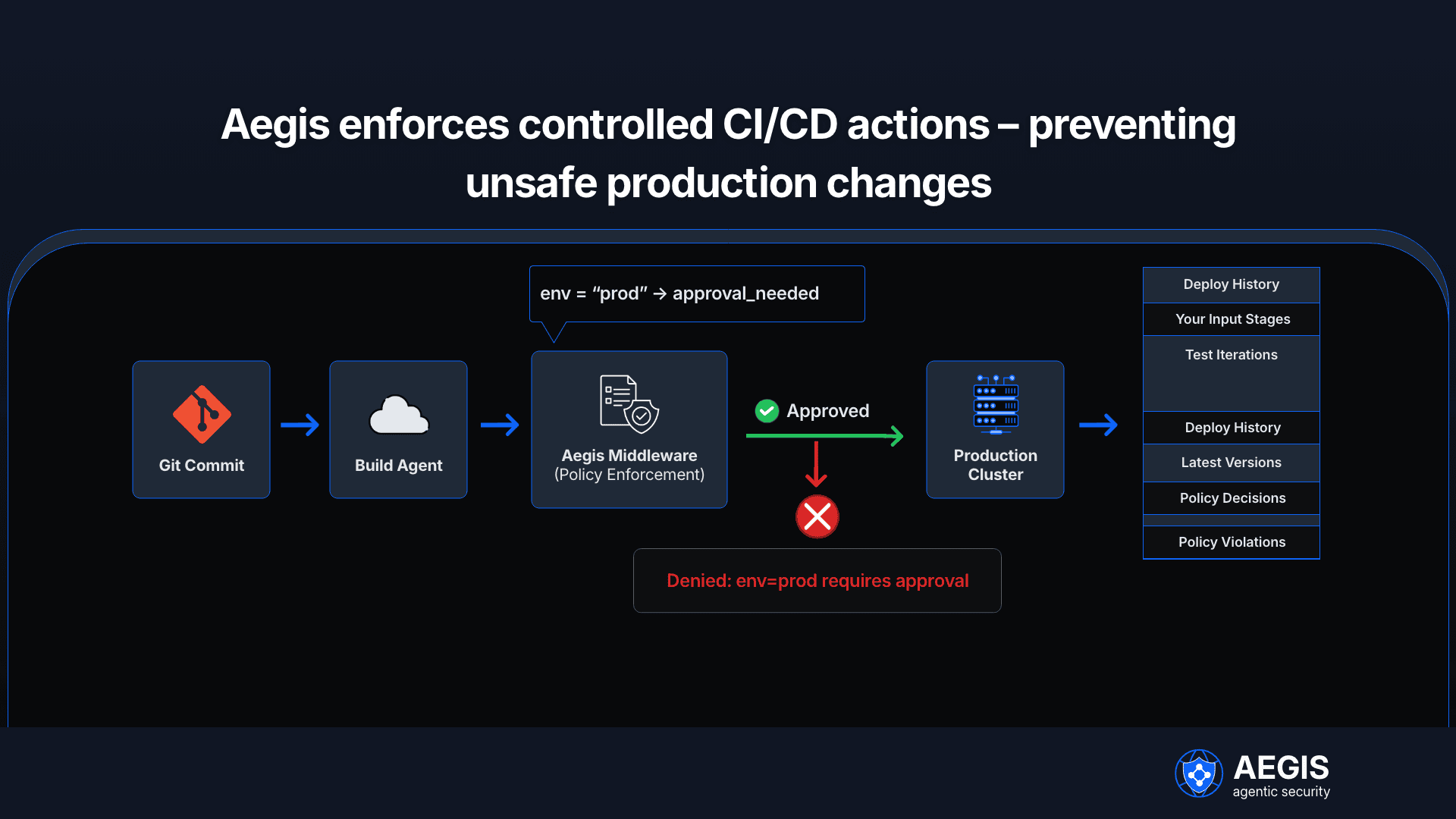
Table: Controls vs threats
Threat | Preventive controls | Runtime detection/enforcement |
Compromised connector | Signed manifests; SCA; vendor SLAs | Egress allowlist; sandboxing; behavioral anomaly |
Dependency backdoor | SCA; pinned dependencies | Network egress monitoring; deny unknown hosts |
RAG poisoning | Data provenance; hardened ingestion | Query minimization; provenance metadata in RAG store |
Token/secret leakage | Short-lived tokens; rotation schedule | Token usage monitoring; fail-closed token checks |
Operational tie-ins: governance & processes
Security is not only technical. Tie runtime controls to vendor risk assessments, SLA clauses for incident response, and connector rotation cadences. Use shadow mode to collect would_block metrics for 7–14 days before enforcement flip; this reduces false positives and operational disruption.
Market context: why this matters now
Industry surveys show growing agentic adoption but mixed ROI and maturity; McKinsey found ~23% of organizations scaling agentic systems and many more experimenting, underscoring the growing operational exposure if runtime controls aren’t in place. Gartner projects over 40% of agentic projects will be canceled by 2027 absent better cost controls and risk management — a stark signal for security and product teams to bake governance into agent rollouts early. (McKinsey & Company)
Implementation checklist (practical runbook)
- Inventory: map all connectors and their authorship, data flows and required scopes.
- Short-lived identity: issue short TTL tokens per agent; store on gateway.
- Policy templates: create per-use-case policies (payments, EHR access, egress).
- Shadow run: collect would-deny events; refine regexes and conditions.
- Approved rollout: flip to enforce; monitor for anomalies and operational friction.
- Continuous SCA: schedule weekly scans; alert on critical CVEs.
Why Aegis matters
Aegis addresses three operational gaps that otherwise doom agentic projects:
- Runtime decisioning at scale — Policies are enforced per call with sub-20ms P99 targets using prepared queries and caching. This prevents slowdowns and keeps interactive agents responsive.
- Auditable, tamper-evident trails — Signed spans and policy versioning produce a forensically useful record for SOCs and auditors, reducing regulatory risk and speeding incident investigations.
- Least-privilege for autonomous actors — By binding token claims, scopes and policy rules to agent identities, Aegis prevents privilege escalation via tool chaining and enforces parameter constraints (e.g., payment ceilings).
Operational outcomes: reduced incident surface (blocked exfiltration and RAG poisoning pathways), controllable FinOps (per-agent budgets, quota enforcement) and a governance model that allows product teams to ship agents faster with confidence. For customers running sensitive workflows in Healthcare, FinTech or regulated SaaS, Aegis ties policy, approval, and telemetry into an auditable guardrail that aligns with compliance needs.
FAQs
Q1 — How do I prevent RAG memory poisoning?
Use provenance-tagged RAG stores, strict ingestion policies, and query minimization (only send minimal context). Periodically scan knowledge stores and enforce content signing for ingested documents. See AgentPoison research for empirical attack patterns. (arXiv)
Q2 — Will runtime policy enforcement add unacceptable latency?
Not if you use prepared queries, in-memory caches and WASM/OPA optimizations. Target P99 decision latencies under 20ms to keep interactive workflows fast; design proxies to be lightweight and avoid deep inline transforms where possible. (McKinsey & Company)
Q3 — What’s a safe rollout path?
Start with shadow mode for 7–14 days, tune regexes and parameter conditions, then switch to enforce with narrow rules and expand scopes as you gain confidence.
Q4 — How do approvals scale with volume?
Use thresholds to limit approvals to genuinely high-risk actions; batch low-risk exceptions, and throttle approval flows with rate limits and per-agent budgets to prevent approver fatigue.
Q5 — What integration points are essential?
Agent registration (identity), proxy/sidecar for enforcement, token service, approval channels (Slack/Teams), and OpenTelemetry export to your SIEM.
Q6 — Where can I find templates and examples?
Start with policy cookbooks (payment ceilings, EHR read-only), sample integrations for LangChain/LangGraph, and shadow-mode dashboards that show would-deny metrics.
Takeaways
Agentic AI offers tangible automation benefits, but third-party connectors introduce supply-chain and runtime surface area that teams must treat with the same rigor as traditional service meshes and IAM. Combine strong vendor vetting, signed manifests, short-lived identities and per-call enforcement to reduce exposure.
A runtime policy mesh like Aegis closes the loop—attesting, enforcing and auditing every agent→tool interaction so security, compliance and engineering teams can scale agentic projects with confidence.