
Lessons Learned from Real-World Agent Breaches
Discover how Aegis Gateway enforces runtime policies, controls egress, and ensures observability for multi-agent AI systems.
Securing Multi-Agent AI with Aegis Gateway
As enterprise adoption of agentic AI accelerates, a new frontier of runtime security challenges emerges. Multi-agent orchestration frameworks like LangChain, LangGraph, and AgentKit allow autonomous systems to reason, plan, and act using interconnected agents. Yet these same capabilities introduce the potential for privilege escalation, data exfiltration, budget overruns, and compliance failures if left unchecked.
Aegis Gateway, developed by AegisSecurity, is designed to solve these problems at their root. It functions as a policy and observability fabric for multi-agent AI systems—a security mesh that enforces least privilege, controls egress, and generates structured telemetry for compliance and FinOps teams.
👉🏻 Identify and eliminate hidden risks across multi-agent ecosystems before they scale
The Security Gap in Multi-Agent AI
The Rise of Autonomous Agents
Market data shows an 800% year-over-year surge in searches for “agentic AI” in 2024, reflecting enterprise momentum toward autonomous AI deployments. Organizations are embedding AI agents into workflows that span payments, DevOps automation, and customer support. According to Architecture & Governance Magazine (2024), over half of surveyed technology executives cite security and compliance as the biggest barriers to deploying these systems.
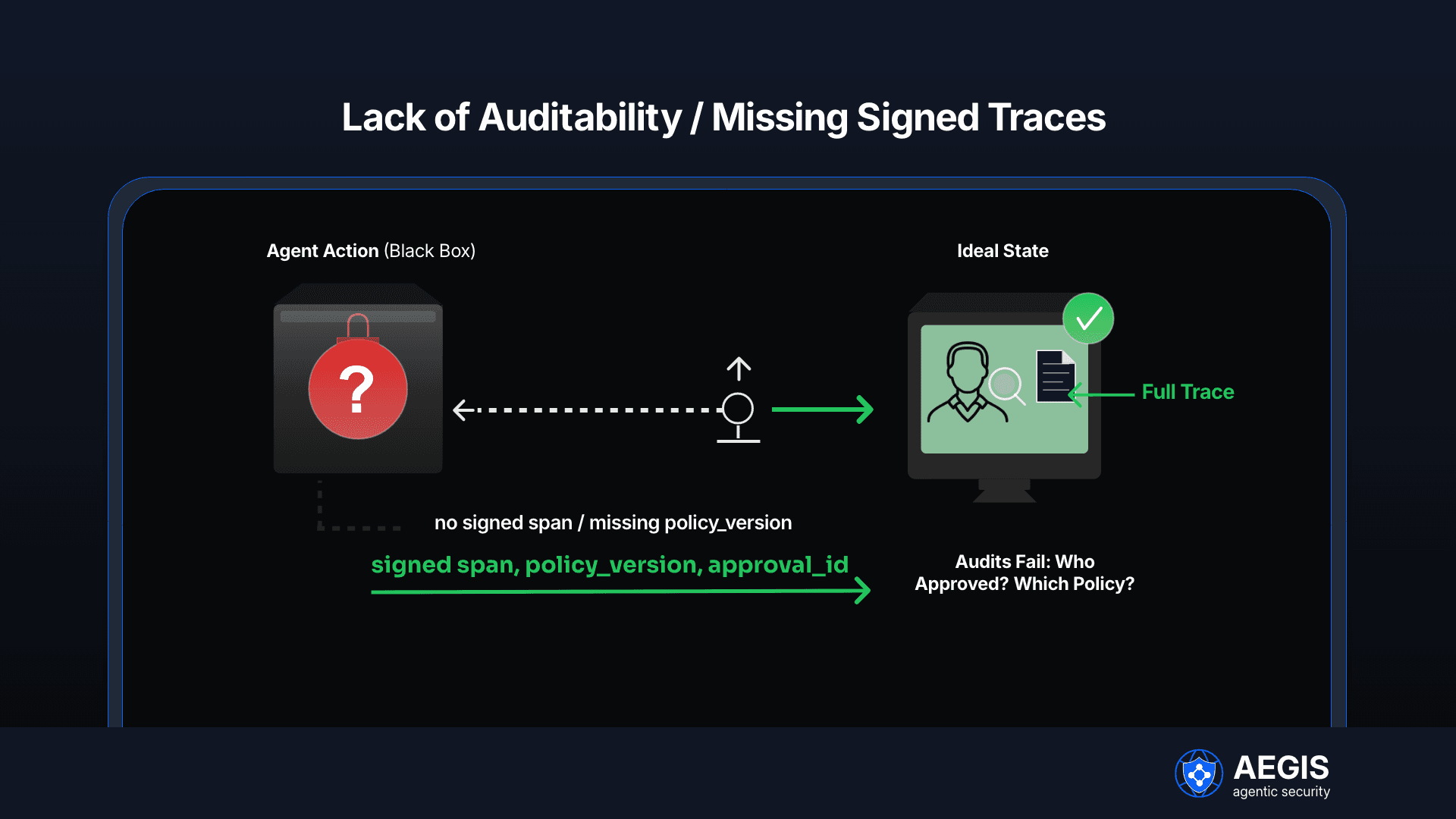
However, today’s agent environments lack runtime policy enforcement. Traditional IAM tools like Okta or Azure AD govern who can call an API—but not what autonomous agents do within those sessions, or how safely they handle parameters.
👉🏻 Gain real-time visibility into agent behavior and stop anomalies instantly
Where Existing Controls Fall Short
Security engineers typically rely on static controls: environment-level IAM, application validation, and manual approvals. These approaches fail in multi-agent ecosystems because agents:
- Communicate and invoke actions without human oversight
- Chain calls dynamically across tools and APIs
- Lack unified identity boundaries and audit trails
Aegis closes this gap with a runtime gateway that evaluates each agent’s request in real time, applying policy-as-code enforcement and auditable decisioning.
👉🏻 Mitigate financial and operational risks with AI-focused insurance strategies
.png&w=3840&q=75)
Inside the Aegis Gateway Architecture
Aegis Gateway combines a data plane for runtime enforcement with a control plane for policy management and governance.
Data Plane: Real-Time Enforcement and Telemetry
The Aegis data plane consists of an Envoy-based proxy, an external authorization server, and an embedded Open Policy Agent (OPA) evaluator.
Workflow overview:
- Every outbound call from an AI agent passes through the Aegis proxy.
- The proxy sends a policy decision request (agent ID, target, parameters) to the authorization server.
- OPA evaluates the call against the compiled policy bundle.
- The server returns a decision: allow, deny, sanitize, or approval_needed.
- Each event emits OpenTelemetry spans for observability.
Latency targets are optimized: ≤20 ms P99 through prepared queries and in-memory caching, ensuring that security enforcement doesn’t impact responsiveness.
Control Plane: Policy, Identity, and Observability
The control plane governs policy authoring, identity issuance, and observability:
- Policy Compiler & Bundle Store: Converts YAML/JSON policies into OPA bundles with version control.
- Token Service: Issues short-lived JWTs per agent, including org, tenant, and scope claims (Ed25519-signed).
- Approvals Service: Sends high-risk action approvals to Slack or Microsoft Teams.
- Dashboard Layer: Displays key metrics—allow/deny ratios, top agents, and per-tool costs.
This separation mirrors best practices from service mesh architectures (e.g., Istio), adapted to agent-level semantics and risk contexts.
Policy-as-Code: Controlling Agents with Precision
Aegis allows enterprises to define fine-grained, declarative security policies in YAML or JSON. Policies define what each agent can do, under which parameters, and when human oversight is needed.
Example Policy
agent: finance-agent
allowed_tools:
- name: stripe-payments
actions:
- create_payment
conditions:
max_amount: 5000
approval_needed: true
This policy ensures that the Finance Agent cannot exceed a $5,000 transaction limit without human approval. Every action is logged with structured metadata—policy_version, decision_reason, and approval_id—to ensure full traceability.
Enforcement Outcomes
Decision Type | Description | Example |
allow | Permitted under policy scope | Payment ≤ $5,000 |
deny | Violates policy condition | Payment > $5,000 without approval |
sanitize | Redacts sensitive fields | Removes SSN from payload |
approval_needed | Requires human confirmation | High-value transaction |
Aegis goes beyond simple allow/deny logic—it supports dynamic approvals and DLP sanitization, allowing safe automation without sacrificing control.
Use Cases Across Regulated Industries
Aegis Gateway’s architecture directly addresses common risks in verticals where compliance and control are paramount.
1. FinTech – Secure Payment Automation
Prevent privilege escalation and unauthorized fund transfers:
- Apply per-agent ceilings and regex-based parameter validation.
- Require Slack/MS Teams approval for transactions exceeding limits.
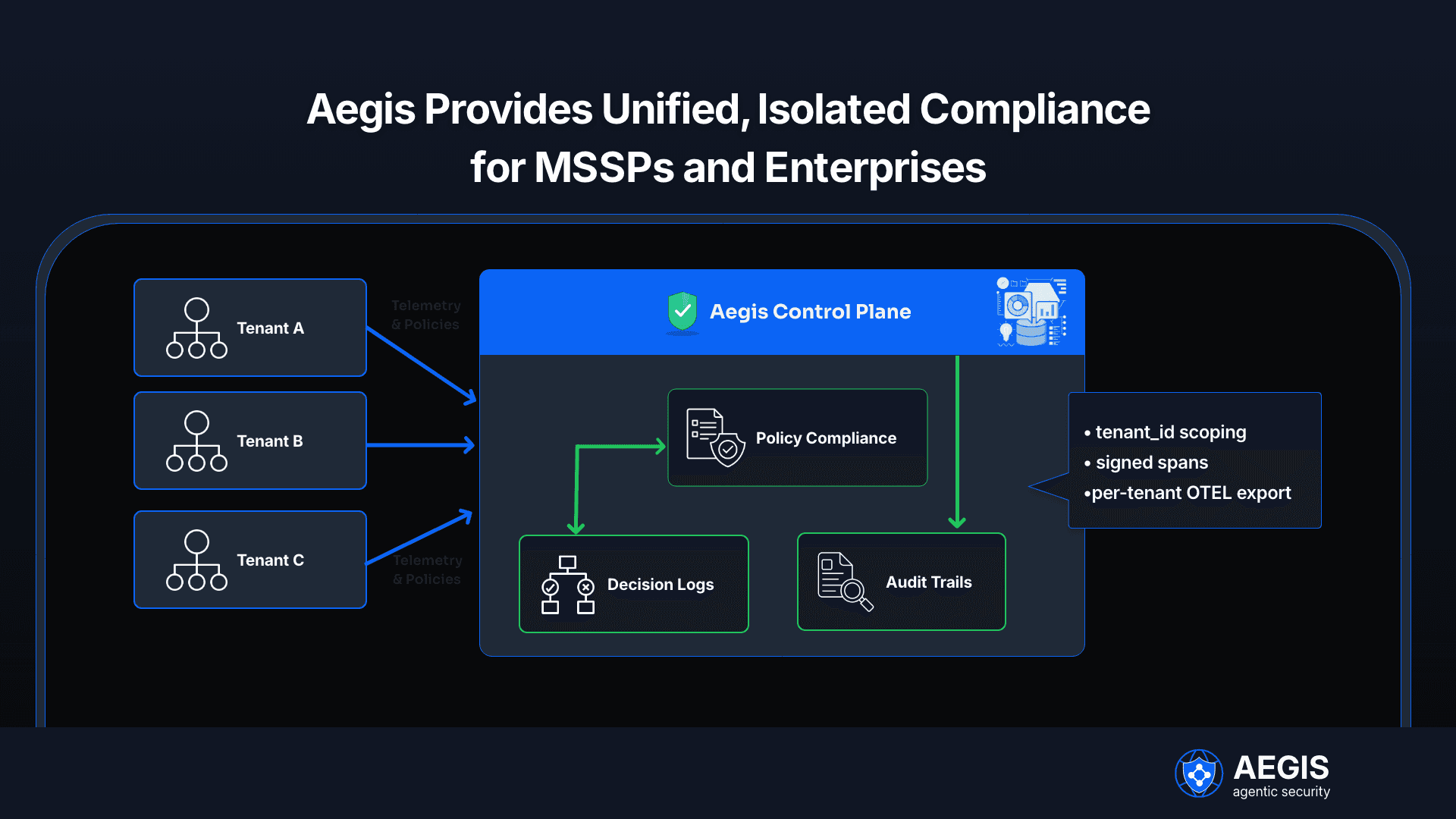
- Generate immutable audit trails for SOC2 and PCI-DSS evidence.
2. Healthcare – PHI/PII Redaction
Protect electronic health data (EHR) from unintentional export:
- Intercept outbound calls containing patient data.
- Apply deterministic DLP to redact SSNs or DOBs.
- Restrict access to approved domains or APIs only.
3. SaaS/FinOps – Cost Governance
Control API usage and spending:
- Define per-agent daily budgets (e.g., $20/day) and request-per-second limits.
- Block or alert when quotas are exceeded.
- Correlate telemetry with cost dashboards.
4. DevOps Automation – Controlled CI/CD
Mitigate risks of overprivileged agents in deployment workflows:
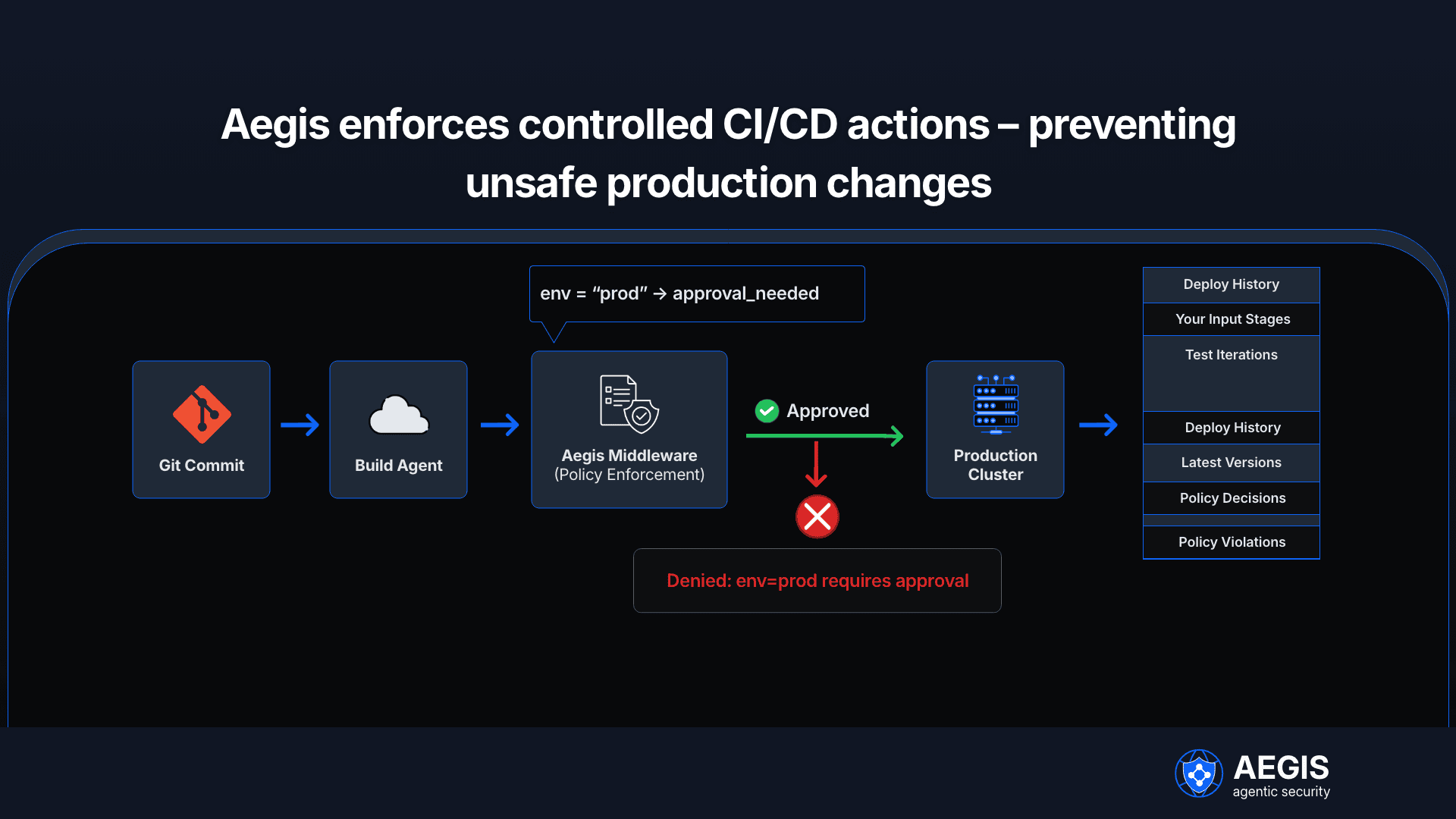
- Allow only staging deployments by default.
- Require human approval for production actions.
- Verify container digests before rollout.
5. MSSPs – Multi-Tenant Audit and Compliance
For managed security providers:
- Enforce tenant-isolated policies and regional routing.
- Export structured SIEM logs for every decision.
- Support signed policy bundles and tamper-proof history.
Observability, Governance, and FinOps Alignment
Aegis integrates with OpenTelemetry, Prometheus, and Grafana for unified insight across all agent-tool interactions. Security, compliance, and FinOps teams can view:
- Total requests per agent or tenant
- Deny and approval ratios
- Average latency and egress patterns
- Budget consumption and policy hits
Example Telemetry Dashboard Metrics
Metric | Description | Benefit |
aegis_decision_total | Count of allow/deny/sanitize outcomes | Tracks policy coverage |
aegis_policy_violation_total | Violations per agent/tool | Detects misbehavior early |
aegis_budget_remaining | Remaining budget per agent | Supports FinOps governance |
aegis_request_latency_ms | Decision latency (P99) | Ensures performance SLAs |
This unified observability layer enables compliance teams to demonstrate authorisation lineage for every decision—essential for SOC2, ISO27001, or HIPAA audits.
Operational Maturity and Developer Experience
Low Overhead and High Compatibility
The Aegis Gateway is deployed as a sidecar or reverse proxy, making integration straightforward for orchestrators like LangChain, LangGraph, CrewAI, and AgentKit. It introduces under 5 ms overhead in typical use, achieving enterprise-grade scalability (10,000+ RPS/region).
Developer Tools and Shadow Mode
Security teams use the Aegis CLI to register agents, push policies, and query telemetry. Developers can test configurations in shadow mode, allowing them to observe policy impact without blocking execution—ideal for rollout tuning and staging environments.
Comparing Aegis to Legacy Controls
Capability | Legacy IAM / API Gateway | Service Mesh (Istio) | Aegis Gateway |
Identity Scoping | ✅ | ✅ | ✅ |
Parameter-Level Policy | ❌ | ❌ | ✅ |
Runtime Approval Workflow | ❌ | ❌ | ✅ |
Observability (OTel) | ⚠️ | ✅ | ✅ |
Egress Control | ⚠️ | ✅ | ✅ |
FinOps Budgeting | ❌ | ❌ | ✅ |
Multi-Agent Awareness | ❌ | ❌ | ✅ |
Aegis extends beyond existing paradigms—it’s the “Istio + OPA” for agentic AI.
Looking Ahead: From Enforcement to Adaptation
Post-MVP roadmap items include:
- Policy visualization and query tools (GraphQL-based inspection).
- Terraform provider for CI/CD integration.
- Adaptive policy learning, where enforcement adapts dynamically to agent behavior.
- Anomaly detection on cross-agent call chains to detect coercion or shadow agents.
As enterprises operationalize AI agents across workflows, this adaptive security mesh will become foundational infrastructure.
Frequently Asked Questions
1. How does Aegis differ from traditional IAM?
IAM focuses on authenticating users and granting API access. Aegis operates at a finer level—it inspects every agent-to-tool call, enforcing policies on parameters, actions, and contextual risk.
2. What happens if the Aegis Gateway fails?
The system is designed with fail-closed semantics for write operations and configurable fail-open behavior for reads, ensuring resilience without unsafe exposure.
3. Can policies evolve without downtime?
Yes. Policies are hot-reloaded from the bundle store, allowing updates in seconds without restarts.
4. How does Aegis support FinOps?
By associating telemetry with cost per agent/tool, Aegis enables real-time budget enforcement and prevents runaway API spend.
5. Is Aegis compatible with non-HTTP tools?
Yes. Client SDKs support decorators for non-HTTP tool invocations, integrating seamlessly into local workflows.
6. Does Aegis provide data privacy controls?
Absolutely. It includes deterministic DLP and PII redaction, ensuring sensitive information never leaves approved domains.
Aegis Gateway establishes the runtime guardrails that enterprises need to safely scale agentic AI. It merges policy enforcement, human approvals, and telemetry into a single fabric—ensuring that every autonomous decision is secure, auditable, and cost-aware.