Top 10 Security Risks in Multi-Agent Systems and How to Mitigate Them
A technical guide to the top 10 agent security risks and how Aegis enforces runtime policy, telemetry, and approvals.
Aegis: Securing Multi-Agent AI — Top 10 Risks & Runtime Controls
Introduction
Multi-agent pipelines — orchestration of specialised LLM agents that call external tools and APIs — unlock automation but multiply attack surfaces. Security teams report rising concern: recent surveys show ~96% of tech professionals see AI agents as a growing security risk, while many organisations lack formal governance. (SailPoint)
This article maps the attack surface, lists the top 10 agent security risks with compact technical and operational controls, and explains how Aegis — a runtime policy and telemetry gateway — enforces allow/deny/sanitize/approval_needed decisions at the agent↔tool boundary.
👉🏻 Identify risks early with structured threat modeling approaches
Attack surface of multi-agent systems
Memory, prompts, egress — three axes
Multi-agent systems combine (a) model prompts & context, (b) retrieval stores / RAG memories, and (c) outbound tool calls. Each axis has unique threats: prompt injection targets the input interpreter, memory poisoning corrupts knowledge used by downstream prompts, and uncontrolled egress enables data exfiltration or rogue actions. OWASP’s GenAI guidance flags prompt injection as a top risk for LLM-based systems. (OWASP Gen AI Security Project)
Top 10 risks (controls and operations)
Below are the top 10 practical risks for multi-agent deployments.
- Prompt injection — Control: sanitize and validate inputs; tokenization filters and context scrubbing. Ops: red-team prompts and run a shadow mode to surface would-block cases. (OWASP Gen AI Security Project)
- Memory poisoning / RAG backdoors — Control: sign and vet memory entries; validate sources before indexing. Ops: periodic integrity checks and retriever provenance audits. (arXiv)
- Rogue agent actions (unauthorised tools) — Control: enforce least-privilege policy for agent→tool bindings. Ops: policy reviews and role-based audits.
- Credential exfiltration — Control: DLP on outputs and redaction rules for secrets. Ops: rotate secrets, inspect commit logs and run simulated leakage tests. (TechRadar)
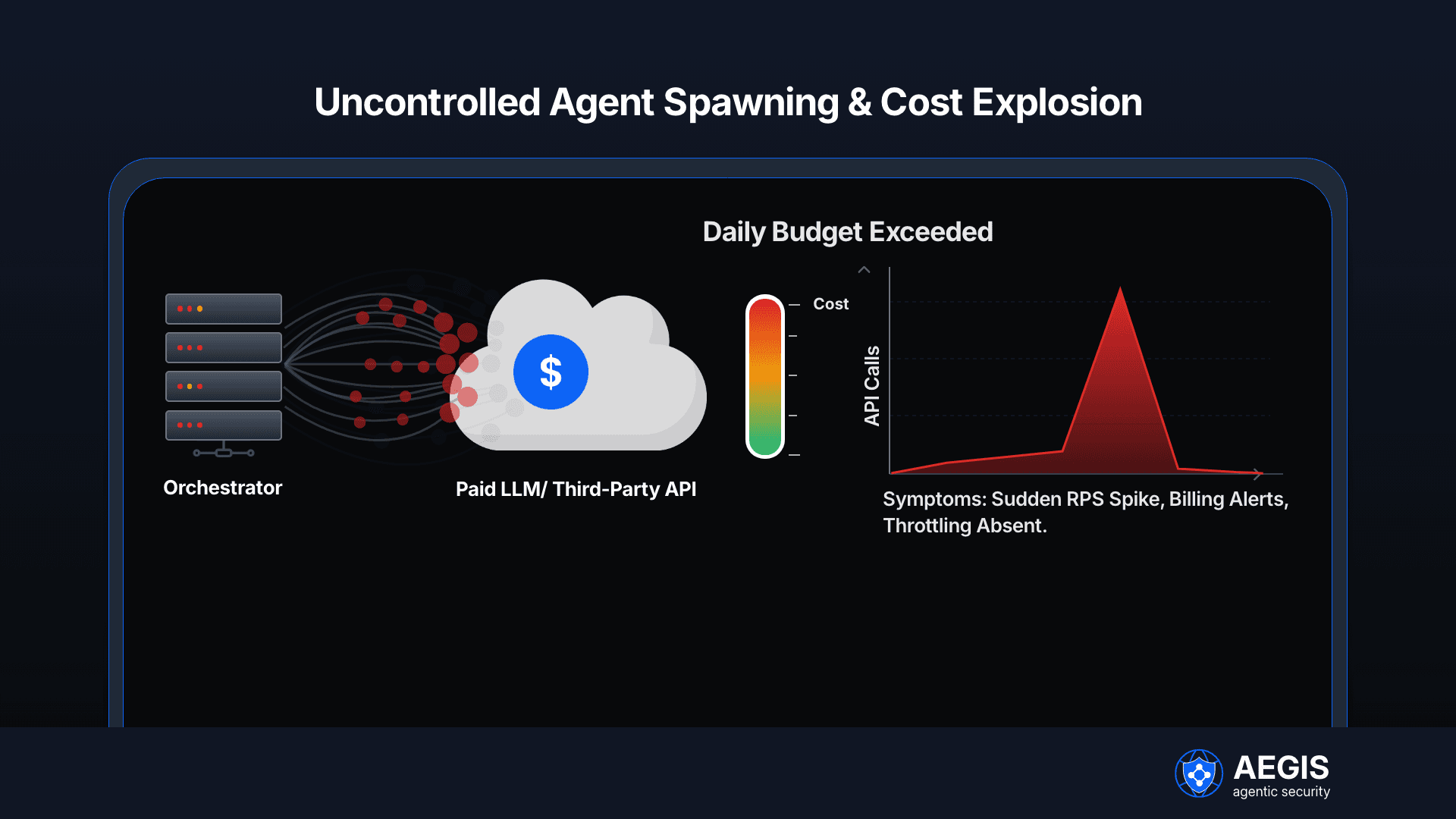
- Uncontrolled spend — Control: per-agent budgets, rate limits and hard quotas. Ops: FinOps alerts and automated budget exhaustion actions.
- Supply chain/toolchain compromise — Control: require signed connector manifests and vetted third-party connectors. Ops: third-party risk reviews and periodic contract attestations.
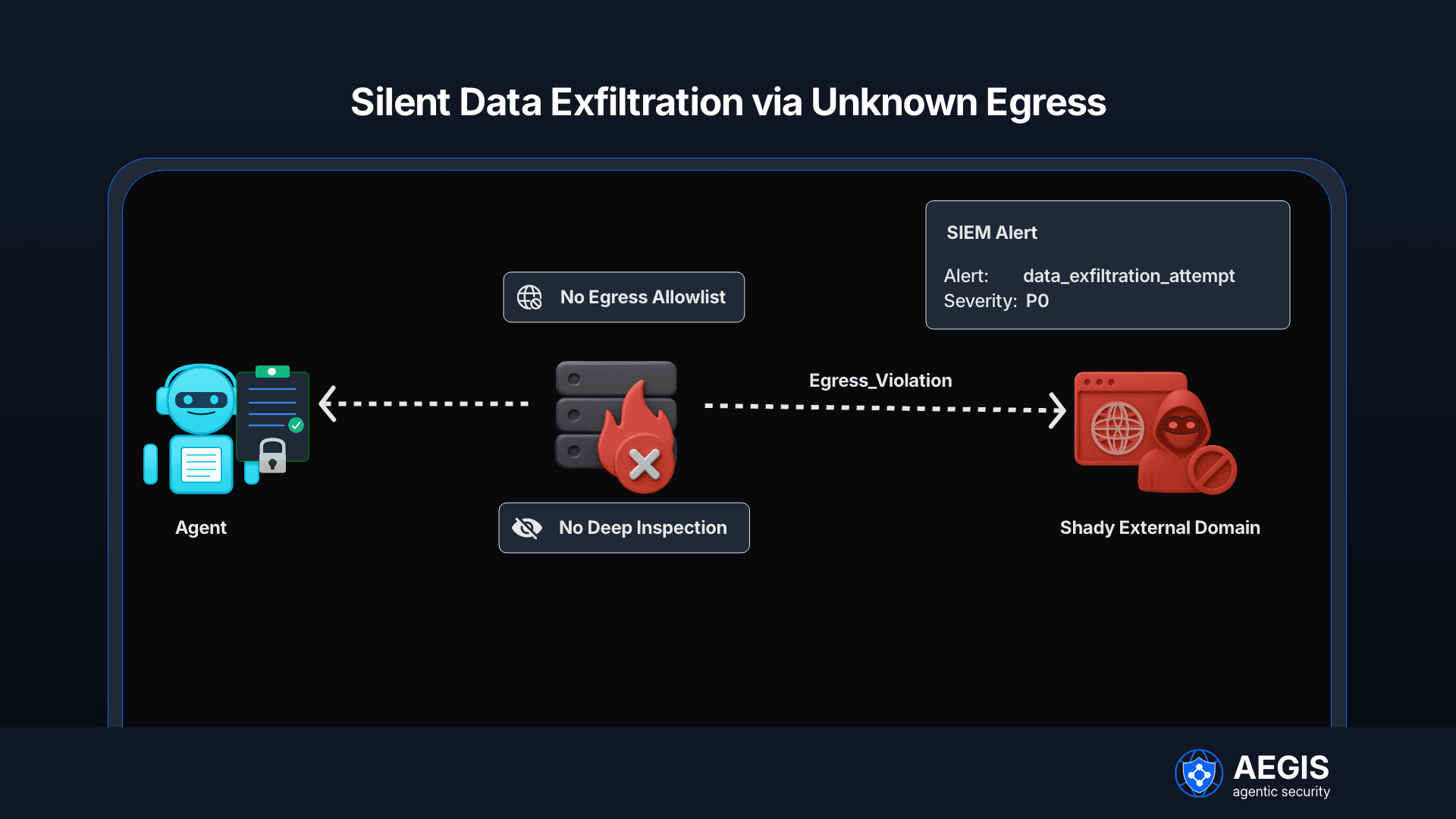
- Egress & data exfiltration — Control: allowlists, proxy egress through a policy gateway, and inspect payloads. Ops: SIEM alerts for unusual destinations and regular egress audits.
- Model hallucination causing bad actions — Control: require approval_needed for high-impact decisions and constrain parameter ranges. Ops: human approvals and rollback playbooks.
- Multi-tenant cross-contamination — Control: strict tenant namespaces, scoped policies, per-tenant bundles. Ops: tenant isolation tests and cross-tenant penetration testing.
- Observability gaps — Control: mandatory OpenTelemetry spans for every agent→tool call. Ops: SIEM integration and runbook correlation for incident response.
Controls & maturity model
Use a three-tier maturity model: Shadow (observe-only), Enforce (allow/deny/sanitize), and Approve (approval_needed for high risk). Start in shadow to collect would-block telemetry, tune thresholds, and then flip enforcement with minimal disruption. Aegis supports shadow mode and OTel emission to accelerate this path.
👉🏻 Protect AI systems from manipulation and malicious inputs
Risk matrix — runtime control view
Risk | Likely impact | Runtime control | Monitoring metric |
Prompt injection | Data leakage, bad actions | Input sanitizer, token filters | % would-block prompts, injection rate |
Memory poisoning | Wrong decisions, reputational harm | Signed memory, source vetting | % memory entries failing integrity checks |
Rogue actions | Unauthorized API calls | Agent→tool allowlist | Blocked tool calls / agent |
Credential exfiltration | Account takeover | Output DLP, redact | Detected secret patterns / incidents |
Uncontrolled spend | Cost spike | Per-agent budgets | Daily spend per agent |
Supply chain compromise | Malicious connector | Manifest signatures | Connector provenance checks |
Egress/exfiltration | Data leak | Egress proxy + allowlist | Outbound anomaly rate |
Hallucination harm | Bad outcomes | Approval_needed policies | Approval queue latency |
Multi-tenant contamination | Compliance failure | Namespaced policies | Cross-tenant call rate |
Observability gaps | Slow IR | Mandatory OTel spans | % calls traced |
How Aegis addresses each risk
Aegis is built as a runtime policy and telemetry gateway — a dedicated enforcement fabric that sits between orchestrator and tools. The architecture provides four pillars: Identity & Policy, Runtime Enforcement, Observability & Auditing, and Approval Workflows. The technical brief for Aegis details these components (policy-as-code, OPA bundles, Envoy ext_authz, OTel traces).
Identity & Policy
Aegis registers agents with unique IDs and issues short-lived JWTs that contain tenant, agent, and scope claims. Policies are authored in YAML/JSON and compiled into OPA bundles for fast evaluation; conditions support ranges, regexes, budgets and actions (allow/deny/sanitize/approval_needed). This lets teams express per-field controls (e.g., amount <= 5000) that prevent parameter injection and rogue actions.
Runtime enforcement & telemetry
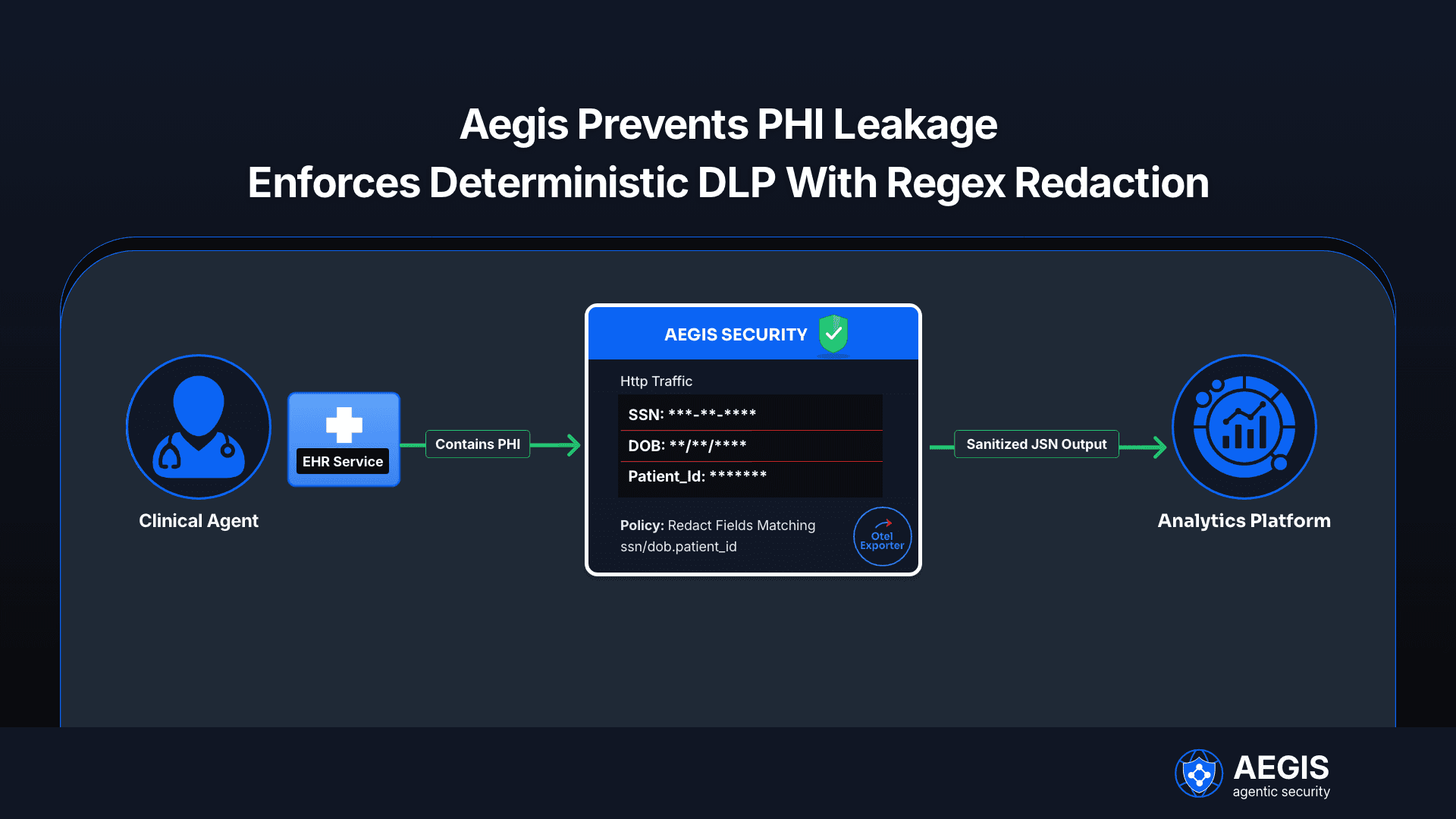
At runtime Aegis functions as a lightweight data plane (proxy/sidecar + decision service). Each agent→tool call is inspected: agent identity, tool, parameters, parent chain, and policy version. Decisions are atomic and return structured reasons; every decision emits an OpenTelemetry span and a signed audit event for compliance. This design enables immediate blocking of disallowed tool calls, deterministic DLP redaction, and pause-for-approval flows.
👉🏻 Learn from past breaches to strengthen your defenses
Approval workflows & FinOps
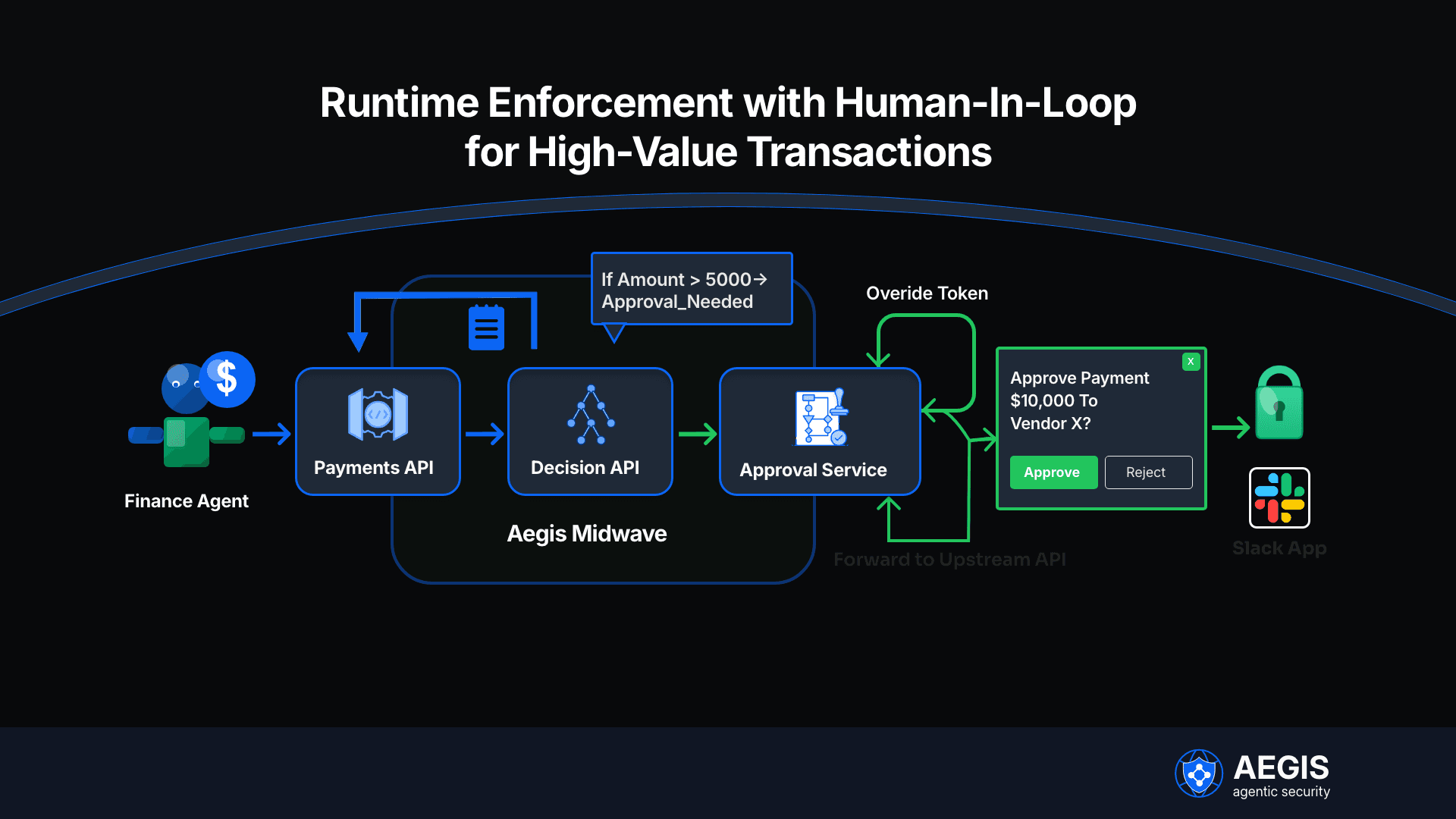
Aegis supports approval_needed outcomes that pause high-risk calls and post interactive approval requests to Slack/Teams. Per-agent budgets and rate limits enforce cost controls; a dashboard surfaces cost by agent and tool for FinOps. These features reduce approval fatigue by allowing thresholds and automated rules to avoid unnecessary human arbitration.
Example attack narrative (short)
An attacker poisons a RAG document with a hidden payment instruction. A planner agent retrieves the poisoned memory and instructs Finance to execute a transfer. Aegis inspects the finance-agent call, sees amount > policy max_amount, returns PolicyViolation and emits an audit event with policy_version and decision_reason; the call is blocked and a SOC alert is generated. This exact scenario is covered in Aegis MVP scenarios and testcases.
Technical comparison table
(Table 2 — Capability | Legacy approach | Aegis approach)
Capability | Legacy approach | Aegis approach |
Per-call parameter inspection | Ad-hoc in code | Policy engine (OPA) at gateway |
Approvals | Manual, separate tool | Built-in approval_needed + override tokens |
Observability | Partial traces | Mandatory OTel spans + SIEM-ready logs |
Cost controls | Post-facto billing | Per-agent budgets & enforcement |
Tenant isolation | Namespace via infra | Tenant-scoped policy bundles |
Deployment and operational guidance
Deploy Aegis as a proxy sidecar or forward proxy in front of tool connectors. Start with the shadow phase for 7–14 days to collect would-block telemetry, tune regexes and parameter conditions, then migrate high-risk policies to enforce with approval flows. Integrate audit logs with your SIEM and map traces to incidents in your runbooks.
Frequently Asked Questions
Q: How does Aegis avoid adding latency to interactive agents?
A: Aegis uses prepared OPA queries, in-memory caches, and optional WASM compiled rules to keep decision latency below targeted P99 budgets (design goal ≤20ms).
Q: Can Aegis redact sensitive fields automatically?
A: Yes — deterministic DLP rules operate at the proxy; sanitize decisions can return redacted parameters to tools.
Q: How do I prevent cross-tenant policy leakage?
A: Policies are compiled into tenant-scoped bundles and hot-reloaded with strict scoping. Test bundles in a staging control plane before promoting.
Q: What if approvals overwhelm operations?
A: Use thresholds, policy granularities, and automated rules to reduce noise; approvals route to Slack/Teams with override tokens for one-time retries.
Q: Are there industry resources on prompt injection and RAG poisoning?
A: OWASP GenAI covers prompt injection best practices; academic work on RAG poisoning and memory attacks is ongoing (PoisonedRAG, NeurIPS analyses). (OWASP Gen AI Security Project)
Q: How do I get started?
A: Begin by classifying agent types, mapping critical tools, and deploying Aegis in shadow mode to collect would-block data.
Closing
Agentic AI brings efficiency but also compound risks that blend API, identity and model vulnerabilities. Aegis applies a runtime policy mesh, deterministic DLP and approval workflows to transform those risks into auditable, enforceable controls — letting security, compliance and FinOps teams govern agents at scale.