Managing API Keys and Secrets in Agent Pipelines
Learn secure methods for managing API keys and secrets in AI agent pipelines with automated rotation, short-lived tokens, and Aegis runtime control.
Managing API Keys and Secrets in Agent Pipelines
The rise of agentic AI has transformed how enterprises automate workflows. Systems like LangGraph, CrewAI, and AgentKit enable autonomous coordination between specialized agents that deploy infrastructure, execute financial transactions, and access APIs. But these capabilities depend on secure access — every agent needs credentials to call external services.
When secrets are mishandled, they become attack vectors. Hardcoded API keys, stale tokens, and unmonitored credentials are common sources of breaches. According to GitGuardian’s 2024 report, over 10 million secrets were exposed in public code repositories last year — a 67% increase year-over-year. The problem intensifies in multi-agent environments, where hundreds of ephemeral processes may each require scoped, temporary credentials.
This blog explores best practices for managing API keys and secrets in agent pipelines, contrasts the legacy and modern approaches, and illustrates how Aegis by Aegissecurity enables automated, policy-driven credential control at runtime.
.png&w=3840&q=75)
The Legacy Problem: Long-Lived Keys and Secret Sprawl
Hardcoded Secrets and Shared Credentials
Traditionally, developers hardcoded API keys into environment variables or configuration files shared across agents. This approach simplifies access but violates basic security principles:
- Keys persist long after agents terminate.
- Revocation is manual, inconsistent, or forgotten.
- Logs and code inadvertently expose secrets during debugging.
Even a single leaked API key can lead to privilege escalation, as compromised agents might perform unauthorized actions.
Manual Rotation and Audit Gaps
Manual rotation cycles — often 90 days or longer — create operational overhead and human error. Many organizations fail to rotate credentials promptly; in regulated sectors like finance or healthcare, this results in compliance violations and latent exposure risk.
👉🏻 Mitigate privacy risks with proactive access and data controls
The Modern Approach - Ephemeral and Automated Secrets
Short-Lived Tokens per Agent
Modern agent pipelines favor ephemeral, agent-scoped tokens minted dynamically at runtime. Each agent requests a token with minimal scope (e.g., read-only access to a specific dataset) and short time-to-live (TTL). When the agent session ends, the token expires automatically.
This aligns with best practices from major cloud providers such as Google Cloud, which recommends short-lived credentials issued via secure token services rather than embedding long-term keys in code.
Automated Rotation and Monitoring
Rotation frequency is crucial — even if a token is leaked, its short lifespan limits damage. The 90-day maximum rotation window cited by GitGuardian is a baseline, but in agentic systems, rotation can be fully automated and occur every few hours.
Combined with anomaly detection, rotation logs feed into observability pipelines, alerting on unusual token minting or use from unrecognized IPs.
👉🏻 Strengthen authentication with rotating, short-lived credentials
The Agentic Security Fabric for Secrets and Identity
Aegis, developed by Aegisecurity addresses these challenges through a policy and observability fabric purpose-built for multi-agent AI systems. It enforces identity boundaries, runtime policy evaluation, and automated credential management — all integrated seamlessly with orchestrators such as LangGraph, AgentKit, and CrewAI.
How Aegis Manages API Keys and Secrets
Security Capability | Aegis Implementation | Outcome |
Token issuance | Short-lived JWTs scoped per agent, signed using Ed25519 | Prevents reuse and impersonation |
Secret injection | Runtime integration with secure stores (Vault/HSM) | No credentials embedded in code |
Rotation automation | Time-based and event-driven rotation triggers | Continuous key hygiene |
Replay protection | Token jti validation and per-IP constraints | Blocks replay and token sharing |
Audit and telemetry | Structured OpenTelemetry spans for each key issuance and use | Compliance-ready audit trail |
Aegis enables organizations to maintain control without slowing development velocity — automating security without requiring developers to modify application logic.
👉🏻 Govern agent traffic with secure and scalable API gateways
Architectural Enforcement: Runtime Policy and Control
Policy-as-Code for Credential Governance
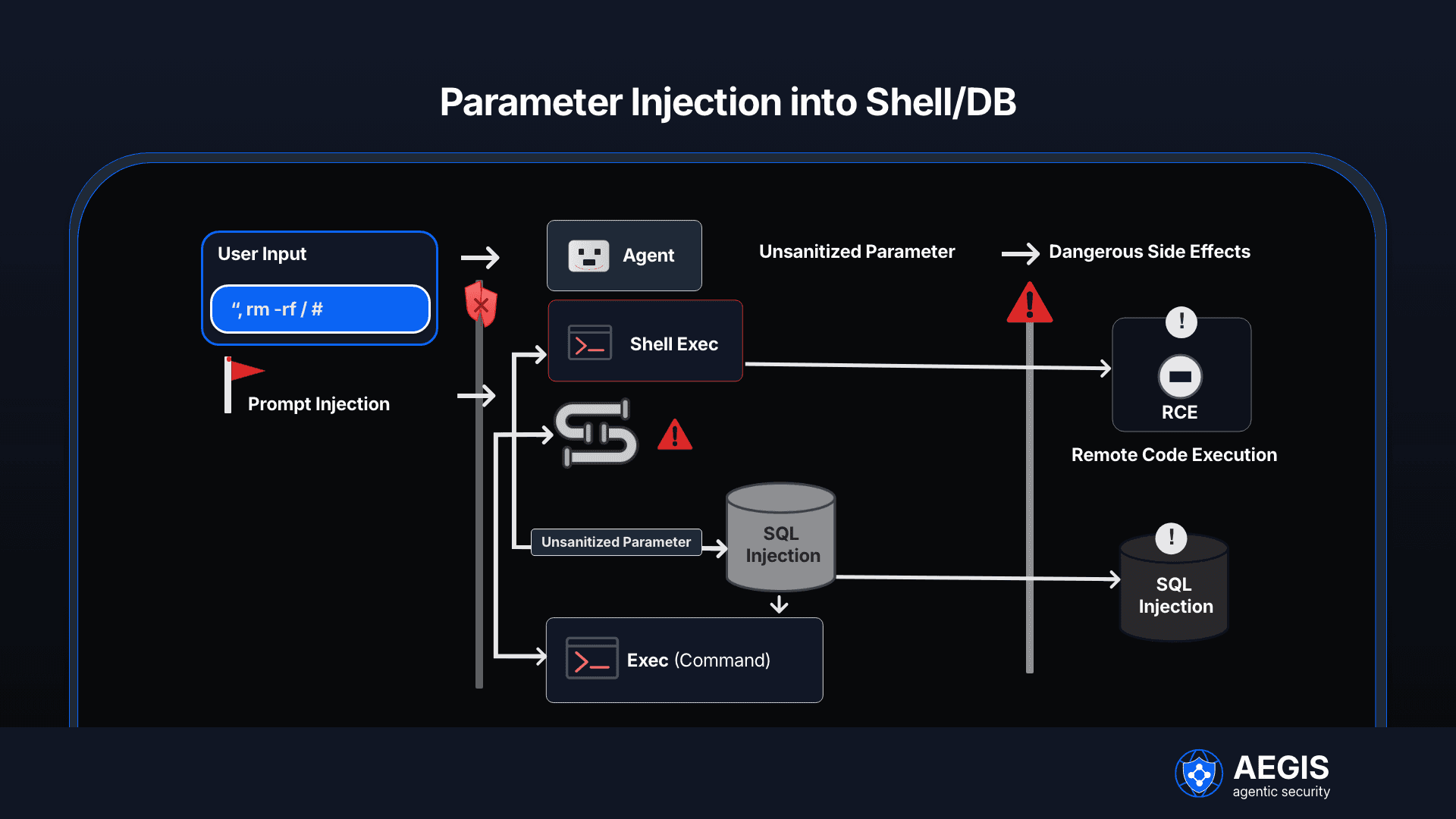
Security engineers define YAML or JSON policies that specify how agents obtain and use credentials. Aegis compiles these into Open Policy Agent (OPA) bundles evaluated in real time. Example:
agent: finance-agent
allowed_tools:
- name: stripe-payments
actions:
- create_payment
conditions:
max_amount: 5000
This policy ensures that even if an agent receives a malicious prompt, it cannot exceed predefined authorization limits. Tokens are only valid for permitted operations and revoked automatically upon violation or expiry.
Real-Time Enforcement at the Tool Boundary
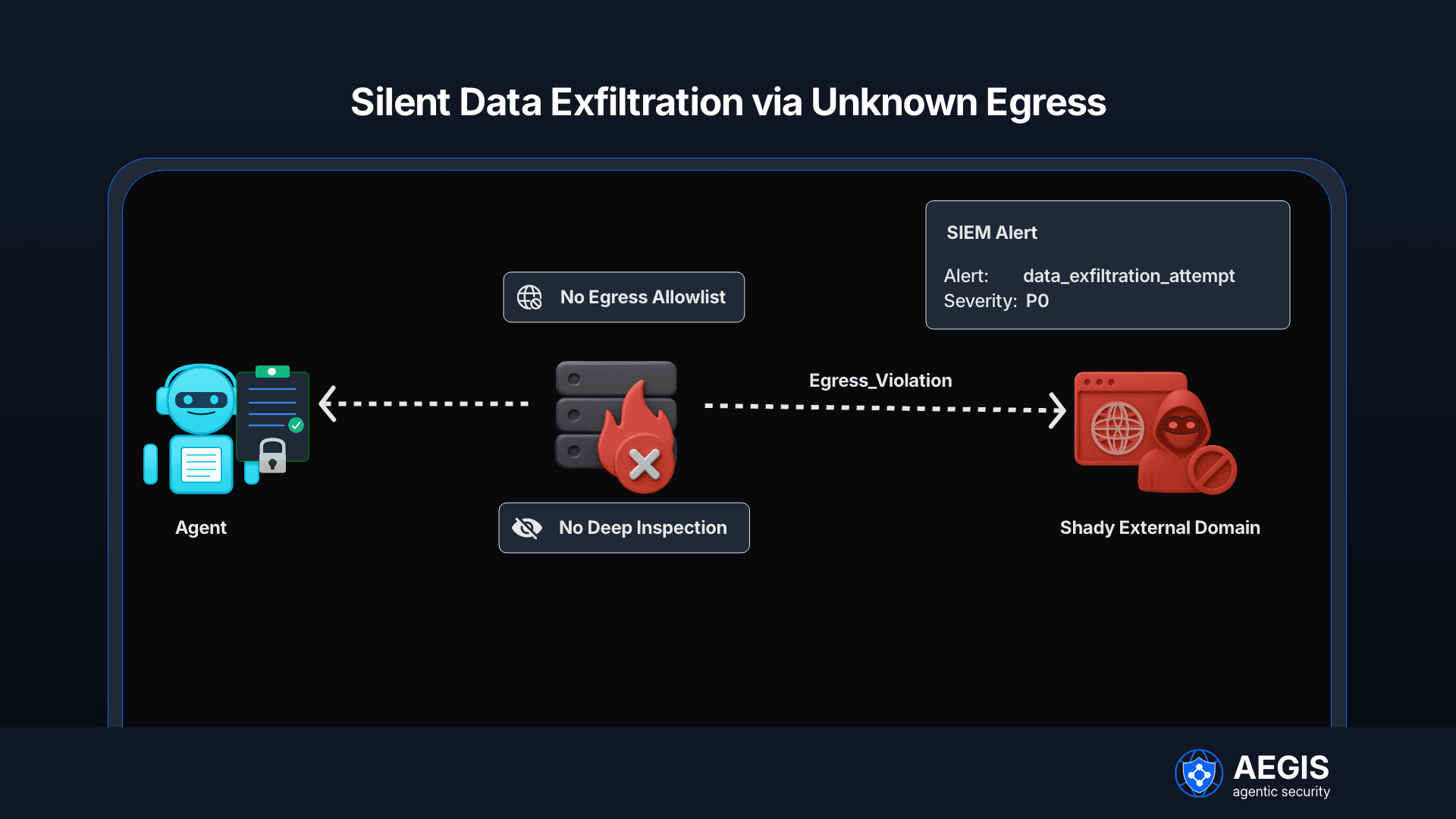
All outbound API calls from agents are routed through the Aegis Gateway, acting as a reverse proxy or sidecar. Before forwarding, it checks the call’s context — agent ID, target endpoint, parameters — against policy rules. Unauthorized actions return standardized error responses while continuing to log telemetry to SIEM systems.
Operational and Compliance Benefits
1. Centralized Auditability
Every key issuance, rotation, and usage event is logged with cryptographic attestation. SOC teams can trace which agent accessed which service, under what policy version, and why — a critical requirement for industries like FinTech and Healthcare.
2. Automated Risk Mitigation
By enforcing short TTLs and ephemeral credentials, Aegis minimizes the window for misuse. Its anomaly detection engine identifies unexpected key behaviors, such as unusual frequency or access from disallowed environments.
3. Policy Hot Reload and Graceful Revocation
Aegis supports policy hot-reloading, allowing updates without downtime. If a breach is suspected, administrators can revoke tokens instantly — blocking new actions while allowing in-flight processes to finish gracefully.
4. FinOps and Multi-Tenancy Insights
Through integration with dashboards and OpenTelemetry, teams gain visibility into per-agent credential usage and related costs. For MSSPs or MSPs, this supports multi-tenant isolation, showing which clients or tenants consume specific services while maintaining strict separation.
Metric | Description | Aegis Control |
Token lifespan | Duration before expiration | Default ≤ 2 hours |
Rotation frequency | Automatic refresh interval | Configurable (≤ 90 days) |
Anomaly detection latency | Time to detect unusual key use | < 10 seconds |
Policy enforcement overhead | Additional latency | < 20 ms (P99) |
Audit trail retention | Historical data for compliance | 12 months (configurable) |
Agentic Security in Action
Secure Payment Workflows in FinTech
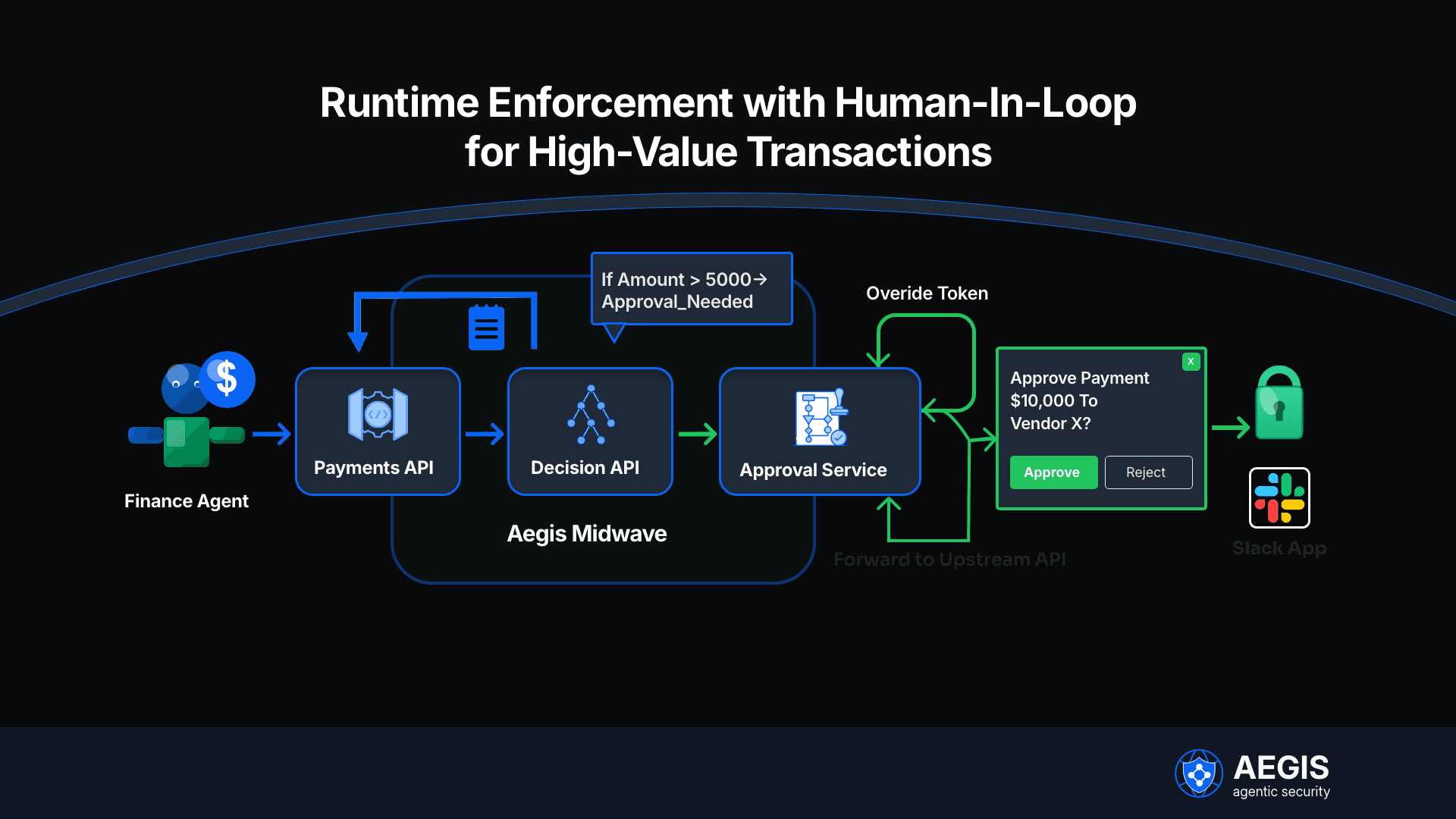
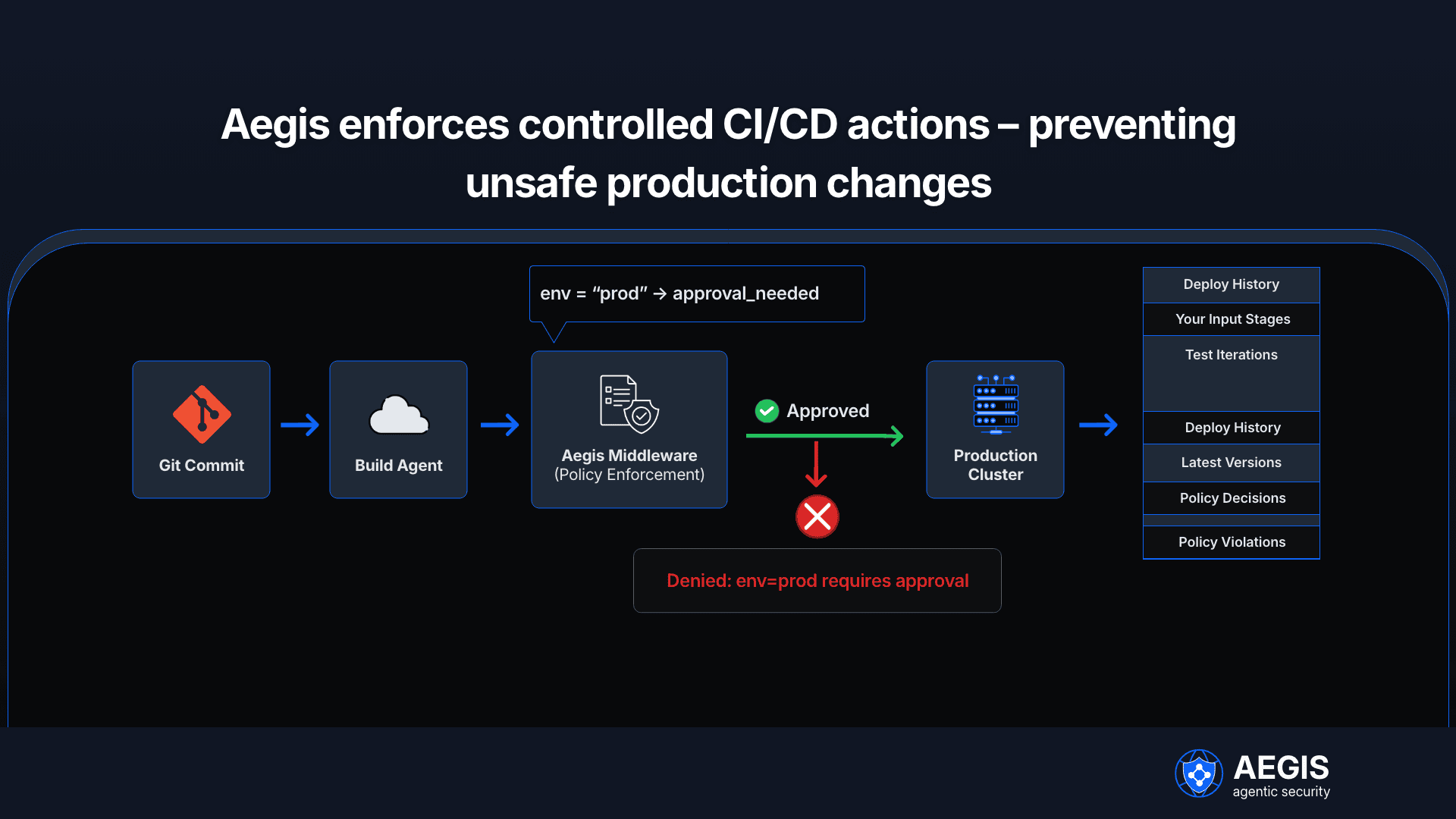
Aegis ensures per-agent payment ceilings and human approval for large transfers. Example: a finance-agent can only initiate payments ≤ $5,000; anything higher triggers an approval request via Slack or Teams before token override issuance.
PHI Protection in Healthcare
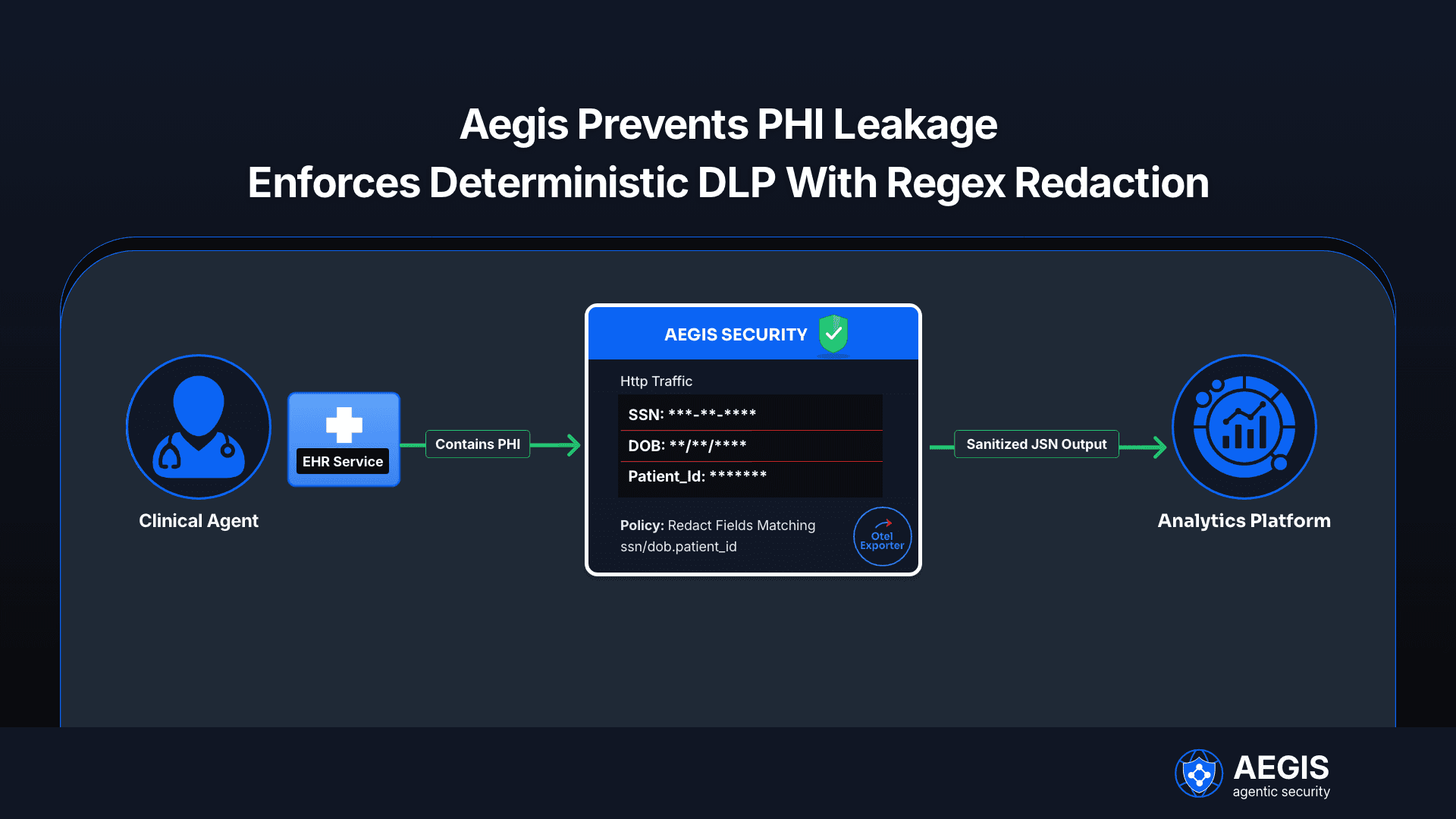
When agents access Electronic Health Record (EHR) systems, Aegis redacts personally identifiable information (PII) using deterministic DLP rules. Unauthorized export attempts are blocked instantly.
SaaS API Cost Governance
By associating credentials with budget and rate limits, Aegis prevents uncontrolled API spend — especially with high-cost LLM or analytics APIs.
Integrating Aegis into Agent Pipelines
Step 1: Register Agents and Policies
Administrators use the Aegis CLI or API to register agents, define allowed tools, and push policies to the control plane.
Step 2: Secure Token Requests
Agents request short-lived JWTs from the Aegis Token Service, which validates their identity and policy scope before minting.
Step 3: Runtime Enforcement
The Aegis Gateway evaluates each API call and allows or blocks it based on context. All actions emit OpenTelemetry spans for monitoring.
Step 4: Continuous Monitoring and Rotation
Scheduled jobs rotate long-term keys stored in HSM-backed secret managers, ensuring no stale credentials remain. Alerts trigger on anomalies or missed rotations.
Best Practices for Secure Key Management
- Never embed long-term keys in code or container images.
- Use short-lived, scoped tokens issued dynamically per agent.
- Automate rotation — aim for ≤ 90 days or faster for high-risk systems.
- Restrict usage by IP or environment, ensuring keys are only valid where expected.
- Integrate secret scanning into CI/CD pipelines to catch leaks early.
- Monitor anomalies — sudden surges in token minting often indicate compromise.
- Audit and visualize usage with dashboards to identify trends and risks.
- Educate developers — avoid printing secrets in logs or error messages.
Future Directions: Agent-Aware Credential Intelligence
As enterprises scale to thousands of agents, static policies and periodic rotations won’t suffice. The next frontier lies in agent-aware adaptive credentialing — systems that adjust token TTLs and scopes dynamically based on behavior, trust level, and workload context.
Aegis is already evolving toward this vision, incorporating AI-driven anomaly detection and self-adjusting policies that react in real time to agent behavior patterns.
Frequently Asked Questions
1. How often should agent credentials be rotated?
Industry best practices suggest 90 days as a maximum. Aegis automates this process, allowing rotation within hours or event-driven triggers.
2. What happens if an agent’s token is compromised?
Aegis detects anomalies, revokes the token immediately, and blocks new calls. Logs provide full traceability of the incident.
3. Can Aegis integrate with existing secret managers?
Yes. It supports integration with enterprise secret stores (Vault, AWS Secrets Manager, HSMs) for runtime injection.
4. Does Aegis support multi-tenant environments?
Absolutely. Aegis isolates tenant policies and keys while maintaining centralized visibility for SOC teams.
5. Is there an approval process for high-risk actions?
Yes. Aegis enforces human-in-the-loop workflows via Slack or Microsoft Teams for any policy action marked approval_needed.
6. What’s the performance impact of Aegis enforcement?
Runtime enforcement adds less than 20 ms latency at the 99th percentile, meeting enterprise performance expectations.